AI High School Life Simulator: Classes, Friends & Campus Drama
2026-08-30
Roleplay Game Master helps you live a high school life simulator by turning every homeroom, hallway rumor, and Friday-night game into a scene that actually remembers you. While menu-driven school games lock you into scripted popularity meters, this AI runs an open-ended campus story — American public school, Japanese academy, boarding school, or magnet STEM — with unlimited memory so friendships, grades, and rivalries compound over time. In August 2026, that persistent, conversational school fantasy is what players keep searching for and rarely get.
✅ Persistent memory for friends, rivals, grades, clubs, and reputations ✅ Open campuses: public, private, Japanese academy, or boarding school ✅ Scenes on demand — class, cafeteria, tryouts, dances, detention ✅ The same story continues across web, iPhone, and Android
To understand why this matters, let's examine why most high school simulators still feel like tapping through a yearbook.
Quick Answer: What Is an AI High School Life Simulator?
An AI high school life simulator is an interactive campus you play in conversation — classes, clubs, crushes, and cliques — where every choice persists and reshapes who you are at school. Roleplay Game Master delivers that fantasy through memory-rich roleplay rather than fixed game menus.
Key capabilities:
- Persistent friends, rivals, grades, and reputations across sessions
- Open-ended campuses: public, private, Japanese academy, or boarding school
- Hallway drama, club politics, dances, and teacher dynamics on demand
- Class, cafeteria, tryout, and detention scenes you can steer mid-conversation
Why Most High School Simulators Stall After Homeroom
School is one of the most requested settings in life sims, and play itself is not a niche habit. The Entertainment Software Association's Power of Play 2025 report surveyed 24,216 players ages 16+ across 21 countries, documenting how games create community, skill practice, and emotional payoff at global scale. Players are not short on appetite for campus stories. They are short on sims that treat high school as a living social system instead of a checklist of unlocks.
Research on why people play makes the gap clearer. A Frontiers in Communication study of game-based coping found that motivational orientations toward narrative involvement, social interaction, and escapism were associated with using games under stress — exactly the mix a high school fantasy has to serve. You want the crush, the club, the rumor, and the feeling of inhabiting a version of yourself who can still change the ending.
24,216 players — surveyed across 21 countries in the ESA's 2025 Power of Play report
That hunger is older than any app store. Adults replay the years they cannot get back. Students try on a braver self between real classes. The genre promises a campus that talks back. But accessing a reactive version of that campus is frustratingly difficult:
- Popularity and grades that only move when you tap the right menu
- Friends and rivals who forget last week's betrayal
- Classes that resolve in a single multiple-choice prompt
- A school that is a map, not a social weather system
Scripted campuses instead of a year you can hijack
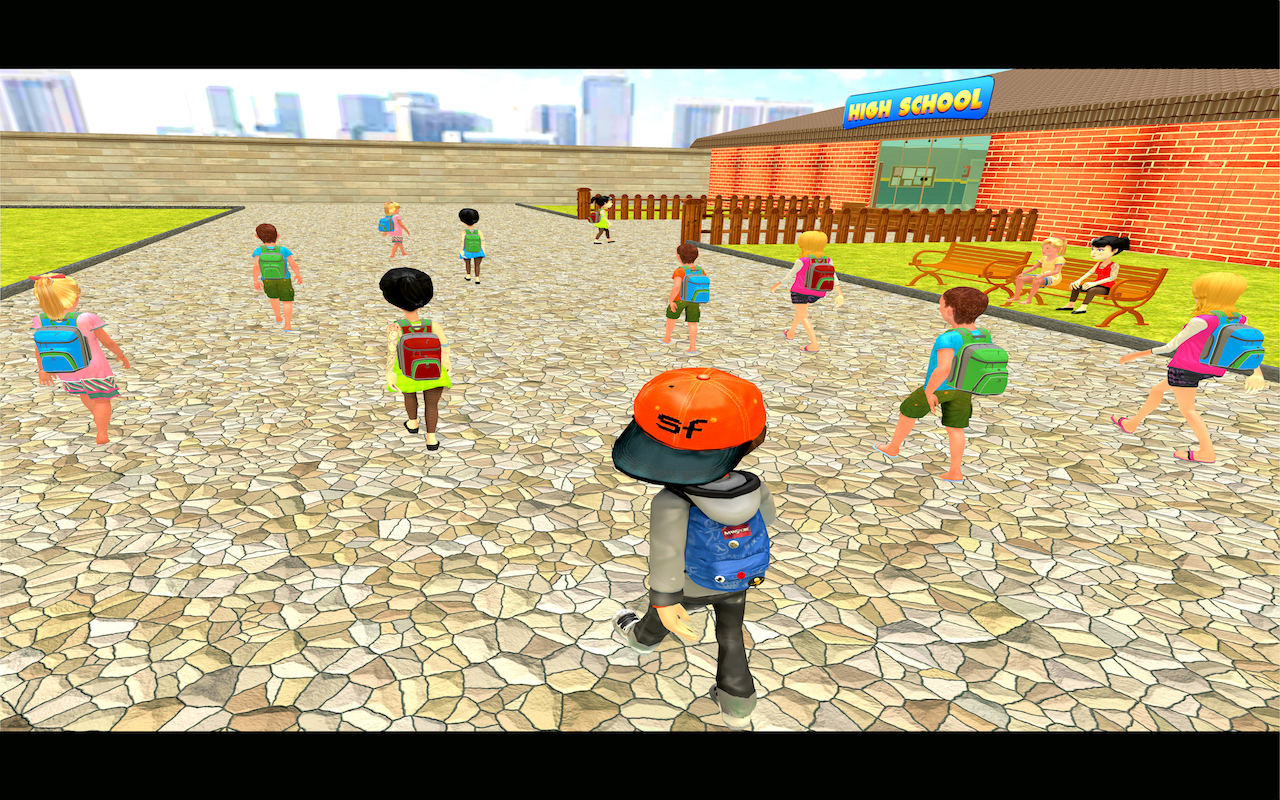
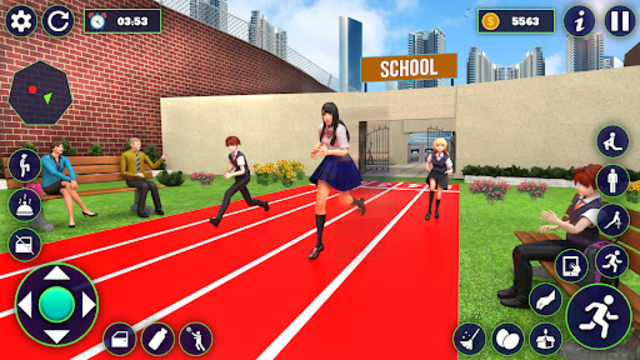
Mobile and 3D school sims can look the part — courtyards, uniforms, track meets, a building labeled HIGH SCHOOL. Those systems are often impressive as dioramas. They are also closed. You play their schedule. You cannot invent a transfer student who joins debate, tanks a group project on purpose, then uses the fallout to run for student council. The fantasy stops at the edges of the designer's flowchart.
Relationships that reset when the bell does
High school is social physics: lab partners, coaches, siblings, teachers, exes, and the group chat. When characters cannot carry a grudge or a secret across weeks of play, the hallway feels like a theme-park queue. You are popular at everyone, not with anyone.
Creativity trapped behind energy timers and grind loops
Quantic Foundry has tracked 12 distinct gamer motivations across data from 2 million players, treating fantasy, story, and social play as separate psychological drivers rather than one vague "fun" meter. What many school sims still sell is repetition: attend another class, buy another outfit, wait for energy to refill. That loop fights the exact motivations a campus story needs — narrative involvement, social stakes, and the freedom to go off-script.
This is exactly what Roleplay Game Master was built for.
Why Roleplay Game Master
Roleplay Game Master is not a popularity meter with dialogue attached. It is an AI high school life simulator that runs your campus as an ongoing story: you set the school, the year, and the stakes, then play scene by scene while the world keeps score. Unlimited memory and strict character consistency mean your lab partner still remembers who copied the homework in week two, and the rival still wants the captain spot you took.
That difference matters more as play itself is studied as a social and emotional tool, not just a pastime. ESA's report notes that researchers at Oxford University, studying more than 80,000 players, found that people feel good playing games — and that gameplay's reported benefits include community, conflict practice, and skill-building. A conversational sim that never drops your continuity is how those benefits show up in a school story: the argument has a next day, the apology has a witness, the grade has a teacher who already formed an opinion of you.
| Traditional Approach | Roleplay Game Master |
|---|---|
| Fixed class menus and scripted events | Open-ended scenes you can steer mid-conversation |
| Friends who reset or stay shallow | Unlimited memory — every slight, alliance, and rumor sticks |
| One prescribed path to popularity | Athlete, artist, nerd, transfer, or hybrid identity |
| Energy timers, ads, and grind loops | Conversational play with no energy gates |
| One school template per title | Any campus, country, era, or intensity you specify |
A year that reacts when you go off-script
Ask for a pop quiz, a hostile group-project meeting, a leaked screenshot, or a pep rally that goes wrong. The simulator does not need a pre-authored quest for each of those. You describe the moment. It plays the room — teachers, rivals, friends, and the version of you the school thinks it knows.
"I'm a freshman at a big public high school. I don't know anyone yet. Walk me through the first day — homeroom, lunch table politics, and last period — and remember every person I meet."
Reputation as a social system, not a high score
Real high school is a stack of audiences: the friend group, the team, the teachers, the siblings who still go there. This AI high school life simulator can run all of them in parallel. A joke you made in chemistry can cost you a lab partner the following week because the session still holds that joke. That is the mechanic traditional games approximate with meters and this tool simply remembers.
Campus life that matches the legend you want
Once the year is moving, the fantasy is in the details: the locker, the bus, the Saturday job, the quiet library table when nobody is performing. You can stay inside the drama or zoom out into academics, college planning, or a fully Japanese-academy register — the parts of school that feel like a second job.
"I covered for my lab partner and failed the quiz. Play the conversation with the teacher after class, then the rumor that starts in the hallway."
Related Agents You'll Also Find Useful
If you are running a full high school life, the story rarely stays in one classroom. These agents cover the adjacent work of surviving the academic year, planning what comes after, and — if your campus is a Japanese academy — speaking the world you are playing in.
College Admissions Consultant
When your character hits junior or senior year, the plot is no longer just who sits with whom. It is essays, lists, and a future that has to look coherent on paper. College Admissions Consultant is an admissions advisor for school selection, essay crafting, and timeline management — useful in-character when the simulator's senior year needs real application texture.
- School-list and essay strategy instead of a generic "apply to college" button
- Timeline management so the roleplay's deadlines feel like a real senior spring
- A natural handoff after a scene: "I need a Common App essay that matches the person I've been playing"
AP Exam Tutor
Most school sims treat class as a tap. If you want the academic pressure to be specific — APUSH DBQs, Calc AB, Bio labs — the AP Exam Tutor covers all 40 AP subjects with diagnostics, rubric-based feedback, and exam strategy. Drop a real unit into the story, then return to the hallway with a grade that means something.
- Adaptive practice across AP subjects rather than flavor-text homework
- Rubric-based writing feedback for the essays your character is supposedly pulling all-nighters on
- A way to make "I'm in three APs" a lived constraint, not a bio line
Learn Japanese Through Roleplay
Japanese high school is its own genre: uniforms, club rooms, cultural festivals, the walk to the station. Learn Japanese Through Roleplay lets vocabulary and speech levels attach to those scenes, so the academy you are playing can speak back in the language of the setting.
- Immersive scenarios instead of isolated vocab drills
- Speech levels and cultural nuance that match club rooms, teachers, and convenience-store runs
- A strong complement if your Roleplay Game Master story is already set in a Japanese high school
Try Roleplay Game Master free — no credit card required.
How It Works
Step 1: Enroll yourself Open the AI high school life simulator and state who you are with enough texture to act on: year, school type, one secret, one ambition, and what "winning" the year looks like. Specificity is the difference between a generic teen daydream and a character the hallway can push against.
"I'm Jordan Hale, 16, a sophomore transfer into a huge suburban public school. I'm on the debate team, I hate group projects, and I still haven't told anyone I left my last school because of a rumor I didn't start."
Step 2: Play the next real period, not the whole year Ask for a single scene with stakes — lunch, a quiz, tryouts, a dance proposal, a parent-teacher conference. Short, concrete scenes give the simulator room to improvise other people who have their own motives.
"Play lunch on Friday. The only open seat is next to the person who spread the rumor. Don't go easy on me."
Step 3: Let memory do the compounding Keep playing in the same thread. Refer back to people, grades, and gossip by name. Unlimited memory is the engine: a favor you did a classmate in scene one can become a vote in scene twelve, or a betrayal if you later freeze them out.
Step 4: Escalate on purpose When the year feels stable, introduce the thing that would ruin it — a failed midterm, a stolen captaincy, a friend group split, a family move. High school stories flatten without pressure. You control when the pressure arrives.
"It's spirit week. I have a calc test, a group presentation, and a dance I don't want to go to. Play Thursday, then the fallout on Monday."
Step 5: Step out of the hallway into the specialist layer Hand college-list panic to the College Admissions Consultant, a real AP unit to the AP Exam Tutor, or academy dialogue to Learn Japanese Through Roleplay. The campus story stays in one place; the supporting craft can live in specialized chats.
Results & Use Cases
🎒 Rebuild an American high school year from the first bell
- Scenario: You start as a freshman who knows nobody, with a locker that won't open and a schedule that puts you in the wrong lunch.
- Traditional Approach: Tap through class menus, wait on energy, and watch a popularity number climb while NPCs recycle the same hallway praise.
- Roleplay Game Master: You live the wrong-table lunch, the group chat you were added to by mistake, and the teacher who decides you are "the quiet one" before you have spoken.
- The year has texture: specific classes, specific enemies, specific reputations
- Relationships persist, so a burned bridge stays burned
- You can change identity mid-year — benchwarmer to captain, loner to club president — without waiting for a DLC
🎌 Run a Japanese academy saga, then speak it
- Scenario: You are a transfer into a private Japanese high school: uniforms, club rooms, cultural festival, a senpai who is not as kind as the brochure.
- Traditional Approach: A visual-novel track with affection meters and little room for the politics behind a club election.
- The simulator: You negotiate the club application in-character, bomb a greeting, then sit through the teacher meeting you only half understand.
- Hand the language layer to Learn Japanese Through Roleplay when you want vocabulary and speech levels attached to those same scenes
- Keep the messy personal myth in the long-running campus thread
- Test two versions of the same student — club-first vs. exam-first — without restarting a save file
📚 Make senior year about more than a popularity bar
- Scenario: Your character is a second-semester junior. The next scenes are not just dances. They are course loads, recommendation asks, and a college list that has to match the person you have been playing.
- Traditional Approach: An "apply to college" button that confers the same status bump regardless of the essay.
- College Admissions Consultant: You get school-list and essay guidance so the character's applications match their actual story — first-gen, athlete, artist, or "I peaked in chemistry and nowhere else."
- Avoids the video-game tell of getting into everywhere and understanding nothing
- Pairs with the AP Exam Tutor when the transcript has to survive a real exam, not flavor text
- Turns college panic into character, not a loading screen
📱 Play a single lunch period on your phone
- Scenario: You have twelve minutes on the bus. You want one complete event: the table, the rumor, a teacher who walks by at the wrong time, and the text that will land after last period.
- Traditional Approach: A loading screen, a stamina bar, and a minigame that does not fit in a spare moment.
- This AI high school life simulator: You dictate the beat-by-beat on iOS or Android, pause mid-conversation, and pick it up on the web later with the same memory intact.
- Full feature parity across devices, so the story does not live on one screen
- Short scenes work; you do not need a two-hour session to get a payoff
- Bring a specialist agent in for the essay or the Japanese line, then jump back for the drama
Play is not only escape. ESA's report cites research in American Psychologist arguing that gaming may be among the most efficient means by which children and youth generate positive feelings, with cognitive, motivational, emotional, and social benefits attached. A literature review summarized there found that high school and undergraduate students who played video games performed better on cognitive tasks than peers who did not. An AI high school life simulator simply puts those social and story motives on a campus that can answer back.
The Frontiers study adds a practical note for anyone using a school sim as more than idle tap-play: greater post-gaming gains in positive affect were associated with motivations toward story, social interaction, and escapism, while autonomy and exploration were linked to larger drops in negative affect. That is a design brief. Open scenes, lasting relationships, and the right to go off-script are not extras. They are the reason the genre exists.
FAQ
What is an AI high school life simulator?
An AI high school life simulator is a conversational campus: you play as a student and the world answers — teachers, friends, rivals, coaches, and the group chat. Unlike a traditional school sim with fixed menus, Roleplay Game Master improvises scenes on demand and remembers your history, so a rumor, a grade, or a broken promise can still matter weeks later.
Is Roleplay Game Master free?
Yes. You can start on a free plan with core features and limited usage, then move to paid tiers if you want more volume. There is no credit card required to try the high school life simulator itself. Usage resets monthly on your billing date, with no daily caps.
How is this different from 3D school sims and mobile campus games?
Menu-driven school games are strong at structured progression — maps, outfits, meters, club loops. They are toys with a campus skin. This AI specializes in unscripted continuity: you invent the student, hijack the plot, and keep a single memory of every relationship. Use a traditional sim when you want a designed toy. Use this when you want a year that can go anywhere.
Can I play a Japanese high school, a boarding school, or only an American public campus?
Any of those, or a hybrid. The simulator does not lock you to one building. Specify the country, the year, the dress code, and the intensity, then play. If you want the academy's language layer — keigo with teachers, casual speech in the club room — add Learn Japanese Through Roleplay beside the freeform saga.
Does an AI high school life simulator work on mobile?
Yes. Play on the web, iPhone, or Android with the same conversation and memory. A lunch-table scene, a crisis text, or a locker-room confrontation fits a spare moment; longer arcs continue when you sit down at a desk. Speech-to-text is available if you would rather talk the scene than type it.
Will classmates stay consistent, or will they forget who I am?
Character consistency and unlimited conversation memory are the point. Names, grudges, grades, and gossip stay in the thread. For the most stable year, keep the campus in one chat and spin specialist work — AP units, college essays, Japanese dialogue — into the other agents rather than restarting the school.
Conclusion
Most high school life simulators sell the courtyard and withhold the year. You get a popularity number, a closet of uniforms, and NPCs who congratulate you on schedule. The hunger underneath those games is older than any app store: to try on a school self, take a social risk, and see who you become when the bell rings.
An AI high school life simulator closes that gap by making the watching specific. Roleplay Game Master remembers the rumor, the quiz, the friend you undercut, and the teacher you finally talked back to. That memory is what turns a costume into a campus.
Try Roleplay Game Master now — pick a locker, survive lunch, rewrite the year. Explore more at Jenova.
For Developers: Roleplay Game Master is available programmatically via the Jenova API — integrate an AI high school life simulator and other immersive roleplay agents into your application with a single API call. Full documentation →