AI Hex Crawl Generator: Playable Maps, Terrain & Hex Keys
2026-09-03
Game Designer Assistant helps you run a real hex crawl by generating coherent wilderness: terrain that follows rivers and ridges, hex keys you can read at the table, and encounter logic that matches the biome. While stocking a six-mile hex map by hand can swallow a week of prep the players never see, this AI hex crawl generator produces a playable region in September 2026—the overlay, the key, and the reasons a party gets lost in the mire.
You set the scale, the system, and how strange the wild should feel. It returns a map you can hex, a key you can scan mid-session, and wandering tables that do not contradict the last hex the party entered.
- ✅ Terrain, movement costs, and visibility rules that support actual overland travel
- ✅ Hex keys with landmarks, lairs, and empty hexes that still feel like places
- ✅ Encounter and restocking logic that keeps the wilderness alive between sessions
- ✅ Full use on web, iOS, and Android so you can stock tomorrow’s hexes on a commute
To understand why this matters, look at how most wilderness sandboxes fail: not from a lack of hex paper, but from maps that were never turned into a key.
Quick Answer: What Is a Hex Crawl Generator?
A hex crawl generator is an AI design tool that builds a wilderness hex map and a playable hex key so you can run overland exploration without stocking every hex by hand.
Key capabilities:
- Geography that behaves like geography—rivers in valleys, mines in hills, mires along slow water
- A hex key with terrain, visible landmarks, hidden features, and movement cost
- Wandering encounters, signs, and restocking notes by biome
- Place names that share a linguistic root via Name Generator
- Export-ready keys you can drop into a sheet with CSV Generator
Why Hex Crawls Stall Before Session One
A hex crawl is not a pretty continent. It is a procedure: the party picks a bearing, you resolve terrain and travel, and the wild answers with a landmark, a lair, a delay, or nothing you can see from the saddle. That procedure only works if every hex the party can reach has a decision already made.
A 10-by-12 sheet is 120 cells. At even eight minutes of thought per hex, you are looking at a full workday before anyone rolls a wandering monster. Most referees never finish. They paint a coastline, label a forest, and then improvise the moment the party leaves the road—which is when the “sandbox” becomes a travel montage.
But turning a map into a crawl is frustratingly difficult:
- Terrain generators that ignore hydrology, elevation, and travel
- Hex sheets so large that 80% of the key will never hit the table
- Pretty regional maps with no overlay, no scale discipline, and no key
- Spreadsheet painters that color tiles and leave the adventure layer blank
- Encounter tables that do not match the biome the party is actually in
A Map Without Hexes Is Not Yet a Crawl
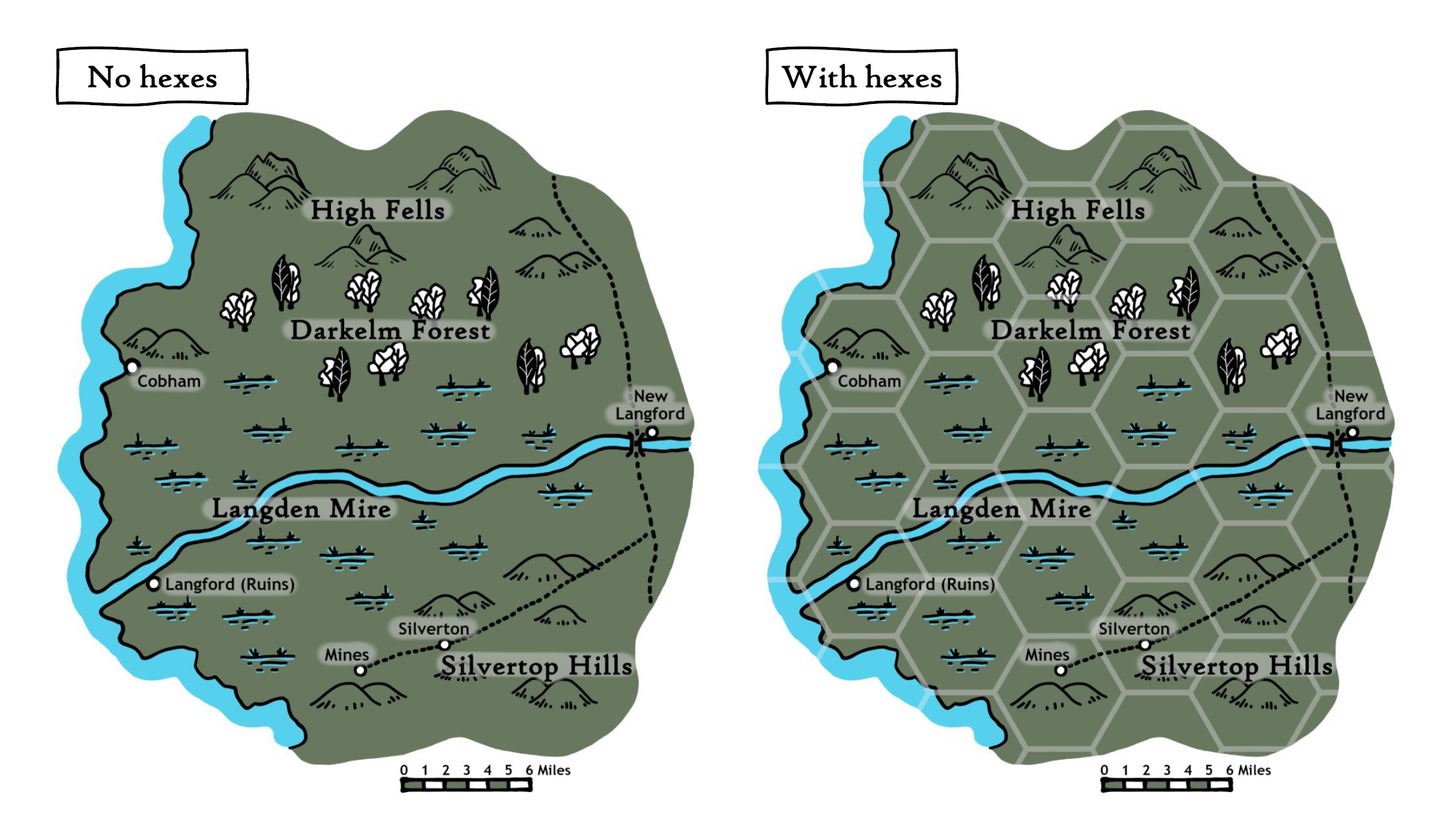
The left-hand version of a regional map can be beautiful and still be unplayable. High fells, a dark forest, a river mire, and a mining hill country only become a crawl when you drop a hex grid on them, pick a scale (six miles is the classic overland default), and decide what is visible from the next hex.
Without that overlay, movement is vibes. With it, you can answer the only questions that matter at the table: How many hexes today? Can they see the ruins? Do they hit the mine road or the bog?
Random Terrain Is Not Geography
Dice-drop wilderness and one-click map toys are fast at coastlines. They are weak at cause. A rainforest jammed against a desert, a river that climbs a ridge, or a “capital” with no food hinterland will not survive contact with curious players.
A hex crawl generator worth using should stock constraints: water flows downhill, roads follow easy grades, bandits sit on bottlenecks, and mines appear where the rock does. Empty hexes should still have a texture—wind, insects, a ruined marker stone—so “nothing happens” does not feel like the GM shrugged.
Spreadsheets Paint Tiles. They Do Not Write the Key.
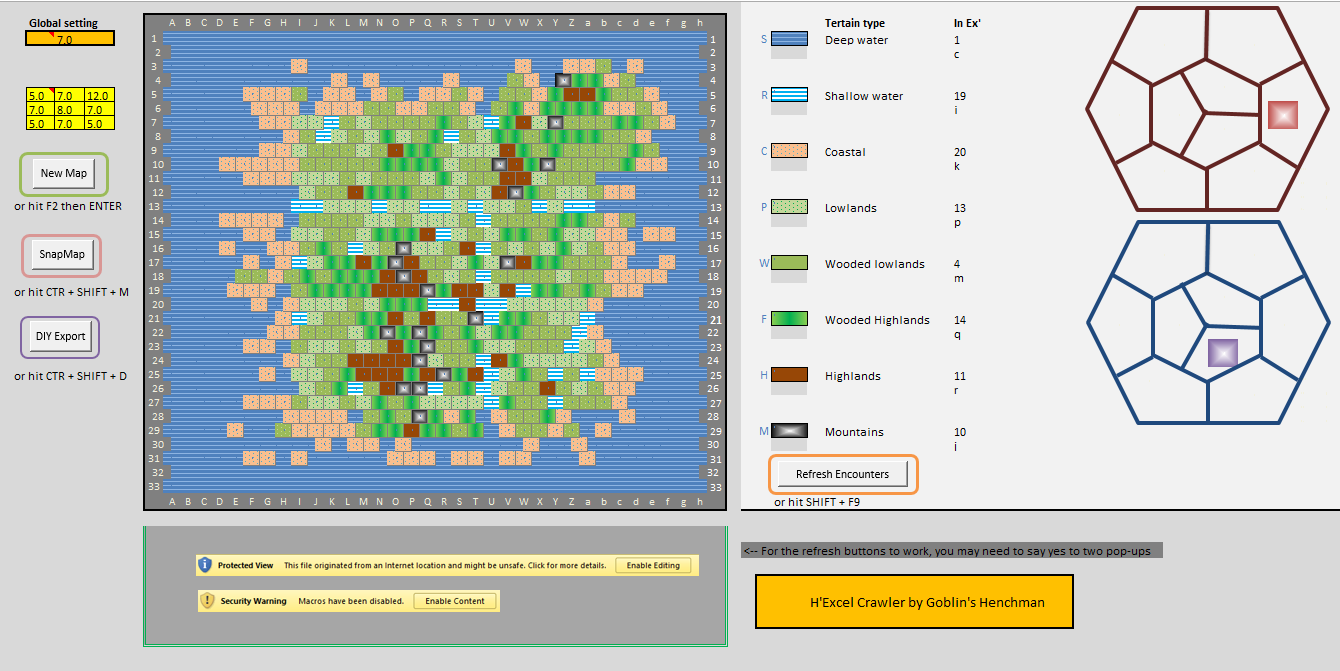
Tools like hex-in-Excel crawlers are honest about what they do. They splat deep water, coast, lowlands, wooded highlands, and mountains onto a coordinate grid, then let you refresh encounters. That is useful cartographic noise. It is not a session.
You still have to name the silver town, decide why the Langford ruins are avoided, and write the one-line secret in hex 0711 so you are not inventing a dragon cult during a rules argument. Color is not a key.
This is exactly what Game Designer Assistant was built for.
Why Game Designer Assistant
Game Designer Assistant treats a hex crawl as a playable system, not a gazetteer. You bring the tone and the first settlement. It returns terrain that implies travel costs, sites that imply rumors, and encounters that belong in that biome—documentation you can keep next to the screen, not a wilderness novel.
It does not replace your taste. It removes the blank-hex tax: the hours spent staring at an empty cell trying to invent a reason anyone would camp there.
| Traditional Approach | Game Designer Assistant |
|---|---|
| Continent first, playable ten-hex loop last | Start with the region the party can cross in a week |
| Random terrain that ignores rivers and ridges | Biomes, hydrology, and movement costs that agree |
| Spreadsheet color grids with no lore | Hex keys with landmarks, lairs, signs, and restock notes |
| One generic chatbot that forgets hex 0407 | Design notes that stay consistent as the crawl expands |
| Pretty map, improvised travel | Overlay logic, visibility, getting lost, and encounter checks |
Terrain That Behaves Like a Place
Ask for a coastal frontier, a highland plateau, or a river mire and you get more than a biome label. You get what the ground does to a marching order: extra days in bog, blocked sight lines in dense wood, exposed ridges that make campfires a problem.
That is the difference between “forest hex” and “Darkelm-style wood where you hear the road but cannot see it.” The generator should tell you what is obvious from an adjacent hex and what is not.
"Build a hex crawl for a level 1–5 D&D sandbox. Use 6-mile hexes. Give me a coastal region about 10×12: high fells in the north, a river mire across the middle, wooded hills with a mine in the south, two villages, and one ruin the locals will not name. Stock every hex with terrain, movement cost, a visible landmark or none, and one hidden feature."
Hex Keys Written for the Table
A usable key is short. Hex ID, terrain, what you can see, what is hidden, and a restock flag. If a hex needs a dungeon, the key points to a five-room site with a reason the nearby village has not cleared it—not a 40-page mega-dungeon you will never finish.
Empty hexes are allowed. They are required. A crawl where every cell contains a unique set-piece stops being wilderness and becomes a carnival. The job is to make emptiness specific.
"Convert this region into a printable hex key: hex ID, terrain, movement cost, visible from adjacent hexes, secret, wandering-table pointer, restock note. Keep each hex to four lines. Mark which hexes are truly empty."
Encounters, Signs, and Restocking
Wandering monsters are not a mood. They are a clock. Forest tables should include tracks, distant drums, and a chance of a lair clue instead of a fight. Mire tables should include getting stuck, bad water, and things that hunt by sound.
Restocking is how the map stays alive after the party clears a camp. The generator should note which hexes refill, which stay scarred, and which factions move in when a lair goes quiet. That is campaign pressure, not a random number.
Scale, Movement, and Getting Lost
Six-mile hexes are the overland default because they sit near a day’s walk on clear ground and they nest cleanly into larger regional hexes. One-mile hexes belong to a single valley. Twenty-four-mile hexes belong on a continent sheet the party will not crawl hex-by-hex.
A hex crawl generator should lock that choice early, then apply movement: roads, rivers, hills, mountains, and the classic “you thought you went north.” Getting lost is content. It is how a mire earns its name.
Related Agents You'll Also Find Useful
If you are stocking a wilderness, you will need more than terrain codes. These agents cover the jobs that sit next to the hex key.
Name Generator — Labels That Sound Native to the Map
Name Generator builds a naming culture, not a syllable dump. Rivers, fells, mining camps, and ruined market towns should sound like they grew from the same tongue.
- Phonetics for people, ships, inns, and geographic labels from one root stock
- The gap between a court’s name for a hill and what drovers call it
- Neighboring cultures that feel adjacent, not copy-pasted
If the party can guess origin by ear, the hex map starts to feel inhabited.
CSV Generator — The Hex Key as a Sheet You Can Filter
CSV Generator turns a drafted key into columns: hex ID, terrain, movement, landmark, secret, encounter table, restock. That is the honest use of a spreadsheet in a crawl—storage and sorting, not pretending a color grid is an adventure.
- Import-friendly keys for VTTs, printouts, and GM screens
- Filters for “all lairs,” “all road hexes,” “all unvisited”
- A living sheet you update after each session without rewriting the bible
Machiavelli Mentor — Who Claims the Empty Hexes
Wilderness is never empty of politics. Machiavelli Mentor maps who taxes the mine road, who pretends the ruins are cursed, and which “bandits” are a deniable border policy.
- Power maps for barons, temples, smugglers, and hill clans
- Off-screen moves when the party spends a week underground
- Negotiation hooks that turn a travel hex into a choice
Film Screenwriter — A Crawl With a Spine
A hex map can still bore a table if nothing is at stake beyond the next random encounter. Film Screenwriter turns geography into pressure: an inciting shortage, a mid-campaign land grab, a finale that still works if the party allies with the wrong keep.
- Session-one hooks that point into the wild, not a cutscene
- Escalation that uses the map you already stocked
- Endings that survive a party going sideways
Try Game Designer Assistant free — no credit card required.
How It Works
A hex crawl generator is only useful if it follows the same discipline good referees already use: pick a scale, stock what the party can reach, and leave the far sheet blank until someone buys a horse.
Step 1: Lock System, Scale, and the First Town
Tell this AI hex crawl generator the ruleset, hex size, session length, and what your players actually enjoy. A horror table that hates starvation clocks and a heroic table that wants ruined empires are not the same wilderness.
"Five players, weekly three-hour sessions, D&D 5e, sword-and-sail tone. They like exploration and hated the last railroad. Six-mile hexes. Start from one port under 1,000 people, not a continent."
Step 2: Build Terrain Before You Place Dungeons
Generate the skeleton the way a cartographer would: coast, highlands, river, mire, wood, hills. Check that water flows, that the mine sits in rock, and that the road takes the easy grade. Then drop the hex overlay so movement has a number.
"Lay out a region like this: western sea, northern high fells, a central forest, a river mire, southern silver hills with a mine, and a ruined ford town. 6-mile hexes. Give movement costs and what you can see from neighboring hexes."
Step 3: Name the Land Before You Name the King
Run Name Generator on the dominant language first. Lock phonetics, then label hexes, streams, inns, and the rival culture over the ridge. Inconsistent names are the fastest way to make a handsome overlay feel fake.
"Invent a highland naming pattern with hard consonants. Generate 15 geographic labels, 10 townsfolk, and 6 mine-related site names that could all appear on the same chart."
Step 4: Stock a Key, Not a Novel
Ask for a four-line key per hex and a pointer to a longer site only where it is earned. Add a terrain-based encounter table with signs and a restock flag. Use Machiavelli Mentor on the three factions that care who controls the ford.
"Write a 12-entry wandering table for the forest and another for the mire. Include tracks, distant noise, and a 2-in-6 chance of a lair clue instead of a fight. Note which cleared camps restock in a week."
Step 5: Print What Hits the Table, Keep the Rest in Memory
Export the key with CSV Generator. Generate the player-facing rumor sheet. Leave the dynastic chart in the thread. Come back next session and ask what moved in the unvisited hexes while the party was underground.
Results & Use Cases
📊 First Sandbox for a New Referee
- Scenario: A new GM wants Isle-of-Dread energy without stocking 400 hexes or cloning someone else’s peninsula.
- Traditional Approach: A weekend of terrain doodles, then panic when the party leaves the road in session two.
- Game Designer Assistant: A home-base town, a ten-by-twelve crawl, and a dungeon the locals will not enter—ready the same night.
- The party has somewhere to sleep, spend, and get lost
- You only fully key the hexes they can reach in the first month
- Continent maps wait until someone cares
💼 Turning a Pretty Map Into a Crawl
- Scenario: You already have a labeled region—fells, forest, mire, mining hills—and zero overlay.
- Traditional Approach: Print the art, squint at distances, and argue about whether the ruins are one day or three from town.
- The hex crawl generator + CSV Generator: A six-mile grid, a movement key, and a sheet you can filter for lairs and roads.
- Visible vs. hidden features per hex
- A scale bar that means something at the table
- Secrets that stay secrets until the party earns them
📱 Commute Prep on a Phone
- Scenario: Game night is tomorrow. You are on a train with twenty minutes and no laptop.
- Traditional Approach: Recycled random encounters that ignore the mire you billed as deadly.
- Tour Guide + the same thread: Tour Guide gives you a walkable hex as a local would describe it—smells, bad fords, which ridge hides the campfires—while you stock the next three hexes by voice.
- Speech-to-text for messy idea dumps between stops
- Sensory briefs you can read aloud without a wiki
- The same memory as your desktop key
🎯 Political Wilderness for a Veteran Table
- Scenario: Six veterans will ignore another goblin cave, but they will fight over a mine road.
- Traditional Approach: A faction spreadsheet that never quite touches the hexes.
- Machiavelli Mentor + Film Screenwriter: Incentive maps laid onto the crawl, plus a twelve-session spine that still works if the party sells the ford to smugglers.
- Off-screen claims on “empty” hexes
- Encounters that are someone else’s policy
- A finale that uses the map you already stocked
For historical texture—monsoon tracks, transhumance, how a silver camp actually eats—Deep Research will pull analog joints you can steal without pasting Earth onto the chart.
FAQ
What is a hex crawl generator?
A hex crawl generator is a tool that produces the playable layer of overland exploration: a hex grid, terrain, a short key per cell, and encounter logic. The hex crawl generator on this workflow also handles movement costs, visibility, getting lost, and restocking so the wild remains a procedure rather than a travel montage.
Is Game Designer Assistant free to use as a hex crawl generator?
Yes. The free tier includes core features with limited monthly usage and no credit card. Paid plans increase usage if you are generating full region keys, encounter tables, and session exports every week—Plus starts at $20/month. Usage resets on your billing date, so the full allotment is available from day one.
How is an AI hex crawl generator different from a spreadsheet mapper or ChatGPT?
A spreadsheet crawler is excellent at coloring terrain tiles and weak at writing the adventure layer. A general chatbot will invent a mire, a mine, and a ruin in three moods and forget the river. Game Designer Assistant is built as a design partner: systems, documentation, and a key you can run, with related specialists for names, politics, and export.
What hex size should I use?
Six-mile hexes are the classic overland default—near a day’s travel on clear ground, easy to nest into larger regional hexes. Use one-mile hexes for a single valley or dungeon approaches. Use large 24-mile hexes only for continent sheets you will not crawl cell by cell. Lock scale before you stock, or movement math will fight the map.
Can a hex crawl generator overlay hexes on a map I already drew?
Yes. Describe the region—or treat a labeled map as the source of truth—and ask for a six-mile overlay, movement costs, and a key. That is the jump from “pretty wilderness” to “the party is in Darkelm Forest, they can hear the road, and they cannot see it.” You still decide what is true; the tool drafts the cells.
Does this work on mobile for last-minute session prep?
Yes. Web, iOS, and Android share feature parity, including speech-to-text. You can stock the next three hexes, regenerate a mire encounter table, or dictate a rumor sheet on a phone, then open the same thread at the table.
Run the Wilderness Your Table Can Actually Cross
Most hex crawls die of area: too many cells, not enough key. A hex crawl generator is worth using only when it respects that fact—when it overlays a real scale, stocks the loop your party can walk, names the land in one tongue, and remembers the river you put through the mire.
Game Designer Assistant is that workflow: terrain that behaves, keys you can scan, encounters that match the ground, and a memory that does not reset when you close the laptop. The Thursday-night sandbox does not need a second unpublished atlas. It needs the next twelve hexes, done.
Try it now, then explore more at Jenova.
For Developers: Game Designer Assistant is available programmatically via the Jenova API — integrate hex-crawl terrain, keys, and encounter generation into your application with a single API call. Full documentation →