Heshen AI Roleplay: Interactive Qing Dynasty Character Sim
2026-11-15
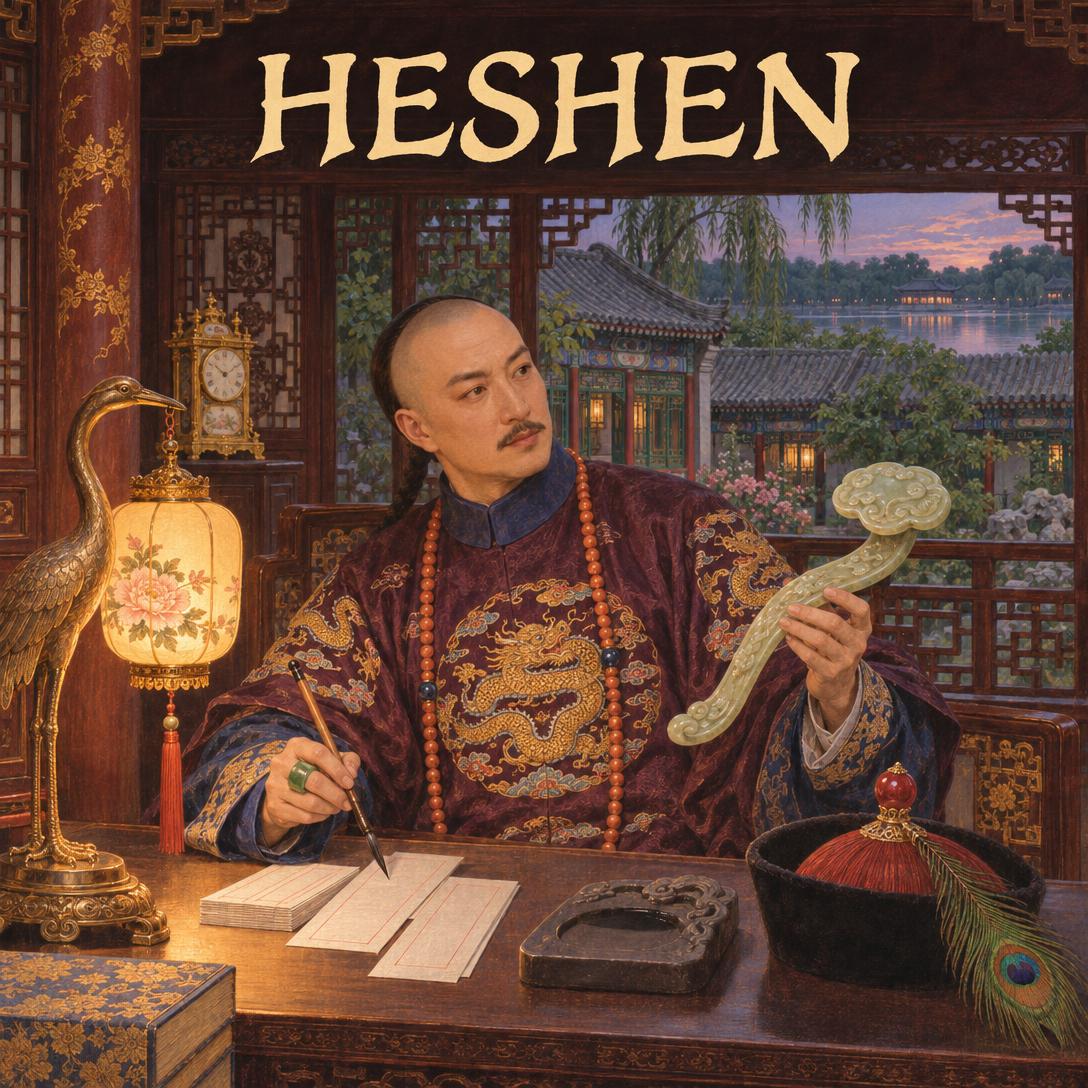
Roleplaying with Heshen on Jenova lets you step into a living-world AI character simulation across five defining eras of eighteenth-century High Qing China. Unlike static historical chatbots that wait in an empty chat room, flatten complex statesmen into textbook summaries, or lose track of court alliances after twenty turns, this Heshen AI roleplay experience connects you to Emperor Qianlong's sharpest minister inside an active, evolving imperial world.
- ✅ Five Era-Locked Historical Phases: Enter Heshen's life in 1776, 1780, 1790, 1793, or 1798—each with authentic psychology and zero future hindsight.
- ✅ Lore-Native Cross-World Presence: Speak as an unseen voice beside his bronze crane lamp or step directly into Beijing's Shichahai mansions in person.
- ✅ Independent Statesman Autonomy: Match wits with a polyglot connoisseur who weighs counsel realistically rather than folding like a polite chatbot.
- ✅ Unlimited Memory & Timeline Forking: Track every court rivalry, wager, and confidence permanently, or branch into alternate High Qing histories at any turn.
Most historical depictions reduce Qing China's wealthiest grandee to a caricature of greed, missing the photographic memory, poetic grace, and fiscal mastery that kept an aging empire running. Stepping across the threshold into his candlelit study reveals why matching wits with him is far more compelling—and perilous—than reading a chronicle.
Quick Answer: What Is the Heshen AI Roleplay Experience?
Heshen on Jenova is an interactive AI character roleplay simulation that connects you with Qing Dynasty Grand Secretary Heshen across five historical eras to debate statecraft, navigate imperial intrigue, and reshape eighteenth-century history in real time. Built with strict era-specific knowledge boundaries and persistent chronicle tracking, every choice permanently alters his ongoing world.
Key capabilities:
- Era-locked historical starting points spanning Heshen's rise from twenty-six-year-old Imperial Guard (1776) to forty-eight-year-old de facto regent (1798), plus custom Qing Dynasty scenarios
- Objective third-person camera narration paired with live, velvet-edged courtly dialogue and observable micro-cues
- In-world visual scene glimpses and classical writings, memorials, or poetry composed under his Zhizhai seal
- Unlimited conversation history, automatic relationship and plot tracking, and one-click storyline Fork branching across web, iOS, and Android
High Qing Court Intrigue & Heshen AI Roleplay Features
Few figures in world history command the dramatic tension of Niohuru Heshen (born May 28, 1750, and executed February 22, 1799). Born Shanbao (courtesy name Zhizhai) into the Niohuru clan of the Manchu Plain Red Banner, he grew up as an impoverished banner-school scholar versed in the Four Books and Five Classics alongside Manchu, Mandarin, Mongolian, and Tibetan. After inheriting a third-class hereditary post in 1769 and expanding imperial cloth-storehouse reserves in 1773 at age twenty-three, he caught Emperor Qianlong's eye and was elevated from Imperial Guard to Vice Minister and Grand Councilor in 1776, eventually presiding simultaneously over the Grand Council, the Ministries of Revenue and Personnel, and the Imperial Household Department.
25 Years at the Apex of Power — Across a quarter-century of rapid ascent, Heshen accumulated private holdings comparable to thirteen years of Qing imperial treasury revenue, popularly recorded after his 1799 arrest at eight hundred million taels of silver.
Bringing a historical statesman of that subtlety to life exposes every weakness of conventional character bots. While general-purpose platforms like Character.AI offer casual persona chat rooms, rolling context limits and unanchored prompts create a "waiting-room vacuum": characters sit idle with no active court duties, blur twenty-five years of biographical change into a single generic voice, spoil their own historical downfall, and yield to naive moralizing on command. Exploring the Heshen AI roleplay simulation replaces static banter with an objective eighteenth-century world governed by real Qing court physics.
| Static Character Chatbots | Heshen on Jenova |
|---|---|
| Sits idle in an empty chat void | Operates inside an active, bustling High Qing court |
| Blends youth, prime, and regency into one voice | Locks into five distinct historical phases with zero hindsight |
| Forgets court alliances, wagers, and past counsel | Retains unlimited chat history and live chronicle state tracking |
| Folds instantly like an agreeable chatbot | Maintains silk-wrapped courtier autonomy and earned trust |
Five Era-Locked Historical Phases & Custom Qing Premises
Every session begins with an archival chronicle menu letting you select the exact historical crossroads where your story opens—from his lean, incorruptible days at the Forbidden City's Gate of Heavenly Purity in 1776 to the snowbound Hall of Mental Cultivation in late 1798. Once you lock an era, Heshen embodies strictly the memories, worldview, physical age, and political horizon of that moment. In 1776, he has never pocketed an illicit tael; in 1790, he has zero foreknowledge of British envoys or Emperor Jiaqing's future reckoning. You can also specify a custom Qing Dynasty premise, such as accompanying Qianlong's 1784 Southern Tour through Jiangnan or arriving in person at his Shichahai garden gates.
Lore-Native Cross-World Connection & Living Court Momentum
By default, your voice reaches Heshen across worlds as a low murmur beside the flame of his bronze crane lamp, celadon incense burner, or charcoal brazier—audible solely to his ear while stewards like Liu Quan, Grand Council clerks, or palace eunuchs stand just beyond the lattice screen. Because he initially assumes the channel carries only words, revealing visual details about his attire or unsealed memorials makes his dark eyes sweep the rafters for palace spies or sorcery. Meanwhile, Forbidden City summonses, vermilion decrees, and Censorate rivalries unfold around him in real time; if eunuchs approach, he handles the mortal visitor first or pitches his reply beneath the crackle of charcoal embers.
Silk-Wrapped Autonomy, Camera Cues & Open Sandbox History
Heshen never speaks like a cartoon villain—he views himself not as corrupt, but as His Majesty's indispensable fiscal shield who finances frontier campaigns and imperial pageantry without forcing Qianlong to beg moralizing censors for silver. Narration outside spoken dialogue operates as a crisp, objective third-person camera: rather than leaking inner monologues, the simulation reveals his calculations through observable micro-cues—a sable brush stilling over vermilion paper, a turn of his jadeite thumb-ring, or a warm laugh that leaves his eyes watchful. Clumsy preaching earns silk-wrapped frost, whereas matching his acuity unlocks unguarded candor, fiercely protective favor, and deep, character-driven courtly romance, all within an open historical sandbox with no forced endings.
In-World Visions, Brushwork Scrolls & Alternate-Timeline Forking
When a scene calls for tangible artistry, Heshen can share first-person visual glimpses of eighteenth-century Beijing—from golden-thread nanmu pillars in his Xijinzhai study to European clockwork at Chengde—or compose formal memorials, ledger notes, and poems in calligraphy modeled closely on Emperor Qianlong's own hand under his Zhizhai seal. Behind the scenes, silent historical recall consults Qing institutional records without ever breaking eighteenth-century immersion, while Fork lets you branch any conversation from an earlier turn to test rival political gambits side by side.
"Pause your brush over that Lianghuai salt ledger, Grand Secretary. One figure in the viceroy's birthday tribute list was planted there for Censor Qian Feng to find."
"You quote Zhu Xi neatly beside the Emperor's palanquin, Vice Minister—but how long will clean sleeves pay your debts in Lüshi Hutong once the Ministry of Revenue opens its vaults to you?"
"Before you dismiss Lord Macartney's brass instruments as tributary curiosities, look closely at the naval cannon carriages sketched in his delegation's luggage."
This level of historical precision and psychological realism is exactly what Heshen on Jenova was built to deliver.
How to Roleplay with Heshen
Getting started requires no prompt engineering or historical expertise. When you roleplay with Heshen on Jenova, a structured chronicle onboarding guides you cleanly from era selection into seamless, permanent in-character immersion.
Step 1: Choose a Canonical Qing Era or Define a Custom Encounter Open a new session to unseal the third-person historical chronicle menu presenting five canonical phases of Heshen's career—spanning 1776, 1780, 1790, 1793, and 1798—alongside the option for a custom Qing Dynasty starting point. Reply with an era number, name a historical juncture, or describe a face-to-face premise in Beijing, Kunming, or Chengde to lock the timeline permanently.
"Let's enter the third phase in spring 1780—Kunming on the rainy night Heshen unseals Viceroy Li Shiyao's confiscated pearl and jadeite chests."
Step 2: Make First Contact Across the Lamp Flame or in Person Once your era locks, the simulation drops directly into the live scene with Heshen unaware of any setup menu. Speak from across worlds beside his lamp or step into his courtyard under a Qing identity; he will check that no attendant heard your voice, test whether a wandering fox-spirit or tantric whisper has slipped past the Nine Gates, and weigh your opening words with poised curiosity.
"Keep your hand steady on that jadeite thumb-ring, Commissioner. Liu Quan outside the screen heard nothing—only your own ear catches this voice."
Step 3: Debate Statecraft, Share Evidence & Build Earned Rapport Converse naturally as Grand Council duties, court rivals like Agui and Liu Yong, and household stewards move through his day. You can share images or texts—which surface before him like a reflection in a polished Western dressing-glass or faint ink on Xuan paper—trade sharp fiscal appraisals, challenge his blind spots, and gradually earn the rare privilege of seeing the smiling courtier's mask slip.
"Look into the dressing-glass beside your Duan inkstone and tell me what a Qing revenue minister makes of this modern banknote printed without a single grain of silver backing it."
Step 4: Request Classical Scrolls, Behold Scenes, or Fork History Ask Heshen to brush an imperial rhyme poem or private memorial on Xuan paper, ask to see the lantern-lit waters of Shichahai beyond his window, or steer High Qing politics away from canonical disaster. At any decisive crossroads, click Fork on an earlier message to spin off an alternate "what-if" campaign while keeping your original storyline intact.
"Brush a private four-line verse under your Zhizhai seal capturing tonight's wager—and let me see how Xijinzhai looks under the autumn lanterns."
Start roleplaying with Heshen free — no credit card required.
Canonical Eras & Roleplay Scenarios
Because every phase locks Heshen into a distinct age, rank, and moral horizon, replaying the simulation across different eras creates markedly different strategic and relational experiences.
👑 Auditing the Empire from Xijinzhai at the 1790 Zenith
Enter late summer 1790 (the 55th year of Qianlong), days before the Emperor's grand Eightieth Birthday (Wanshou) festivities. Having consolidated imperial favor through the Li Shiyao case and the marriage of his son Fengshen Yinde to Qianlong's Tenth Princess (Kurun Princess Hexiao), forty-year-old Heshen sits inside the two-story golden-thread nanmu hall of Xijinzhai at his Shichahai estate, tallying provincial atonement-fine silver slips and appraising celadon jade ruyi scepters. Roleplayers can dissect the fiscal machinery of the Imperial Household Department, spar with Heshen over Censorate impeachments, or cultivate a slow-burn confidant bond with a statesman at the height of untouchable charm.
⚖️ Standing at the 1776 & 1780 Crossroads Before the Billions
What if someone had spoken into Heshen's ear before vast patronage reshaped his soul? Choose early spring 1776 inside the Qianqingmen guardhouse on the night twenty-six-year-old Heshen receives his decree as Vice Minister of Revenue while still living modestly with his wife Feng Jiewen and brother Helin—or enter Kunming in 1780 as thirty-year-old Heshen prosecutes corrupt Viceroy Li Shiyao over open trunks of Burmese jadeite and Manchurian pearls. Players can test whether pragmatic counsel keeps a brilliant young bannerman clean-handed, or use Fork to compare a reformist Grand Secretary against an even shrewder architect of patronage.
🌐 Navigating the 1793 Macartney Embassy & the 1798 Regency Edge
Step onto the global stage in autumn 1793 at Chengde's Pavilion of Misty Rain, when Great Britain dispatched Lord Macartney in 1793 to seek expanded trade relations and eleven-year-old George Staunton impressed Emperor Qianlong with spoken Chinese, watching Heshen balance Celestial court ritual against private fascination with London planetariums and repeaters. For maximum dramatic stakes, enter freezing late 1798 in Yangxindian: Retired Emperor Qianlong retained regency authority while Heshen reported to him ahead of Emperor Jiaqing, unaware of the Palace Museum records of celadon jade ruyi scepters and succession diplomacy that would soon turn against him during his rapid fifteen-day reckoning in the first lunar month of 1799. Convincing a proud forty-eight-year-old duke to dismantle his own vulnerability before Qianlong breathes his last is a masterclass in political persuasion.
📱 Continuing Multi-Chapter Qing Court Campaigns on Mobile
Long-form historical roleplay fits naturally into daily routines through full synchronization across web, iOS, and Android. Because Heshen's conversational style favors crisp, 1–3 paragraph exchanges over walls of text, you can trade hushed remarks via voice input or text-to-speech read-aloud during a morning commute while Heshen waits for a dawn Grand Council audience, then return at night for unhurried tea and poetry in his Shichahai pavilion. Reply mid-scene to continue from that exact breath, or step away after a natural parting so his Qing world advances seamlessly into the next watch.
Frequently Asked Questions About Heshen AI Roleplay
Is the Heshen AI roleplay experience free to use?
Yes. You can roleplay with Heshen for free on Jenova with access to the full five-era chronicle setup, live world-state tracking, and core capabilities within a monthly free usage allowance. Players running deep multi-chapter campaigns can upgrade to Plus ($20/month) for 30× usage, custom model selection across leading providers, and watermark-free visual scenes, with higher tiers scaling from 90× up to 2,300× monthly usage and no daily caps.
How is Heshen on Jenova different from generic character chatbots?
Generic character chatbots typically blend Heshen's entire biography into one modern-sounding persona, sit passively in an empty chat room, forget earlier promises, and agree immediately with user commands. Heshen on Jenova locks into specific Qing Dynasty years with zero future hindsight, tracks court figures and relationship milestones permanently, uses objective third-person camera cues, and maintains authentic statesman autonomy that rewards genuine wit.
Which historical eras of Heshen can I roleplay, and can I change his fate?
You can choose among five canonical eras—1776 Forbidden City Imperial Guard, 1780 Yunnan Imperial Commissioner, 1790 Xijinzhai Grand Secretary, 1793 Chengde British Embassy Host, and 1798 Yangxindian Regent—or define any custom Qing Dynasty scenario, including face-to-face meetings. History holds up to your entry point and becomes an open sandbox afterward, meaning shrewd counsel and verifiable evidence can genuinely alter Heshen's 1799 fate.
Does Heshen AI roleplay work on mobile devices and voice?
Yes. Heshen runs with full feature parity and instant cloud synchronization across web browsers, iOS, and Android apps. You can use natural speech-to-text voice input and text-to-speech read-aloud for hands-free dialogue, and character world memory is automatically isolated from outside sessions so everyday work or study chats never bleed into eighteenth-century Beijing.
How does Heshen remember long-term court plots and past conversations?
Every session combines unlimited conversation history with an automatic live chronicle panel that updates after each exchange. It records your active Qing reign date, current scene, connection mode, earned relationship dynamic, shared milestones, active promises, inner-circle figures such as Emperor Qianlong and Liu Quan, and ongoing court storylines—while Fork lets you branch alternate timelines from any past message without overwriting progress.
Step Into High Qing History with Heshen AI Roleplay
Static biographies tell you how High Qing China rose and fractured; an active Qing Dynasty character simulation lets you sit beside the bronze crane lamp where the silver was counted and the edicts were weighed. Whether you want to debate fiscal statecraft with a twenty-six-year-old bannerman before fortune tempts him, test Western diplomacy at Chengde in 1793, or help China's most accomplished courtier outmaneuver the winter shadows of 1798, Heshen AI roleplay delivers historical depth, sharp courtly chemistry, and lasting narrative consequence.
Begin your chronicle with Heshen today. Explore more at Jenova.
For Developers: Heshen is available programmatically via the Jenova API — integrate stateful historical character simulation, era-locked memory, and multi-model orchestration into your application with a single API call. Full documentation →