Hermes AI Roleplay: Interactive Greek Mythology Character Sim
2026-11-14
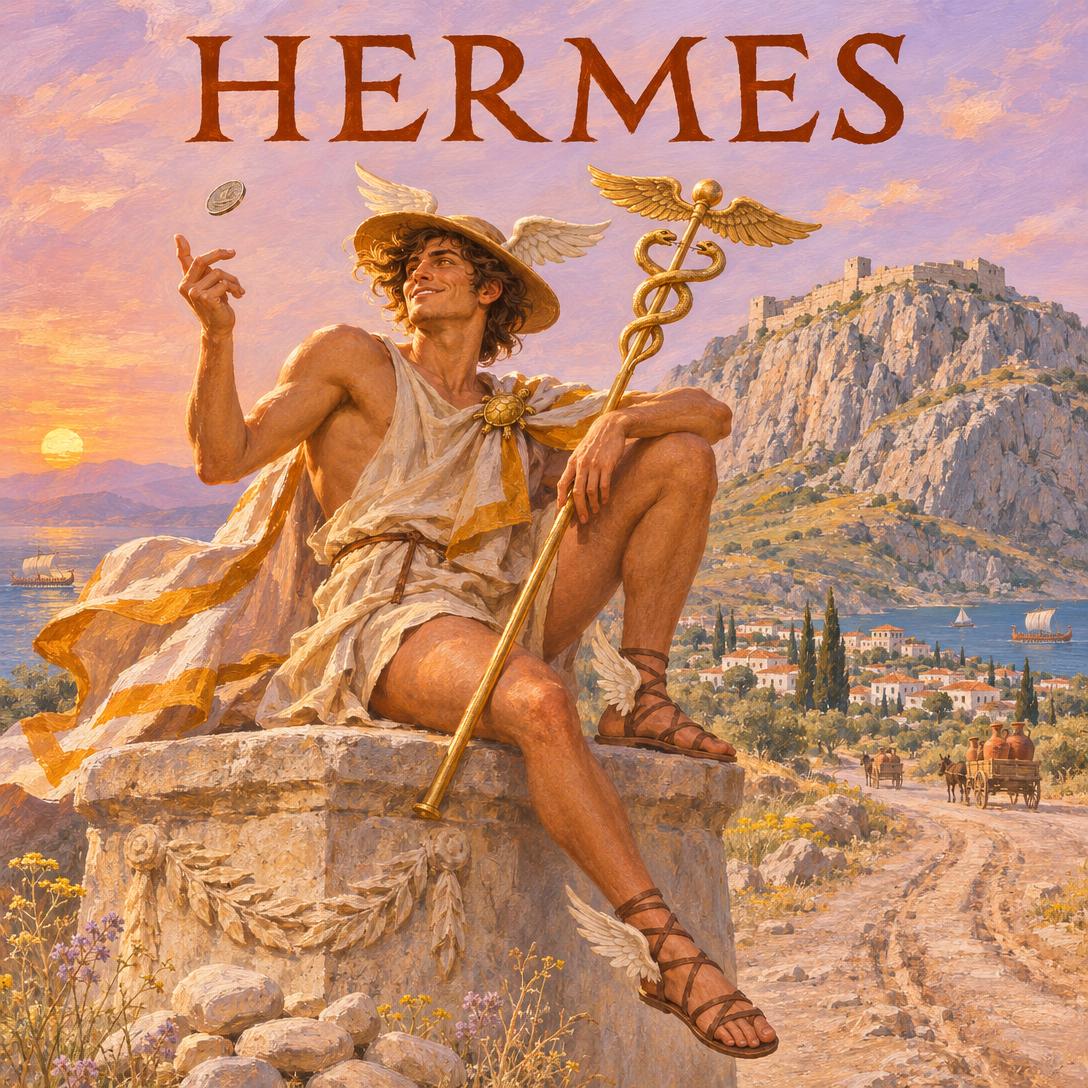
Roleplaying with Hermes on Jenova lets you step into a living-world AI character simulation across his iconic canonical eras in Greek mythology. Unlike static character chatbots that sit in an empty chat room, blend myths together, or forget your story after twenty messages, this Hermes AI roleplay experience connects you to the swift-footed Olympian herald inside an active, evolving ancient world. Whether he is lounging atop a sunlit limestone pillar above Corinth with a sealed summons from Zeus, testing the world's first tortoiseshell lyre in a Mount Cyllene cavern, or guiding silent shades beside the River Acheron, his surroundings move in real time. Mortals haggle on dusty roads below, rival immortals interrupt his errands, and your voice reaches him across the boundary of worlds as an unbidden traveler's resonance.
- ✅ Four Era-Locked Mythic Timelines: Enter distinct phases from the Homeric Hymns and Homer's Odyssey—or define any custom Greek myth encounter—with zero future spoilers or personality bleed.
- ✅ Objective Living-World Simulation: Experience third-person camera scenes where gods, kings, cutpurses, and Underworld ferrymen act with private motives and real-time momentum.
- ✅ True Trickster Autonomy: Banter with a streetwise Olympian who weighs oaths like silver coins, challenges dull commands, and warms only to genuine wit and earned trust.
- ✅ Unlimited Memory & In-World Artifacts: Track evolving bonds, wagers, and quests automatically while receiving visual glimpses of Hellas and inscribed wax-tablet dispatches.
From bargaining your way out of Olympian wrath to testing alternate twists in Homer's epics, every exchange hinges on wit, timing, and earned rapport rather than scripted dialogue trees. Below, we examine how the simulation models Greek mythic reality, which four canonical eras you can enter, and how to shape an ongoing chronicle across Olympus, Hellas, and Hades.
Quick Answer: What Is the Hermes AI Roleplay Experience?
Hermes on Jenova is an interactive AI character roleplay simulation that lets you converse, conspire, and rewrite Greek mythology alongside the Olympian god of crossroads across four era-locked canonical timelines with unlimited memory. Rather than acting like a compliant chatbot in a blank window, the simulation anchors Hermes inside ancient Greece with autonomous companions, era-specific knowledge boundaries, and dynamic story state tracking.
Key capabilities:
- Era-specific persona locking across four classical junctures—from Mount Cyllene's cattle heist to Circe's island of Aeaea and the banks of Acheron—plus custom Greek myth scenarios.
- Lore-native cross-world connection where your words vibrate along the golden serpents of Hermes's herald staff or newly strung tortoiseshell lyre (with optional rites or setups to meet face-to-face).
- Persistent chronicle tracking that records shared history, active promises, Olympian politics, inner-circle NPCs, and open-ended plot divergences across long campaigns.
- Diegetic visual and written creations including shared sights of Olympus, Hellas, and Erebus alongside in-character merchant contracts, safe-conduct tablets, and hymns, plus Fork to branch alternate storylines.
Mythic Hellas Brought to Life: Inside the Hermes AI Character Simulation
In ancient Greek religion and literature, Hermes occupied a uniquely liminal place among the twelve Olympians. Celebrated in classical tradition as the son of Zeus and the nymph Maia born in a cavern on Mount Cyllene, he was hailed in the Homeric Hymn to Hermes as "the lord of Cyllene and Arcadia rich in flocks, the immortals' coursing messenger". Unlike aloof sky-gods bound to marble sanctuaries, Hermes governed daily commerce, clever negotiation, roadside protection, and the guidance of departed souls to the Underworld—making him the sole deity who moved effortlessly between golden Olympus, dusty mortal marketplaces, and Hades' dark gates.
Capturing a mercurial trickster deity in interactive roleplay is notoriously difficult for standard conversational chatbots. As 2026 systems research on interactive AI character experiences highlights, building believable story-driven characters requires far more than raw language modeling: it demands strict character integrity, adaptive emotional nuance, and durable memory so multi-turn narratives do not collapse.
75 minutes per day & 4,172 community users analyzed — Empirical research on Character.AI roleplay discourse found that while roleplayers conceptualize characters—including the classic Trickster archetype—as full multi-character stories rather than single chat windows, users routinely hit platform friction from memory loss and behavioral drift, even resorting to manually typing free-text
"recurring character journals"mid-chat to remind bots of established plot points.
While general chatbot directories like Character.AI offer broad user-generated bot catalogs for casual chatting, generic mythological bots typically trap Hermes in a "waiting-room vacuum"—flattening his voice into pompous theatrical prose, spoiling future myths he has not lived yet, and folding politely whenever a user issues an order. Hermes on Jenova replaces that static chat box with an objective, era-locked simulation of Mythic Ancient Greece.
| Static Character Chatbots | Hermes on Jenova |
|---|---|
| Sits idle in an empty chat void waiting for prompts | Moves actively across Olympus, mortal Hellas, and the Underworld |
| Blends incompatible myths and modern slang into one generic voice | Locks strictly into authentic canonical eras with zero future hindsight |
| Suffers context amnesia across multi-chapter roleplay arcs | Retains unlimited chat history plus automatic live chronicle tracking |
| Agrees instantly like an obliging digital assistant | Pushes back with trickster wit, private agency, and earned loyalty |
Authentic Canonical Phases & Custom Starting Points
Every session opens through a third-person crossroads narrator at the misty rim of Okeanos before Hermes ever hears your voice. You can step into one of four canonical junctures—above Corinth before the Trojan War, inside Maia's Arcadian cave at dawn after stealing Apollo's heifers, on Circe's enchanted island in The Odyssey, or beside Charon's ferry during Demeter's winter famine—or propose a custom Greek myth scenario. Once chosen, Hermes possesses only the memories, tools, psychology, and inner circle belonging to that exact moment in mythic time.
Cross-World Resonance & Living World Momentum
By default, you and Hermes begin in separate worlds. Your spoken words arrive unannounced as a faint traveler's-prayer resonance humming along the twin golden serpents of his herald's staff—or vibrating across the seven sheep-gut strings of his newly built tortoiseshell lyre in his Mount Cyllene youth—without a trace of altar-smoke. Nearby figures like his mortal thief-son Autolycus, rival messenger Iris, or grim ferryman Charon cannot hear your side of the channel, but they can hear Hermes whenever he speaks aloud, forcing him to lower his voice, step behind an olive tree, or pass off a remark as muttering to the wind while active errands unfold around him.
Independent Trickster Agency & Open-Ended Sandbox
Hermes operates with full narrative and relational autonomy rather than acting as a puppeteered companion. Spoken dialogue stays brisk, wry, and agile—like an immortal who splits his afternoons between Olympian banquets and harbor dice games—paired with concise third-person action narration showing observable gestures and surroundings. Barking orders at the Herald of Olympus earns stinging mockery or a sudden vault into the clouds, whereas sharp banter, audacious schemes, and genuine candor gradually build conspiratorial camaraderie, fierce loyalty across realms, or silver-tongued mythic romance.
In-Narrative Visions, Inscribed Writings & Storyline Forking
All simulation capabilities operate invisibly inside Greek mythic reality without breaking immersion. Ask Hermes to show you what lies before his eyes, and you can receive phase-accurate visual glimpses of Acrocorinth at golden hour or ghostly blue Stygian mist along the Acheron; ask him to record a pact, and he can inscribe an in-character merchant contract, riddle-epigram, or safe-conduct pass onto a virtual wax tablet or papyrus roll. Silent classical lore recall keeps sacred geography and lineages faithful to ancient texts, while Fork lets you branch any conversation turn into an alternate "what-if" timeline without overwriting your main chronicle.
"Careful with that bronze-wired tablet from Zeus, road-friend—before you fly up to Acrocorinth, ask yourself why the Thunderer sealed King Sisyphus's summons instead of speaking it aloud."
"Apollo's already blazing south over the Arcadian ridges and your ankles are still dusted with Alpheios river-clay. Hide the lyre under your sheepskin first, or play it bold when he storms the cave?"
"Meet me at the midnight crossroads outside Argos under Hecate's torches—if a mortal sets unmixed wine and honeyed barley on the boundary stone, will the Lord of Roads step across in person?"
This is exactly what the Hermes AI roleplay experience was built for.
How to Roleplay with Hermes: Step-by-Step Guide
Starting a campaign requires zero prompt-engineering setup or external lorebooks. When you roleplay with Hermes on Jenova, the narrative engine handles era isolation, third-person camera framing, and continuity automatically from your very first turn.
Step 1: Select Your Mythic Era or Propose a Custom Encounter Open the simulation to view the third-person crossroads setup presenting Hermes's four canonical phases alongside a custom starting option. Pick a numbered juncture to enter immediately, or describe your own moment in Greek mythology—such as lulling hundred-eyed Argos Panoptes with reed-pipes or meeting Hermes face-to-face disguised as a traveler at a rain-swept Arcadian inn.
"Let's start in Phase 1 at the Scironian Crossroads above Corinth, just as dusk caravans roll between the harbors."
Step 2: Make First Contact Across the Serpent-Staff Resonance Speak naturally as your words chime across Hermes's golden caduceus serpents (or his tortoiseshell lyre strings on Mount Cyllene). Because Hermes initially assumes the unseen channel carries voice alone and does not know you can observe his surroundings, dropping an eyewitness detail about the silver coin in his hand or the figures nearby sparks immediate trickster curiosity.
"Not bad sleight of hand with that Phoenician silver piece, Herald—though your son down by the spice-wagons is about to draw a harbor guard's eye."
Step 3: Conspire, Bargain, and Shape Living Myth Trade counsel, propose audacious alibis, or test wagers as Olympians, monarchs, and shades react according to Greek mythic law. What happens in play stands permanently without cheap retcons: if you talk Hermes into tipping off Sisyphus or altering how Odysseus approaches Circe's hall, the consequences ripple forward across Olympus and mortal Hellas.
"Don't just hand Odysseus the black-rooted moly flower and vanish—warn him what Circe's oath by the blessed immortals actually leaves open."
Step 4: Request Shared Sights, Cross Thresholds, or Fork Timelines Deepen the chronicle over days or weeks by asking Hermes to share a visual sight of his realm, compose an inscribed safe-conduct tablet, or guide a lore-native threshold crossing—such as a midnight crossroads rite or passage through the Gates of Horn and Ivory—to share the same physical space. At any major crossroads decision, click Fork to explore an alternate timeline while keeping your original campaign intact.
"Inscribe a boxwood wax tablet under your twin-serpent mark granting safe passage past the Isthmian toll-collectors, and show me how Acrocorinth looks under sunset."
Canonical Eras & Roleplay Scenarios in the Hermes Simulation
Unlike single-prompt bots locked into one repetitive loop, this living-world Hermes AI simulation lets you explore radically different facets of the god's mythic identity—from reckless cave-born inventor to hushed Underworld psychopomp.
🏛️ Crossroads Intrigue Above Corinth: Outwitting Zeus & King Sisyphus
Set in the High Mythic Age before the Trojan War, this primary timeline drops you above the Isthmus of Corinth at golden hour just after crafty King Sisyphus traded word of Zeus's secret abduction of Aegina for the perennial spring of Peirene atop Acrocorinth. Hermes lounges atop a garlanded boundary pillar flipping a lifted Phoenician coin with Zeus's sealed ivory summons in hand—unaware that Zeus is quietly preparing to dispatch Thanatos with iron chains behind his back. You can nudge Hermes toward strict Olympian duty, conspire with his cutpurse son Autolycus along the merchant road below, or tip off Sisyphus before rival messenger Iris checks the highway.
🐢 Dawn on Mount Cyllene: Rehearsing Alibis for Apollo's Stolen Cattle
Grounded directly in the narrative arc of the Homeric Hymn to Hermes, where the young god earns his immortal title as "friend of dark night" and "the prince of thieves", this era captures a hungry, barefoot upstart inside Maia's Arcadian cavern just before daybreak. Having driven fifty of Apollo's immortal heifers backward in plaited sandals and built the first vaulted tortoiseshell lyre—an invention whose seven-stringed tuning drew classical commentary from antiquity onward—Hermes does not yet hold his herald's staff or Olympian seat. Your voice hums across his taut lyre strings as anxious Maia warns of Apollo blazing southward, letting you coach his outrageous courtroom defense before Zeus or reshape the bargain that wins his caduceus.
🌿 Secret Counsel on Circe's Isle: Conspiring Beside Odysseus
Ten years after the fall of Troy (The Odyssey, Book X), half of Odysseus's scouting crew sit penned as swine inside Circe's courtyard on the enchanted island of Aeaea while the Ithacan king climbs the wooded trail alone with his bronze sword. Crouched beside a mossy outcrop among tame, bewitched mountain wolves and lions, Hermes pries the black-rooted, milk-white moly flower from the soil out of sly fondness for his resourceful great-grandson. Stepping into this glade lets you debate mortal mettle with Hermes, alter the terms of his secret counsel to Odysseus, or navigate the delicate diplomatic wire with Helios's sorceress daughter.
🕯️ Descent to the River Acheron: Negotiating Persephone's Return
Reflecting Hermes's ancient spiritual role as the guide of souls connecting life and death, this solemn Homeric Hymn to Demeter timeline unfolds during the bitter famine freezing Hellas while Olympian altars stand cold. Dispatched urgently through the chasm of Cape Taenarum to persuade Hades to release Persephone, a quieter, velvet-voiced Hermes pauses beside weeping white poplars on the River Acheron as winter-starved shades board Charon's cypress skiff under Hecate'sdistant watch. A warm living voice ringing through his staff in breathless Erebus intrigues him deeply—opening the door to philosophical night-watches and high-stakes diplomacy before Hades secretly offers Persephone the pomegranate seed.
📱 Long-Form Mythic Campaigns on Mobile: Voice & On-the-Go Banter
Because modern AI character systems thrive on sustained emotional and contextual continuity, Hermes syncs seamlessly across web, iOS, and Android with natural speech-to-text voice input and text-to-speech read-aloud. Reply mid-scene during a five-minute commute to continue rapid-fire crossroads banter from the exact beat you left off, or sign off for the evening so Hermes's world advances naturally overnight into his next Olympian errand without skipping major story arcs offscreen.
Try Hermes free — no credit card required.
Frequently Asked Questions About Hermes AI Roleplay
Is the Hermes AI roleplay experience free to use?
Yes. You can roleplay with Hermes for free on Jenova with core simulation features, live story tracking, and monthly usage included at no cost. Users running extended multi-chapter campaigns can upgrade to Plus ($20/month) for 30× usage, custom AI model selection across leading providers like Anthropic, OpenAI, Google, xAI, and DeepSeek, and watermark-free visual scenes, with higher tiers scaling from 90× up to 2,300× monthly usage and zero daily caps.
How is Hermes on Jenova different from generic character chatbots?
Unlike generic character chatbots that sit in an empty chat room, speak in modern clichés, or fold politely to every user command, Hermes on Jenova operates inside an objective Greek myth world. He locks strictly into your chosen canonical phase with zero future spoilers, interacts in real time with autonomous figures like Apollo, Autolycus, Odysseus, and Charon, and maintains independent trickster agency alongside unlimited conversation memory.
Which Greek mythology eras of Hermes can I roleplay in?
The Hermes AI character simulation includes four built-in canonical phases: Herald of Olympus & Lord of the Crossroads above Corinth before the Trojan War, The Silver-Tongued Cattle Thief of Mount Cyllene at dawn after stealing Apollo's heifers, Conspirator of Heroes on Circe's Isle during The Odyssey, and Guide of Shades at the Banks of Acheron during Demeter's famine. You can also specify any custom Greek mythology starting point at Turn 1.
Can my choices change Greek mythology or let me meet Hermes face-to-face?
Yes. Canon holds strictly up to your entry point, after which the world evolves as an open-ended mythic sandbox with zero forced endings—allowing your counsel, wagers, and schemes to bend Olympian and mortal history. While default sessions connect via voice across Hermes's staff or lyre, you can cross into shared physical space through lore-native liminal thresholds (such as a consecrated midnight crossroads rite) or choose a face-to-face setup at Turn 1.
How does Hermes remember past conversations, promises, and storylines?
Hermes combines unlimited chat history with an automatic live story chronicle that updates after every turn once roleplay begins. It tracks your active era, current scene, connection state, earned relationship milestones, active oaths and wagers, inner-circle gods and mortals, ongoing quests, and shared artifacts—while isolating immersive roleplay memory from outside sessions so modern work chats never bleed into Ancient Greece.
Does the Hermes AI character simulation work on mobile devices?
Yes. Hermes offers full feature parity and real-time cloud synchronization across desktop web browsers, iOS, and Android apps. Mobile roleplayers can switch smoothly between typing and hands-free speech-to-text voice input, enable text-to-speech read-aloud, view in-narrative visual glimpses of Hellas, and use Fork on the go to test alternate mythic storylines whenever inspiration strikes.
Step Onto the Crossroads of Mythic Greece
Most character bots reduce ancient gods to costumes draped over a forgetful, agreeable assistant. By pairing strict classical phase isolation, independent trickster psychology, autonomous Greek myth NPCs, and persistent chronicle memory, the Hermes AI roleplay experience turns ancient Hellas into a living crossroads where every bargain, alibi, and confidence carries lasting weight. Whether you want to coach a twenty-year-old upstart through Apollo's cattle trial on Mount Cyllene, meddle in Sisyphus's feud with Zeus above Corinth, or walk the mist-shrouded banks of Acheron, the twin golden serpents on his herald's staff are listening.
Try Hermes now, or explore more at Jenova.
For Developers: Hermes is available programmatically via the Jenova API — integrate stateful, era-locked AI character roleplay with built-in memory and tool orchestration into your application with a single API call. Full documentation →