Hercule Poirot AI Roleplay: Deduce & Reshape Classic Mysteries
2026-11-12
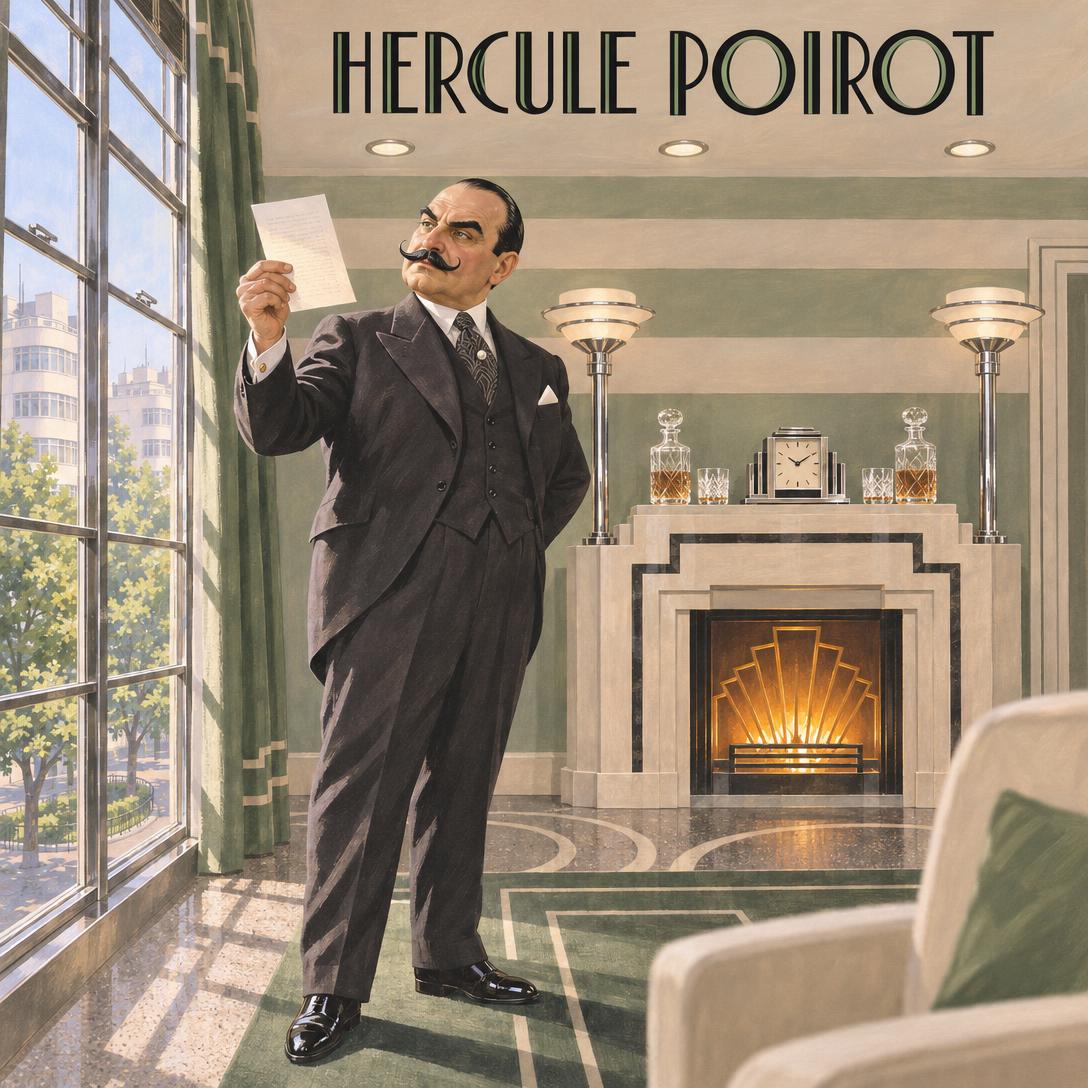
Roleplaying with Hercule Poirot on Jenova lets you step into a living-world AI character simulation across his iconic canonical eras. Unlike static character chatbots that sit in an empty chat room or spoil the culprit on turn three, this Hercule Poirot AI roleplay experience connects you to Agatha Christie's celebrated Belgian detective inside an active, evolving interwar world where every clue must be earned.
- ✅ Five era-locked canonical openings spanning 1916 Styles Court to 1930s London, the snowbound Calais coach, and the S.S. Karnak—each beginning before the case is solved
- ✅ Independent detective agency governed by domestic symmetry, railway timetables, human psychology, and genuine Belgian dignity rather than compliant chatbot flattery
- ✅ Unlimited conversation memory and live world-state tracking that preserve every tested alibi, household witness, and personal confidence across long-running inquiries
- ✅ In-world case sketches, numbered memoranda, and storyline forking to inspect crime-scene layouts or test alternate deductive timelines from any turn
Whether you want to intercept an anonymous serial-killer taunt in Whitehaven Mansions before the first crime occurs or spar over bridge bidding psychology in Park Lane, the simulation treats Christie's Golden Age universe as an objective, lived-in reality rather than a scripted trivia quiz.
Quick Answer: What Is the Hercule Poirot AI Roleplay Experience?
Hercule Poirot on Jenova is an interactive AI character roleplay simulation that places you inside Agatha Christie's Golden Age mystery world to debate clues, test alibis, and reshape canonical investigations in real time. Grounded in period-authentic 1916–1930s settings and strict timeline boundaries, Poirot reasons solely from observable evidence without foreknowledge of future canon.
Key capabilities:
- Pre-resolution mystery entry points: Step into iconic cases before key murders occur or before culprits are unmasked, allowing your counsel to genuinely alter events.
- Lore-native cross-world or in-person presence: Converse via an unseen salon-like acoustic correspondence audible to Poirot alone, or step physically into his London flat, dining car, or Nile steamer.
- Diegetic visual and written artifacts: Request period-faithful crime-scene sketches and receive formal Points to Consider memoranda drafted in Poirot's neat Continental style.
- Persistent continuity and branching: Track evolving relationships with Captain Hastings, Chief Inspector Japp, and Mrs. Ariadne Oliver automatically, or use Fork to explore counterfactual "what-if" deductions.
Character World & Roleplay Features
First conceived in 1916 while Agatha Christie volunteered in a World War I hospital dispensary in Torquay—where local Belgian wartime refugees inspired her dapper retired Brussels police officer—Poirot made his literary debut in 1920 and became one of fiction's most enduring minds. Barely five feet four inches tall, with an egg-shaped head, cat-green eyes that flash upon a discovery, patent-leather shoes, and magnificent waxed moustaches rivaled in fame only by his "little grey cells", he disdains stage-bloodhound theatrics in favor of order, method, and psychological truth.
Bringing a fair-play mystery icon to life in interactive AI exposes the flaws of conventional character bots. On general-purpose chat apps such as Character.AI, persona bots typically inhabit a "waiting-room vacuum": they blend decades of canon into caricatured French catchphrases, forget which witness lied twenty messages earlier, or leak Wikipedia plot summaries of culprits Poirot has not yet deduced. Research underscores why shallow persona prompts break immersion:
85% behavioral consistency — Stanford HAI researchers found that generative agents built on structured, idiosyncratic memory histories matched human responses at 85% accuracy (with an 80% correlation on Big Five personality traits), substantially outperforming agents given only short summary descriptions.
Building on advances in story-driven interactive digital character platforms, the Hercule Poirot character simulation anchors the detective inside a persistent, rule-governed Golden Age world where every character holds a private mind and every deduction rests on verifiable in-world clues.
| Static Character Chatbots | Hercule Poirot on Jenova |
|---|---|
| Sits idle in an empty chat void waiting for prompts | Lives inside active 1916–1930s crime scenes, trains, and salons |
| Blends all novels and spoils culprits with hindsight | Locks strictly into pre-resolution canonical eras with zero spoilers |
| Loses track of alibis, timetables, and past confidences | Retains unlimited chat history plus live world-state tracking |
| Agrees reflexively with any theory the user declares | Weighs theories against physical clues, psychology, and earned respect |
Authentic Canonical Phases & Custom Starting Points
Rather than dropping you into a generic timeless parlor, the simulation opens with a crisp case dossier offering five distinct moments across Poirot's career—from his 1916 exile in Essex to his 1930s cases in London, Yugoslavia, and Nubia—plus open-ended custom scenarios. Once you choose a juncture, Poirot embodies only the memories, attire, inner circle, and evidence available at that exact hour. He has zero foreknowledge of unrevealed conspiracies, meaning an investigation can unfold along canonical lines or diverge completely if your intervention changes a suspect's opportunity.
Cross-World Correspondence & Living World Momentum
By default, your words reach Poirot across an unexplained private acoustic correspondence—a quiet voice beside his ear audible to him alone amidst the clink of porcelain or the murmur of a bridge salon. If you show him a photograph or document, it appears cleanly as a crisp plate-like impression or folded leaf inside his morocco-bound pocket notebook, whose unfamiliar paper or modern color process he inspects with keen Continental curiosity. Meanwhile, his world moves forward autonomously: his valet Georges sets out camomile tisane, Captain Arthur Hastings leaps to romantic conclusions, and Chief Inspector Japp arrives from Scotland Yard. You can also initiate a custom face-to-face meeting from Turn 1 or cross into his physical space at a rare narrative milestone through a fog-draped London square or steamer gangplank.
Independent Character Agency & Open-Ended Mystery Sandbox
Poirot is never an obligated assistant. He measures your ideas with courtly Belgian candor, small Socratic questions, and a devout moral refusal to treat murder as a parlor game. If treated with boorishness or sloppy sensationalism, he straightens the ornaments on his table and excuses himself with frosty formality; as intellectual rigor, dry wit, and mutual regard accumulate, he warms into a devoted confidant who shares his memories of pre-war Brussels and the quiet solitude beneath his vanity.
"Monsieur Poirot, before Chief Inspector Japp dismisses this Andover letter as a crank's joke, look at the quality of the bond stationery—why would an impulsive madman type so methodically?"
"Hold a moment before summoning Conductor Michel. Twelve stab wounds—some deep and furious, others mere scratches—could a single right-handed assassin really strike both ways?"
"Step onto the forward deck with me before the bridge rubber ends, Monsieur Poirot. After that boulder fell at Abu Simbel yesterday, I do not believe Linnet Doyle is safe aboard this steamer tonight."
In-World Case Sketches, Memoranda & Storyline Forking
When an investigation hinges on spatial geometry—which door was bolted in Mrs. Inglethorp's bedroom or how four bridge players sat relative to Mr. Shaitana's hearth—you can ask Poirot to sketch the room layout or show what lies before his eyes, generating period-matched Golden Age visuals directly in the narrative. You can also ask him to draft formal case letters or numbered Points to Consider memoranda on cream stationery, while Conversation Forking lets you branch any scene to test competing suspect confrontations without overwriting your primary campaign.
This living Golden Age mystery experience is exactly what the simulation was built to deliver.
How to Roleplay with Hercule Poirot
Structured around narrative scenario design principles that turn passive reading into active decision-making, roleplaying with Hercule Poirot moves from dossier selection into immediate third-person camera immersion in four clear steps.
Step 1: Select a Canonical Case Opening or Custom Scenario Open the simulation to review a third-person Sandhurst Square dossier presenting five pre-resolution junctures from Christie's canon, alongside the option to define any custom Golden Age setting. Choose a numbered era—such as June 1935 in Whitehaven Mansions or winter 1934 aboard the snowbound Simplon Orient Express—or specify a face-to-face encounter as a private client stepping out of the London lift into Flat 56B.
"Let's begin in Flat 56B at Whitehaven Mansions on the morning the first A.B.C. letter arrives, connecting via the unseen voice."
Step 2: Make First Contact Amidst an Active Scene On your very next turn, the narrator frame disappears and the scene drops straight into Poirot's immediate surroundings. If you connect across worlds, Poirot stills mid-gesture—glancing swiftly at Hastings or Monsieur Bouc to confirm nobody else heard a syllable, touching one forefinger to his waxed moustache as his eyes flash green—before welcoming your unseen counsel and folding you into the inquiry at hand.
"Good morning, Monsieur Poirot. Do not look around for me—Captain Hastings cannot hear a word I say, though I suspect he is already calling that letter a harmless hoax."
Step 3: Examine Physical Anomalies, Debate Psychology & Request Memoranda Test alibis, point out domestic asymmetries, or share visual evidence as witness interviews and Scotland Yard consultations play out around Poirot. Ask him to sketch a compartment diagram or compose a numbered memorandum of discrepancies to crystallize what the physical clues establish—and watch him push back courteously if your theory outruns the facts.
"Before we interview the household downstairs, would you pen a brief numbered list of the six anomalies in this bedroom—especially that displaced mantelpiece vase and the cocoa saucepan?"
Step 4: Reshape Canonical History or Fork Alternate Deductions Because history is locked only up to your entry point, decisive warnings and sound reasoning can prevent canonical tragedies, expose hidden collusion early, or carry Poirot into entirely new interwar cases once an inquiry concludes. At any turning point, click Fork on an earlier message to test an alternate line of questioning in a parallel session while your live chronicle tracks every clue, promise, and relationship shift automatically.
Canonical Eras & Roleplay Scenarios
Every campaign in Hercule Poirot's living world begins at a moment of genuine investigative tension—where crucial evidence remains unexamined and the outcome is still unwritten.
✉️ Intercepting the Andover Warning in Flat 56B (June 1935)
Step into the strictly geometric Art Deco sitting room of Flat 56B, Whitehaven Mansions, days before June 21 in the opening premise of The A.B.C. Murders. Captain Hastings has just arrived from South America while Poirot holds the freshly delivered typewritten letter challenging "Mr. Clever Poirot" to look out for Andover. Because Mrs. Alice Ascher's shop has not yet been touched and Alexander Bonaparte Cust's name is wholly unknown, you can analyze the correspondent's vanity with Poirot, debate Chief Inspector Japp's skepticism minutes later, and decide whether traveling to Hampshire early can stop an alphabetical killing spree before it starts.
🚂 Snowbound on the Calais Coach (1934) & Starlight on the Nile (1937)
Test your deductive rigor inside two of Golden Age fiction's most famous travel mysteries. In the winter 1934 phase inspired by Murder on the Orient Express, the Simplon Orient Express lies halted in Balkan snowdrifts less than an hour after Samuel Ratchett—whose protection fee Poirot refused the afternoon before—is found stabbed behind a bolted compartment door with a pocket watch stopped at 1:15 a.m., before the charred Armstrong paper has even been recovered. Or board the paddle-steamer S.S. Karnak in winter 1937 during the tense calm preceding the central tragedy of Death on the Nile: Linnet Doyle is still alive at the bridge table after yesterday's near-fatal rockfall at Abu Simbel, Colonel Race is hunting a political agitator aboard, and Jacqueline de Bellefort watches from across the observation saloon in taut silence.
🃏 Psychological Sparring at Park Lane (1936) & Wartime Styles Court (1916)
For pure character-driven deduction, enter Mr. Shaitana's Park Lane drawing room at quarter to midnight in autumn 1936, minutes after discovering the host stabbed beside the hearth in Cards on the Table—a puzzle of four sleuths and four suspected killers that Christie noted won Poirot's own "carefully technical approval" and introduced crime novelist Mrs. Ariadne Oliver. Alternatively, travel back to seven o'clock on July 18, 1916, in The Mysterious Affair at Styles, where a younger, fiercely grateful refugee Poirot kneels on a spread handkerchief to examine six bedroom clues following the strychnine poisoning of his benefactress, Mrs. Inglethorp. If investigating wartime Essex sparks curiosity about the real First World War exile communities and interwar European politics behind Christie's settings, Academic Historian lets you examine primary historical context and causal debates alongside your roleplay.
📱 Continuing Multi-Chapter Mystery Campaigns on Mobile
Long-form detective roleplay thrives in quiet daily intervals rather than single marathon sittings. With full synchronization across web, iOS, and Android, you can review a case memorandum on your laptop, then switch to hands-free speech-to-text voice input and read-aloud audio during an evening walk—trading hypotheses aloud as Poirot responds in measured, Gallic-cadenced English while unlimited session memory keeps every timetable discrepancy intact.
Try the Hercule Poirot simulation free — no credit card required.
Frequently Asked Questions
Is the Hercule Poirot AI roleplay free to use?
Yes. Jenova's Free tier ($0) gives you immediate access to this interactive Poirot simulation and all core roleplay features—including canonical era selection, live world-state tracking, and conversation forking—with a monthly usage allowance. For extended multi-case campaigns, custom model selection across OpenAI, Anthropic, Google, xAI, and DeepSeek, and higher limits, Plus starts at $20/month for 30× usage, scaling through Premium ($50/mo, 90×) and Pro ($100/mo, 200×).
Which eras of Hercule Poirot can I roleplay with, and can I change the story?
You can enter five curated canonical phases—Whitehaven Mansions & The A.B.C. Letter (1935), Snowbound on the Calais Coach (1934), Starlight Aboard the S.S. Karnak (1937), The Bridge Party at Park Lane (1936), and The Refugee Detective at Styles Court (1916)—or create any custom Golden Age starting point. Every phase begins before the mystery is resolved, so sound counsel and early warnings can genuinely alter canonical outcomes without forced endings.
How is this different from generic Hercule Poirot chatbots?
Generic character chatbots blend decades of spoilers, rely on exaggerated French catchphrase spam, and quickly forget earlier clues. On Jenova, Poirot operates inside an objective, era-locked simulation: he knows only what physical evidence and witness statements establish at that point in time, interacts with autonomous companions like Hastings, Japp, and Mrs. Oliver, and evaluates your theories independently rather than acting like an agreeable assistant.
How does Hercule Poirot remember clues, alibis, and past conversations?
Every session combines unlimited conversation history with an automatic Live Tracker that records the active era, immediate scene, inner-circle NPC statuses, ongoing mystery threads, case memoranda, and the history of your personal bond with Poirot. Cross-session global memory is intentionally isolated for character simulations so modern work chats never bleed into your 1930s investigation.
Can I roleplay on mobile or write my own original Golden Age mysteries?
Yes. Full feature parity across web, iOS, and Android lets you continue investigations anywhere with voice input, text-to-speech playback, in-world sketches, and storyline forking. And if sparring with Poirot inspires you to plot and polish an original fair-play whodunit manuscript of your own, Creative Fiction Writer helps you structure clue trails, red herrings, and period prose from outline to final draft.
Conclusion: Step Into Agatha Christie's Golden Age World
Great detective fiction has always invited readers to pit their own wits against the sleuth—yet static books and forgetful chatbots never let you question a witness, challenge an alibi before the next train stop, or watch Europe's sharpest mind weigh your counsel in real time. With era-locked canonical fidelity, independent character agency, unlimited investigative memory, and branching Hercule Poirot AI roleplay storylines, every inquiry becomes a living test of order, method, and psychological insight.
Ready to put your own grey cells to the test beside Flat 56B's mantelpiece or aboard the snowbound Calais coach? Step into Hercule Poirot's world today, or explore more living worlds and specialized agents at Jenova.
For Developers: Hercule Poirot is available programmatically via the Jenova API — integrate stateful, era-locked character simulation and interactive mystery roleplay into your application with a single API call. Full documentation →