AI Heist Game: Plan, Infiltrate & Escape With an AI Game Master
2026-10-16
Roleplay Game Master turns any score you can imagine into a playable AI heist game. You can case a museum gala, crack a casino vault, or lift one overpriced pint from a pub manager's office. If you're searching for an AI heist game in October 2026, this is the format with no level boundaries. Instead of following a scripted map, you describe the target, assemble a crew, and draw up the plan. The AI then plays every guard, fixer, and mark, and they react to what you actually do. Scripted heists eventually run out of surprises. This AI tracks your choices with unlimited memory, so a burned contact or a tripped alarm still matters three sessions later.
- ✅ Runs any heist you can describe, from bank vaults and art galas to cyberpunk data vaults
- ✅ Unlimited memory keeps your crew, gathered intel, and rising heat consistent across sessions
- ✅ Guards, fixers, and marks stay in character instead of resetting between scenes
- ✅ Play on web, iOS, or Android, with voice input for hands-free scheming
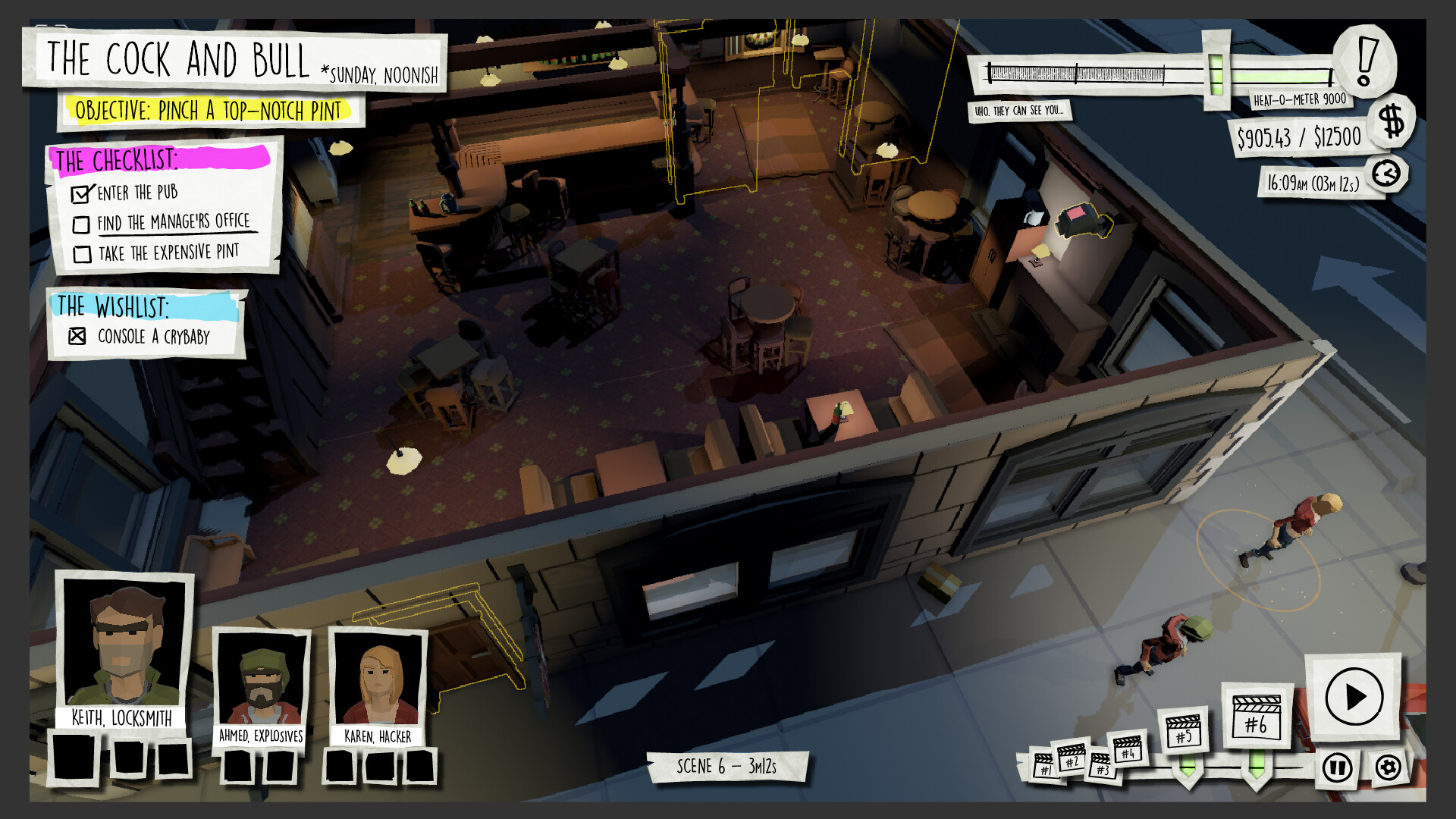
Planning screens like the one above capture what players love about the genre. You get a floor plan, a checklist, a crew of specialists, and a heat meter that punishes sloppiness. The limit is that a planning screen can only offer the options its designers built in. To see why an AI-run heist feels different, it helps to look at where traditional heist games hit their ceiling.
Quick Answer: What Is an AI Heist Game?
An AI heist game is an interactive crime-caper experience where an AI game master generates the target, plays every character, and adapts security, complications, and consequences to your crew's plan in real time. You don't pick from preset routes. You improvise in plain language.
Key capabilities:
- Custom targets and settings, including noir 1940s banks, modern casinos, and orbital stations
- Reactive NPCs whose suspicion, loyalty, and bribability depend on your earlier actions
- Persistent campaign memory covering crew roster, cased intel, stolen loot, and enemies made
- Open-ended solutions, so you can talk past a guard, forge a work order, or cause a distraction instead of picking the "correct" door
The Problem: Scripted Heists Run Out of Surprises
Game studios are investing heavily in AI. Most of that investment goes into production tools, though, and very little into the moment-to-moment improvisation that makes a heist feel alive.
36% — Share of surveyed game developers who say their studio uses AI for game development in some form, per Statista data on generative AI adoption in 2025
$51.2 billion — Projected size of the AI in gaming market by 2033, with an expected 36.1% growth rate between 2025 and 2033, as summarized by Coursera's overview of AI in game development
Game AI researchers have long identified the core tension. The proceedings of AAAI's Challenges in Game AI workshop include work titled "Mediating the Tension between Plot and Interaction" and "Symbolic Representation of Game World State: Toward Real-Time Planning in Games." That tension sits at the center of every heist. The designer wants a tight, dramatic job, and the player wants to do something nobody planned for.
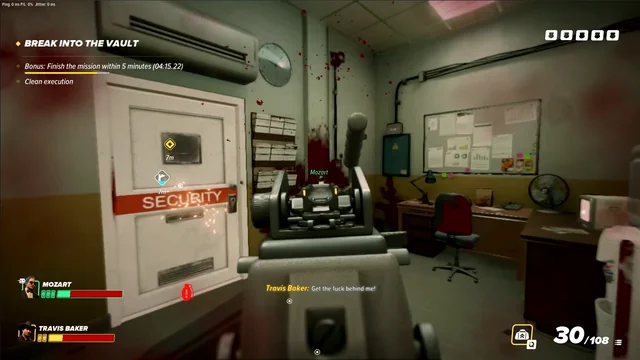
But getting a heist that truly responds to your plan is frustratingly difficult:
- Fixed maps and scripted patrols. Once you've memorized the guard rotation and keycard locations, the "plan" becomes muscle memory.
- Bot crewmates with predefined behavior. AI teammates in co-op heist shooters follow designed routines. They can't contribute an idea or adapt to a creative plan.
- Limited verbs. You can only do what the interface allows. Usually that means shooting, drilling, or hacking a highlighted object, not bluffing your way in as a fire inspector.
- Scheduling a full crew. The best moments in co-op heists usually need three friends online at the same time.
This is exactly the gap an AI game master was built to fill.
Why Roleplay Game Master Works as an AI Heist Game
Roleplay Game Master is an immersive roleplay engine with unlimited memory, consistent characters, and complete creative freedom over the scenario. For heist fans, that means a game master who never runs out of floors to add to the building and never forgets which guard you bribed.
Industry analysis notes that AI can improve player experience by enabling adaptive gameplay, more realistic NPC behavior, personalized challenges, and dynamic environments. A text-driven heist gets all four without waiting for a studio to ship a new map.
| Traditional Heist Game | Roleplay Game Master |
|---|---|
| Handful of handcrafted maps | Any target, era, or setting you describe |
| Guards follow scripted patrol loops | Guards react to noise, disguises, and conversations |
| Crew bots execute preset actions | Crew members have personalities, skills, and opinions |
| Progress resets each mission | Unlimited memory carries heat, loot, and grudges forward |
| Needs a full online squad | Play solo anytime, or narrate for friends at the table |
Build Any Crew, Hit Any Target
Pitch a job in a sentence and the AI builds out the world. It populates the target with security layers, insiders, and complications. You can recruit a locksmith, a hacker, and a demolitions expert, or a con artist and a retired cat burglar with a gambling problem.
"Set up a heist on a private art auction in Monaco. I'm the planner. Give me three crew candidates with strengths and one fatal flaw each."
NPCs That Remember and React
Character consistency matters more in heists than in almost any other genre. The night manager you charmed during casing should recognize you on the night of the job. The fence you shorted should raise their prices. Because the AI holds the full history, social engineering becomes a real strategic layer rather than a dialogue tree.
Plans That Can Break Beautifully
Every great heist story turns on the moment the plan goes sideways. The AI introduces complications that grow out of your choices: a shift change you didn't scout, a crew member who panics, an alarm system upgraded after your last job in the same city. You improvise, and the story keeps going instead of ending in a mission-failed screen.
"The vault timer just reset early. Our hacker is still in the van. What does the guard at the elevator see right now?"
Campaigns That Span Weeks
Unlimited memory turns one-off jobs into a criminal career. Your crew's reputation, safehouses, and accumulated heat persist. That makes it possible to run a long con across many sessions, the kind of slow-burn campaign that scripted games rarely support.
Related Agents You'll Also Find Useful
If your heist sessions leave you wanting more tension, mystery, or the urge to build your own game, these agents fit naturally alongside them.
The Mansion
You wake in a mansion with no memory of how you arrived, and every room hides secrets. It's a strong pick if your favorite part of a heist is reading a building room by room.
- Room-by-room exploration with hidden secrets
- Survival stakes, since every shadow could be your last
- A clear escape goal that rewards careful observation
The Asylum
You play an investigator sent into a shuttered psychiatric institution where something has gone wrong. If you enjoy casing a location and piecing together intel, this investigation game uses those same muscles.
- Ward-by-ward investigation of a hidden story
- Atmospheric, suspense-driven pacing
- Discovery-driven progression instead of combat
Game Designer Assistant
If you're also working on a heist game of your own, whether a tabletop module, an indie stealth title, or a level for a mod, this design partner covers brainstorming, systems analysis, and documentation.
- Systems analysis for mechanics like heat meters and alarm escalation
- Design documentation and concept art support
- Genre and market expertise across platforms
Try it free with no credit card required.
How to Play an AI Heist Game: Step by Step
Step 1: Pitch the Score
Open the AI game master and describe the target, setting, and tone. Be as specific or as loose as you like. The AI fills in the gaps with security, staff, and opportunities.
"1970s London. A gentleman's club with a private vault in the basement. Tone: Ocean's Eleven meets Guy Ritchie."
Step 2: Assemble Your Crew
Ask for crew candidates or bring your own. Give each member a specialty and a weakness so the plan has natural pressure points.
"I want a locksmith, a hacker, and an inside person who works the coat check. Make one of them secretly in debt to a rival gang."
Step 3: Case the Target and Lock the Plan
Run reconnaissance scenes. Pose as a delivery driver, chat up staff, and count cameras. Then lay out your plan step by step and ask the AI to summarize the risks.
"Recap everything we learned while casing. Then list the three weakest points in my plan."
Step 4: Execute and Improvise
Play the job beat by beat. Guards respond to what you actually say and do, and complications grow out of your choices. When something breaks, you adapt in plain language.
"Our inside person signals that a second guard just arrived. I tell the locksmith to keep working and walk out to stall him with a lost-wallet story."
Step 5: Carry the Fallout Forward
After the score, split the take, deal with loose ends, and pick your next target. The AI remembers who saw your face, which contacts you burned, and how hot your crew is. Your next job starts with real consequences.
Results & Use Cases
🎯 The Solo Long Con
Scenario: A player wants a multi-session campaign that starts with petty grifts and builds toward a museum's crown jewel.
Traditional Approach: Buy several heist titles and replay their fixed missions. None of them share continuity.
With an AI game master: A single campaign where each small job earns contacts, cash, and intel that unlock the final score.
- Persistent reputation and heat across sessions
- NPCs who remember earlier encounters
- A finale shaped by every earlier decision
👥 Tabletop-Style Game Night
Scenario: Four friends want a heist night but don't have a human game master willing to prep for hours.
Traditional Approach: One person spends an evening writing a module, then improvises when players go off-script.
With an AI game master: One host types the group's decisions while the AI narrates, plays every NPC, and handles complications instantly.
- Zero prep time for the host
- Every player's wild idea gets a real response
- Scenes can be reread aloud for dramatic reveals
📱 The Commute Caper
Scenario: A player has 15 minutes on the train and wants a quick, self-contained job.
Traditional Approach: Heist shooters need a console or PC, a stable connection, and usually a squad.
With an AI game master on mobile: Pitch a pint-sized score, such as lifting a rare bottle from a pub's back office, and finish it before your stop, using voice input when typing isn't convenient.
- Works on iOS and Android with the same experience as web
- Pick up the campaign later exactly where you left off
- No squad or matchmaking required
✍️ Prototyping a Heist Level
Scenario: An indie developer wants to stress-test a heist level concept before building it.
Traditional Approach: Build a greybox, recruit playtesters, and iterate over weeks.
With an AI game master: Describe the level's layout and security, then play through it to see which routes and exploits players might find. Pair the session with the design assistant mentioned above to document the systems.
- Fast discovery of unintended solutions
- Narrative playtesting before any code exists
- A clear list of balancing questions for the real build
Frequently Asked Questions
What is the best AI heist game?
It depends on what you want from the genre. For action, co-op shooting, and polished visuals, traditional heist titles deliver. For open-ended planning, social engineering, and consequences that persist, a text-based AI game master offers something scripted games can't: any target, any approach, and NPCs that react to your specific plan. Many players enjoy both, using shooters for adrenaline and AI-run heists for strategy and story.
Is Roleplay Game Master free to play?
Yes. You can start on the free tier, which includes core features with limited usage. Heavier players can upgrade to paid plans starting at $20/month for the Plus tier, which offers 30× the free usage and custom model selection. Higher tiers add more capacity. Usage resets monthly, with the full allowance available from day one. Start a free heist session here.
Can an AI heist game remember my crew between sessions?
Yes, provided the AI supports long-term memory. An AI game master with unlimited memory keeps track of your crew roster, their personalities, the intel you gathered, the loot you split, and the enemies you made. That continuity turns one-off jobs into a full criminal campaign where earlier decisions shape later scores.
How is an AI heist game different from shooters like Payday 3?
Heist shooters focus on real-time action across handcrafted maps with defined objectives, such as breaking into a vault under a time bonus. An AI heist game focuses on planning and improvisation. You can attempt any approach you can describe, and the world responds. AI-driven play has trade-offs, and analysts point to challenges around performance, fairness, transparency, and creative control. It complements action games rather than replacing them.
Can I design my own heist game with AI?
Yes. Beyond playing heists, you can use AI to design them. The Game Designer Assistant helps with brainstorming, systems analysis, and documentation for mechanics like alarm escalation and crew skill trees. It suits tabletop modules, indie stealth games, and level concepts you want to playtest narratively before building.
Does an AI heist game work on mobile?
Yes. A text-based AI heist game runs anywhere you can chat. Roleplay Game Master works on web, iOS, and Android with the same features on each, and your campaign syncs across devices. Speech-to-text lets you dictate commands like "stall the guard while the locksmith works" when typing is inconvenient.
Conclusion: Every Score, Your Way
Traditional heist games deliver great moments, but they're bound by fixed maps, scripted patrols, and crewmates who can't think. As outlets like MIT Technology Review have explored, generative AI is reshaping what it means to play, especially through more immersive characters. An AI heist game puts that shift in your hands right now. You choose the target and the crew, the plan breaks in ways that make sense, and the consequences follow you into the next job.
Whether you want a solo long con, a zero-prep game night, or a quick caper on your commute, an AI-run crime caper adapts to how you like to scheme.
Try Roleplay Game Master now and plan your first score. Explore more at Jenova.
For Developers: Roleplay Game Master is available programmatically via the Jenova API. Integrate adaptive, memory-driven interactive storytelling into your game or app with a single API call. Full documentation →