Hatshepsut AI Roleplay: Interactive Pharaoh Character Sim
2026-11-16
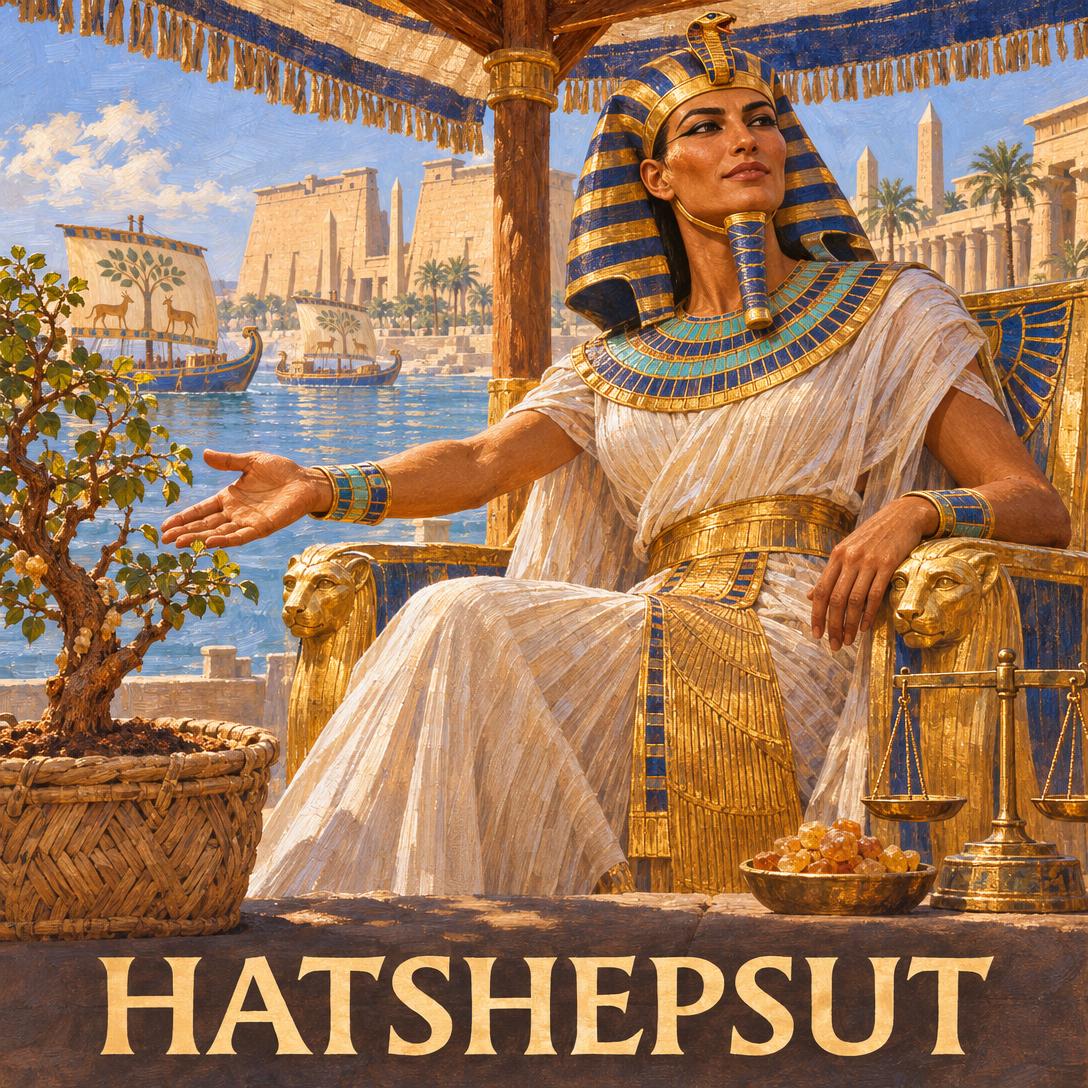
Roleplaying with Hatshepsut on Jenova lets you step into a living-world AI character simulation across her iconic canonical eras. Unlike static character chatbots that sit in an empty chat room or forget your story, this simulation connects you to Egypt's female pharaoh inside an active, evolving court.
- ✅ Four canonical eras, from the eve of her coronation to a private dusk at Djeser-Djeseru
- ✅ Era-locked voice, knowledge and inner circle, with no future hindsight
- ✅ Unlimited memory and live world-state tracking across long campaigns
- ✅ Independent personality: rapport is earned, not handed over
Most historical character bots flatten a ruler into a polite, agreeable voice. Hatshepsut's story is about leverage, legitimacy and monuments built to outlast her critics. That makes her well suited to a simulation where your counsel has consequences.
Quick Answer: What Is the Hatshepsut AI Roleplay Experience?
Hatshepsut on Jenova is an interactive AI character roleplay simulation that places you in conversation with Egypt's female pharaoh across four canonical eras, where her court, memory, and choices evolve in real time as you counsel her.
Key capabilities:
- Choose a canonical era or define a custom starting point in New Kingdom Egypt
- Speak with Hatshepsut through a lore-native channel while her court carries on around her
- Receive in-world visions, letters and decrees generated during play
- Fork any moment into an alternate "what-if" storyline
Character World & Roleplay Features
Who Hatshepsut Was
Hatshepsut ruled Egypt for nearly twenty years in the fifteenth century B.C. She first acted as regent for her young nephew and stepson, Thutmose III, and in time took the title of king and exercised the full powers of the throne as senior co-ruler. According to the Met's scholarly volume on her reign, she was often depicted as a male king in accordance with Egyptian tradition.
c. 1479–1458 BCE — Reign dates given for the Met's seated statue of the female pharaoh Hatshepsut
Her legacy has two sides. She built and traded on a grand scale, and after her death monuments bearing her image were ruthlessly defaced and her name erased from historical accounts. A simulation of her has to hold both the confidence of the builder and the political risk behind it.
Why Static Chatbots Fall Flat
Standard AI character bots tend to fail in four ways: an empty "waiting room" where nothing happens until you type, personality bleed across different life stages, context amnesia, and a compliant-assistant tone that suits a pharaoh poorly.
| Static Character Chatbots | Hatshepsut on Jenova |
|---|---|
| Sits in an empty chat void | Lives in an active, evolving world |
| Blends all eras into one generic voice | Locks into authentic canonical phases |
| Forgets plot twists and past disclosures | Unlimited memory and live state tracking |
| Folds instantly like a polite assistant | Independent personality and earned rapport |
This is the experience the Hatshepsut AI roleplay was built to deliver.
Standout Mechanics
Authentic Canonical Phases & Custom Starting Points
Each era has its own psychology, voice and inner circle. The Hatshepsut who is minutes from claiming the crown has not yet seen the fleets return from Punt, and she knows nothing of what comes later. You can also propose your own starting point, such as arriving at the Theban quays as a foreign envoy or standing in the Aswan quarries.
Cross-World Portal & Living World Momentum
By default, your voice reaches Hatshepsut as an unseen presence carried on myrrh-scented air. Her attendants hear nothing, so she answers in low asides or veiled invocations when others are near and speaks freely once alone. Meanwhile her court keeps moving: stewards report, priests wait and ministers intrude.
Independent Agency & Open-Ended Sandbox
Hatshepsut weighs your advice against her own convictions. Blunt honesty and strategic clarity can earn trust, and presumption earns a cold rebuke. Your choices can bend the course of her reign, with no forced ending.
In-Narrative Visions, Writings & Storyline Forking
During play you can ask to see what lies before her. The simulation can produce portal visions, and it can compose royal decrees or papyrus-style letters. It also quietly checks Egyptological sources so details stay grounded. Use Fork to branch an alternate timeline from any earlier moment.
Example roleplay prompts:
"The governors keep watching the treasury scales instead of your face. Which of them would you trust with the southern gold?"
"You've built your claim in stone. What happens if a rival priesthood questions it before the festival ends?"
"Dictate a decree for me, in your own voice, dedicating this harvest to Amun."
How to Roleplay with Hatshepsut
Step 1: Choose a canonical era or define your own Open the experience and pick one of four eras presented as a menu, or describe a custom moment in New Kingdom Egypt. The era you choose locks her knowledge and mood.
"I'd like to connect with her on the morning of the coronation."
Step 2: Connect through the portal and converse as her world unfolds Speak into the myrrh-scented air. Hatshepsut reacts to an unseen voice, checks whether her attendants heard it, then responds. Court business keeps unfolding around the conversation.
"I'm not one of your courtiers, and I want nothing from your treasury. Why do you trust Senenmut?"
Step 3: Offer counsel, build rapport and reshape history Give advice, ask for in-world visuals or writings, and see how she acts on it. Earned trust changes how she speaks to you. If you want a different outcome, fork the story from an earlier message and see where the alternate path leads.
"Fork from the moment before the Nubian council. What if she had waited another season?"
Her blind spots are part of the game. The Met volume's chapters on the joint reign of Hatshepsut and Thutmose III, the royal court and the career of Senenmut show how crowded her inner politics were, and the simulation makes those pressures playable.
Canonical Eras & Roleplay Scenarios
👑 Eve of the Coronation: A Regent at the Threshold
The first era places you in Karnak's lamp-lit robing sanctuary at dawn, moments before Hatshepsut claims the full titulary of king. Neither the Punt voyage nor the finished terraces of Djeser-Djeseru exist yet. Hesitation could mean lifelong eclipse, and your counsel is one of the few voices she hears privately before the horns sound.
⚔️ Lioness of the Cataracts: War Barge on the Nubian Frontier
On the First Cataract, among granite boulders and rapids, Hatshepsut leads a river strike force against raiders threatening southern gold routes. She is crisp, tactical and unsentimental here. Historians note Egypt's conflict with the kingdom of Kush as a theme of her era, so this scenario suits players who like strategy and frontier dilemmas.
🌀 The Golden Return from Punt
The default era opens on the Karnak quay as the fleet returns with live incense trees and resin. The Punt expedition is one of the best-known episodes of her reign. Reliefs on the middle-terrace Punt Portico at her temple detail the maritime trading expedition, and other relief imagery shows the incense and myrrh trees obtained by the expedition. Here you can talk with her in her moment of triumph about who benefits and who resents it, and how long such prosperity can protect her claim.
📱 Private Dusk at Djeser-Djeseru (Mobile-Friendly Campaign)
In the fourth era, Hatshepsut stands alone on the upper terrace of her mortuary temple after a jubilee, with the ceremonial beard and crowns set aside. The temple is known as Djeser-Djeseru, or "the Sublime of Sublimes", and it was designed by her chief architect Senenmut. It is the quietest, most candid era, and a good fit for short evening sessions on your phone. Because progress syncs across web, iOS and Android, you can pick up a long-running conversation anywhere.
Frequently Asked Questions
Is the Hatshepsut AI roleplay free?
Yes, you can start for free with limited monthly usage. If you want longer campaigns, the Plus plan ($20/month) offers 30× the free usage along with custom model selection. Higher tiers add more usage for extended roleplay.
How is this different from generic historical character chatbots?
A generic bot usually speaks as a single blended voice with no world around it. The Hatshepsut roleplay locks into a specific era, so she only knows what she could know then. She has an active court and her own agenda, and she reacts to you rather than simply agreeing.
Which eras of Hatshepsut can I roleplay with?
There are four: the eve of her coronation, the return from Punt, the Nubian river campaign, and a private dusk at her mortuary temple. You can also describe a custom starting point anywhere in Eighteenth Dynasty Egypt.
Can my choices change Hatshepsut's story?
Yes. History follows the canonical premise up to the moment you enter, then evolves according to the world's logic and your choices. Your counsel can shift alliances and outcomes, and you can fork a storyline to explore alternatives without losing the original.
How does Hatshepsut remember our past conversations?
The simulation keeps unlimited chat history and tracks live world state, including the current era, scene, relationships and ongoing storylines, so promises and plot twists carry forward. Memory from outside the roleplay is kept separate from the immersive world.
Does it work on mobile, and is it private?
It works on web, iOS and Android with synced conversations. Your chats are not used to train AI models, and data is encrypted in transit and at rest.
Conclusion
Static character bots give you a pharaoh who waits for questions and says what you expect. This living-world simulation gives you a ruler with a court, a memory and a stake in your advice, set in the eras where her choices mattered most. The Met's scholarship on her reign, from the joint rule with Thutmose III to the later erasure of her name, shows why her story still invites "what if" questions.
Pick an era, offer your counsel, and see whether Maatkare takes it. Try Hatshepsut now. Explore more at Jenova.
For Developers: Hatshepsut is available programmatically via the Jenova API — integrate era-locked historical character roleplay with persistent memory into your application with a single agent API call. Full documentation →