AI Hat Designer: Caps, Fedoras & Fascinators From Sketch to Tech Pack
2026-10-06
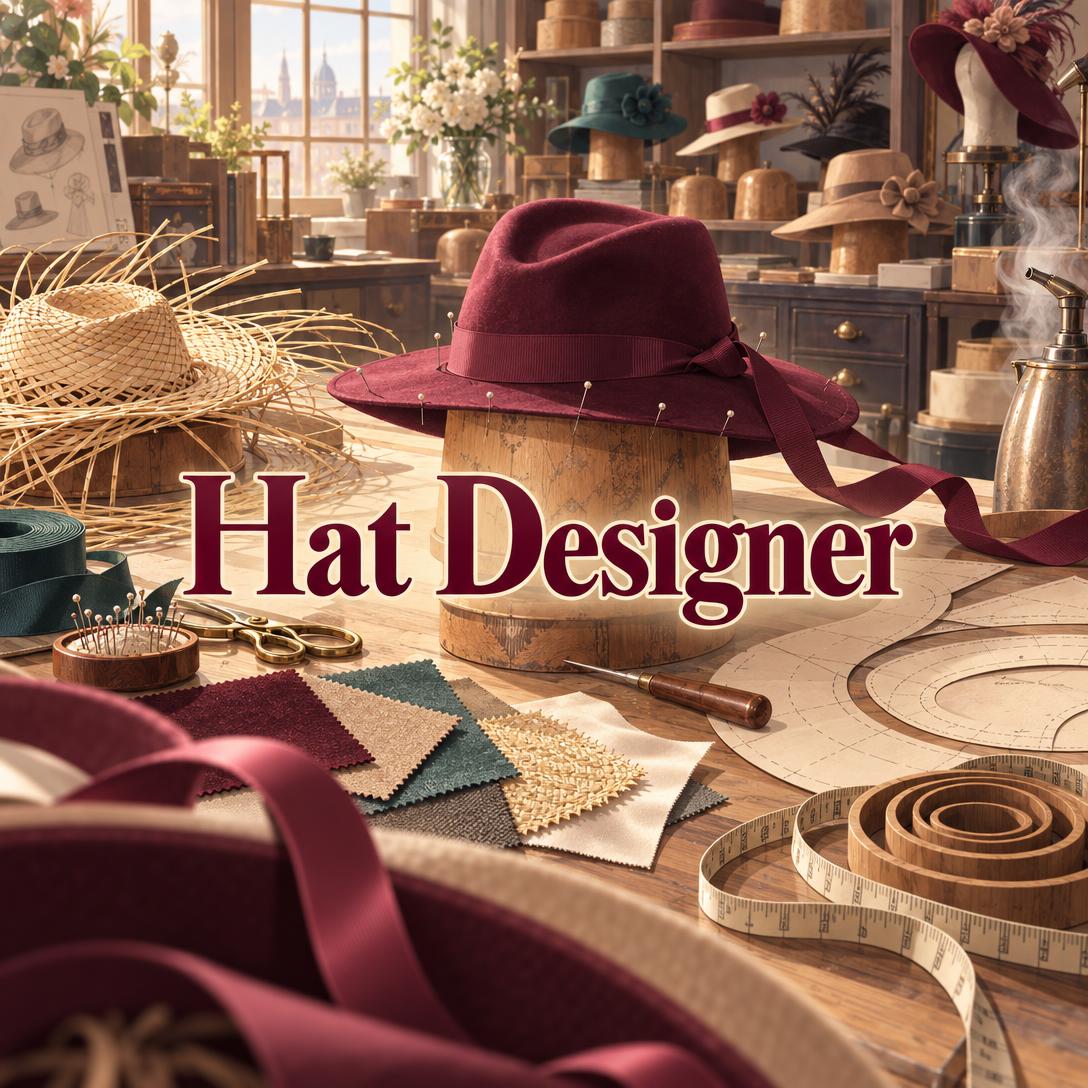
Hat Designer helps you design headwear by combining visual concept generation with millinery and production expertise in one conversation. It covers structured snapbacks, hand-blocked felt fedoras, and sculptural fascinators. Hat design sits awkwardly between fashion and engineering, so good ideas often stall before they become wearable products. This AI hat designer connects the two: it sketches the look, explains the construction, and helps you plan how the hat gets made.
- ✅ Generates hat concepts from a single description or reference photo
- ✅ Advises on crown shape, brim behavior, materials, and stiffening methods
- ✅ Guides fit using face shape, proportion, and US/UK/metric sizing systems
- ✅ Supports brand building with tech pack planning, MOQ context, and collection structure
Most people can picture the hat they want. Fewer can explain why a 3-inch wired brim behaves differently from a stiffened one, or what a factory needs on a spec sheet. To understand why that gap matters, let's look at what designers, brand founders, and occasion-hat buyers run into today.
Quick Answer: What Is Hat Designer?
Hat Designer is an AI headwear design partner that turns your ideas into visual hat concepts. It pairs those concepts with construction, material, fit, and production guidance, so you can move from inspiration to a manufacturable design in one conversation.
Key capabilities:
- Visual concept generation for caps, brimmed hats, knits, and millinery
- Material and construction advice, from twill weights to fur felt to sinamay
- Fit and proportion guidance based on face shape, frame, and complexion
- Brand, collection, and tech pack planning for headwear lines
The Creative Challenges of Designing Hats
Hats are small objects with many decisions packed into them. A single cap involves panel count, crown profile, foam-front structure, closure type, sweatband material, and decoration method. A felt fedora depends on block selection, steaming tolerance, shellac or sizing, and brim finishing. Each choice affects how the hat looks, how it sits, and what it costs.
The commercial side has also become harder to get right. Buyers now notice quality quickly:
$10 vs. $30 — In 2026, the difference between a budget cap and a premium cap is "no longer branding—it's construction"
Turning an idea into a hat is still frustratingly difficult:
- The vocabulary barrier. Factories and milliners work in terms like "pre-curved brim," "6-panel structured," and "bound edge." Without that language, a brief often produces the wrong sample.
- Expensive guesswork. Industry commentary notes that MOQ is often the deciding factor between launching a product and abandoning the idea. A wrong trend call can leave brands sitting on thousands of unsold units.
- Material confusion. Sustainable options include organic cotton, rPET, recycled nylon, hemp, bamboo, and cork. Each one comes with its own certification standards such as GOTS and GRS and its own performance trade-offs.
- Fit uncertainty. A hat that looks good on a mannequin can overwhelm a petite frame or shorten an already round face.
Why Hat Designer Works for Every Kind of Headwear
This AI headwear partner covers the whole path from creative direction to technical specification. It acts like an experienced milliner, a commercial cap designer, and a production advisor in one. It holds strong opinions, explains the reasons behind construction choices, and generates designs as soon as it has enough direction.
| Traditional Approach | Hat Designer |
|---|---|
| Sketch by hand or hire an illustrator before seeing a concept | Generate product-photograph-style concepts from one description |
| Learn construction terms through trial, error, and rejected samples | Get crown, brim, closure, and interior recommendations with the reasoning behind them |
| Research materials across scattered supplier blogs | Compare felt, straw, knit, technical, and millinery fabrics in context |
| Guess at fit from generic charts | Get proportion, face-shape, and color guidance for the wearer |
| Write spec sheets from scratch | Plan tech pack contents: views, dimensions, Pantone callouts, decoration placement |
🎨 Visual Concepts That Reflect Real Construction
Concepts are built from specific hat anatomy, including crown shape, brim width, edge finish, and structure level. That makes them more useful than images produced from vague prompts. If one image generation model doesn't capture the look you want, you can switch to another, since models differ in style, quality, and speed.
🧵 Material and Finishing Expertise
The AI explains these choices in practical terms:
- Why fur felt holds shape better than wool felt
- How Panama straw is graded by weave tightness
- When gelatin sizing is a better choice than shellac
It also covers sustainable choices such as organic cotton and recycled polyester. That matters because eco-friendly hats are moving beyond capsule releases and becoming core product lines.
📐 Fit, Proportion, and Color
Fit guidance starts with general principles that the AI applies to the individual wearer:
- Brim width shouldn't exceed shoulder width.
- Round faces often benefit from vertical emphasis.
- Warm skin tones often pair well with earth tones.
These are starting points. Personal style always overrides the formula.
🏭 Production Realism
The AI walks you through the full pipeline: concept, tech pack, initial sample, counter sample, pre-production sample, and bulk. It also explains common cost drivers. MOQs and pricing vary by supplier, so it will always recommend getting direct quotes.
Example prompts:
"Design a 6-panel structured snapback in washed olive twill with a tonal 3D puff logo for a $40 retail price point"
"I need a fascinator for Royal Ascot to match a cobalt midi dress with a high neckline"
"Critique this fedora sketch. Is the crown too tall for a 2.5-inch brim?"
How It Works: Designing a Hat With AI Step by Step
Step 1: Describe the Hat and Its Context Start with what the hat is, who wears it, and where. "Unstructured dad cap for a coffee brand's merch table" points the design in a very different direction than "felt trilby for winter city wear."
"A wide-brim straw sun hat for a beach wedding guest, natural raffia, nothing too floppy"
Step 2: Share References or Brand Assets (Optional) You can upload an outfit photo, mood image, logo, or competitor hat. The AI pulls out the colors, aesthetic direction, and key details, then confirms them with you before building on them. You can also name a reference brand. It will adapt the feel without cloning the brand.
"Here's my logo and dress. Pull the palette and suggest a cocktail hat that coordinates without matching exactly"
Step 3: Review the Generated Concept Start designing with Hat Designer and you'll get a visual concept plus a short explanation of the silhouette, materials, and construction decisions behind it. If your brief is unclear, expect one targeted question at most before it generates.
"Show me this as a studio product shot, three-quarter angle, on a neutral background"
Step 4: Refine Proportions, Materials, and Details Iterate with specific changes, such as a narrower brim, a pinched crown, a leather sweatband, or chain-stitch embroidery instead of flat. The AI keeps everything else as it was and changes only what you ask for.
"Drop the crown about half an inch, switch the band to tonal grosgrain, and keep everything else"
Step 5: Plan Specs and Production Once a design is approved, map out the technical side. That includes tech pack contents, Pantone callouts, decoration placement, sizing in US, UK, and metric systems, and questions to ask suppliers. Remember that generated images are visual starting points, not production-ready patterns.
"Outline a tech pack for this cap and list what I should ask a domestic manufacturer about MOQs"
Try it free on the Free tier, with no credit card required.
Creative Showcase: What You Can Design
🧢 Launching a Streetwear Cap Line
Scenario: A first-time founder wants a three-style cap drop: a structured snapback, a dad cap, and a trucker, all under one minimal aesthetic.
Traditional Approach: Freelance design fees, back-and-forth with factories over unclear briefs, and the risk of committing to a large first order before testing demand.
Your headwear design partner: It builds a hero snapback first, then extends the same style direction to the dad cap and trucker. Each style gets construction recommendations, such as 8oz twill with a foam front for the snapback and an unstructured crown for the dad cap.
- Collection structure moves from hero piece to core styles to seasonal colorways
- Decoration options are explained, including 3D puff, tone-on-tone, and woven patches
- It aligns with the 2026 shift toward testing with smaller batches and scaling on demand
If you're still defining the brand itself, Brand Kit Generator can build out logos, palettes, and typography. Those assets then carry directly into your cap embroidery and labels.
👒 An Occasion Hat for Ascot, the Derby, or a Wedding
Scenario: A wedding guest needs a fascinator that suits a navy midi dress and a garden setting, and looks elegant rather than costume-like.
Traditional Approach: Browsing boutiques, guessing at scale and placement, or commissioning a milliner without a clear brief.
Hat Designer: It starts with the outfit, looking at color, neckline, silhouette, and formality. It then factors in dress-code conventions and practical issues like weather, event length, and photographs.
- Recommends base materials such as sinamay or buckram, along with suitable trims
- Advises on placement relative to your hair part and face shape
- Produces a visual brief you can take straight to a milliner
📱 Designing on the Go From a Supply Shop
Scenario: You're at a fabric or millinery supply shop holding a corduroy swatch, and you want to know whether it would work for a bucket hat.
Traditional Approach: Buy the yardage, go home, and find out later.
Hat Designer: Snap a photo on your phone, ask about wale width and weight, and get a quick concept of the finished hat before you buy. The web, iOS, and Android apps have the same features, and your conversation syncs across devices.
- Material suitability check while you're still in the shop
- Speech-to-text works well for describing ideas hands-free
- Trend context, such as the modern vintage direction of classics re-imagined
🎩 Critique for a Working Milliner
Scenario: An experienced milliner uploads a sketch of a homburg for a felt collection and wants peer-level feedback.
Traditional Approach: Waiting for feedback from colleagues or seeing problems only after blocking a sample.
Hat Designer: It points out what works first, then flags problems in priority order: wearability and proportion, then construction and materials, then aesthetic refinements. It can generate a revised version for comparison.
- Technical depth matched to professional vocabulary, without explaining basics
- Discusses block selection, steaming, and brim curl
- Considers color, including the earthy neutrals like beige and olive that are showing up across headwear
FAQ
Is Hat Designer free to use?
Yes. You can start on the Free tier, which includes all core features with limited usage. Paid plans start at $20/month for Plus, which offers 30× more usage, custom model selection, and no watermarks. Higher tiers suit heavier design or collection work. Usage resets monthly on your billing date, and there are no daily caps.
Can an AI hat designer create a tech pack for manufacturing?
It can plan and draft tech pack content. That includes front, back, and side views with dimensions, material callouts, Pantone colors, decoration placement, construction notes, and hardware specs. Generated concepts are visual starting points, not production-ready patterns. Always confirm specs, MOQs, and pricing directly with your manufacturer, because they vary by supplier.
How do I choose a hat that suits my face shape?
The AI uses proportion and face-shape principles as starting points. Round faces often suit angular shapes and medium-to-high crowns. Square faces often suit softer curves and wide brims. Oblong faces often suit low crowns. It also considers your frame and coloring. For styling the hat with the rest of your wardrobe, Fashion Consultant can evaluate full outfits.
How is Hat Designer different from a general AI image generator?
A general image generator produces images. Hat Designer reasons about the hat first: category, structure, crown and brim proportions, material, and embellishment. Only then does it create the image. It also explains construction choices, critiques uploaded designs, suggests fit adjustments, and supports production planning. That makes its concepts more useful for making real hats.
Can I use it to design hats to sell online?
Yes. It supports brand positioning, collection structure, colorway strategy, and sustainable material choices for a commercial headwear line. Once your designs are ready to list, Etsy Business Advisor can help with listing optimization, pricing, and competitor research for handmade and small-batch sellers.
Does Hat Designer work on mobile?
Yes. It works on web, iOS, and Android with the same features on each. You can upload photos of hats, swatches, or outfits from your phone, describe ideas with speech-to-text, and pick up the same conversation later on desktop.
Conclusion
Designing a hat used to require fluency in several fields at once: millinery construction, textile behavior, fit theory, and factory communication. Most ideas stalled somewhere between the sketch and the sample. Buyers now judge premium headwear by construction rather than logo, and small-batch production has made launching more accessible, so the cost of a vague brief has only grown.
An AI hat designer closes that gap. It handles the whole range, from a weekend fascinator to a full streetwear cap line. You get visual concepts, material reasoning, proportion guidance, and production planning that make your next sample far more likely to be right.
Try Hat Designer now. Explore more at Jenova.
For Developers: Hat Designer is available programmatically via the Jenova API. You can integrate hat concept generation and headwear production guidance into your fashion or e-commerce application with a single API call. Full documentation →