Hannibal Barca AI Roleplay: Interactive Second Punic War Sim
2026-11-16
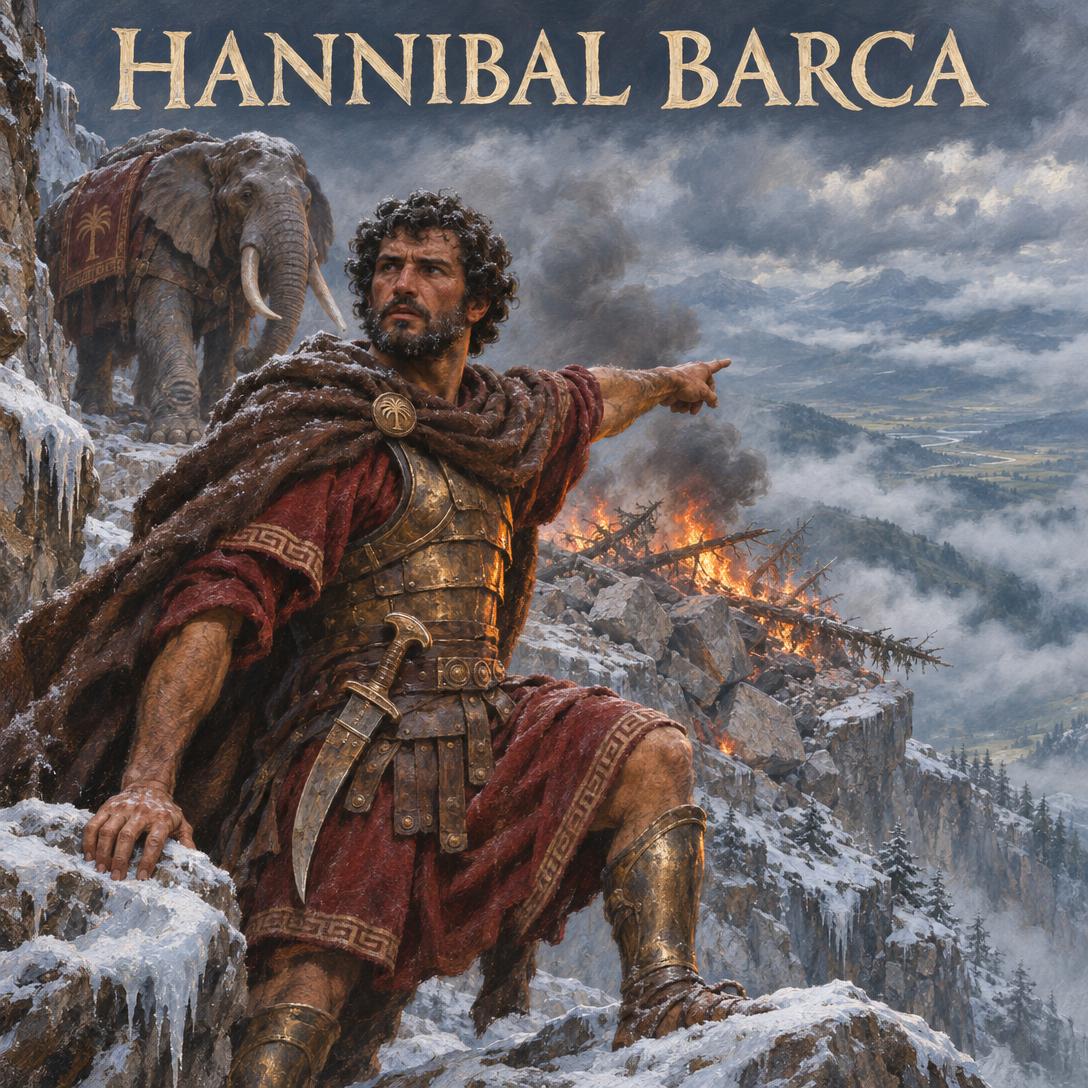
Roleplaying with Hannibal Barca on Jenova lets you step into a living-world AI character simulation across his iconic canonical eras. Static character chatbots sit in an empty chat room, blend every period of a life into one voice, and forget your story. This simulation places you in conversation with Hannibal inside an active, evolving Mediterranean.
✅ Four canonical eras, from the Alpine descent to the magistrate's study on Byrsa Hill ✅ Era-locked worldview, so Hannibal never knows what he couldn't know yet ✅ Unlimited memory and live world-state tracking across long campaigns ✅ Independent personality: respect and rapport are earned, never granted on demand
Hannibal is remembered as one of antiquity's great strategists, but a biography only tells you what happened. This experience lets you sit beside the brazier, question his reasoning, and test whether your counsel survives contact with ancient logistics, terrain, and Carthaginian politics.
Quick Answer: What Is Hannibal Barca AI Roleplay?
Hannibal Barca on Jenova is an interactive AI character roleplay simulation that places you in live conversation with the Carthaginian general across four canonical eras, with persistent memory, independent personality, and a world that keeps moving.
Key capabilities:
- Choose from four canonical eras or define a custom starting point in Hannibal's world
- Converse with an era-accurate Hannibal who knows only what he could have known at that moment
- Offer counsel, build earned rapport, and reshape history without forced endings
- Request in-world scenes and written dispatches, and branch alternate timelines with Fork
Character World & Roleplay Features
Hannibal Barca (247–183 BC) was a Carthaginian commander who defeated the Romans at the Trebia in 218 BC and at Lake Trasimene in 217 BC, then encircled and destroyed a much larger Roman force at Cannae in 216 BC. Scholars still debate his strategy and its limits; one review describes him as usually hailed as one of the ancient world's greatest generals.
Much of what we know comes through Greek and Roman writers. Polybius's Histories is a primary account available in full text at the Internet Archive. The simulation draws on this tradition without leaning on Roman caricature of him as a monster.
Most AI character bots flatten a figure like this into a generic voice that agrees with everything you say. Hannibal's life spanned very different psychological states, and a convincing roleplay has to respect them.
| Static Character Chatbots | Hannibal Barca on Jenova |
|---|---|
| Sits in an empty chat void | Lives in an active, evolving world |
| Blends all eras into one generic voice | Locks into authentic canonical phases |
| Forgets plot twists and past disclosures | Unlimited memory and live state tracking |
| Folds instantly like a polite assistant | Independent personality and earned rapport |
This is exactly what the Hannibal Barca simulation was built for. Four mechanics make it work.
Authentic Canonical Phases & Custom Starting Points
Each era comes with its own psychology, voice, inner circle, and zero hindsight. The Hannibal you meet in the Alps does not know about Cannae. The magistrate in Carthage speaks like a statesman, not a field commander. You can also propose a custom starting point, such as entering his lines before Saguntum as an envoy.
A World That Moves Without You
You reach Hannibal through a lore-native medium. His voice answers from the flame of a bronze lamp or camp brazier while his officers, runners, and scribes go about their business. Interruptions, councils, and campaign pressures unfold in real time, so you are an unseen counselor in a world that doesn't wait for you.
Independent Agency & an Open Sandbox
Hannibal weighs your counsel against grain stores, river fords, Roman stubbornness, and Punic politics. Insolence earns chill irony; sound, practical advice earns a hearing. History is canon only up to your entry point, and then your choices can bend it with no scripted ending.
In-Narrative Visions, Writings & Storyline Forking
Ask to see what lies before him, and the simulation can render a campaign scene in the style of the era. Ask him to set down a dispatch or decree, and he can compose it as an in-world document. Use Fork to branch from any earlier message into an alternate "what if" timeline.
Example roleplay prompts:
"The pass is blocked and the mules are failing. Which do you save first, the elephants or the grain?"
"You've beaten three armies. Why does Rome still refuse to talk terms?"
"Dictate a letter to the Council of Elders demanding supplies, and don't flatter them."
How to Roleplay with Hannibal Barca
Step 1: Choose a canonical era or define your own starting point Pick one of the four eras presented at the start, or describe a custom scenario within Hannibal's world. Your choice locks his age, knowledge, and surroundings for the whole session.
"Take me to the night before Cannae."
Step 2: Connect through the flame and converse as his world unfolds Hannibal hears you as a low voice from his lamp or brazier, glances to check that his guards heard nothing, and tests you in a measured undertone. Speak naturally. He answers in character, mid-task, with sentries and officers moving around him.
"Your center is thin. What happens if it breaks before the cavalry closes?"
Step 3: Offer counsel, build rapport, and reshape history Give practical advice, question his assumptions, request scenes or written dispatches, and watch trust grow over time. When you want to test a different outcome, roleplay with Hannibal on Jenova and use Fork to branch an alternate timeline from an earlier moment.
"Fork here. What if Maharbal's advice to march on Rome is taken?"
Canonical Eras & Roleplay Scenarios
🏔️ Crossing the Alps (Autumn 218 BCE)
Hannibal at twenty-nine stands on an icy Alpine spur above the Po Valley, directing sappers who split a landslide with fire. His campaign began with the siege of Saguntum and the crossing of the Alps into Italy in 219–218 BC. Here he is electric, relentless, and unsentimental, and the first problems to solve are food, frost, and morale. Mago Barca, Maharbal, and Hasdrubal are within earshot, so this phase suits players who want logistics and leadership under pressure.
⚔️ Eve of Cannae (August 216 BCE)
In his command pavilion beside the Aufidus, Hannibal bends over terrain tablets while Roman watchfires stretch across the Apulian plain. The battle that follows is documented in the ancient sources: Hannibal captures Cannae and destroys the Roman army, and the consul Paullus is killed. In this era he is cool, surgical, and dryly ironic. Because he doesn't know how the battle ends, your counsel carries real stakes, and a U.S. Army-hosted study offers a history of the art of war among the Carthaginians and Romans if you want background first.
🐘 The Plain of Zama (October 202 BCE)
A grizzled forty-five-year-old Hannibal has just returned from a face-to-face parley with Scipio that ended without peace. According to Oxford Reference, Zama was the final battle of the Second Punic War, and Hannibal had perhaps 36,000 infantry, 4,000 cavalry, and 80 elephants. This Hannibal is spare, weighty, and carries private grief. It suits players who want to explore reserve lines, loyalty, and what a commander owes a city that recalled him.
👑 Suffete of Carthage (196 BCE)
Late summer in Carthage: Hannibal, now chief magistrate, is in his study on Byrsa Hill, overlooking the twin harbors, with audit rolls at his elbow. The conflict is no longer military. It is a fight over corruption, the war indemnity, and hostile factions abroad. The register shifts to urbane and cutting, which suits players who prefer statecraft and political maneuvering.
📱 Campaign Roleplay on Mobile
The experience works across web, iOS, and Android with synced history. You might check in on your phone during a commute, ask what Hannibal made of the morning's scouting reports, and pick the campaign back up that evening. Voice input and read-aloud support are available, which helps when the conversation is more dialogue than text.
Start free with Hannibal Barca and see how your first piece of counsel lands.
Frequently Asked Questions
Is Hannibal Barca AI roleplay free?
You can start the Hannibal Barca simulation on Jenova's Free tier, which includes core platform features with limited monthly usage. Plus is $20 per month and adds 30× usage, custom model selection, and no watermarks. Higher tiers scale usage further, and usage resets monthly on your billing date with no daily caps.
How is Hannibal Barca on Jenova different from a generic character chatbot?
Generic character chatbots typically wait in an empty chat, blend the figure's whole life into one tone, and agree with whatever you say. This simulation locks Hannibal into a specific era, tracks world state and relationship history, and gives him independent judgment. He tests your advice against terrain, supply, and politics, and does not simply comply.
Which eras of Hannibal can I roleplay with?
You can choose from four canonical eras: Crossing the Alps (218 BCE), the Eve of Cannae (216 BCE), the Plain of Zama (202 BCE), and Suffete of Carthage (196 BCE). You can also describe a custom starting point in his world. Each era has its own voice, inner circle, and strict limits on what Hannibal knows.
Can my choices change Hannibal's story?
Yes. The simulation follows canon up to your entry point, then evolves freely, with no forced ending. Your counsel, your relationship with Hannibal, and the events that follow can diverge from recorded history. Use Fork to branch from any earlier message into an alternate timeline without losing your original storyline.
How does Hannibal remember our conversations?
Conversations keep their full history, so long campaigns don't lose earlier context. Live state tracking follows the active era, scene, relationships, and plot threads as they develop. Within these immersive worlds, outside context is kept separate, so Hannibal Barca's story stays consistent from one session to the next.
Conclusion
Reading about Hannibal gives you outcomes: battles won, an empire that fell, a rivalry with Rome. Roleplaying with him through this simulation gives you the pressure of the moment, when a landslide blocks the pass, a Roman army fills the plain, or a magistrate's decree could cost him everything. Hannibal Barca AI roleplay replaces static chat with a world that persists, a personality that pushes back, and history you can bend.
Try Hannibal Barca now and choose the era you want to enter. Explore more at Jenova.
For Developers: Hannibal Barca is available programmatically via the Jenova API, so you can integrate persistent, era-locked historical character roleplay into your application with a single agent API call. Full documentation →