What Is the Best AI Tool for Designing Handbags?
2026-10-06
Which AI Tools Can Take a Handbag From Concept Image to Production-Ready Spec?
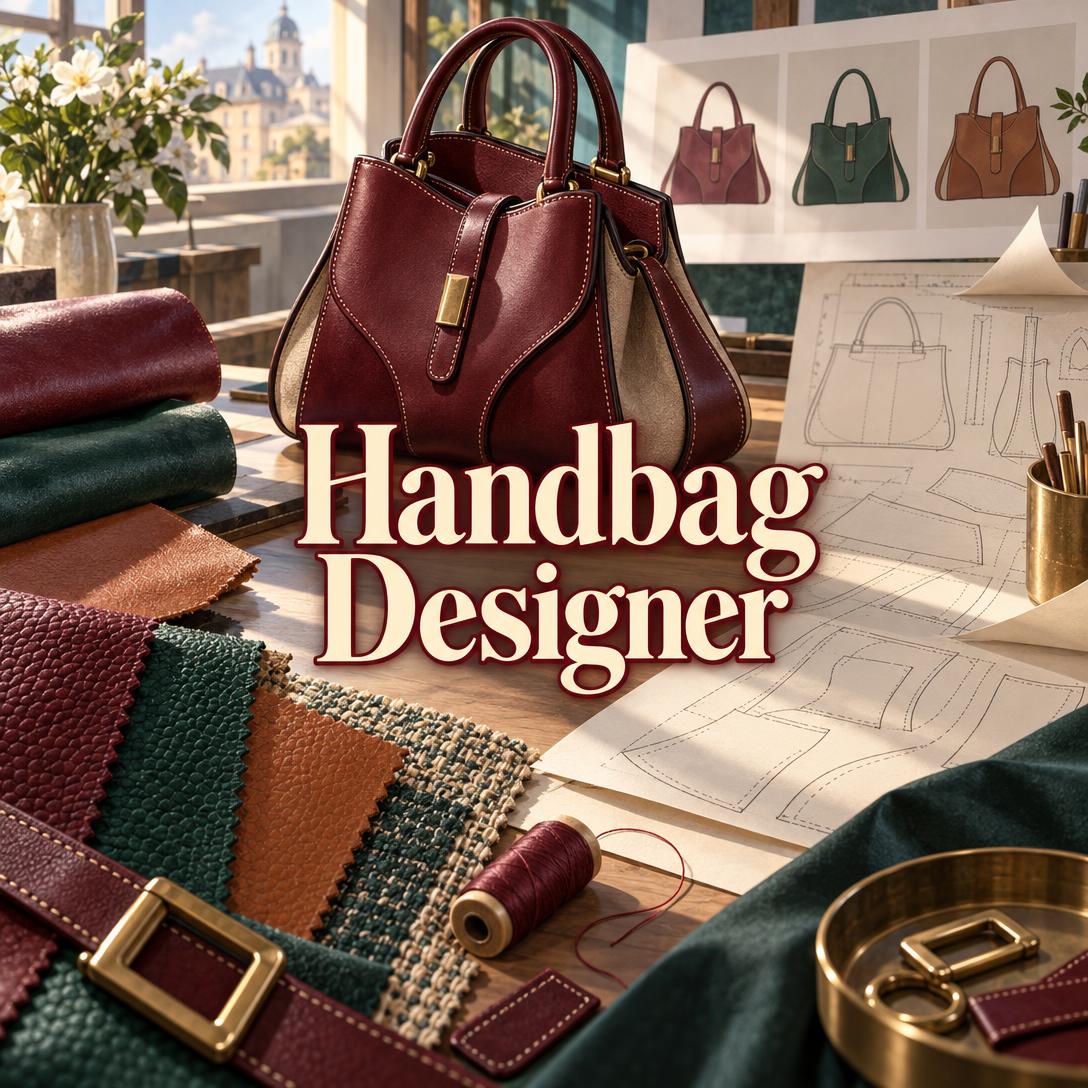
As of 2026, no single AI tool covers the full handbag development path, and the leading options are each strongest at a different stage. Jenova's Handbag Designer is strongest at bag-specific design judgment. It generates photorealistic concept images, critiques silhouettes, advises on leathers and hardware, and drafts tech packs as documents.
CLO Virtual Fashion (CLO) and Browzwear lead in 3D simulation and vendor collaboration. Style3D pairs 3D modeling with cloud asset sharing. Techpacker specializes in tech pack documentation, and Modelia focuses on on-model marketing imagery.
Key factors that separate useful AI handbag design tools from generic image generators:
✅ Bag-specific design logic: reasoning about silhouette, proportion, and handle drop, not just attractive pictures ✅ Material-construction fit: checking whether the chosen leather or textile can actually hold the intended shape ✅ Price-point feasibility: flagging construction choices that the target retail price cannot support ✅ Production handoff: tech packs, bills of materials (BOMs), and measurements a factory can work from ✅ Honest output limits: a clear line between concept images and dimensioned technical documents
The right choice depends on where your bottleneck sits: ideation, technical development, or marketing imagery. Identifying that bottleneck requires a consistent evaluation framework, outlined below.
Why Are Accessory Brands Turning to AI for Handbag Design in 2026?
Accessory brands are adopting AI for two reasons. Traditional product development is slow and sample-heavy, and AI-generated fashion visuals have become commercially mainstream. Traditional fashion design methods can take 3 to 8 months to move from concept to manufacturing, and every physical sample round adds cost before a style reaches market.
The market data reflects that shift:
The global AI fashion models market was valued at USD 703.5 million in 2025 and is projected to reach USD 6.2 billion by 2036, a 21.7% CAGR. Generative AI models are expected to hold the largest technology share in 2026, and "AI-Assisted Fashion Design" is tracked as its own application segment.
Large brands are already using these tools in production. Meticulous Research reports that H&M launched its first AI-enabled digital twin imagery in 2025 and Mango deployed AI-generated model visuals in campaign content.
The economic case is clearest in digital sampling. Australian fashion group APG & Co reported a 50% reduction in development and fit sampling costs in FY25, with 100% of styles across Saba, Sportscraft, and Jag developed in CLO and CLO-SET. JD Sports similarly cited manual, disconnected processes, long lead times, and high sampling costs as the core problems its 3D and AI stack was built to solve.
🎯 Why Handbags Are a Special Case
Almost all of this evidence comes from apparel. The U.S. occupational definition of a fashion designer covers people who design clothing and accessories, create original designs or adapt trends, and conduct market research. Most AI fashion software, however, is documented around garments: drape, fit, and body simulation.
Handbags are hard goods. Their appeal depends on internal structure, hardware, edge finishing, and how a bag sits on a table. This makes tool selection harder than vendor marketing suggests.
What Should You Look for in an AI Handbag Design Tool?
A good AI handbag design tool should be judged on six dimensions, from first sketch to factory sample. We call this the Silhouette-to-Sample Framework. It weights design judgment as heavily as image quality, because a beautiful render of an unbuildable bag still costs money in sampling.
| Dimension | What to Test | Why It Matters for Bags |
|---|---|---|
| 1. Design judgment | Does the tool reason about silhouette, proportion, and handle drop? | A bag that looks generic in blacked-out silhouette won't be rescued by hardware |
| 2. Visualization fidelity | Are materials, stitching, and hardware rendered convincingly? | Buyers and factories react to visible quality cues |
| 3. Material and hardware intelligence | Can it distinguish full-grain from corrected-grain, or a turn lock from a magnetic snap? | Material choice dictates construction and cost tier |
| 4. Construction and cost feasibility | Does it flag choices that break the price point? | Hand-painted edges don't work on a $200 retail bag |
| 5. Production documentation | Can it produce tech packs, BOMs, and measurements? | Factories build from specs, not mood images |
| 6. Collaboration and handoff | Can vendors review work without specialist software? | Revision loops are where timelines slip |
The handbag-specific test that matters most is how well a tool connects design intent to buildable reality. One fashion AI directory describes the useful tools as those that connect design intent to product reality, reduce sample rounds, and show fabric behavior before the first physical prototype exists.
📊 How to Weight the Framework by User Profile
- Independent makers and new brands: weight dimensions 1, 3, and 4 most heavily, because design judgment and feasibility prevent expensive first mistakes.
- Growing direct-to-consumer (DTC) brands: balance all six, with extra weight on dimension 5 as factory relationships formalize.
- Established teams with vendor networks: weight dimensions 5 and 6 most heavily, since 3D review and structured product data drive throughput.
- Marketing and e-commerce teams: weight dimension 2 almost exclusively.
How Does Jenova's Handbag Designer Compare to CLO, Browzwear, Style3D, Techpacker, and Modelia?
Jenova's Handbag Designer is the only option in this group built specifically around handbag design reasoning. CLO and Browzwear are stronger for physics-based 3D sampling and structured vendor collaboration. Techpacker and Modelia each cover a narrower slice of the workflow. Feature details below reflect sources reviewed at the time of writing in 2026 and may change.
| Dimension | Jenova's Handbag Designer | CLO (CLO 3D + CLO-SET) | Browzwear (VStitcher + Stylezone) | Style3D | Techpacker | Modelia |
|---|---|---|---|---|---|---|
| Primary function | Bag design partner: concepts, critique, materials, documents | 3D design and product-development workspace | 3D visualization, fit validation, collection hub | 3D modeling and cloud asset management | Tech pack building and sharing | AI on-model imagery |
| Handbag-specific guidance | Core focus: silhouette families, handle drop, closures, edge finishing | Sources reviewed describe garment workflows | Sources reviewed describe garment workflows | Sources reviewed describe garment workflows | Category-agnostic documentation | Not a design tool |
| Concept visualization | Photorealistic product, lifestyle, flat-lay, and detail images | 3D garment visualization | True-to-life drape, fit, and movement | 3D visualization before production | Not documented in sources reviewed | Model imagery in under a minute |
| 3D / physics simulation | No; 2D images only | Yes; drape simulation and virtual fit | Yes; fit validation | Yes; 3D modeling | No | No |
| Tech pack / BOM support | Drafts tech packs, spec sheets, line sheets, and BOMs as PDF, DOCX, or XLSX | Web Tech Pack, BOM, measurements, cost data | Stylezone hub for tech packs, assets, patterns | Supports tech pack streamlining | Component libraries, measurements, BOMs, version control | Not documented |
| Vendor collaboration | Files shareable via Drive, Dropbox, or Notion integrations; no vendor portal | Browser review without opening CLO; role-based access | Cloud sync, iteration history, comments | Sharing across brands, suppliers, manufacturers | Sharing built in | Not documented |
| Pricing (2026) | Free tier; paid plans from $20/month | Free plan available for CLO-SET | Unverified | Unverified | Unverified | Marketed as low-cost; exact pricing unverified |
| Best For | Designers and founders shaping bag concepts and collections | Brands running full 3D development with vendors | Teams standardizing 3D across design and production | Teams building cloud-based digital asset libraries | Formalizing specs for factories | E-commerce imagery at scale |
👜 Jenova's Handbag Designer
Jenova's Handbag Designer acts as a senior accessories designer. It covers silhouette and proportion, material science, and manufacturing pragmatism across ultra-luxury, luxury, accessible luxury, contemporary, mass-market, and artisan segments.
Its design framework is organized around concrete bag-specific principles:
- Silhouette families: structured, soft, compact, oversized, and sculptural
- Handle drop as the measurement that determines carry: hand, crook of arm, or shoulder
- Interior architecture designed inside-out rather than outside-in
- A "sitting test" for structured bags, which should look composed on a table with the flap settling properly
Examining the agent's design framework shows a deliberate push away from generic category defaults. It critiques designs in a fixed priority order: silhouette and proportion, then material-construction fit, then hardware, then market alignment. It also checks feasibility against stated price bands, such as $300–1,500 for accessible luxury.
Limitations:
- It produces 2D images, not physics-simulated 3D prototypes.
- Its technical flats and dimensioned spec drawings are unreliable as images, so it routes those to document generation instead.
- Multi-bag collection overview images have only moderate cross-bag consistency.
- Its scope covers bags only, not apparel, shoes, or jewelry beyond bag hardware.
🧵 CLO (CLO 3D + CLO-SET)
CLO's strength is connecting 3D design to production data. CLO-SET combines browser-based 3D review, version management, BOM, measurements, construction details, cost information, and Web Tech Pack workflows. External collaborators can review assets without opening CLO.
Limitations: Its documented workflows center on garments. It demands 3D design skills that typically sit at the professional end of the toolkit, and it offers no built-in design critique.
🧥 Browzwear (VStitcher + Stylezone)
Browzwear excels at fit validation and centralizing assets. JD Sports uses Browzwear for 3D visualization and fit validation and Stylezone as a central hub for tech packs, shared assets, and patterns. Meticulous Research lists Browzwear's AI imagery capability through Lalaland.ai.
Limitations: It works best inside the Browzwear ecosystem, its strengths are garment drape and body fit, and pricing was not publicly verified for this guide.
🧊 Style3D
Style3D's 3D modeling lets designers visualize products before production, detect issues early, refine fit, and reduce sample costs. Style3D Cloud adds storage, search, and sharing of digital fashion assets across brands, suppliers, and manufacturers.
Limitations: Like CLO, its documented positioning is apparel-first, and it is a 3D environment rather than a design advisor.
📋 Techpacker
Techpacker is a user-friendly platform for building and sharing tech packs that supports component libraries, measurements, BOMs, and version control.
Limitations: It documents a design but doesn't help create one. It offers no concept generation, critique, or feasibility reasoning.
📸 Modelia
Modelia generates realistic images of models wearing products in under a minute. It can also swap backgrounds and adjust a model's age, hair color, and expression.
Limitations: It is a marketing imagery tool, not a design tool, and it does not address construction, materials, or production.
Can AI Give Reliable Advice on Handbag Materials, Hardware, and Construction?
AI gives reliable advice on established handbag principles: leather grades, closure behavior, edge finishing, and stitching methods. Claims about sustainable materials and supplier certifications still need independent verification. The most useful AI design partners know the difference and research when a claim depends on current facts.
Leather and Alternatives
A capable AI design partner should distinguish the four main leather grades:
- Full-grain: unaltered surface that develops patina; the highest quality
- Top-grain: sanded or refinished for consistency and durability
- Corrected-grain: embossed or coated for a uniform finish
- Split or suede: the inner layer, with a napped surface
Each grade signals a different market tier and behaves differently in construction. Jenova's Handbag Designer treats "vegan leather" as many materials rather than one, evaluating PU, Piñatex, Mylo, Desserto, and apple leather separately on hand-feel, durability, and aging.
That caution matters because the alternatives market is crowded with new claims. Industry coverage in 2026 highlights Piñatex, mycelium, and lab-grown leather as emerging options. Quality and aging behavior vary widely across them.
Hardware and Closures
Closure choice is a three-way trade-off between security, access speed, and character:
| Closure | Security | Access Speed | Typical Character |
|---|---|---|---|
| Turn lock | High | Medium | Classic, tactile |
| Push lock | High | Fast | Clean, modern |
| Magnetic snap | Low–Medium | Instant | Casual, effortless |
| Frame / kiss lock | High | Medium | Vintage |
| Flap-only | Low | Instant | Minimal, gravity-reliant |
Hardware finish also signals era and tier. Polished gold reads as traditional luxury, while matte black reads as contemporary.
Sustainability Claims
Sustainability is where AI advice most needs grounding. Some independent brands, such as Roiff Studio, emphasize sourcing leather from Leather Working Group (LWG)-certified tanneries as a transparency signal. Advocacy group Fashion Revolution publishes a 2025 report ranking 200 of the world's largest fashion brands on disclosure of their climate and energy policies.
On the design side, The Sustainability Consortium's snapshot on non-leather handbags notes that environmental impact can be reduced by designing products that use fewer resources. Jenova's Handbag Designer requires sustainability claims to be specific and verifiable, and it runs live research when checking material innovations or certifications.
How Do AI Tools Handle Handbag Tech Packs and Production Handoff?
AI tools handle handbag tech packs in one of two ways. Structured platforms like CLO-SET, Browzwear Stylezone, and Techpacker store specs as shared, version-controlled data. Jenova's Handbag Designer instead drafts tech packs, spec sheets, line sheets, and BOMs as standalone PDF, DOCX, or XLSX files. The right fit depends on whether your factory relationship runs on a shared platform or on documents.
Documents remain common in practice. Some product developers still deliberately use Excel for tech packs because it keeps the document collaborative across everyone in the development process. A 2026 roundup of AI fashion workflow tools likewise compared options across concept, 3D, tech packs, and launch, reflecting how fragmented the handoff stage still is.
What a Handbag Tech Pack Should Capture
A complete handbag spec goes beyond garment conventions. It should cover:
- Dimensions: body width, height, and depth, plus handle drop and strap length range
- Materials: grade, finish, and thickness for each panel, plus lining material
- Hardware: closure type, finish, placement, and supplier references
- Edge finishing: painted, burnished, turned, bound, or raw
- Stitching: saddle stitch, machine topstitch, blind stitch, or edge stitch, plus stitches per inch
- Reinforcement: stiffeners, base boards, piping, and stress-point patches at handle anchors and corners
The Prototype Path
Most bags move through a predictable sequence:
- Canvas mock-up
- First leather prototype
- Revised prototype
- Pre-production sample
- Production
Each step is a cost checkpoint. Jenova's Handbag Designer flags the main cost drivers early: material yield, pattern piece count, hardware quantity, edge finishing method, lining complexity, labor market, and minimum order quantity (MOQ). For example, a design with thirty pattern pieces at accessible-luxury pricing needs production volume to justify the tooling.
What Are the Limits of AI in Handbag Design?
AI handles a meaningful but partial share of design work. It cannot replace physical sampling, hands-on material judgment, or a designer's point of view. One analysis citing Microsoft Research estimates that AI reaches about 27% of a fashion designer's tasks. Even advanced 3D platforms are described as supporting digital pattern development, fabric simulation, and virtual prototyping while still having clear limitations.
Three risks deserve attention:
- Homogenization: When many brands use similar AI tools, output can begin to look the same, reducing originality.
- Copyright exposure: The same source flags concerns about AI trained on existing fashion collections without proper licensing.
- Image-versus-spec confusion: A photorealistic image is not a buildable spec, and generated text and dimensions on images are often unreliable.
Jenova's Handbag Designer addresses these risks in specific ways. It pushes designs toward distinctiveness rather than category averages. It adapts rather than copies named references such as an iconic designer bag. It is explicit that dimensioned technical drawings belong in documents, not images.
It still cannot tell you how a specific hide will behave under a specific factory's skiving machine. That knowledge comes only from a physical sample.
How Do You Get Started Designing a Handbag With AI?
Most AI handbag workflows follow the same arc. You define who carries the bag and at what price, generate and narrow concepts, then formalize the winning design into a spec. The tools differ mainly in where that arc starts.
Getting Started With Jenova's Handbag Designer
- Open the agent at jenova.ai/a/handbag-designer.
- Describe the bag type, carry context, and market position:
"A structured top-handle bag for a working professional, accessible luxury around $650. Pebbled calfskin in cognac, brushed gold turn lock, painted edges. Show me three distinct silhouette directions."
- Review the exploration variants. Each is generated as a separate image with a brief design rationale.
- Refine the chosen direction. The agent changes only what you mention and preserves everything else:
"Keep variant two, but lengthen the handle drop so it fits in the crook of the arm and switch the lining to ivory microsuede."
- Ask for production documentation:
"Compile a tech pack with dimensions, materials, hardware, and edge finishing as a PDF, and a BOM as a spreadsheet."
If a request is too bare to act on, the agent asks at most two questions, such as who the bag is for and who is carrying it. Otherwise it generates immediately using strong defaults. It also adjusts its vocabulary automatically, whether you write like an enthusiast or a production professional. Users can switch between image generation models from the chat interface to compare rendering styles.
Getting Started With CLO-SET
CLO-SET offers a Free plan. Teams upload and manage 3D assets, review them in the browser-based viewer, and attach BOM, measurement, and cost data through Web Tech Pack workflows. The practical prerequisite is a 3D model built in CLO, which assumes existing 3D design skills.
Getting Started With Modelia
Modelia suits the final stage, after a physical sample exists. You upload product images and generate on-model visuals with adjustable backgrounds and models.
Which AI Handbag Design Tool Fits Your Brand Stage?
The best fit depends on brand maturity. Early-stage designers benefit most from design judgment and feasibility checks. Established teams benefit most from 3D sampling and structured vendor collaboration. Many brands end up combining two tools rather than choosing one.
💼 Contextual Recommendations
- Independent artisan or Etsy maker: Jenova's Handbag Designer covers concepts, materials, and a first tech pack without requiring 3D skills. Founders building an identity can pair it with Brand Kit Generator for logos and palettes.
- Contemporary DTC brand ($100–500 retail): Use Jenova's Handbag Designer for collection architecture (hero, core, seasonal, entry, and aspirational pieces) and Techpacker or a spreadsheet for factory specs. Pricing Strategist helps pressure-test margin at each tier.
- Accessible luxury or luxury team with vendors: CLO or Browzwear for 3D review and production data, with Jenova's Handbag Designer upstream for ideation and critique.
- E-commerce and marketing team: Modelia for on-model imagery and Product Photo Editor for retouching and background work on real product photos.
For teams building their own tooling, the same agent capabilities are accessible through the Jenova API platform.
What Do Accessory Design Experts Say About AI-Assisted Handbag Development?
Product designers working on AI for accessories argue that the value lies in enforcing bag-specific design discipline before money is spent on samples, not in generating more images faster.
"The most common failure we see in AI-generated bags is a silhouette that collapses into the category average. Black out the image, and if you can't tell it apart from a thousand other crossbodies, no amount of hardware or surface treatment will save it. That's why our handbag agent evaluates silhouette and proportion before it ever discusses color or finish."
"Handle drop is the single most underrated measurement in bag design. A few centimeters move a bag from hand-carry to crook-of-arm to shoulder, and that changes who buys it and when they use it. Generic image tools treat the handle as decoration. A design partner has to treat it as the variable that defines how the bag lives with its owner."
"Feasibility needs to be checked at the concept stage, not the sample stage. Hand-painted edges at a $200 retail price don't work, and neither does a thirty-piece pattern at accessible-luxury volumes. Catching those conflicts in a conversation costs nothing; catching them in a second leather prototype costs weeks."
"We're deliberate about what images can't do. Dimensioned technical flats rendered as images are unreliable, so we route specs into documents. Teams that blur that line end up sending a factory a picture that looks precise but isn't."
— Jenova Product Team, builders of specialist AI agents used by 30,000+ users in 70+ countries
References
- CLO-SET — 5 3D Product Collaboration Tools for Fashion Brands (2026), including APG & Co sampling cost results and CLO-SET Free plan
- Browzwear — How JD Sports Uses 3D & AI to Cut Sampling Costs
- Style3D — How Can AI Streamline Apparel Tech Packs for Designers?
- Arcus Apparel Group — Best Fashion Design Software for Apparel Startups in 2025 (Techpacker overview)
- Modelia — Best AI Tools for Apparel and Fashion Brands in 2025 (development timelines, AI risks)
- Meticulous Research — AI Fashion Models Market Size & Forecast 2026–2036
- O*NET OnLine — 27-1022.00 Fashion Designers occupational summary
- Fashion AI Toolkit Directory — Criteria for useful fashion AI tools
- cucubird — Next-Gen Eco-Friendly Leather Solutions Reshaping Sustainable Fashion in 2026
- Roiff Studio — LWG-Certified Tanneries and Leather Bag Sourcing
- Fashion Revolution — 2025 brand disclosure report on climate and energy policies
- The Sustainability Consortium — Non-leather Handbags Snapshot
- Sarah Koriya on LinkedIn — Why I Continue To Use Excel for Tech Packs
- The F* Word Inc. — AI Fashion Workflow Tools (2026): 9 Tested
- 100xworker — Will AI Replace Fashion Designers? A Task-by-Task Look
- RoleFate — Fashion Designer AI Exposure Analysis