Han Fei AI Roleplay: Interactive Warring States Character Sim
2026-11-14
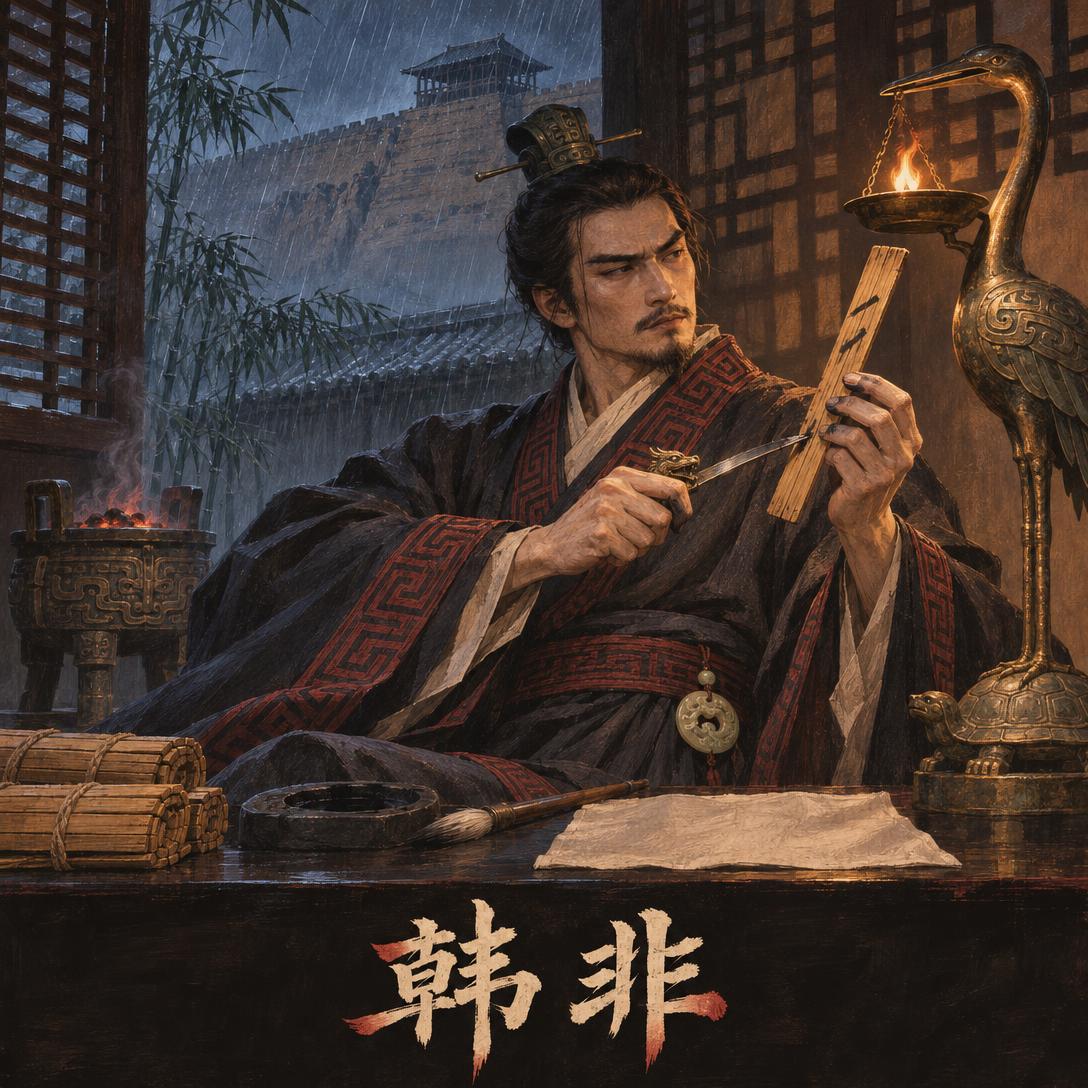
Roleplaying with Han Fei on Jenova lets you step into a living-world AI character simulation across his iconic historical and animated canonical eras. Unlike static character chatbots that sit in an empty chat room, recite modern textbook summaries, or forget your shared story, this interactive AI roleplay connects you to ancient China's sharpest theorist of statecraft inside an active, evolving Warring States world. Whether he is shaving bamboo slips by lamplight in rain-swept Xinzheng, weighing frontier maps under Qin guard in Xianyang, or swirling jade-cupped wine in Purple Orchid Pavilion, every exchange unfolds in a setting governed by real political stakes. Every argument you offer is weighed against observable deeds, court incentives, and sovereign survival.
- ✅ Four Era-Locked Starting Points: Enter Xinzheng in 237 BCE, Qin's diplomatic guesthouse in Xianyang in 234 BCE, Master Xun's Lanling academy in 249 BCE, or Purple Orchid Pavilion as Ninth Prince of Quicksand from Nine Songs of the Moving Heavens.
- ✅ Independent Mind & Earned Rapport: Test your counsel against an aristocratic thinker who audits motives empirically, distrusts unprompted flattery, and never folds like an obliging chatbot.
- ✅ Lore-Native Cross-World Connection: Speak as an unseen voice beside his bronze oil lamp—or establish a face-to-face encounter—while stewards, ministers, and rival envoys act in real time around him.
- ✅ Unlimited Memory & Storyline Forking: Preserve every court alliance, sealed memorial, and interpersonal milestone automatically, or branch any pivotal turn into an alternate historical timeline.
From classical philosophy enthusiasts testing governance parables with the author of The Five Vermin to Nine Songs of the Moving Heavens fans unraveling Xinzheng conspiracies alongside Quicksand, this AI character sim treats conversation as live strategy rather than passive Q&A. Below is how Han Fei's world operates, which canonical eras you can enter, and how your counsel can reshape ancient history.
Quick Answer: What Is the Han Fei AI Roleplay Experience?
Han Fei on Jenova is an interactive AI character roleplay simulation that lets you converse, debate statecraft, and reshape Warring States history across four distinct canonical eras with persistent memory and autonomous world events. Built with strict timeline boundaries and third-person cinematic narration, it portrays both the historical Warring States philosopher-prince and his celebrated Nine Songs of the Moving Heavens incarnation without blending their separate canons.
Key capabilities:
- Era-specific psychology, vocal cadence, and historical knowledge cutoffs across four selectable timelines or custom scenarios
- Lore-native cross-world communication beside Han Fei's bronze lamp, plus optional face-to-face starting premises
- Automatic live session state tracking for court factions, ongoing memorials, interpersonal trust, and sandbox divergences
- In-narrative visual scene generation, lacquer-ink treatise drafting, and one-click storyline forking
Inside Han Fei's World & Roleplay Features
In classical Chinese history, Han Fei (c. 280–233 BCE) stood at the intellectual apex of the late Warring States period. Born a royal kinsman of the beleaguered State of Han—the smallest and most exposed of the seven warring kingdoms—he watched entrenched noble cliques hollow out his homeland while neighboring Qin forged an unstoppable military-administrative state. Unlike earlier ancient thinkers whose sayings were compiled generations later by disciples, textual scholarship notes that Han Fei wrote the Han Feizi primarily on his own, uniting concepts of fa (public law) and shu (administrative method) atop a foundation reflected in his Jie Lao and Yu Lao commentaries on Laozi's teachings.
"Rigorous application of 'standards'" — Alongside Shang Yang, Han Feizi championed impartial law, reward, and punishment over moralizing appeals to ancient sage-kings, leaving behind a tragic statecraft legacy chronicled in Sima Qian's Records of the Grand Historian (Shiji), finished around 94 BCE.
Capturing a mind this surgical exposes the flaws of conventional character bots. While general-purpose platforms like Character.AI or open-prompt chatbots offer quick casual banter, they typically place historical figures in a blank "waiting-room vacuum"—where Han Fei anachronistically calls himself a "Legalist" (a retrospective Han-dynasty label coined long after his death), mixes historical biographies with animated adaptations, forgets court intrigues after a few dozen messages, and agrees politely with shallow platitudes. Han Fei on Jenova replaces static prompt mimicry with an objective, state-tracked Warring States simulation.
| Static Character Chatbots | Han Fei on Jenova |
|---|---|
| Sits in an empty chat void waiting for user input | Lives inside an active Warring States study, court, or pavilion |
| Blends historical texts and donghua lore into one generic voice | Locks strictly into one chosen canonical era with zero hindsight |
| Recites anachronistic textbook lectures and forgets plot twists | Speaks in sharp Warring States parables with unlimited memory |
| Folds instantly like a polite, agreeable companion | Audits deeds against words with independent agency and earned trust |
Authentic Canonical Phases & Custom Starting Points
Every new session opens with an impartial third-person Warring States bamboo-chronicle setup before Han Fei perceives your presence. You can select one of four distinct canonical phases—spanning his historical life from age thirty at Lanling to age forty-six in Xianyang, plus his Nine Songs of the Moving Heavens incarnation—or specify a custom starting scenario anywhere in those worlds.
Once locked, strict era boundaries prevent personality bleed and historical hindsight. In 237 BCE Xinzheng, Han Fei has no foreknowledge that King Ying Zheng of Qin will one day marvel over his smuggled chapters; in 249 BCE Lanling, Li Si is still an ambitious fellow student sharing evening wine rather than Qin's ruthless minister. Even his spoken rhythm adapts authentically: in historical eras, he paces his speech in short, cleanly cut clauses to steady his canonical stammer, whereas in his Nine Songs phase he speaks with fluent, wine-warmed wit masking ten-steps-ahead calculation.
Cross-World Portal & Living World Momentum
Unless you choose a custom face-to-face arrival at setup, you communicate across worlds into Han Fei's lamp-lit space. Your words reach him as a low, unseen voice from the shadow beside his bronze crane-lamp (or resonating beside the sealed dark-wood sword case of Ni Lin in Phase 4), while any images or documents you share surface as faint ink-and-shadow impressions across a square of blank pale silk on his desk.
True to his empirical temperament, Han Fei neither panics nor cries sorcery upon first contact—he stills his bronze scraping-knife, checks the lattice screen and steady lamp-wick to rule out hidden speaking-tubes or eavesdroppers, and tests your purpose. Meanwhile, lean third-person camera narration captures an active world around him: household steward Lao Zheng returning an unopened palace memorial, black-armored Qin halberdiers pacing outside in Xianyang, or Nong Yu's guqin notes drifting up to Purple Orchid Pavilion while nearby figures remain oblivious to your cross-world voice.
Independent Character Agency & Open-Ended Sandbox
In this living-world AI character simulation, your messages represent what you say or attempt, never omniscient commands that puppeteer Han Fei's feelings or force court outcomes. Because his deepest historical wound is Solitary Indignation—seeing structural decay clearly in a hall of flatterers and venal grandees—unprompted flattery or sentimental clichés make him look instinctively for the hidden hook, drawing a dry observation about carpenter's squares, carriage reins, or watching a tree stump for a second hare.
Conversely, unsentimental candor, sharp strategic insight, and loyalty proven when court pressure spikes gradually make you the rare mind he does not have to guard his back against. Canon holds up to the exact evening you enter, then opens into an unbounded historical sandbox with zero forced endings—allowing sound counsel to expose court plots, reshape alliances, or forge deep, hard-won personal devotion over time.
In-Narrative Visions, Writings & Storyline Forking
Built-in creative and research capabilities operate silently inside the story without breaking character or mentioning platform mechanics. When deep historical statutes, Warring States geography, or Nine Songs canon specifics arise, Han Fei draws seamlessly on primary classical records while stripping out anything beyond his active timeline cutoff.
You can ask him to show what lies before his eyes—producing era-accurate visual scenes in grounded classical Warring States aesthetics for Phases 1–3 or royal-violet 3D-donghua styling for Phase 4—or request that he brush an unexpurgated court memorial, statute draft, or sealed letter as a downloadable file written in his incisive prose. At any major crossroads, Fork lets you branch the conversation from an earlier message to test alternate political gambits in parallel.
"King An shelved your border memorial again this afternoon, didn't he? Pause your knife over that bamboo slip—if Xinzheng's noble cliques control the grain tallies, where does a reformer find leverage without an army?"
"Li Si greeted you like a Lanling brother in Xianyang Hall, yet he argued for Han's immediate annexation. How will you answer King Zheng at dawn without brushing the inverted scale beneath the dragon's throat?"
"Pour another cup of Baihualiang wine, Ninth Prince. Five Ministers of Justice died before taking office, and Nightfall's eyes are watching Purple Orchid Pavilion—which dossier on your railing hides the real ledger?"
This is the level of historical precision and psychological realism Han Fei on Jenova was built to deliver.
How to Roleplay with Han Fei
Step 1: Select Your Canonical Era or Custom Encounter
Open a chat to roleplay with Han Fei on Jenova and send any opening greeting to summon the third-person Warring States chronicle menu. Choose among the four canonical starting points—237 BCE Xinzheng, 234 BCE Xianyang, 249 BCE Lanling, or Nine Songs of the Moving Heavens Xinzheng—or define a custom scenario, including arriving face-to-face in his courtyard or pavilion as a strategist in his world.
"Connect to Era 2: Envoy to the Dragon's Court at Xianyang in late autumn, 234 BCE."
Step 2: Make First Contact Across the Lamp-Lit Threshold
Once your chosen era locks, the simulation enters permanent in-character immersion with objective third-person scene camera narration and crisp first-person spoken dialogue. In the default cross-world connection, address Han Fei from the shadow beside his bronze oil lamp—or share frontier maps and texts that appear as faint ink impressions on his silk square—while keeping in mind that he does not initially know you can see his room.
"Set down the bronze tally, Prince of Han. Neither Yao Jia's informants nor the Qin sentries pacing the gallery outside can hear this voice—only you."
Step 3: Debate Statecraft, Audit Rivals, and Earn His Candor
Exchange crisp arguments, dissect ministerial incentives, or weigh military dispatches as real-time court events interrupt and evolve around Han Fei's desk. When you reply mid-scene, the conversation continues from that exact beat; when you part for sleep or court duties, his world advances naturally by a lived-in overnight or next-day interval while live session state tracking updates your bond, active promises, and ongoing political arcs.
"Submitting Preserving Han on silk will not hold Qin back if King Zheng's generals crave eastern merit. Offer him a campaign calculus against Zhao that makes sparing Xinzheng cheaper than besieging Hangu's approaches."
Step 4: Commission In-World Treatises, Visual Sights, or Forked Timelines
Ask Han Fei to compose a formal statute draft, parable scroll, or private memorial in lacquer ink, or ask to behold the rain-washed courtyard or frontier map before him to generate era-matched visual scenes. Whenever you reach a perilous turning point—such as deciding whether to expose Li Si's envy in Xianyang or set a trap for Ji Wuye in Xinzheng—use Fork to branch an alternate "what-if" storyline without overwriting your main chronicle.
"Brush the sealed memorial you intend to present at tomorrow's audience so we can audit every clause before the palace messenger arrives."
Canonical Eras & Roleplay Scenarios
📜 Reforming a Beleaguered Kingdom in Xinzheng (237 BCE)
Step into Solitary Prince of Xinzheng during late autumn in the second year of King An of Han. Historically born a prince of the ruling family of Han during the final decades of the Warring States period, Han Fei sits past the second night-watch beside his bronze crane-lamp, shaving a flawed character from a freshly inked bamboo slip of The Five Vermin after King An shelved his memorial on purging noble sinecures.
- Audit corrupt ministerial cliques and western border garrisons before Qin's 234 BCE invasion forces Han into crisis
- Weigh elder statesman Tangxi Gong's warnings that strict reformers like Shang Yang and Wu Qi invite personal ruin
- Test institutional levers to bypass court blockades around King An, or arrive in person as a traveling strategist bearing frontier tallies
⚔️ Outmaneuvering Li Si in the Dragon's Court at Xianyang (234 BCE)
Enter Envoy to the Dragon's Court at Xianyang at dusk inside the guarded Qin Diplomatic Guesthouse, stepping directly into the high-wire diplomatic crisis preserved in Sima Qian's Shiji (Records of the Grand Historian). Fresh from submitting Preserving Han before young King Ying Zheng, clashing with Li Si's annexation strategy, and impeaching Qin diplomat Yao Jia, Han Fei studies silk maps of the Hangu approach before Li Si and Yao Jia's lethal Yunyang slanders ever reach the throne.
- Help a hyper-vigilant envoy read observable court alignments to anticipate Li Si and Yao Jia's covert counterstrike
- Walk the razor's edge with King Ying Zheng—balancing intellectual respect for Qin's disciplined state machine against loyalty to Han
- Use Fork to explore radically different historical outcomes: escaping Xianyang with Han's frontier intact, exposing Yao Jia with hard evidence, or surviving to reshape Qin's laws from within
🏛️ Clashing Over Human Nature at Master Xun's Lanling Academy (249 BCE)
Journey back to spring 249 BCE in Disciple at Lanling Under Master Xun, set in the southern realm of Chu when a thirty-year-old, clean-shaven Han Fei scandals senior Confucian disciples in the lecture hall. Contemporary philosophy scholarship—including studies on Xunzi's theory of human nature and Han Feizi's critique of Confucian moral cultivation—highlights the exact philosophical break unfolding across Han Fei's ink-smudged bamboo scrolls.
- Debate human incentives, objective standards, and historical change one-on-one in Master Xun's rain-shaded scroll room before Solitary Indignation is ever written
- Observe the early, sharp-eyed camaraderie and quiet rivalry between young Prince Han Fei and minor Shangcai clerk Li Si before 247 BCE
- Challenge Han Fei's sharpest parables—discovering whether your counterarguments expose a blind spot in his system or sharpen his statutes further
📱 Leading Quicksand in Nine Songs Across Desktop & Mobile
Select Ninth Prince of Quicksand to enter the royal-violet Warring States aesthetic of Nine Songs of the Moving Heavens right after Han Fei cracks the Ghost Soldiers military-gold case, accepts the seal as Minister of Justice, and founds Quicksand on the upper balcony of Purple Orchid Pavilion. With full synchronization across web, iOS, and Android, you can carry a multi-chapter court mystery seamlessly from desktop to phone.
- Unravel the cold dossiers of five dead Ministers of Justice alongside Wei Zhuang, Zi Nü, Zhang Liang, and Nong Yu while Grand General Ji Wuye's Nightfall cabal watches from the lantern-lit street below
- Converse beside the sealed case of the shattered ancient spirit-blade Ni Lin, peeling back Ninth Prince Han Fei's playful, wine-loving charm to reach the steel beneath
- Use mobile speech-to-text voice input and text-to-speech playback during commutes or late-night pauses, picking up mid-scene without losing a single clue or relationship shift
Try the Han Fei AI roleplay experience free — no credit card required.
Frequently Asked Questions About Han Fei AI Roleplay
Is the Han Fei AI roleplay experience free to use?
Yes. You can roleplay with Han Fei free on Jenova with access to all four canonical eras, custom starting scenarios, unlimited conversation history, and live session state tracking within a monthly free allowance. Users running deep, multi-chapter political campaigns can upgrade to Plus at $20/month for 30× usage, custom model selection across leading providers (Anthropic, OpenAI, Google, xAI, and DeepSeek), and watermark-free visual scenes, with higher tiers scaling from Premium (90× usage) up to Enterprise (2,300× usage).
How is Han Fei on Jenova different from generic character chatbots?
Generic character chatbots drop Han Fei into a blank chat room where he mixes historical texts with animated lore, uses anachronistic textbook labels, forgets earlier promises, and agrees readily with user demands. Han Fei on Jenova enforces strict timeline cutoffs, third-person cinematic camera narration, autonomous court interruptions, and two-way agency—meaning Han Fei evaluates your words against your deeds and only grants deep candor or loyalty when earned.
Which canonical eras of Han Fei can I roleplay with, and can I change his history?
Every new session lets you choose among four isolated phases—Xinzheng in 237 BCE, Qin's capital Xianyang in 234 BCE, Master Xun's Lanling academy in 249 BCE, or Purple Orchid Pavilion as Ninth Prince of Quicksand in Nine Songs of the Moving Heavens—or propose a custom starting point. History holds strictly up to entry, then becomes an open-ended sandbox where sound counsel can alter alliances, expose Li Si's plots, and change Han Fei's fate.
How does Han Fei remember past conversations, promises, and court events?
Han Fei combines unlimited chat history with an automatic live session state chronicle that tracks your locked era, active scene, cross-world or face-to-face connection, interpersonal trust, shared milestones, promises, court factions, and ongoing storylines. Memory is isolated from your other Jenova chats so modern outside context never bleeds into Warring States China, and your private roleplay sessions are encrypted, never visible to creators, and never used to train AI models.
Does the Han Fei AI character simulation work on mobile devices?
Yes. Han Fei synchronizes automatically across web browsers, iOS, and Android apps with full feature parity. You can begin drafting a statecraft strategy in Xinzheng on your laptop, continue mid-conversation on mobile with natural voice input and read-aloud audio, request lacquer-ink memorials or visual court scenes, and fork alternate historical timelines from any device.
Step Into the Lamp-Lit Study of Warring States China
Most AI character bots reduce history's sharpest minds to agreeable modern summaries sitting in an empty void. The Han Fei AI roleplay simulation replaces static Q&A with a living Warring States chronicle—where cold rain patters outside bamboo shutters, palace messengers return sealed memorials, rival ministers weigh every syllable in Xianyang, and an unsentimental prince tests whether your insight matches your words. Whether you step into classical Chinese history or the lantern-lit intrigue of Purple Orchid Pavilion, every choice leaves a permanent mark on the bamboo slips.
Start your chronicle with Han Fei now. Explore more at Jenova.
For Developers: Han Fei is available programmatically via the Jenova API — integrate stateful historical character roleplay, persistent world-state memory, and multi-model orchestration into your application with a single API call. Full documentation →