AI Guild Management Game: Recruit, Dispatch & Grow Your Guild
2026-10-17
Roleplay Game Master turns any conversation into a fully playable AI guild management game. You recruit adventurers, haggle over contracts, send parties into dungeons, and deal with the fallout, all inside a living campaign that remembers every hire, every death, and every coin in your treasury. As of October 2026, most guild sims still run on fixed content pools and scripted events. This AI game master generates recruits, quests, rivalries, and consequences in response to the choices you actually make.
- ✅ Unlimited memory: Your roster, ledger, and guild history persist across long campaigns
- ✅ Consistent characters: Recruits keep their personalities, grudges, and loyalties session after session
- ✅ Any ruleset, any setting: High fantasy, grimdark mercenaries, sci-fi bounty hunters, or a guild you design from scratch
- ✅ Plays anywhere: Web, iOS, and Android, with voice input for hands-free turns
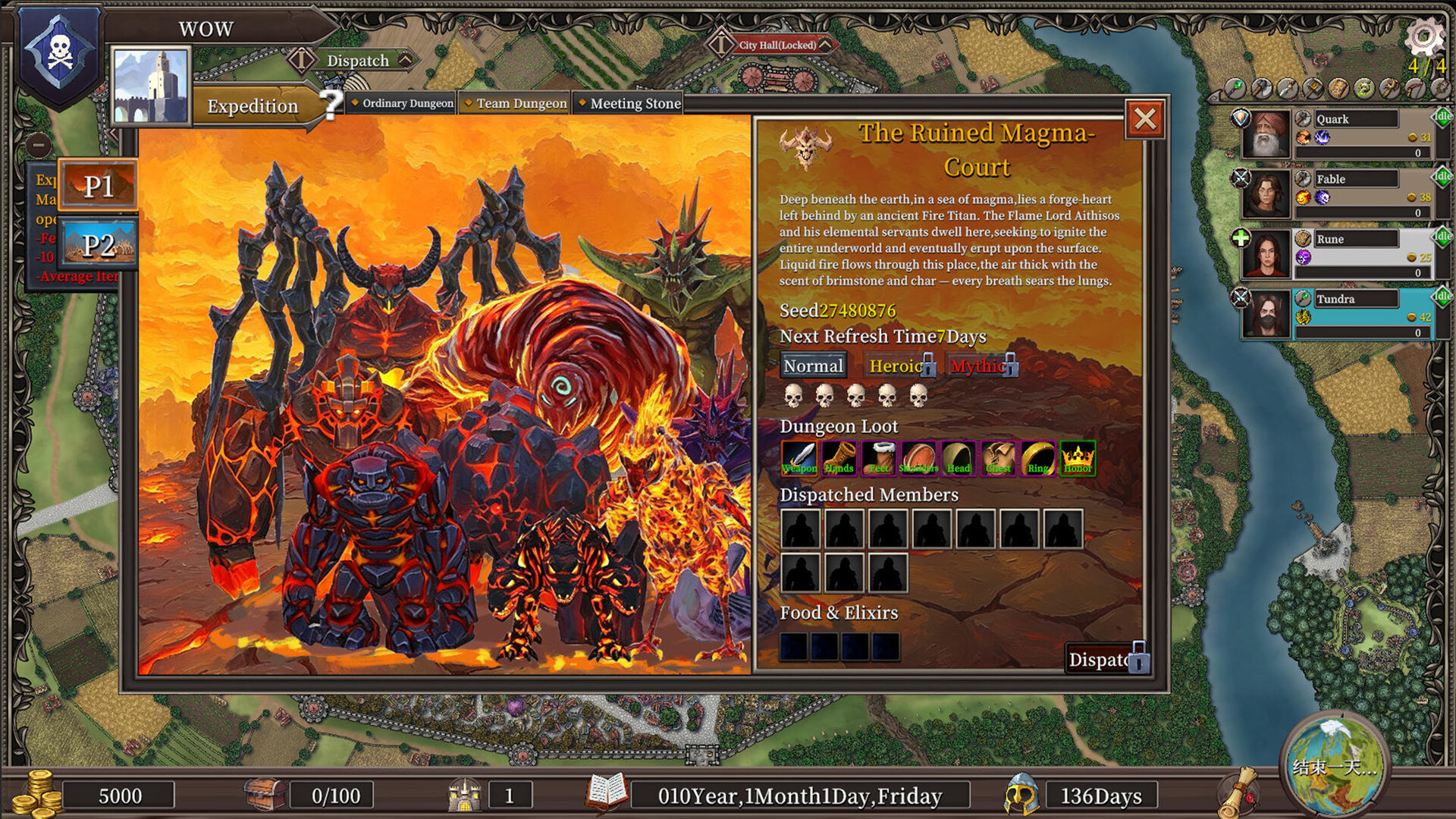
The expedition screen above captures the core loop that guild management fans love: choose a dungeon, weigh the risk, pick your party, and hope they come back. The question is what happens when that loop runs out of surprises. To see why AI changes the equation, it helps to look at where traditional guild management games hit their limits.
Quick Answer: What Is an AI Guild Management Game?
An AI guild management game is a strategy or roleplay game where an AI generates recruits, quests, events, and consequences in real time, so you run a guild's roster, finances, and reputation in a world that reacts to your decisions.
Key capabilities:
- Procedurally invented adventurers with distinct classes, backstories, and personality quirks
- Expedition outcomes shaped by party composition, preparation, and the rules you set
- Persistent guild state, including gold, injuries, morale, renown, and rival factions
- Open-ended events, from political intrigue to member betrayals, that never come from a fixed script
The Problem: Guild Sims Run Out of Story
The guild management genre is healthy. Comic Book Resources recently highlighted titles ranging from Our Adventurer Guild to Epic Manager, which blends Football Manager–style management with tactical RPG combat. New releases keep arriving, including Steam's Guild Management Simulator, where you balance Tanks, Healers, and Damage Dealers against injury risk and expedition rewards.
10 guild-focused games — CBR's roundup of the best games that let you manage a guild
Pre-generated, not live — Guild Management Simulator's Steam disclosure states the game does not generate content while running or connect players to an AI service
6 propositions for member retention — ACM study on factors influencing continuance intentions of MMORPG guild members
That Steam disclosure is revealing. Many games labeled "AI" use generative tools only during development, not at runtime. Once you've seen the event pool, you've seen the game. But getting a guild experience that stays fresh after 50 hours is frustratingly difficult:
- Finite content pools: Even randomized recruits, like those in Adventurer Manager according to CBR, are drawn from fixed templates that repeat
- Shallow consequences: A dead adventurer often amounts to a stat change rather than grieving guildmates, a reputation hit, or a vengeful sibling
- Locked settings and rules: You play the developer's guild in the developer's world, and you can't redesign the economy or swap fantasy for space pirates
- Real guild leadership is administrative work: As one guild management system analysis notes, boss kills drive attendance, attendance drives points, and points drive marketplace access. It's an interconnected system that's hard to experiment with on live members
Players clearly want the fantasy of running something bigger than a single hero. As a Medium essay on MMORPG guilds argues, top guilds can function much like corporations. Nick Yee's research on MMORPG motivations has even explored which players gravitate toward guild roles. The appetite is there; the content depth often isn't.
This is exactly what Roleplay Game Master was built for.
Why Roleplay Game Master Works as an AI Guild Management Game
Roleplay Game Master is an immersive roleplay engine with unlimited memory, consistent characters, and complete creative freedom. Those three traits matter enormously for guild management. Generating a quest is easy. What's hard is remembering that the dwarf you hired 30 turns ago still resents the elf who stole her loot share.
Instead of choosing from a menu of pre-written contracts, you describe your guild and the AI builds the world around it. It tracks the consequences, voices every recruit, and escalates the story based on how you lead.
| Traditional Guild Sim | Roleplay Game Master |
|---|---|
| Fixed pool of recruits and events | Recruits and events invented in response to your choices |
| Developer-defined setting and economy | Any setting, any currency, any ruleset you define |
| Deaths and failures are stat changes | Failures ripple through morale, reputation, and relationships |
| Content runs out after one or two playthroughs | Every campaign diverges from the first decision |
| Requires a PC and a specific storefront | Plays on web, iOS, and Android |
Long Campaigns Without Lost Context
Guild management is a long game. Unlimited memory means your treasury balance, each member's injuries, faction standings, and the debt you owe the merchant guild all persist. You can request a full guild status report at any point and pick up a campaign weeks later exactly where you left it.
Recruits With Personalities That Hold
Character consistency is what separates a roster from a spreadsheet. A cowardly healer stays cowardly until something changes them. A mercenary who was underpaid remembers it at contract renewal. This is the emergent drama that scripted sims struggle to deliver.
Your Rules, Your Difficulty Curve
Want Normal, Heroic, and Mythic dungeon tiers? A DKP-style loot system? Permadeath? Weekly wage costs? You define the mechanics, and the AI game master enforces them. You can also ask it to keep the numbers visible every turn.
"Start a guild management campaign. I'm the new guildmaster of a failing adventurers' guild in a port city with 300 gold and three members. Track gold, morale, and renown after every turn."
"Generate five recruits at the tavern with class, level, wage demand, one strength, one flaw, and a secret I might discover later."
"Use three difficulty tiers for dungeons. Higher tiers give better loot but a real chance of permanent death. Never soften outcomes."
One honest caveat: this is a text-driven experience. You won't get the pixel art or animated battle screens of a dedicated title. In exchange, you get a guild whose story can go anywhere.
Related Agents You'll Also Find Useful
If you enjoy running rosters and making high-stakes personnel calls, these agents extend the experience.
K-Pop Producer
Love managing talent under pressure? This is roster management in another arena. You select trainees, navigate power dynamics, and shape careers over 60 intense days, using the same instincts you'd apply to building a balanced party.
- Talent selection with competing personalities
- Power dynamics and politics that evolve with your choices
- A defined 60-day arc for a tighter, finite campaign
Trading Card Game Creator
If you're also designing mechanics, such as loot tables, class balance, or a card-based expedition system for your guild, this agent acts as a complete TCG design studio covering mechanics, lore, card art, and balance.
- Mechanics design and balance testing
- Lore and card art for your guild's world
- Concept-to-playable-set workflow
Creative Fiction Writer
Great campaigns deserve to be written down. Turn your guild's rise, or its spectacular collapse, into polished fiction with a storytelling partner that offers deep research for authentic worlds and expert editorial insight.
- Transform campaign logs into narrative chapters
- Genre-aware prose and editorial feedback
- Worldbuilding research for richer settings
Try Roleplay Game Master free — no credit card required.
How to Play an AI Guild Management Game, Step by Step
Step 1: Define Your Guild and World
Describe the setting, your guild's reputation, and your starting resources. Specific details give the AI more to build on.
"Grimdark mercenary company, northern frontier, 12 members, 800 gold, and a reputation for finishing contracts no one else will take."
Step 2: Set the Rules and Economy
Tell the AI game master which mechanics to enforce: wages, injuries, loot splits, renown, and difficulty tiers. Ask for a status block after every turn so the numbers stay transparent.
"Members cost weekly wages. Injured members sit out two expeditions. Show a status block with gold, morale, and renown after each turn."
Step 3: Recruit Your Roster
Visit the tavern, post a job board, or poach from a rival guild. Interview candidates, negotiate wages, and watch for red flags.
"I post a notice for a healer. Show me who answers and let me interview the two most promising."
Step 4: Dispatch Expeditions
Choose a contract, assign a party, and decide on supplies such as food, elixirs, and gear. The outcome reflects party composition, preparation, and the tier you chose.
"Send Fable, Rune, and Tundra to the Magma-Court on Heroic with two fire-resistance elixirs. Narrate the expedition and its consequences."
Step 5: Manage the Aftermath and Grow
Pay wages, handle injuries, settle loot disputes, upgrade your hall, and respond to events. Over time, your choices compound into a guild with its own history.
"Give me a guild status report and three events that could happen this week based on what's gone on so far."
Results & Use Cases
📊 The Economy-Focused Guildmaster
Scenario: You love the numbers side of management sims, such as wages versus income and risk versus reward, but dedicated games feel solved after a few runs.
Traditional Approach: Replay the same sim on harder difficulty or install mods, and eventually hit the content ceiling.
Roleplay Game Master: Design a custom economy with inflation, guild taxes, and rival bidding on contracts, then play it indefinitely.
- Rules you write, enforced every turn
- Running ledgers you can audit anytime
- Market events that respond to your guild's dominance
⚔️ The Expedition Dispatcher
Scenario: Your favorite part of games like Dragon Age: Inquisition's war table, or the dispatch board in Dispatch, is sending agents on missions and reading the results.
Traditional Approach: Missions resolve with a short text blurb and a reward pop-up.
Roleplay Game Master: Every dispatch becomes a narrated mini-story with real stakes, including betrayals in the field, unexpected discoveries, and survivors who come home changed.
- Party chemistry affects outcomes
- Failed missions create follow-up hooks
- Optional detailed after-action reports
📱 The Commute Campaign
Scenario: You have 15 minutes on the train and want to make meaningful guild decisions without loading a PC game.
Traditional Approach: Mobile guild games built around timers, energy systems, and in-app purchases.
Roleplay Game Master: Take a few turns on your phone, use speech-to-text to issue orders hands-free, and continue on desktop that evening with full context intact.
- Full feature parity across web, iOS, and Android
- Settings and history sync across devices
- No energy timers between turns
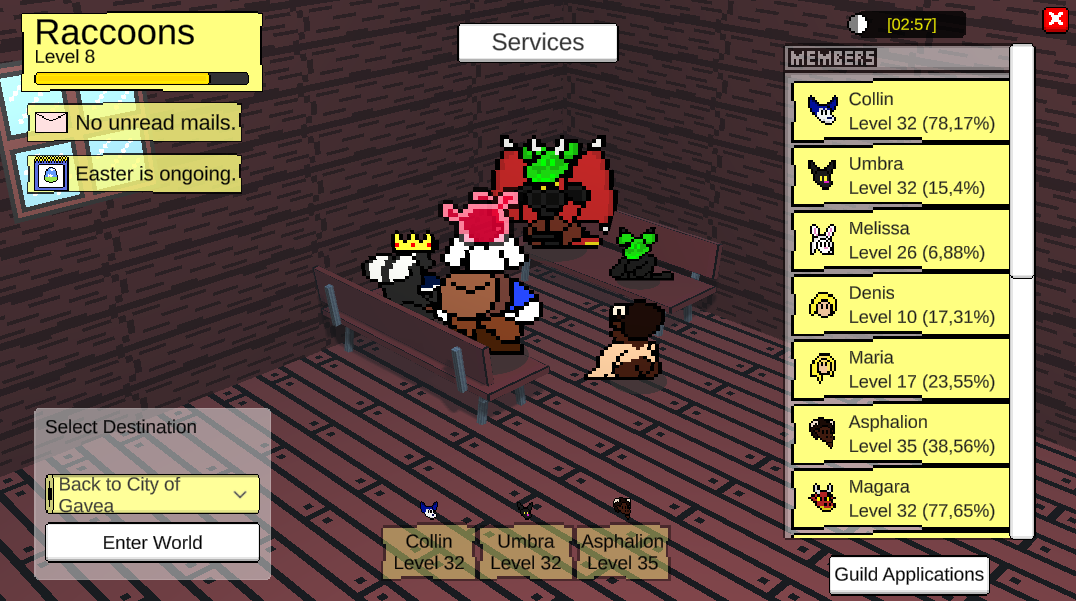
🛡️ The Real MMO Guild Officer
Scenario: You run an actual MMORPG guild like the one above, with member levels, contribution percentages, and a stack of applications, and you're considering a new loot or points policy.
Traditional Approach: Roll the policy out live and hope it doesn't trigger drama. Tools like
and cogm help with rosters, events, and fight analysis, but they don't predict how people will react.Roleplay Game Master: Simulate a guild of personalities reacting to your proposed rules before you announce them. Then use Project Coordinator to track the officer tasks, deadlines, and blockers that come with the rollout.
- Stress-test loot and attendance rules in a safe sandbox
- Rehearse difficult conversations with demanding members
- Keep officer duties organized in one place
Frequently Asked Questions
What is the best AI guild management game?
It depends on what you want. Dedicated titles like Our Adventurer Guild or Guild Management Simulator offer polished visuals and tuned mechanics, but their content is pre-built. If you want a guild whose recruits, events, and story are generated live in response to your decisions, an AI game master offers far more variety, with the trade-off that the experience is text-based.
Is Roleplay Game Master free?
Yes. Roleplay Game Master is available on the free tier with all core features and limited usage, which is enough to start a campaign. Long-running guild campaigns benefit from paid plans: Plus at $20/month provides 30× the free usage plus custom model selection, and higher tiers scale further. Usage resets monthly with no daily caps.
How is an AI guild game different from a guild sim on Steam?
Most guild sims draw from fixed content. Even games that used AI during development, like Guild Management Simulator, ship pre-generated material and don't create anything while you play. An AI game master generates recruits, dialogue, and consequences in real time, so two campaigns starting from the same prompt can diverge completely.
Can the AI track my guild's gold, roster, and injuries?
Yes. With unlimited memory, the AI game master can maintain your treasury, member status, injuries, and faction standings across a long campaign. The most reliable approach is to request a status block after every turn and occasionally ask for a full guild report. Like any AI, it can make arithmetic slips, so a quick glance at the ledger keeps things precise.
Can I play an AI guild management game on my phone?
Yes. The experience has full feature parity across web, iOS, and Android, with settings and chat history synced between devices. Speech-to-text lets you issue orders by voice, which works well for quick turns on a commute. You can start a campaign on desktop and continue on mobile without losing any context.
Conclusion
Traditional guild sims deliver a satisfying loop of recruiting, dispatching, looting, and upgrading, but fixed content means that loop eventually stops surprising you. An AI guild management game removes that ceiling. Your recruits remember, your failures leave scars, and your guild's history belongs to you rather than to a developer's script.
Whether you want a numbers-heavy economy sim, a narrative-driven mercenary saga, or a sandbox for testing real MMO guild policies, a generative AI game master adapts to how you want to lead.
Try Roleplay Game Master now and found your first guild. Explore more at Jenova.
For Developers: Roleplay Game Master is available programmatically via the Jenova API, so you can integrate persistent, character-consistent AI game mastering into your own game or community app with a single API call. Full documentation →