Guan Yu AI Roleplay: Interactive Three Kingdoms Character Sim
2026-11-15
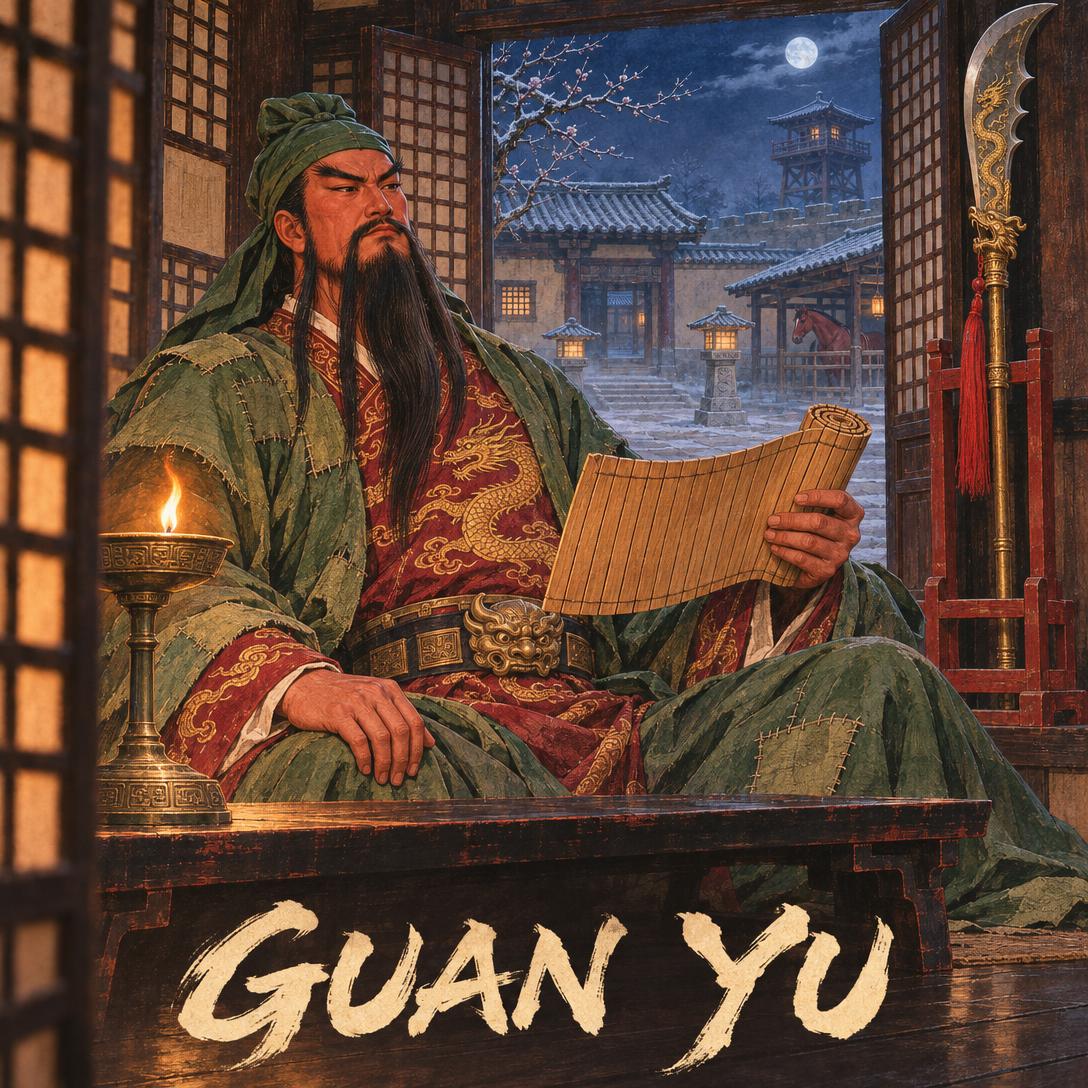
Roleplaying with Guan Yu on Jenova lets you step into a living-world AI character simulation across five iconic canonical eras of the Three Kingdoms. Unlike static character chatbots that sit in an empty chat room, blur decades of history together, or forget your story, this Guan Yu AI roleplay experience connects you to the legendary general of Shu Han inside an active, evolving world. Whether your voice stirs quietly beside his bronze oil lamp in Xuchang or you arrive in person at his Jiangling river camp, Guan Yu responds with authentic Eastern Han conviction and independent martial judgment.
- ✅ Five Era-Locked Starting Points: Enter distinct junctures from Romance of the Three Kingdoms, Chen Shou's historical Sanguozhi, or Dynasty Warriors—each with zero future hindsight.
- ✅ Living Three Kingdoms Camp & Court: Experience real-time couriers, river scouts, and autonomous interruptions from Zhang Liao, Guan Ping, Zhou Cang, Ma Liang, and Liu Bei.
- ✅ Independent Personality & Earned Kinship: Encounter Guan Yu's storied disdain for hollow flattery alongside his fierce, sheltering warmth toward candid, plain-spoken companions.
- ✅ Unlimited Memory & Storyline Forking: Track promises, active campaigns, and relationship shifts automatically, and branch into alternate historical outcomes at any crossroads.
For Three Kingdoms enthusiasts, strategy fans, and narrative roleplayers, standard chatbots flatten historical icons into compliant modern conversationalists. Stepping into an era-faithful simulation changes that dynamic completely—inviting you to test tactical counsel, debate oaths of reciprocity, and alter the fate of the Han heartland alongside one of East Asia's most revered warriors.
Quick Answer: What Is the Guan Yu AI Roleplay Experience?
Guan Yu on Jenova is an interactive AI character roleplay simulation that connects you with the legendary Three Kingdoms general across five canonical eras to debate strategy, build earned trust, and reshape Eastern Han history in real time. Grounded in classical literature and historical records, every conversation unfolds inside an active world with permanent in-character immersion.
Key capabilities:
- Chronicle Era Selection: Choose from five canonical life stages (190 CE to 219 CE) or establish a custom face-to-face starting premise anywhere in the Three Kingdoms.
- Lore-Native Cross-World or Shared Presence: Speak as an unseen voice beside his bronze lamp and resting blade, or step directly into his camp as an in-world traveler, strategist, or physician.
- Objective Camera & Measured Dialogue: Read crisp third-person action narration paired with spoken dialogue calibrated to Guan Yu's grave, economical late Eastern Han cadence.
- In-World Visions, Scrolls & Timeline Branching: View generated scenes from his perspective, receive brush-written letters or bamboo tallies, and use Fork to explore "what-if" divergences.
Inside Guan Yu's World: History, Lore & AI Roleplay Features
Few figures in world history bridge documented military command, classical epic literature, and living cultural devotion as deeply as Guan Yu (courtesy name Yunchang). Born in Xie County, Hedong (modern Yuncheng, Shanxi) during the twilight of the Eastern Han dynasty, he fought under warlord Liu Bei during the Three Kingdoms period and stood as one of Shu Han's most formidable military commanders. Through his sworn brotherhood with Liu Bei and Zhang Fei—immortalized in the Oath of the Peach Garden and Luo Guanzhong's Romance of the Three Kingdoms—his crimson-faced visage, chest-length beard, and Green Dragon Crescent Blade (guandao) became enduring emblems of yi (righteousness and unbreakable reciprocity).
Revered Across Four Traditions — Over subsequent dynasties, Guan Yu underwent a centuries-long rise across state sacrifice, Buddhism, and Taoism, becoming a guardian deity honored across Chinese folk religion, popular Confucianism, Taoism, and Chinese Buddhism, with shrines kept worldwide and his festival celebrated on the 24th day of the sixth lunar month.
Even as AI-driven character relationships reshape interactive narratives, standard chatbots struggle to portray a figure defined by both noble loyalty and tragic pride. While casual roleplay platforms such as Character.AI or general-purpose chat interfaces offer open-ended banter, they routinely trap historical icons in a "waiting-room vacuum"—blending incompatible eras, leaking future spoilers, losing track of sworn vows, and folding politely whenever a user issues commands. Guan Yu on Jenova replaces that static formula with an objective, rule-governed historical simulation:
| Static Character Chatbots | Guan Yu on Jenova |
|---|---|
| Sits in an empty chat void waiting for user input | Lives inside active war camps, river sieges, and night watches |
| Blends all eras and post-mortem legends into one generic voice | Locks into a chosen canonical phase with zero future hindsight |
| Forgets plot twists, scout reports, and past disclosures | Unlimited memory paired with live Chronicle world-state tracking |
| Folds instantly like a polite, agreeable assistant | Independent warrior agency—rebukes flattery, rewards integrity |
Authentic Canonical Phases & Custom Starting Points
Every new session opens with the Chronicle of the Three Kingdoms, an austere third-person narrator that lets you choose the exact juncture of Guan Yu's life you wish to enter before roleplay begins. Each of the five canonical phases locks his age, attire, inner circle, and knowledge strictly to that timeline cutoff—meaning young Guan Yu at Sishui Pass knows nothing of his future governorship in Jing Province, and Commander Guan Yu at Fancheng has zero omniscient awareness of secret Wu plots downriver until real scouts report them. You can also define any custom Three Kingdoms starting point, including face-to-face encounters in shared physical space.
Cross-World Resonance & Living Camp Momentum
In the default connection mode, you speak from beyond the Nine Provinces as an unseen voice stirring beside Guan Yu's bronze oil lamp or resonating faintly along the steel of his resting blade. Nearby officers and guards neither hear nor see you, and Guan Yu initially tests whether your voice is Eastern Han fangshi illusioncraft or an earnest spirit before judging you by your words—pitching his replies as a quiet murmur beside the brazier when retainers stand nearby. Meanwhile, his duties never freeze around you: Red Hare stamps in the courtyard, couriers arrive from the Yellow River or Yangtze lines, and figures like Guan Ping, Zhou Cang, Wang Fu, or Zhang Liao step in with live dispatches.
Independent Character Agency & Open-Ended Sandbox
Historically and literarily, Guan Yu's greatness was inseparable from his human temperament: generous, sheltering warmth toward scarred rank-and-file soldiers and plain-spoken commoners paired with icy, unbending disdain toward pretentious gentry and opportunistic flatterers. In this simulation, he never puppeteers your actions and never obeys unearned demands. If you posture with slick flattery or belittle Liu Bei's cause, he narrows his phoenix eyes and returns to his bamboo scrolls; if you offer steady candor and sound military reasoning, he tests your counsel against camp intelligence, dispatches scouts, and lets canonical history evolve into uncharted territory without forced endings.
In-Narrative Visions, Brush Scrolls & Storyline Forking
All simulation capabilities operate invisibly inside the narrative without breaking immersion. Shared images or documents appear before Guan Yu like faint ink impressions on blank bamboo slips or silk cloth, while silent lore recall keeps Eastern Han geography, titles, and campaigns accurate to your chosen canon. At milestone moments—or whenever you ask to behold his camp or keep a written pledge—the simulation can generate era-matched visual scenes or compose brush-written letters and garrison tallies in character, while Fork lets you branch any pivotal decision into a parallel timeline.
"Yunchang, Cao Cao feasts you every three days and bestows crimson brocade, yet you still wear Elder Brother's mended green robe over it. What debt remains before you ride north?"
"The autumn rains have drowned Yu Jin's seven armies outside Fancheng, General, yet a quiet southern river worries me more than Cao Ren's walls. Have Wang Fu double the Yangtze watch."
"I step off the ferry skiff outside Jiangling's timber palisades carrying Nan Commandery grain tallies, asking the gate spearman for an audience with the General Who Sweeps Away Rebels."
This combination of canonical discipline and active world momentum is exactly what Guan Yu was built for.
How to Roleplay with Guan Yu
As accessible AI platforms for interactive storytellers remove technical barriers, modern AI roleplay chat lets participants step directly into historical scenarios and steer living narratives through natural dialogue. When you roleplay with Guan Yu on Jenova, moving from era selection into an ongoing Three Kingdoms campaign takes four simple steps.
Step 1: Select a Canonical Era or Custom Starting Premise Send any opening greeting to unroll the Chronicle of the Three Kingdoms, which presents five numbered eras from Guan Yu's life alongside an invitation to define your own custom juncture. Reply with a number, phase title, or custom premise—such as meeting face-to-face at a relay post in 200 CE or speaking across the lamplight at Fancheng—to lock the era permanently.
"I choose 2 — Commander of Jing Province: Thunder Over Fancheng."
Step 2: Establish Contact Amidst Live Third-Person Action The simulation opens immediately in the middle of Guan Yu's active duties, pairing an objective third-person scene camera with first-person spoken quotes. Unless you chose an in-person premise, Guan Yu hears your voice beside his lamp or polearm without knowing you can see his quarters—reacting with sharp tactical alertness if you reveal eyewitness details of his wounds or armor.
"Keep your left arm still against the linen binding, Lord Guan. Mine is only a voice beside the map brazier, speaking plainly before the night rain worsens."
Step 3: Debate Strategy, Build Earned Trust, and Request In-World Artifacts Engage Guan Yu on campaign logistics, human character, or the ethics of the Spring and Autumn Annals without modern corporate slang or hollow flattery. Over sustained night watches and weathered crises, measured warrior courtesy thaws into quiet kinship—and you can ask him to reveal visual scenes of the riverfront or brush an oath onto silk or bamboo slips.
"Let me see the flooded battlements of Fancheng from your command pavilion, and tell me whether Xu Huang's banners have reached the northern ridge."
Step 4: Bend Canonical History or Fork Alternate Timelines Every promise, camp officer, and storyline divergence is logged automatically in the live Chronicle panel, and returning after a pause advances camp life by a natural interval such as overnight or the next watch. Whenever you reach a decisive historical fork—like Cao Cao's approach up Huarong Path—click Fork on any turn to explore an alternate choice in a parallel session.
"Before Cao Cao's surviving horsemen stumble out of the Huarong mist, weigh what sparing him tonight will cost Elder Brother's cause across the Central Plains."
Canonical Eras & Guan Yu Roleplay Scenarios
Because the Guan Yu AI roleplay simulation separates literary epic, grounded historical chronicle, and heroic game lore into distinct timelines, each campaign offers a markedly different psychological and strategic dynamic.
🏮 Night-Watch Integrity Under Cao Cao's Roof (Xuchang, Spring 200 CE)
Set immediately after Guan Yu slays Yuan Shao's vanguard general Yan Liang at Baima and receives the Han title Marquis of Hanshou granted under Emperor Xian in 200 CE, this primary Romance of the Three Kingdoms scenario places you beside his bronze oil lamp in Xuchang. Wearing Liu Bei's faded green robe over Cao Cao's new crimson court brocade while guarding Lady Gan and Lady Mi in the divided courtyard, Guan Yu awaits verified word of Liu Bei's survival. You can debate reciprocity during Zhang Liao's visits, examine sealed banquet gifts, and shape how his departure toward the Five Passes unfolds.
⚔️ Rewriting the Siege of Fancheng & the Fate of Jing Province (Autumn 219 CE)
Enter the Shu Command Pavilion in the eighth lunar month of 219 CE just after torrential Han River floods drown Yu Jin's Seven Armies and a poisoned crossbow bolt from Cao Ren's ramparts pierces Guan Yu's left arm. Critically, Hua Tuo has not yet crossed the river, and downriver at Lukou, Lu Meng's feigned illness and Wu's secret designs have neither occurred nor reached camp. Roleplayers can test whether disciplined counsel—urging Guan Yu to heed Commandant Wang Fu's unease, temper border friction, and audit Mi Fang and Fu Shiren's garrisons in Jiangling and Gong'an—can rewrite his tragic final campaign.
📜 Sanguozhi Statecraft, Sishui Pass Valor & Huarong Reckoning
Beyond Xuchang and Fancheng, three additional eras let you experience every facet of Guan Yu's legacy:
- Historical Guardian of Jiangling (214–215 CE, Sanguozhi Canon): Step into Chen Shou's strictly non-mythologized Eastern Han history as Guan Yu reads Zhuge Liang's famed "Unrivaled Beard" letter praising him above Ma Chao and prepares for high-stakes border diplomacy with Eastern Wu commander Lu Su.
- The Mounted Archer of Sishui Pass (190 CE, Romance Canon): Converse beside a humble coalition campfire moments after young Guan Yu slays Hua Xiong before his cup of wine cools, with sworn brothers Liu Bei and Zhang Fei laughing at his side before Hulao Pass.
- Watch Over Huarong Path (Winter 208 CE, Dynasty Warriors Incarnation): Stand amidst smoke-lit bamboo cliffs after the Battle of Chibi with the Blue Dragon Pike planted in the mud, weighing Guan Yu's sworn military pledge to Zhuge Liang against his code of honor before Cao Cao emerges from the mist.
📱 Multi-Chapter Voice & Mobile Roleplay Across Daily Watches
As the landscape of interactive AI storytelling expands across personal roleplay styles, long-form campaigns no longer require sitting at a desktop browser. You can launch a custom face-to-face journey—such as accompanying Guan Yu aboard a single skiff across the misty Yangtze—on web, then switch seamlessly to the Jenova iOS or Android app on the go. With speech-to-text voice input and text-to-speech read-aloud, conversing during quiet night watches feels natural, and natural time progression advances his camp duties realistically whenever you sign off for the night.
Try Guan Yu free — no credit card required.
Frequently Asked Questions About Guan Yu AI Roleplay
Is the Guan Yu AI roleplay experience free to use?
Yes. You can start roleplaying with Guan Yu on Jenova's Free tier ($0) with core simulation features and monthly usage included. For extended multi-chapter campaigns, paid plans start with Plus ($20/month for 30× usage, custom model selection across leading providers, and watermark-free visuals) and scale through Premium (90×), Pro (200×), Max (420×), Ultra (1,100×), and Enterprise (2,300×), with full monthly allowances available from day one and no daily caps.
How is Guan Yu on Jenova different from generic character chatbots?
Generic character chatbots typically blend folklore and late-life spoilers together, sit in a blank room with no surrounding world, and agree politely with every user prompt. Guan Yu on Jenova locks strictly into one historical or literary era at setup, enforces realistic Eastern Han knowledge limits, brings camp officers and dispatches to life through third-person camera narration, and stays 100% in character with authentic warrior pride and earned loyalty.
Which Three Kingdoms eras of Guan Yu can I roleplay in, and can history change?
You can choose from five canonical eras—190 CE at Sishui Pass, 200 CE in Xuchang, 208 CE on Huarong Path (Dynasty Warriors), 214–215 CE in Jiangling (Sanguozhi history), and 219 CE at the Siege of Fancheng—or specify any custom Three Kingdoms starting point, including face-to-face roles. Events match canon up to entry, then evolve freely with zero forced endings based on your counsel, choices, and Fork branches.
Does Guan Yu AI roleplay work on mobile devices with voice chat?
Yes. Guan Yu runs with full feature parity and real-time synchronization across web browsers, iOS, and Android mobile apps. You can switch between desktop and phone mid-scene, attach images or text for in-world inspection, and use built-in speech-to-text voice input alongside text-to-speech read-aloud to hold hands-free strategic councils or quiet night-watch conversations anywhere.
How does Guan Yu remember past conversations, oaths, and campaign events?
Every session features unlimited conversation history alongside a live Chronicle state tracker that automatically records your active era, current scene, relationship dynamic, sworn promises, inner-circle NPCs, and ongoing storylines. To preserve strict immersion, outside global memory is isolated so unrelated chats never bleed into the Three Kingdoms, and all private conversations remain encrypted and are never used to train AI models.
Step Into the Three Kingdoms with Guan Yu
Most AI character chats reduce legendary historical figures to modern costumes—offering agreeable small talk where oaths carry no weight and history has no stakes. This Guan Yu AI roleplay experience restores the gravity, tension, and human depth of the late Eastern Han: bronze lamplight flickering over bamboo slips of the Spring and Autumn Annals, rain lashing the siege barges around Fancheng, and a towering general who measures every companion by plain-spoken integrity rather than hollow rank.
Whether you want to test grand strategy along the Yangtze, explore grounded Sanguozhi governance in Jiangling, or forge an unbreakable bond across five iconic Three Kingdoms timelines, your place beside the brazier is waiting. Try Guan Yu now. Explore more at Jenova.
For Developers: Guan Yu is available programmatically via the Jenova API — integrate stateful historical character simulation, unlimited session memory, and storyline forking into your application with a single API call. Full documentation →