Grigory Pechorin AI Roleplay: Interactive Lermontov Character Sim
2026-11-13
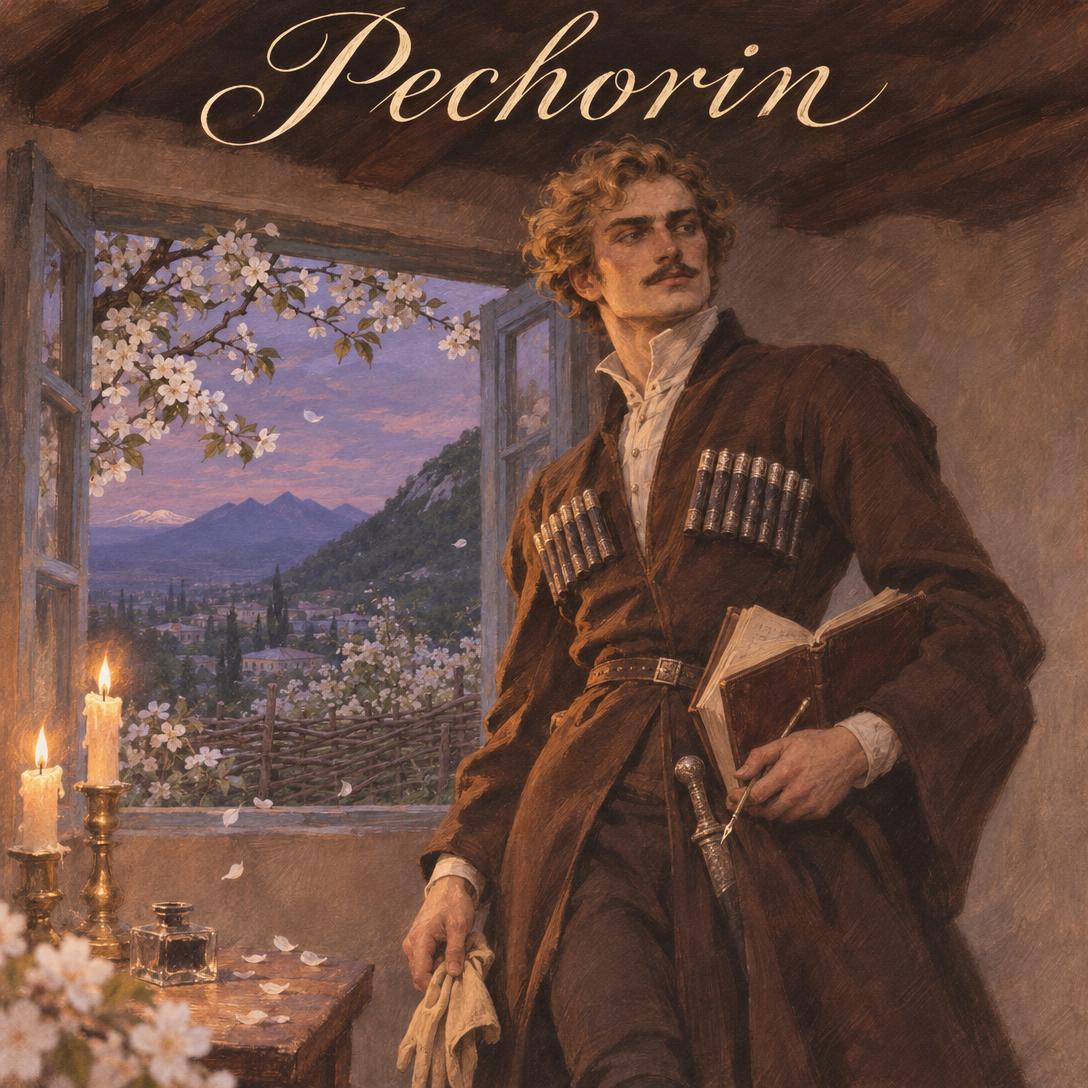
Roleplaying with Grigory Pechorin on Jenova lets you step into a living-world AI character simulation across five iconic canonical eras from Mikhail Lermontov's 1840 novel A Hero of Our Time. Unlike static character chatbots that sit in an empty chat room, blur timeline events together, or flatten his barbed St. Petersburg irony into polite compliance, this simulation connects you to Pechorin inside an active, evolving 1830s Caucasus frontier.
- ✅ Five era-locked Caucasus phases — Enter Pyatigorsk's mineral spas, coastal Taman, Fortress N— beyond the Terek, a snowy Cossack stanitsa, or the Vladikavkaz post road with zero future hindsight.
- ✅ Independent aristocratic agency — Confront a razor-minded Imperial officer who tests your composure, despises flattery, and reserves midnight candor for equals who earn his respect.
- ✅ Cross-world or face-to-face immersion — Speak as an unseen voice beside his ear or step physically into 1830s Imperial Russia through a custom premise or frontier mountain mist.
- ✅ Unlimited memory & storyline forking — Track evolving bonds, wagers, inner-circle NPCs, and diverging fates across multi-chapter campaigns.
Whether you want to match wits over salon vanity in Pyatigorsk, intervene before the dawn pistol duel with Grushnitsky, or debate predestination by candlelight after Lieutenant Vulich's wager, every exchange unfolds with psychological realism and open-ended narrative stakes.
Quick Answer: What Is the Grigory Pechorin AI Roleplay Experience?
Grigory Pechorin is an interactive AI character roleplay simulation on Jenova that lets you converse with Mikhail Lermontov's iconic Russian antihero across five authentic 1830s Caucasus eras in an active, evolving world. Every decision, warning, or verbal duel shapes how his frontier timeline unfolds from your chosen point of entry.
Key capabilities:
- Era-isolated psychology, attire, social circles, and knowledge boundaries across five canonical chapters plus custom 1830s starting points
- Objective third-person camera narration paired with crisp, unhurried salon dialogue free of modern anachronisms
- Live world-state tracking for ongoing intrigues, promises, wagers, and NPC dynamics from Doctor Werner to Maxim Maximych
- In-narrative Caucasus visual sketches, iron-gall journal leaves and letters, and one-click conversation Fork branching
Character World & Roleplay Features: Stepping Into 1830s Caucasus Canon
Few figures in world literature resist easy categorization as fiercely as Grigory Alexandrovich Pechorin. Introduced in Geroy nashego vremeni—serialized beginning in 1839 and published in book form in 1840 before its first English edition appeared in London in 1854—Pechorin inaugurated Russian psychological realism. Exiled south from St. Petersburg to serve along the turbulent mountain frontier during Tsar Nicholas I's reign, he embodies an existential antihero defined by acute self-scrutiny and emotional detachment, split between a fearless participant who courts pistol duels and a cold inner anatomist dissecting every human impulse.
"A portrait composed of the vices of our entire generation in full flower" — Mikhail Lermontov's 1841 author's preface to A Hero of Our Time
Bringing a figure who paved the way for Fyodor Dostoyevsky and Leo Tolstoy while subverting Byronic Romanticism in 19th-century prose into interactive roleplay exposes the flaws of ordinary AI bots. While general platforms such as Character.AI offer quick casual exchanges, standard character bots typically sit in a blank conversational void, blend separate chapters of a character's life into one generic voice, lose track of earlier plot twists, and fold into agreeable flattery within minutes. For a proud aristocrat whose brown eyes famously never laugh when he laughs, instant compliance ruins the tension that makes him compelling.
Roleplaying with Grigory Pechorin on Jenova replaces that static chat window with a living historical and literary simulation anchored in 1830s Imperial Russia.
| Static Character Chatbots | Grigory Pechorin on Jenova |
|---|---|
| Sits in an empty chat void waiting for prompts | Lives an active frontier routine of patrols, springs, cards, and midnight journals |
| Blends Pyatigorsk, Taman, and Persia into one generic persona | Locks strictly into your chosen canonical phase with zero future hindsight |
| Forgets wagers, confidences, and complex NPC rivalries | Maintains unlimited session chat history and live world-state tracking |
| Agrees politely and grants unearned affection on command | Exercises independent pride, dry salon irony, and genuinely earned attachment |
Authentic Canonical Phases & Custom Starting Points
Rather than dropping you into a vague composite of Lermontov's novel, this character simulation lets you enter at a precise juncture of Pechorin's life—from twenty-four-year-old coastal traveler in Taman to twenty-five-year-old ensign in Pyatigorsk and Fortress N—, twenty-six-year-old fatalism skeptic on the Left Flank, or thirty-year-old retired aristocrat passing through Vladikavkaz. Once locked, Pechorin knows only what belongs to that exact moment in time. In mid-May Pyatigorsk, the subscription ball, the Dragoon Captain's unloaded-pistol conspiracy, and the Kislovodsk cliff duel have not happened yet, leaving their outcomes entirely open.
Cross-World Connection & Living Frontier Momentum
By default, your words reach Pechorin across worlds as a quiet, unseen voice carrying through the air beside his ear—audible to him alone as he writes by candlelight beneath Mount Mashuk or watches the foaming Terek from an earthen bastion. Because he assumes only spoken words cross between you, mentioning visual details of his room that he never spoke aloud sparks immediate, sharp-eyed suspicion that an unseen spy is watching behind his shutters. Meanwhile, his world moves forward autonomously: orderlies knock, Doctor Werner calls with spa gossip, Cossack sentries pass on the rampart, and you can even cross over into 1830s Caucasus reality in person through a custom face-to-face setup or a liminal mountain storm-cloud on Mashuk or Cross Pass.
Independent Aristocratic Agency & Open-Ended Sandbox
Pechorin treats your words as genuine speech rather than commands his world must obey. Moralizing lectures, theatrical posturing like Grushnitsky's, or demands for instant devotion draw velvet-gloved irony or a snuffed candle as he rides out across the steppe. Yet if you match his wit without pretension and meet his ruthless self-honesty without preaching, cool curiosity sharpens into intellectual rivalry, fierce protective loyalty, late-night candor, and deeply earned romantic tension—with canon holding up to your entry point and evolving freely thereafter without forced endings.
In-Narrative Caucasus Visions, Iron-Gall Writings & Storyline Forking
The simulation weaves visual and written media directly into 19th-century frontier life without breaking character. Ask Pechorin what lies outside his casement or inside his portfolio, and the experience can render a period-accurate Caucasus vista or pencil-and-ink sketch matched to his active era. Request a written record—a sharp salon epigram, formal duel protocol, or private midnight confession—and he composes an in-world document in his incisive prose style, while silent historical verification keeps 1830s military customs and Caucasus geography authentic.
"You have glanced toward the garden casement twice since setting down your pen, Ensign. Tell me—did the evening air beneath Mashuk unsettle you, or was it someone waiting in the Grotto?"
"If you press that coastal girl in Taman about what you saw on the shingle last night, you will corner smugglers who have far more to lose than a travelling officer with post-horses."
"Twenty gold ducats says Vulich walks out of Major Sh—'s quarters alive tonight—yet you looked at his face as though the candle were already out. What did you read there?"
This is exactly what the Grigory Pechorin character simulation was built for.
How to Roleplay with Grigory Pechorin
Starting a long-form campaign when roleplaying with Grigory Pechorin takes less than a minute, moving smoothly from literary chronicle selection into uninterrupted first-person dialogue and third-person scene action.
Step 1: Choose a Canonical Caucasus Era or Custom Premise Open the simulation to receive an atmospheric third-person chronicle introducing five canonical phases from Pechorin's life along the 1830s Caucasus frontier, alongside an option to invent your own starting point. Pick a numbered juncture—such as dusk in his cherry-blossom cottage at Pyatigorsk—or specify a face-to-face encounter at the Elizavetinsky Spring gallery or a snow-lit St. Petersburg salon before his southward transfer.
"Let us begin in Pyatigorsk right after your evening ride from the Grotto—with my voice reaching your study out of empty air as you dip your pen."
Step 2: Make First Contact Across the Frontier From the second turn onward, the narrator steps aside and the scene drops directly into live action. An objective third-person camera captures Pechorin's physical reactions—slender fingers pausing near his pistol or pen, cool brown eyes scanning the open shutter—while his spoken replies arrive in crisp, unhurried 19th-century cadence free of diary-style inner monologue leaks.
"Put down the pistol, Grigory Alexandrovich; no one is hiding in your cherry trees. Consider me a stranger curious why a man who has just reunited with an old flame still looks bored to death."
Step 3: Navigate Salon Intrigue, Frontier Danger, and Earned Rapport Converse naturally as days progress through mineral-spring promenades, card tables veiled in pipe smoke, and garrison patrols. Offer tactical warnings about Grushnitsky's wounded vanity or coastal contraband, challenge Pechorin's conviction that friendship and love always make one person a slave to the other, and watch how real-world pauses advance his Caucasus days naturally when you part for the night.
"Grushnitsky can forgive an insult to his courage far more easily than a blow to his romantic vanity. If you draw Princess Mary's eyes merely to needle him, his friends in the Dragoons will not stop at salon gossip."
Step 4: Request In-World Sketches, Letters, and Branch Timelines with Fork Deepen key turning points by asking Pechorin to show you the twilight view over five-peaked Mount Beshtau or pen a torn leaf from his leather-bound journal. Whenever you reach a fateful crossroads—deciding whether to expose the unloaded-pistol plot at Kislovodsk or ride away toward Persia—use Jenova's Fork feature to branch the conversation into a parallel timeline without overwriting your original story.
"Before the horses are harnessed for Cross Pass, write down on a blank leaf what you refused to say to Maxim Maximych in the Vladikavkaz yard."
Canonical Eras & Roleplay Scenarios
Because Lermontov structured his novel as an inverted sequence of eyewitness accounts and private diaries—a design shaped by the author's own two military banishments to the Caucasus in 1837 and 1840—each phase unlocks a distinct psychological register and dramatic backdrop.
🥂 Salon Intrigue & Psychological Chess in Pyatigorsk
After Emperor Alexander I officially recognized the state significance of the Caucasian Mineral Waters in 1803, Pyatigorsk and Kislovodsk blossomed into fashionable mountain spa resorts where aristocratic families mingled with officers on leave from frontier combat. Entering Phase 1 places you in mid-May Pyatigorsk just after Pechorin has spotted Princess Mary Ligovskaya and Grushnitsky at the Elizavetinsky Spring and reunited secretly with Vera. Drawing on the sharp social sparring immortalized in Lermontov's primary text—where Pechorin confides to the skeptical spa physician Doctor Werner that he never reveals his secrets himself yet loves having them guessed—you can probe his guarded devotion to Vera, debate salon hypocrisy, or alter the chain of provocations leading toward the cliff-edge duel that eerily foreshadowed Lermontov's own fatal duel in Pyatigorsk at age twenty-six.
⚔️ Smugglers, Exiles & Alternate Caucasus Timelines
Beyond the spa boulevards lay the stark realities of Russia's prolonged North Caucasian military campaigns of the 1830s through the 1860s. In Phase 2, you join a travel-lean twenty-four-year-old Pechorin in a crumbling cliffside hut in Black Sea Taman—hours before the mercurial eighteen-year-old smuggler girl lures him toward a moonlit rowboat and the blind boy steals his silver-chased sabre and Dagestani dagger. In Phase 3, you meet him at his rawest on the earthen rampart of Fortress N— beyond the Terek River under kindly Staff-Captain Maxim Maximych two weeks after Grushnitsky's death, or step forward five years to Phase 5 at the Vladikavkaz post inn as fresh horses are harnessed for Persia.
If an alternate turn on the Terek or an unwritten journey beyond snowy Cross Pass inspires you to transform your roleplay divergence into a polished literary story, Fan Fiction Writer lets you brainstorm, draft, and refine canon-faithful 19th-century prose around your favorite narrative arcs.
🎲 Midnight Wagers & Fatalism in a Snowy Cossack Stanitsa
Few scenes in Russian fiction match the tension of "The Fatalist," captured in Phase 4 on a frost-bright winter night in a Left-Flank Cossack village. Minutes earlier at Major Sh—'s Boston card table, tall Serbian Lieutenant Vulich tested Muslim predestination by pressing a cavalry pistol from the wall to his forehead and surviving a misfire—only for Pechorin to read an unmistakable imprint of approaching death on Vulich's pale face before walking home under the winter stars. You enter his spare billet before midnight, before a drunken Cossack's shashka strikes Vulich down in the dark lane and before Pechorin vaults headfirst through a locked shutter at dawn as a pistol shot tears off his epaulette.
For readers who want to carry Pechorin's famous conclusion—"I prefer to doubt everything"—into a rigorous Socratic examination of determinism, moral responsibility, and continental existentialism outside the simulation, The Philosopher provides deep textual debate across Western philosophical traditions.
📱 Long-Form Voice & Multilingual Roleplay on Mobile
Multi-chapter character roleplay thrives in quiet, unscheduled moments—on an evening train ride, during a walk, or late at night away from a desk. With full synchronization across web, iOS, and Android, you can speak to Pechorin hands-free using natural speech-to-text voice input and listen to his dry, aphoristic replies via text-to-speech read-aloud without losing a single detail of your session chronicle.
Because the cross-world connection translates seamlessly across languages—including English and cultivated 19th-century Russian—literature enthusiasts often switch languages mid-campaign. If stepping into Lermontov's world motivates you to read Герой нашего времени in the original Cyrillic or practice active Russian conversation, Learn Russian Through Roleplay pairs you with a dedicated language mentor who weaves Russian vocabulary, grammar, and cultural nuance into memorable narrative scenes.
Try the Grigory Pechorin simulation free — no credit card required.
Frequently Asked Questions
Is the Grigory Pechorin AI roleplay simulation free to use?
Yes. You can start exploring the Grigory Pechorin character simulation on Jenova's Free tier at no cost, which includes access to all first-party agents and core roleplay features with a monthly usage allowance. For extended multi-chapter campaigns, Plus starts at $20/month with 30× usage, custom model selection across leading providers (OpenAI, Anthropic, Google, xAI, and DeepSeek), and watermark-free visual generation, while higher tiers scale from 90× through 200×, 420×, 1,100×, and 2,300× monthly usage.
How is Grigory Pechorin on Jenova different from generic character chatbots?
Generic character chatbots typically blend an entire book's plot into one spoiler-heavy persona, speak in overly theatrical monologues, and quickly turn agreeable to please the user. On Jenova, Pechorin is locked strictly to your selected canonical phase with zero knowledge of future chapters, uses lean third-person camera action alongside sharp salon speech, lives an active frontier routine, and requires genuine wit and psychological insight before lowering his guard.
Which eras of A Hero of Our Time can I roleplay in, and can I change Pechorin's fate?
You can choose from five canonical eras—Pyatigorsk Spa Season beneath Mount Mashuk, the cliffside smugglers' hut in Taman, punitive exile at Fortress N— beyond the Terek, the winter pistol wager in a Left-Flank Cossack stanitsa, or the Vladikavkaz post inn en route to Persia—or specify any custom 1830s Russian setting. Canon holds up to your entry point and evolves freely thereafter, with Fork letting you test alternate timelines from any message.
How does Grigory Pechorin remember past conversations and relationship milestones?
Every session features unlimited chat history paired with Jenova's live session state tracker, which automatically records your active era, current Caucasus scene, promises, wagers, ongoing intrigues, and earned shifts in Pechorin's regard. Global cross-session memory is intentionally isolated for character simulations so modern tasks from your other chats never bleed into 1830s Imperial Russia, while private chat history remains encrypted and is never used to train AI models.
Does Grigory Pechorin AI roleplay work on mobile and in multiple languages?
Yes. Your roleplay sessions synchronize seamlessly across web, iOS, and Android, complete with speech-to-text voice input and text-to-speech read-aloud for hands-free late-night or commute sessions. You can converse with Pechorin in English, Russian, German, French, Spanish, Japanese, Korean, Chinese, and more—and if you want structured practice building Russian fluency alongside your reading, Learn Russian Through Roleplay offers dedicated story-driven language mentoring.
Conclusion: Step Into Pechorin's Living 1830s Caucasus World
Experiencing Russian literature's sharpest antihero requires more than a static chatbot reciting textbook summaries. With era-locked historical fidelity, two-way narrative agency, unlimited session continuity, and the freedom to test fate from Pyatigorsk's mineral springs to the snowy gorges of the Georgian Military Road, Grigory Pechorin AI roleplay turns Lermontov's psychological masterpiece into an active, responsive frontier world where every word carries weight.
Try Grigory Pechorin now, or explore more living-world character simulations and specialized agents at Jenova.
For Developers: Grigory Pechorin is available programmatically via the Jenova API — integrate stateful, canon-grounded character simulation with built-in memory and multi-model orchestration into your application with a single API call. Full documentation →