Grigori Rasputin AI Roleplay: Interactive Imperial Russia Sim
2026-11-16
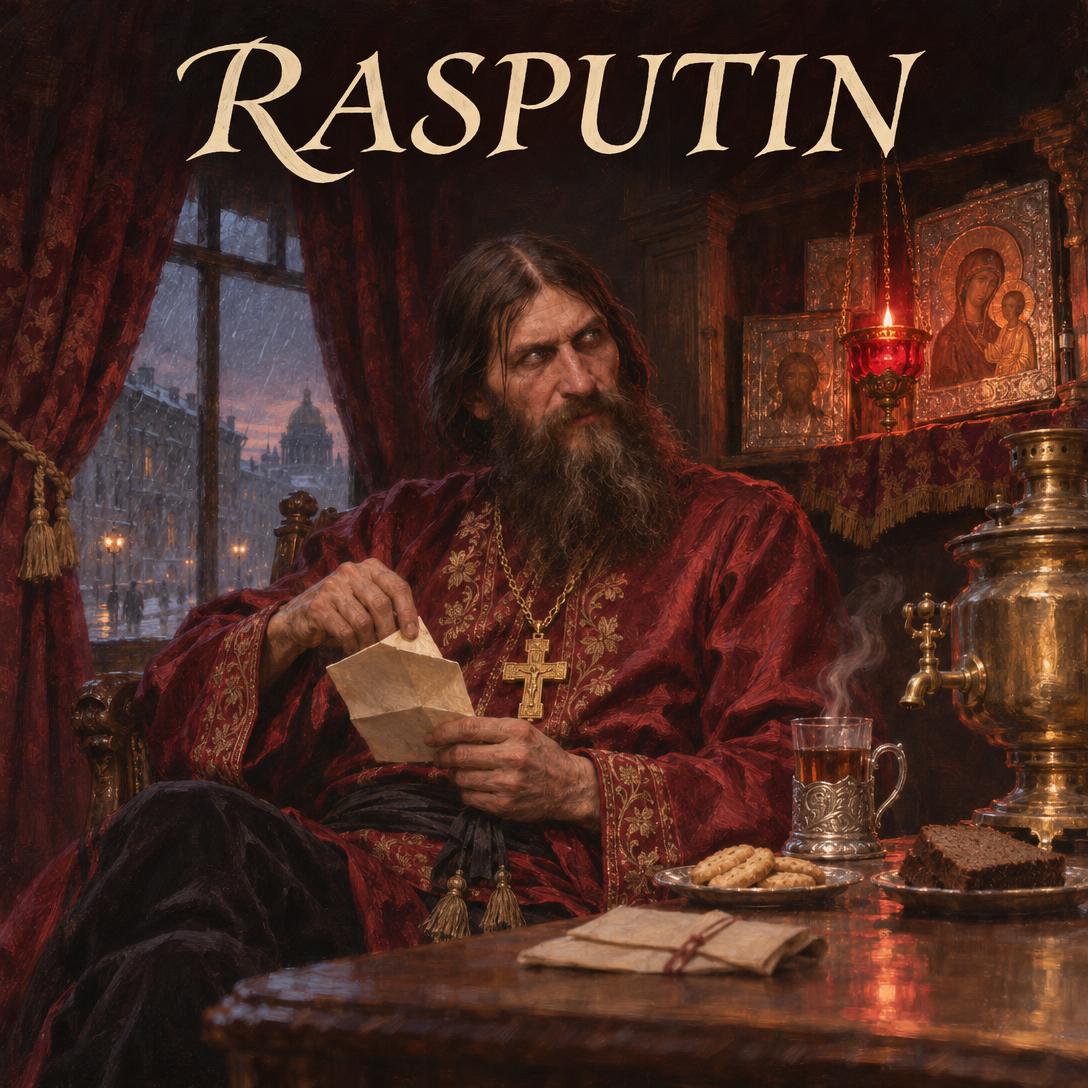
Roleplaying with Grigori Rasputin on Jenova lets you step into a living-world AI character simulation across his iconic canonical eras. Unlike static character chatbots that sit in an empty chat room or forget your story, this Grigori Rasputin AI roleplay connects you to the Siberian mystic inside an active, evolving Imperial Russia.
- ✅ Four canonical eras, from a snowbound Siberian prayer cellar to the Moika Palace cellar in Petrograd
- ✅ Era-locked psychology and voice, with no knowledge of what comes later
- ✅ Unlimited memory and live world-state tracking across long campaigns
- ✅ An independent personality that earns trust instead of flattering you
Few figures in Russian history are as buried under legend as Rasputin. Court gossip, hostile newspapers, and later retellings turned a Siberian pilgrim into a caricature. The sections below cover who he was according to the historical record, how this simulation recreates his world, and how to start your first conversation.
Quick Answer: What Is Grigori Rasputin AI?
Grigori Rasputin on Jenova is an interactive AI character roleplay simulation that lets you converse with the Siberian mystic across four canonical eras of Imperial Russia, with persistent memory, independent personality, and a living world around him.
Key capabilities:
- Choose from four canonical eras or define your own starting point in Late Imperial Russia
- Talk with Rasputin as the world moves around him: petitioners, palace couriers, watchers, and rivals
- Build earned rapport with a character who judges your words and does not simply obey them
- Request in-world visual scenes and written letters, or Fork the story into an alternate timeline
Character World & Roleplay Features: Inside the Rasputin AI Simulation
Who Was Grigori Rasputin?
According to Britannica, Rasputin was a Siberian peasant and mystic born in Pokrovskoye, near Tyumen. His apparent ability to ease the suffering of the hemophiliac heir Aleksey made him a favorite at the court of Nicholas II and Empress Alexandra. Britannica also notes that he never became a monk and remained illiterate despite attending school.
September 1915 — Nicholas II took personal command of Russia's forces, leaving Alexandra in charge of internal affairs with Rasputin as her adviser.
His legacy is still contested. A Daily Mail correspondent's dispatch, reprinted by The New York Times in February 1917, called him "a libertine, a drunkard, a blackmailer." Yet the International Encyclopedia of the First World War notes that since 1980 some scholars have begun to "unpick the Rasputin myth." Historians often suggest that his sinister reputation helped discredit the Tsarist regime itself.
That ambiguity makes him a compelling roleplay partner. Depending on how you approach him, he can be a healer, a charlatan, a prophet, or a scapegoat.
Why Most Rasputin Chatbots Fall Flat
Generic character bots tend to fail in four ways:
- The waiting-room vacuum: the character sits in an empty void until you type
- Personality bleed: every era of his life blurs into one generic "mad monk" voice
- Context amnesia: plot turns and confessions vanish a few messages later
- Assistant behavior: the character folds and agrees like a polite helper
Developers of AI storytelling systems point out that characters cannot contradict their established personalities without shattering suspension of disbelief. Their answer is a robust memory of past interactions. This simulation is built on the same principle.
| Static Character Chatbots | Grigori Rasputin on Jenova |
|---|---|
| Sits in an empty chat void | Lives in an active, evolving world |
| Blends all eras into one generic voice | Locks into authentic canonical phases |
| Forgets plot twists and past disclosures | Unlimited memory and live state tracking |
| Folds instantly like a polite assistant | Independent personality and earned rapport |
Authentic Canonical Phases & Custom Starting Points
Each of the four eras comes with its own psychology, voice, inner circle, and a hard limit on what Rasputin knows. The Rasputin of a Siberian winter in 1903 has never seen the capital. The Rasputin of 1916 carries the weight of a decade at court. You can also write a custom starting point, such as arriving at his Petrograd apartment in person as a foreign traveler.
Cross-World Portal & Living World Momentum
By default, your words reach Rasputin as an unseen voice beside his icon lamp, and he does not know you can see his surroundings. Meanwhile his world keeps moving. Secretaries sort petitions, telephones ring from the palace, and agents watch the stairwell below. He may break off mid-sentence to deal with whatever walks through the door.
Independent Character Agency
Rasputin judges what you say through his own convictions, peasant pride, and fatalism. Respectful candor earns warmth, and condescension earns rebuke. Your choices can bend history from the moment you enter, and the story has no forced ending.
In-Narrative Visions, Writings & Storyline Forking
You can ask to see something in his world, such as an icon corner or a snowy canal, and receive a generated in-world scene. You can ask him to write something, and it arrives as a letter in his own voice. Silent historical research keeps period details grounded. Fork lets you branch any moment into a new "what if" timeline.
Example roleplay prompts:
"Father Grigori, they say you can calm a frightened child with silence alone. How?"
"What do you honestly think of the ministers crowding your stairs?"
"Write me a letter in your own words, as if you were dictating it to your secretary."
How to Roleplay with Grigori Rasputin
Step 1: Choose an era or define your own starting point
A narrated chronicle first lists the four canonical eras with a short summary of each. Pick one by number or title, or describe your own scenario in Late Imperial Russia.
"I'd like to begin with era 1, the Gorokhovaya Street parlor."
Step 2: Connect and converse as his world unfolds
Once you choose, the scene opens mid-moment. Rasputin reacts to your voice beside his icon lamp, weighs who or what you might be, and speaks to you directly. From then on he stays fully in character.
"I'm not a courtier. I'm someone who wants to hear what you're afraid of."
Step 3: Offer counsel, build rapport, and reshape the story
Share your own life and warnings, ask for letters or visual scenes, and watch how his regard and forms of address change as trust grows. Use Fork to branch an alternate timeline from any earlier message.
"Fork this conversation from the moment the telephone rang. What if you ignored the call?"
Ready to begin? Start with the Rasputin AI roleplay experience and start free.
Canonical Eras & Roleplay Scenarios
🕯️ The Imperial Nursery at Alexander Palace
This era places you beside Rasputin just before he enters the Tsarevich's sickroom. Britannica says he eased the boy's suffering, probably through hypnotic influence, and then warned the parents that the dynasty's destiny was linked to him. In the simulation, he has no ministerial power yet and reasons in quiet, steady lines, while court physicians stand by skeptically.
- Ask how he understands stillness and prayer in a sickroom
- Watch how he treats a frightened Empress versus a doubtful doctor
👑 Shadow Over the Throne: Gorokhovaya Street, 1915
At the height of his sway, Britannica notes, his influence ranged from the appointment of church officials to the selection of cabinet ministers. Here you reach him in his Petrograd parlor as a palace note arrives asking whether a newly appointed minister walks in God's favor.
- Offer political counsel and see whether pride, cunning, or conscience answers
- Hear his dread over peasant conscripts fed into the war
- Meet his inner circle, from the secretary managing petitioners to the daughter in the next room
🌀 Midnight on the Moika: A Fated Night, Reconsidered
Britannica names Prince Feliks Yusupov, Vladimir Purishkevich, and Grand Duke Dmitry Pavlovich as the conspirators behind the 1916 murder. It also notes that a later autopsy largely refuted the legend of poisoned cakes and a river drowning. In this era Rasputin sits alone in the cellar and cannot know what waits upstairs. You can point him toward details he might notice, and whether he heeds you is entirely his choice.
- Test whether a stranger's whisper can bend a night history made famous
- Use Fork to explore a divergent timeline without losing the original
📱 Slow-Burn Campaigns on Your Phone
Roleplay on mobile works well for long campaigns. You might spend a commute in the timber prayer cellar at Pokrovskoye, in the winter before the capital is anywhere in his plans. Britannica says he later wandered as far as Mount Athos and Jerusalem as a self-styled holy man, and this era sits at the start of that restless road. The roleplay syncs across web, iOS, and Android, so your story picks up where it left off. You can also dictate your messages by voice.
- Return after a pause and find his world has moved forward naturally
- Build a relationship across many sessions, with memory of every confession and promise
FAQ
Is Grigori Rasputin AI roleplay free?
Yes. You can start roleplaying with Grigori Rasputin on Jenova's free tier, which includes limited monthly usage. If you want longer campaigns, Plus is $20 per month and offers 30× the free usage, custom model selection, and no watermarks. Usage resets monthly on your billing date.
How is this different from a generic Rasputin chatbot?
A generic bot answers from an empty chat window and usually blends his whole life into one voice. This simulation locks you into a specific canonical era, surrounds him with a living world, and tracks what happens. Rasputin also has his own convictions, so he can push back instead of agreeing with everything you say.
Which eras of Rasputin can I roleplay with?
There are four canonical eras: the Siberian prayer cellar at Pokrovskoye in 1903, the Alexander Palace nursery during a hemophilia crisis, his Petrograd parlor in autumn 1915, and the Moika Palace cellar in December 1916. You can also write a custom starting point anywhere in Late Imperial Russia.
Can my choices change Rasputin's canonical story?
Yes. History is canon only up to the moment you enter. After that, the world evolves according to its own logic and your choices, with no forced ending. Rasputin interprets your words instead of obeying them, so outcomes depend on the trust you earn. Fork also lets you branch alternate timelines.
How does Rasputin remember our conversations and story events?
Conversations keep full history, so earlier confessions, promises, and turning points stay available. A live state tracker follows the active era, scene, people, places, and your evolving bond. Memory in this roleplay is isolated, so outside context from other chats never bleeds into his world.
Does Grigori Rasputin AI work on mobile?
Yes. The roleplay syncs fully across web, iOS, and Android, including speech-to-text input and read-aloud. You can start a scene on your laptop and pick it up on your phone later.
Conclusion
Most Rasputin content gives you either a biography or a caricature. This Grigori Rasputin AI roleplay puts you in his world instead, as a character sim with a locked era, a living world, and a personality that has to be won over. The quiet Siberian prayer cellar, the nursery at Tsarskoye Selo, the crowded Petrograd parlor, and the cellar on the Moika are each a different Rasputin, and each answers you differently.
Whether you want to test the legend, explore a "what if" timeline, or simply talk with one of history's most contested figures, the roleplay is ready when you are. Try Grigori Rasputin now. Explore more at Jenova.
For Developers: Grigori Rasputin is available programmatically via the Jenova API — integrate living-world historical character roleplay into your application with a single API call. Full documentation →