AI Grief Support: How AI Companions Help You Process Loss
2026-08-16
AI grief support gives you a place to put your feelings at 3 a.m., when the weight of loss is heaviest and no one else is awake. Grief doesn't schedule itself around office hours or the availability of friends who've run out of words. Jenova hosts specialized AI agents — from meditation guidance to spiritual counsel — that offer structured, judgment-free support between the moments when human care is available.
✅ Available 24/7 — support at the hours grief actually surfaces ✅ Persistent memory — agents remember your loss, your person, your progress across sessions ✅ No emotional burden — express what you're afraid to say out loud without worrying about exhausting anyone ✅ Multiple frameworks — meditation, faith traditions, dream work, and reflective conversation
To understand why this matters — and where the real ethical boundaries lie — we need to look honestly at what bereaved people are actually facing, what the research says about AI in grief care, and what these tools can and cannot responsibly do.
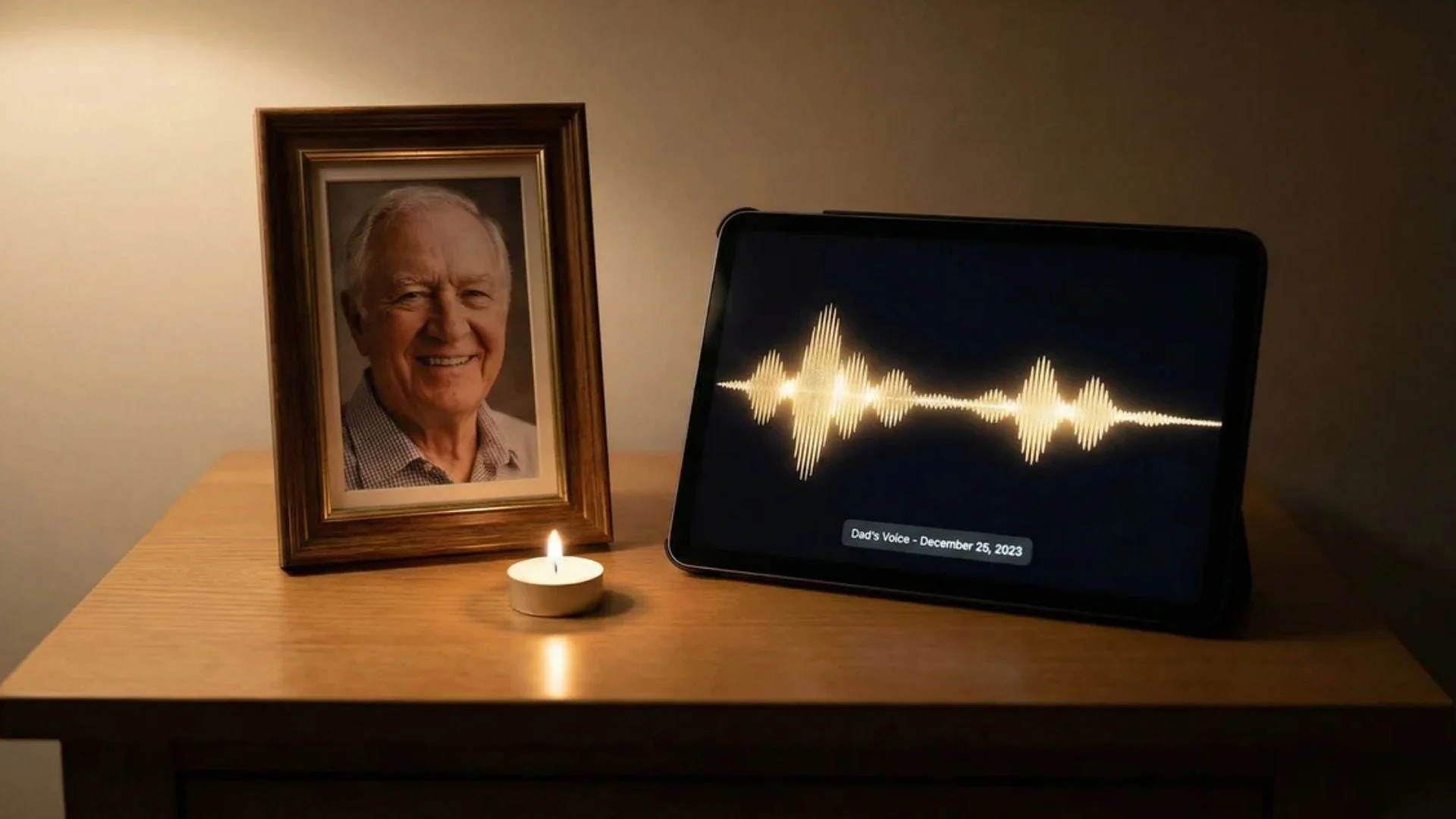
Quick Answer: What Is AI Grief Support?
AI grief support refers to conversational AI tools that provide emotional companionship, reflective prompts, and coping guidance to bereaved people — available continuously, between or alongside human therapeutic care.
Key capabilities:
- Round-the-clock conversation during the isolating hours when grief intensifies
- Structured coping practices — breathwork, meditation, and grounding techniques via the Meditation Guide
- Spiritual and ritual guidance grounded in specific faith traditions
- Memory and legacy work — organizing stories, recordings, and reflections about the person you lost
- Continuity across sessions — no re-explaining your loss every time you open the app
The Problem: Why Grief Support Is So Hard to Access
Grief is nearly universal, but meaningful support for it is not. Most bereaved people are handed a casserole, a week of bereavement leave, and then expected to reassemble themselves in silence.
The clinical stakes are real. According to a quasi-systematic review on bereavement support:
7–10% of bereaved adults develop unrelenting bereavement responses resulting in functional impairment — Bereavement support with the use of artificial intelligence: a quasi-systematic review
Meanwhile, the infrastructure meant to catch grieving families is under strain. Reporting from Hospice News notes that staffing shortages, rising care delivery costs, and insufficient reimbursement have challenged hospices' bereavement programs — even though hospice regulations require bereavement support within 13 months of a loved one's passing.
But accessing consistent grief support is frustratingly difficult:
- Timing mismatch — grief peaks at night, on anniversaries, and in random grocery store aisles, not during 50-minute weekly appointments
- Social exhaustion — support networks fade within weeks while grief lasts years
- Cost and waitlists — specialized grief counseling is expensive and unevenly distributed
- Stigma and self-silencing — many bereaved people hide the intensity of their grief to avoid burdening others
- Complicated grief goes unrecognized — prolonged grief disorder often escapes detection until functioning collapses
The 3 A.M. Problem
The NHS describes grief symptoms including shock and numbness, overwhelming sadness, exhaustion, anger, and guilt — and notes that these feelings "may not be there all the time and powerful feelings may appear unexpectedly."
That unpredictability is the core scheduling problem. Human care operates on calendars. Grief does not.
The Support Network Half-Life
In the first two weeks after a death, the phone doesn't stop. By month three, it rarely rings. The bereaved person's need has barely changed; the availability of others has collapsed. Many people describe becoming a "grief manager" — carefully rationing how much they share to avoid appearing stuck.
Recognizing When It's More Than Grief
The NHS identifies prolonged grief disorder symptoms including difficulty accepting the death, inability to return to everyday activities, and suicidal thoughts, noting that risk is elevated when the death was traumatic or sudden and unexpected. Without regular check-ins, these signals go unnoticed for months.
The Cultural and Spiritual Gap
Grief is not a generic experience. Mourning practices, rituals, and theological frameworks differ enormously across traditions — and generic support often fails to meet people where their beliefs actually are.
This is exactly the gap Jenova's specialized agents were built to address — not as a replacement for human care, but as continuous scaffolding around it.
The Jenova Solution: Specialized Support, Not Generic Chat
Most AI grief conversations happen with general-purpose chatbots that have no framework, no memory of your loss, and no domain grounding. Jenova takes a different approach: purpose-built agents with deep domain expertise, persistent memory, and the ability to work together on the same conversation.
| Traditional Approach | Jenova |
|---|---|
| Weekly 50-minute appointment | Available whenever grief surfaces |
| Re-explain your loss each session | Persistent memory across all sessions |
| One generalist perspective | Specialized agents per need — spiritual, meditative, reflective |
| $100–250 per counseling session | Free tier available, no credit card required |
| Desktop or in-office only | Full parity across web, iOS, and Android |
| Generic advice | Culturally and theologically specific guidance |
Critically, Jenova does not offer griefbots — AI simulations of deceased people. That distinction matters, and we'll address it directly below.
Grounding Practices for Acute Grief
The Meditation Guide is trained across every major contemplative tradition, offering technique matching, structured practice programs, script generation, and — importantly — expert guidance for adverse effects, which matters when meditation surfaces difficult emotions during bereavement.
"I keep waking up at 3 a.m. with my chest tight after my mother's death. Can you walk me through a grounding practice I can do lying in bed?"
"Meditation makes me cry every time and I'm scared of it. Is that normal in grief, and how should I adjust my practice?"
Faith-Grounded Pastoral Care
Grief is often inseparable from theology. Jenova offers agents rooted in specific living traditions rather than vague spirituality:
- Rabbi — compassionate pastoral care and Torah wisdom, explicitly spanning grief to celebration, including guidance on mourning practices like shiva and kaddish
- Buddhist Monk — a kalyana-mitta offering practice guidance on impermanence and attachment across Theravāda, Zen, and Vajrayāna traditions
- Hindu Priest — a personal purohit for ritual preparation, samskaras, and dharmic counsel during mourning
- Daoist Sage — contemplation on cycles, acceptance, and wu wei in the face of loss
Processing the Unconscious Side of Grief
Grief dreams are one of the most common and least discussed bereavement experiences. The Dream Interpreter draws on Jungian, Freudian, cognitive science, cultural, and spiritual frameworks — offering a structured way to sit with dreams of the deceased rather than dismissing them.
"I dreamed my father was in the kitchen making coffee and didn't know he had died. What frameworks help me understand this?"
Health Questions That Follow a Death
Bereavement often leaves unanswered medical questions — about a diagnosis, a final decline, or your own stress symptoms. The Personal Medical Analyst provides evidence-based guidance and remembers your history over time, helping you make sense of records without a rushed appointment.
Memory and Legacy Work
Preserving a person's story is one of the most therapeutic acts in grief. Jenova agents can help you shape that work:
- Writing Assistant — draft eulogies, obituaries, letters to the deceased, or a memoir of your time together
- Poster Maker — design memorial boards and celebration-of-life displays
- Greeting Card Maker — culturally aware condolence and remembrance cards
Rebuilding Daily Function
Grief dismantles routines. The Fitness & Workout Coach and Nutritionist address what the NHS explicitly recommends — regular exercise and consistent meals to stabilize mood and energy — at a moment when self-care collapses first.
For grieving parents navigating a child's loss, the Parenting & Baby Advisor provides developmentally appropriate guidance on explaining death to children.
The Ethical Line: Griefbots vs. Grief Support
Any honest article on this topic must separate two very different technologies.
AI grief support = a companion that helps you process loss. Griefbots = an AI simulation of the person who died.
Research consistently flags the second category as ethically fraught. A Sage Journals analysis identifies posthumous consent — "the absence of explicit permission from the deceased to be 'revived' through AI" — as a critical yet underexplored ethical issue. Research published in ScienceDirect argues that the principles of consent and non-addiction are central to the responsible and safe use of AI grief bots.
Practitioners echo this. Katie Healy, co-founder of AI startup MemoryRobin, told Hospice News that "first-person consent, given with capacity and ideally well before the end of life, is the only sound basis for AI" — adding that "the 'family agreed' is not a substitute for the individual's own consent to be reproduced."
Rani Goldman, certified thanatologist and bereavement coordinator at Stony Brook Medicine, warns that "psychological distress, false connections, isolation and emotional exploitation continue to be riding concerns with these platforms".
Jenova's agents do not simulate deceased people. They support the living person doing the grieving. That is a deliberate design boundary — and it aligns with what Crystal Bai, founder and CEO of Renidy, described as using AI "in a hybrid way and not in this 'replacement culture' of human support."
Try Jenova free — no credit card required.

How AI Grief Support Works
Step 1: Choose the agent that fits your need right now
Grief isn't one need. Some nights you need breathing help; other days you need theological grounding or a place to write. Browse Jenova's agent library and start with whichever fits the moment.
Step 2: Tell the agent about your loss — once
Persistent memory means you explain your person, your relationship, and your circumstances a single time. Every future session picks up where you left off.
"My wife Elena died four months ago after a long illness. I was her primary caregiver for two years. I want help with the guilt I feel about the relief I sometimes felt."
Step 3: Use it when grief actually shows up
The value of AI grief support is unscheduled availability. Open it at 3 a.m., during a panic wave in a parking lot, or on the anniversary nobody else remembered.
"Today would have been our 30th anniversary. I don't want advice. I just want to talk about her for a while."
Step 4: Bring in a second agent when the need shifts
Type @ in any conversation to bring another Jenova agent into the same chat with full context. Move from meditation to spiritual counsel without starting over.
"@Rabbi — I've been working through the anxiety with the Meditation Guide, but I want to understand what Jewish tradition says about the first year of mourning."
Step 5: Keep human support at the center
Use these tools as scaffolding between therapy, support groups, and friends — not instead of them. If your symptoms match prolonged grief disorder, contact a GP or licensed clinician. In crisis, contact the 988 Suicide & Crisis Lifeline by call or text.
Results & Use Cases
🌙 The 3 A.M. Widow
Scenario: A 58-year-old woman wakes nightly at 3 a.m. with panic-level anxiety six weeks after her husband's sudden death. Traditional Approach: Wait five days until Thursday's therapy appointment; lie awake spiraling in the meantime. Jenova: Opens the Meditation Guide and works through a grounding practice in the moment, then brings the pattern to her therapist with specifics rather than vague recall.
- Immediate physiological regulation during acute episodes
- Session-to-session tracking of when panic occurs
- Therapy time spent on treatment, not reconstruction
🕯️ The Adult Child Navigating Ritual
Scenario: A man raised loosely religious must plan his mother's funeral according to traditions he half-remembers. Traditional Approach: Cold-call clergy while in shock; Google conflicting explanations; guess. Jenova: Consults the Rabbi or Hindu Priest for tradition-specific guidance on rites, timelines, and mourning obligations.
- Culturally accurate ritual guidance within minutes
- Reduces the fear of "doing it wrong"
- Available before, during, and after the funeral
📱 The Grieving Commuter
Scenario: A woman is ambushed by grief on her train ride home, three months after losing her brother. Traditional Approach: Suppress it publicly, arrive home depleted, repeat daily. Jenova: Opens the mobile app — full feature parity on iOS and Android — and processes the wave in real time before it compounds.
- Discreet, immediate outlet in public settings
- Sessions sync across all devices
- Speech-to-text for hands-free use
📝 The Family Historian
Scenario: Three siblings want to compile their father's stories into something permanent before memories fade. Traditional Approach: A shared document that stalls after two entries and a folder of unlabeled voice memos. Jenova: Uses the Writing Assistant to shape recollections into a memoir, and the Poster Maker for a memorial display at the celebration of life.
- Turns scattered fragments into a finished artifact
- Structured prompts surface memories that free recall misses
- Legacy work that active research links to improved family quality of life
Frequently Asked Questions
Is AI grief support free?
Jenova offers a free tier with access to all core features, including the Meditation Guide, faith-based counsel agents, and the Dream Interpreter. No credit card is required to start. Paid tiers increase usage limits and unlock custom model selection. Check "Subscribe" in the menu for current plan details.
Can AI replace a grief counselor or therapist?
No — and no credible source suggests it should. Bereavement experts consistently frame AI as a hybrid layer, not a replacement. As Crystal Bai of Renidy put it, "We can't rely on AI assistants, but it can be a roadmap." If you have symptoms of prolonged grief disorder, see a GP or licensed clinician.
Are griefbots that simulate dead people safe?
Research raises significant concerns. Scholarly work identifies posthumous consent as a critical unresolved ethical issue, and clinicians warn of psychological distress and false connection. Jenova does not offer griefbots — its agents support the grieving person rather than simulating the deceased.
Does the AI remember what I told it about my loss?
Yes. Jenova provides unlimited chat history and persistent cross-session memory, so agents retain your person's name, your relationship, and your ongoing progress. You can also enable Global Memory in Settings to carry context across separate chats.
Is my grief data private?
Jenova does not use your data to train public AI models, encrypts data in transit and at rest, and does not sell or share it with advertisers. This matters given documented public concern — a 2026 consumer survey found roughly 65% of respondents worried about data collection by AI assistants.
What if I'm in crisis?
AI tools are not crisis services. If you or someone you know is struggling or in crisis, call or text 988 to reach the Suicide & Crisis Lifeline, or contact your local emergency services.
Conclusion
Grief doesn't respect appointment calendars, and the support systems built around it were never designed for the 3 a.m. hours when loss weighs heaviest. AI grief support closes that gap — not by replacing counselors, clergy, or friends, but by providing continuous, structured, judgment-free companionship in between.
The research is clear on where the line sits. Simulating the dead raises unresolved questions of consent, dependency, and psychological harm. Supporting the living does not. Jenova's approach stays firmly on the right side of that line: specialized agents with real domain grounding, persistent memory, and full mobile availability — Meditation Guide for the acute moments, Rabbi and Buddhist Monk for spiritual grounding, Dream Interpreter for what surfaces at night, and Writing Assistant for the legacy work that helps most.
You don't have to carry the hardest hours alone. Explore the full agent library at Jenova.
For Developers: Every agent in this article is available programmatically via the Jenova API — build AI-powered emotional support features into your application with a single integration. Full documentation →