AI Graphic Novel Generator: Build Full-Length Illustrated Books
2026-08-10
Comic Creator is your personal comic book artist for crafting complete stories — and it scales all the way up to full-length graphic novel sagas. It handles the parts that stop long-form projects cold: sequential art across hundreds of pages, chapter-level pacing, bold visual styles held consistent from first page to last, and characters who look the same in chapter twelve as they did in chapter one. You bring the story and the direction; the AI executes the visual craft.
✅ Book-length capability — multi-chapter arcs and complete graphic novel sagas, not isolated pages ✅ Character consistency maintained across hundreds of panels and every chapter ✅ Sequential art and dynamic layouts built on real comic visual grammar ✅ Bold, uniform style — fantasy, sci-fi, noir, literary, or a custom look applied throughout
A graphic novel is a fundamentally different problem from a single issue. It's a book — with act structure, chapter breaks, thematic throughlines, and a production load that has killed more indie projects than any other format in sequential art. Understanding why long-form is the hardest tier of the medium is the fastest route to seeing what an AI graphic novel generator actually solves.
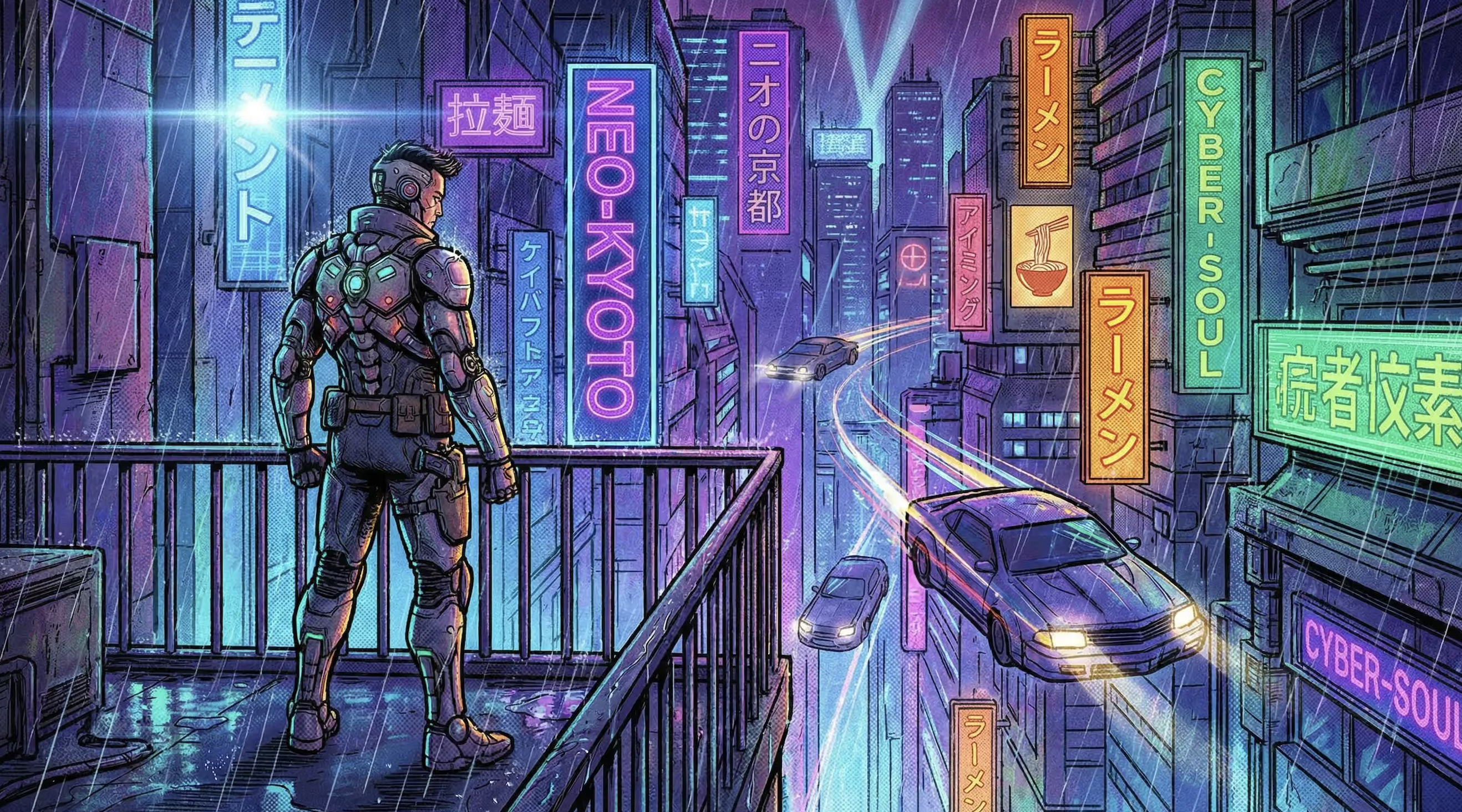
Quick Answer: What Is an AI Graphic Novel Generator?
An AI graphic novel generator is a tool that turns a written story into a complete, book-length illustrated work — producing sequential pages, panel layouts, and consistent character art across multiple chapters in a single unified style.
Key capabilities:
- Book-level story architecture — premise, act structure, chapter arcs, and thematic throughlines with the Comic Creator
- Character consistency at book scale — the same face, build, costume, and expression range across hundreds of pages
- Sequential page composition — panel hierarchy, gutter pacing, splash pages, and chapter-opening spreads
- Unified visual style — a single art direction held from page one to the final page
- Long-form output — complete graphic novels and multi-volume sagas, not single issues or one-off illustrations
The Problem: Why Graphic Novels Are the Hardest Format to Finish
The market has never been healthier, and long-form is where the money is.
USD 18.1 billion graphic novel market in 2026, reaching USD 45.16 billion by 2035 at a 7.2% CAGR — graphic novel market size and forecast
USD 2.2 billion in US and Canadian comics and graphic novel sales in 2025 — outstripping COVID-era highs — ICv2 White Paper on 2025 sales
Graphic novel sales are over 2.5× comic sales by format, with direct-market graphic novel sales up 28% year over year — ICv2 sales analysis
Readers want books, not just issues. Retailers surveyed by ICv2 named adult graphic novels among the categories expected to grow the most. But actually producing a 150-to-300-page illustrated book is where nearly every independent creator stalls:
- The page count is punishing — a graphic novel is 10 to 20 times the art volume of a single issue
- Character consistency compounds — drift that's invisible over 22 pages is glaring over 250
- Style drift over months — an artist's hand changes across a year-long project
- Chapter-level pacing is a book-writing skill layered on top of a drawing skill
- Hiring an art team for a full book costs more than most creators will ever recoup
- Distribution has gotten harder for the smallest publishers after industry consolidation
Character Consistency Compounds at Book Length
This is the single biggest failure point, and it scales badly. A slight drift in a jawline across two pages is imperceptible. The same drift accumulating across 250 pages produces a character the reader no longer recognizes. Industry analysis is direct that character consistency was always the biggest technical barrier to AI comics, and generic image generators fail here structurally — they produce a striking image with zero memory of the previous one.
That's fine for a cover. It's fatal for a book.
Style Drift Is a Long-Form-Specific Problem
A human artist drawing 250 pages over eighteen months will improve — and that improvement shows. Line weight tightens, anatomy sharpens, color choices mature. Readers experience it as inconsistency. Professional studios solve this with rigid style guides and dedicated art directors. Solo creators generally can't.
Chapter Pacing Is a Book Skill, Not a Page Skill
A single issue needs a hook, a turn, and a cliffhanger. A graphic novel needs act structure, chapter breaks that land on meaningful beats, subplot interleaving, thematic escalation, and a climax earned across hundreds of pages. Most first attempts read as a sequence of good scenes with no architecture holding them together.
The Volume Is a Multi-Year Commitment
At a realistic solo pace, a full graphic novel is a one-to-three-year unpaid project with no guarantee of an audience at the end. That risk profile is why so many manuscripts stay manuscripts.
The Skill Gap Is Really a Storytelling Bottleneck
The frustrating part: the people with the strongest long-form narrative instincts — novelists, screenwriters, worldbuilders — are frequently the ones who can't draw at all. Industry analysis frames the shift plainly: for writers who can't draw, the biggest barrier between a script and a finished comic has disappeared, and the creator's role moves from doing everything to directing and refining.
This is exactly what the Comic Creator was built for.
Why Comic Creator for Graphic Novels
The Comic Creator functions as a full comic book artist collaborator built for complete stories — explicitly scaled from single issues up to epic graphic novel sagas. It treats a graphic novel as a book first: narrative architecture drives every page decision, because that's how long-form sequential art actually works.
| Traditional Graphic Novel Production | Comic Creator |
|---|---|
| One to three years of solo unpaid production | Produce chapters at a sustainable, repeatable pace |
| Character consistency degrades across hundreds of pages | Locked character references carried across the entire book |
| Style drifts as the artist's hand evolves over months | A single unified art direction from page one to the last |
| Hiring an art team for a full book costs more than most recoup | Iterate freely at platform subscription cost |
| Chapter pacing learned through failed drafts | Book-level act structure and chapter architecture built in |
| Creative control shared with writers, pencillers, inkers, colorists | Full authorship and direction retained end to end |
Book Architecture Before Art
The Comic Creator builds the book before it builds a single page. Premise, three-act structure, chapter count and length, subplot placement, thematic escalation, and where the climax lands. You cannot compose page 180 well without knowing what page 180 is carrying.
"I want a fantasy graphic novel about a knight who kills the last dragon and discovers the kingdom needed the dragon alive. Help me structure this as a 200-page book with chapter breaks."
Character Consistency Across Hundreds of Pages
Design your cast once and their appearance carries forward — facial structure, build, armor and costume detail, scars, signature expressions — across every panel of every chapter. At book length this isn't a nice-to-have; it's the difference between a graphic novel and a portfolio.
"Design my protagonist: a woman in her late twenties, dark shoulder-length hair, scaled plate armor, torn cloak, glowing longsword. Lock this design and the color palette for the entire book."
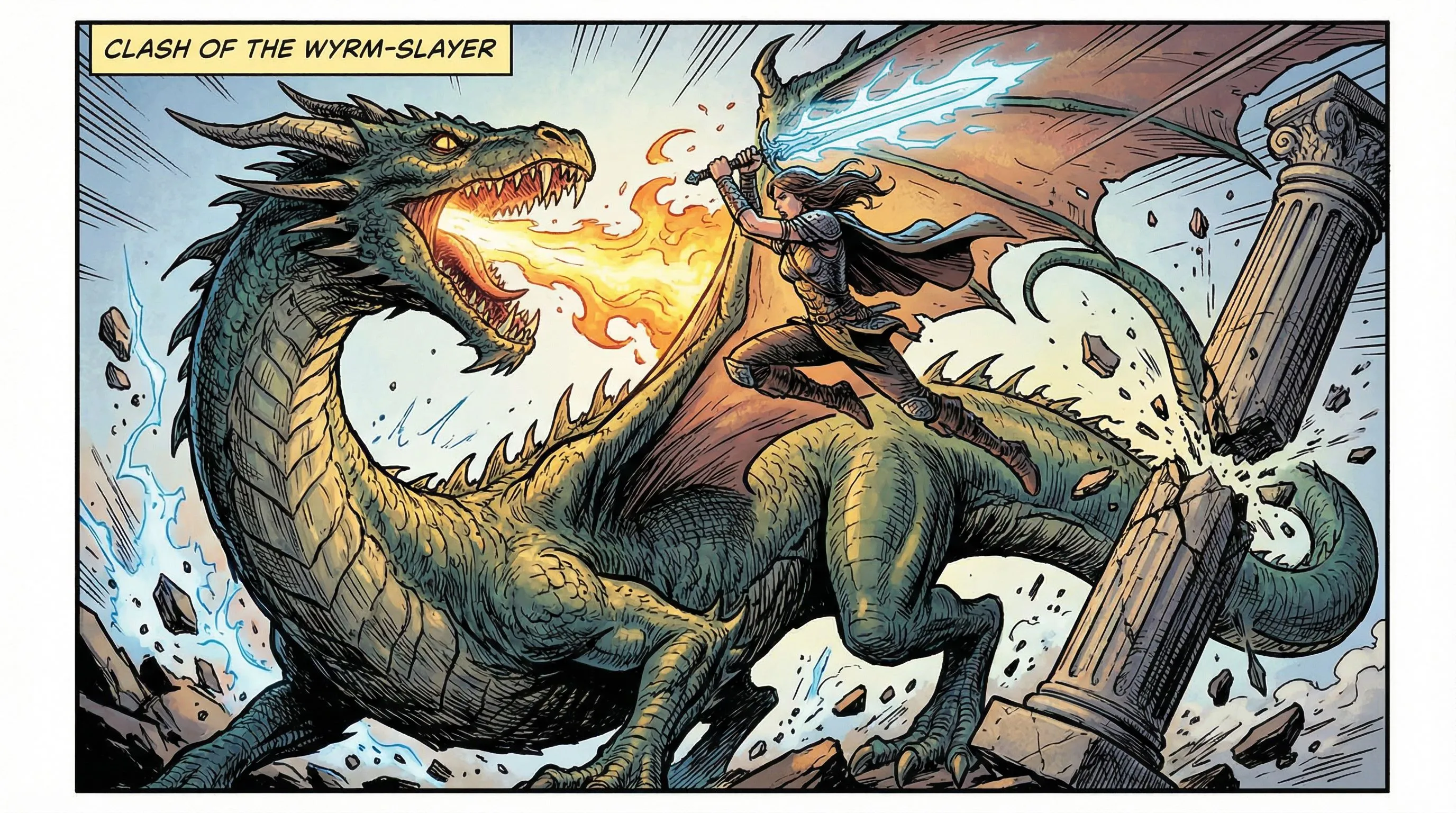
Dynamic Sequential Layouts
Panel hierarchy, gutter pacing as a timing device, diagonal compositions for kinetic action, wide establishing shots for scale, full-bleed splash pages for climactic beats, and chapter-opening spreads that reset the reader's attention.
A Single Unified Style Across the Book
Fantasy with heavy ink and saturated color. Cyberpunk with neon-lit high contrast. Noir with deep shadow and a limited palette. Literary with restrained linework and muted tones. Whatever register you choose applies uniformly — no drift between chapter one and chapter twelve.
Long-Form Memory Is the Actual Unlock
Recalling a character's exact design, a subplot's status, and a running visual motif 200 pages in is a memory problem, not an art problem. Unlimited chat history and persistent cross-session memory are what make a multi-month book project workable rather than a constant re-briefing exercise.
Related Agents You'll Also Find Useful
Graphic novels rarely stay in one lane. If you're building a full-length book, these agents cover the adjacent work you'll hit before you finish chapter three.
Creative Fiction Writer
Long-form graphic novels need real prose groundwork — worldbuilding bibles, character backstory documents, or a full novel draft you'll later adapt into panels.
- Deep research for authentic world construction
- Editorial insight from first draft to final manuscript
- Genre fluency across every narrative tradition
Manga Creator
If your book leans toward right-to-left Japanese sequential art — with its own panel conventions, screentone traditions, and pacing grammar.
- Manga-native visual storytelling and panel flow
- One-shots through 200+ page serialized epics
- Consistent art style across long-running arcs
Webtoon Creator
For serializing your graphic novel to mobile-first platforms before or after print release — vertical scroll is where a large share of new sequential-art readership now lives.
- Vertical scroll rhythm and pacing built for phone screens
- Episode hooks and cliffhanger structure for serialized release
- Full-color consistency across 100+ episode sagas
Graphic Designer
Every graphic novel needs assets that aren't interior pages — cover art, spine and back-cover design, title lettering, and promotional graphics for retail listings.
- Cover design and title treatment
- Print-ready formatting for physical editions
- Marketing and social graphics for launch
Try the Comic Creator free — no credit card required.
How It Works
Step 1: Bring Your Book Concept
Start with whatever exists — a finished novel, a rough outline, or a single premise. The AI develops it into a book-length structure with act breaks, chapter count, and arc placement.
"I have an idea about a courier in a rain-soaked megacity who smuggles memories between people. Help me turn this into a 180-page graphic novel structure."
Step 2: Lock In Your Cast and Art Direction
Design your characters and fix the visual register for the whole book. This becomes the reference every later chapter builds on, so page 200 still matches page one.
"Cyberpunk style, neon-heavy palette, high contrast, rain in almost every exterior. Lead is a cyborg courier, cropped dark hair, armored exosuit with teal accents. Lock this in for the full book."
Step 3: Break the Book Into Chapters
Map chapter boundaries to meaningful narrative beats, then plan page counts per chapter. This is where a graphic novel differs most from a single issue.
"Break this into eight chapters. I want chapter four to end on the reveal that her employer manufactured the memories she's been delivering."
Step 4: Storyboard and Generate Pages
Work chapter by chapter — pages into panels, panels into finished art with dialogue placement. Then iterate freely.
"Storyboard chapter one, 22 pages. Page 14 feels cramped — cut it from six panels to three and make the rooftop reveal a full-page splash."
Step 5: Carry the Book Forward
Continue into chapter two, then eight, with cast, palette, and style persisting automatically. This is where long-form memory does the heavy lifting — you aren't rebuilding your world every session.
"Start chapter five. Same cast, same palette. She goes back to the clinic and finds it's been empty for three years."
Results & Use Cases
📚 The Novelist Adapting to Sequential Art
Scenario: An author has a finished novel and wants a graphic novel edition to reach the fastest-growing segment of the book market.
Traditional Approach: Pitch to a publisher, wait through acquisition, or self-finance an art team for 200+ pages at a cost most authors will never recoup.
Comic Creator: Adapt the manuscript into chapter-by-chapter storyboards, then produce finished pages while keeping full authorship.
- Full creative control at every stage of adaptation
- Immediate iteration instead of multi-week revision cycles with a studio
- A complete book rather than a pitch package that may never be greenlit
Long-form is where the demand is concentrated — graphic novel sales are over 2.5 times comic sales by format.
💼 The Indie Creator Shipping a Full Book
Scenario: A creator has been drafting the same graphic novel for four years and has 30 finished pages.
Traditional Approach: Continue at roughly a page a week and finish sometime after year six, assuming motivation holds.
Comic Creator: Produce complete chapters at a sustainable cadence with the cast and style locked from the start.
- A finishable timeline instead of an indefinite one
- Character and color consistency held across the entire book
- Chapter architecture planned upfront rather than improvised
📱 The Cross-Format Publisher
Scenario: A creator wants their book to exist as both a print graphic novel and a serialized mobile release to build an audience pre-launch.
Traditional Approach: Two separate production pipelines with different pacing disciplines, effectively doubling the work.
Comic Creator + Webtoon Creator: Develop the book once, then produce a format-native vertical scroll serialization for mobile platforms.
- Story and character assets reusable across both formats
- Full feature parity on mobile — review chapters on the same screen your serialized readers use
- Audience built before the print edition ships
🎓 The Educator or Nonfiction Author
Scenario: A historian wants to turn a research subject into an illustrated nonfiction graphic novel for general readers and classrooms.
Traditional Approach: No illustration budget, no drawing ability, and a subject too niche to attract publisher investment.
Comic Creator: Convert researched material into a chaptered illustrated narrative with a recurring cast and consistent visual language.
- Dense subject matter rendered in a format general readers finish
- Fast iteration when a chapter needs restructuring for clarity
- Reusable characters and settings across the whole book
🖊️ The Pitch-Ready Portfolio Builder
Scenario: A creator needs a polished sample — 30 finished pages plus a full outline — to pitch a graphic novel to a publisher or agent.
Traditional Approach: Months of drafting and redrawing a sample that's frequently abandoned before it's presentable.
Comic Creator: Produce a consistently styled sample chapter with professional page flow alongside the complete book structure.
- Submission-ready pages instead of an unfinished draft
- Multiple art directions tested before committing to one
- Presentation quality that lets the story be judged on merit
FAQ
Is the AI graphic novel generator free to use?
Yes — Jenova offers a free tier with all core features and limited monthly usage, enough to structure a book, design your cast, and produce sample pages. Paid tiers start at $20/month and scale usage substantially for creators producing full-length chapters. Usage resets monthly on your billing date with no daily caps, so you can push through an entire chapter in one sitting.
Can AI keep characters consistent across a 200-page book?
Yes — this is the core capability separating the Comic Creator from a generic image generator. Character designs and color palettes are locked as persistent references and carried forward using unlimited chat history and cross-session memory. Industry analysis notes that character reference systems now maintain visual identity throughout an entire series, turning the medium's hardest technical barrier into a solved workflow step.
How is a graphic novel different from a comic or webtoon?
A graphic novel is a complete, book-length work with act structure and chapter breaks, usually released as a single volume. A comic is typically a 20-to-30-page issue in an ongoing series. A webtoon is a vertical-scroll episodic format built for phones. The Comic Creator covers single issues through full graphic novel sagas, while the Webtoon Creator handles the scroll format separately because its pacing grammar is fundamentally different.
Do I need drawing skill to use it?
No. The workflow starts with your story — premise, chapter structure, characters, and beats described in plain language. The AI handles anatomy, perspective, inking, color, and page composition. Drawing knowledge helps if you want to direct specific visual choices, but it isn't a prerequisite for producing a finished book.
Can I sell or publish a graphic novel made with AI?
Commercial publication is possible, but copyright treatment is nuanced and evolving. The US Copyright Office has an active initiative examining copyright in AI-generated works, and its Part 2 report addresses the copyrightability of generative AI outputs directly. Registration has been granted where there is sufficient human original authorship in the selection, arrangement, and coordination of AI-generated material, while purely AI-generated images lack the human authorship required for protection. Your script, chapter structure, character concepts, and creative direction are your own authorship. Outcomes are decided case by case — consult a legal professional before commercial publication at scale.
How long can a single project be?
The Comic Creator is built for complete stories, from single issues up to epic graphic novel sagas spanning multiple volumes. Long-form is precisely where consistency matters most, and persistent memory across sessions is what makes a multi-month book project practical rather than a constant re-briefing exercise.
Does it work on mobile?
Yes. Jenova has full feature parity across web, iOS, and Android with settings syncing across devices. Outline a chapter on your phone during a commute, then produce and refine the pages on desktop later.
Conclusion
The barrier to making a graphic novel was never a shortage of good long-form stories. It was the one-to-three-year unpaid production commitment, the character consistency that degrades over hundreds of pages, and the style drift that betrays every solo book project drawn over months.
With the graphic novel market on track for USD 45.16 billion by 2035 and long-form outselling single issues by more than two and a half to one, the creators who win are the ones who can actually finish a book. An AI graphic novel generator removes the production ceiling without removing your authorship: you still own the story, the structure, the cast, and every thematic decision. The AI executes the sequential art.
Whether you're adapting a novel, finishing the book you've been drafting for four years, building a pitch-ready sample chapter, or turning research into illustrated nonfiction — the production load is no longer the reason your graphic novel doesn't exist.
Try Comic Creator now. Explore more at Jenova.
For Developers: Comic Creator is available programmatically via the Jenova API — integrate long-form sequential art generation into your publishing or creative application with a single API call. Full documentation →