AI Graduate Admissions Consultant: Essay, School & Interview Prep
2026-08-20
An AI graduate admissions consultant helps you build a stronger graduate application by reviewing your profile against real admissions standards, pressure-testing your school list, and sharpening every essay and interview answer before a committee ever sees them. Human consultants charge premium hourly rates and book out months ahead of deadlines. This AI gives you the same structured, candid feedback loop — available the moment you need it, at 2 a.m. the night before a round one deadline.
✅ Profile reviews that surface your real competitive position, not flattery ✅ School selection strategy calibrated to your stats, goals, and risk tolerance ✅ Essay and application reviews with specific, line-level revision guidance ✅ Mock interview practice with honest feedback on substance and delivery
Graduate admissions has become a harder, noisier process — more applicants competing for realigning seats, shifting institutional priorities, and new AI-use policies that most applicants misunderstand. To see why a structured advisory workflow matters so much now, it's worth examining what applicants are actually up against.

Quick Answer: What Is an AI Graduate Admissions Consultant?
An AI graduate admissions consultant is an expert advisory tool that evaluates your candidate profile, recommends target schools, reviews and refines application essays, and runs mock interviews to strengthen your odds of admission. It delivers the structured guidance of a professional advisor on demand.
Key capabilities:
- Profile evaluation — assesses academics, test scores, work experience, and extracurriculars against program benchmarks
- School list strategy — builds a balanced reach/target/safety portfolio matched to your goals
- Application review — line-level feedback on essays, resumes, and short-answer responses via the MBA Admissions Consultant
- Interview preparation — realistic mock interviews with candid critique on content, structure, and delivery
The Problem: Why Graduate Applications Break Down
Graduate education is in a period of structural realignment. Institutions are not simply seeing "more applicants" — the distribution is shifting, and applicants who plan around outdated assumptions build the wrong strategy.
110 fewer master's-level applicants at medium institutions in 2024 versus 2023, while large institutions posted growth across applications, first-time enrollment, and total enrollment — CGS/ETS Survey of Graduate Enrollment and Degrees
7% global growth in business school applications, with momentum shifting toward Asia and continental Europe while the U.S., UK, and Canada lose applicants — GMAC Application Trends coverage, Poets&Quants
4% year-over-year application growth for full-time, two-year MBA programs — the only MBA format to report an increase — GMAC Application Trends Survey
But translating that landscape into a winning application is where most candidates stall:
- No honest read on where they actually stand competitively
- School lists built on rankings rather than fit and realistic odds
- Essays that recite a resume instead of arguing a candidacy
- Recommenders briefed too late, or not briefed at all
- Interview prep that starts days before the interview
- Misreading institutional AI-use policies and risking the entire application
You Have No Objective Read on Your Own Profile
Friends encourage you. Family overestimates you. Online forums either inflate or crush you. Almost nobody in your circle has read thousands of applications and can tell you plainly that your 3.4 GPA is survivable but your career narrative is not yet coherent. Without that calibration, you optimize the wrong things and submit late in the round because you couldn't decide what mattered.
Rankings Drive School Lists Instead of Fit
Most applicants build a list from a top-25 table and a gut feeling. That ignores program-specific priorities, regional demand shifts, and where your profile is genuinely differentiated. The CGS/ETS data shows institutions of different sizes experiencing sharply different application and enrollment dynamics — a list assembled without that context is a list assembled blind.
Essays Summarize Instead of Persuade
Committees read your resume separately. When your statement of purpose narrates the same content in prose, you've spent your most valuable real estate saying nothing new. The hardest part of essay writing is not the prose — it's deciding which two or three things about you deserve the space at all, and most applicants never get an outside read sharp enough to force that decision.
Interview Prep Starts Far Too Late
Behavioral interviews reward rehearsed structure and specific evidence. Applicants who first articulate their "why this program" answer out loud during the actual interview sound exactly like what they are: unprepared. Reps matter, and reps require a practice partner who will push back.
AI Policies Are Widely Misunderstood
Institutions have published explicit, enforceable rules. The University of Michigan's Rackham Graduate School permits GenAI for researching the application process and for grammar and spelling review — but prohibits using it to outline, substantively draft, or write essay content, and requires applicants to attest they are the sole author of all written passages. Admission "may be revoked if any part of the application contains falsifications, misrepresentations, or omissions," including a false attestation. Caltech similarly requires applicants to review its ethical AI guidelines before submitting supplemental essays.
The takeaway is not "avoid AI." It's that AI belongs in the advisory seat — strategy, critique, research, and rehearsal — not the author's seat. This is exactly what the MBA Admissions Consultant was built for.
Why the MBA Admissions Consultant Changes the Economics
The MBA Admissions Consultant functions as a dedicated admissions advisor: it reviews your profile, guides school selection, critiques your applications, and runs interview practice. It engages with the specifics of your candidacy rather than dispensing generic advice, and it holds a consistent standard across every draft you bring it — which is precisely what an application needs over a three-month build.
| Traditional Consulting | MBA Admissions Consultant |
|---|---|
| Premium hourly rates, packages priced for a narrow slice of applicants | Included with a Jenova account — free tier available |
| Booked out weeks ahead; limited sessions per package | Available on demand, unlimited iterations within your plan |
| Feedback arrives days after you send a draft | Line-level critique in the same working session |
| Mock interviews cost extra and are scheduled scarcely | Unlimited mock interviews with immediate feedback |
| Advice colored by one consultant's school network | Program-agnostic guidance grounded in your actual profile |
Candid Profile Assessment
The consultant evaluates academics, test performance, professional trajectory, leadership evidence, and personal context together — then tells you where you're competitive, where you're thin, and what can realistically be strengthened before the deadline. That last part matters most: an honest gap analysis with three months on the clock is actionable. The same analysis two weeks out is just anxiety.
"Here's my profile: 3.4 GPA in mechanical engineering, 710 GMAT, four years at a mid-size manufacturer, promoted once. Where do I actually stand for M7 programs, and what's my most fixable weakness?"
School Strategy Built From Your Profile Outward
Instead of starting from a rankings table, the consultant works from your goals, constraints, and competitive position to construct a balanced portfolio. It flags where your background is differentiated, where you're a demographic overlap, and which programs' stated priorities genuinely align with your story.
"Build me a nine-school list across reach, target, and safety for a career switch from engineering into product management, and explain the reasoning behind each placement."
Application Review That Argues, Not Edits
The consultant reads your draft the way a committee reads it: What's the thesis of this candidacy? Does the evidence support it? What's the weakest paragraph and why? It will tell you when an essay is well-written but strategically empty — the single most common failure mode in strong applicants' drafts.
"Read my statement of purpose and tell me what argument it's making about my candidacy. Then tell me where the evidence is thin."
Interview Practice With Real Pressure
Run behavioral rounds, "why this school" rounds, and stress-test follow-ups as many times as you need. You get feedback on substance, structure, and the gap between what you meant and what you actually said.
"Run a 30-minute mock MBA interview for Kellogg, then critique my answers on specificity, structure, and how well I connected to their program."
Because you drive the writing and the consultant critiques it, the workflow maps cleanly onto policies like Rackham's — you remain the sole author of every written passage while getting the strategic guidance and review that ethical use permits.
Related Agents You'll Also Find Useful
Graduate admissions is a multi-workstream project. These agents cover the pieces that sit alongside your core application.
GMAT Tutor
If your test score is the constraint on your school list, GMAT Tutor is the highest-leverage place to spend the next eight weeks. It coaches Quant, Verbal, IR, and AWA with a plan aligned to your target score and application timeline.
- Diagnostic-driven study plans built around your deadline
- Section-specific strategy for pacing and question triage
- Adaptive difficulty as your accuracy improves
GRE Tutor
For master's and PhD applicants outside business school, GRE Tutor provides the same structured coaching across Verbal, Quant, and Analytical Writing.
- Foundational concept repair through advanced test-day tactics
- AWA feedback on argument structure and evidence
- Score-target-driven prioritization of study time
Interview Coach
Admissions interviews and post-degree recruiting interviews are different sports. Interview Coach handles behavioral, case, technical, and executive formats with answer development, mock practice, and honest feedback — useful the moment you're admitted and internship recruiting begins.
- Answer frameworks that survive follow-up questions
- Repeatable mock sessions across interview formats
- Direct critique rather than reassurance
Resume & Cover Letter Writer
Your application resume is a different document from your job-search resume — one page, achievement-dense, and readable by a committee in ninety seconds. Resume & Cover Letter Writer produces tailored, ATS-optimized documents positioned for your target.
- Achievement framing with quantified impact
- Formatting that survives both human and automated review
- Company and program research folded into the positioning
Try Jenova free — no credit card required.
How It Works: From Profile to Submitted Application
Step 1: Establish Your Baseline
Open the MBA Admissions Consultant and give it the full picture — GPA, transcript context, test scores, work history, leadership, and post-degree goals. Attach your resume so the assessment works from actual documents rather than your summary of them.
"Here's my resume and my full profile. Give me a candid competitive assessment, including the two things most likely to hold my application back."
Step 2: Lock the School List Early
A finalized list drives everything downstream: essay count, recommender briefing, deadline sequencing. Work with the consultant to settle it before you write a word of essay content.
"Given that assessment, build my final school list with round-one and round-two placements, and tell me which two schools deserve the most essay effort."
Step 3: Draft, Then Bring It for Review
Write your own essays — this keeps you compliant with institutional authorship attestations. Then bring each draft in for structural critique, evidence gaps, and paragraph-level revision guidance. Iterate until the argument is tight.
"This is draft three of my Wharton essay one. What's the strongest paragraph, what's the weakest, and what should I cut to make room for more evidence?"
Step 4: Track Every Deadline and Document
Applications fail on logistics as often as on content. Multiple essays, recommenders, transcripts, and test score reports across six to ten schools is a real project-management problem, and dedicated applicant workspaces exist specifically to keep it from collapsing.
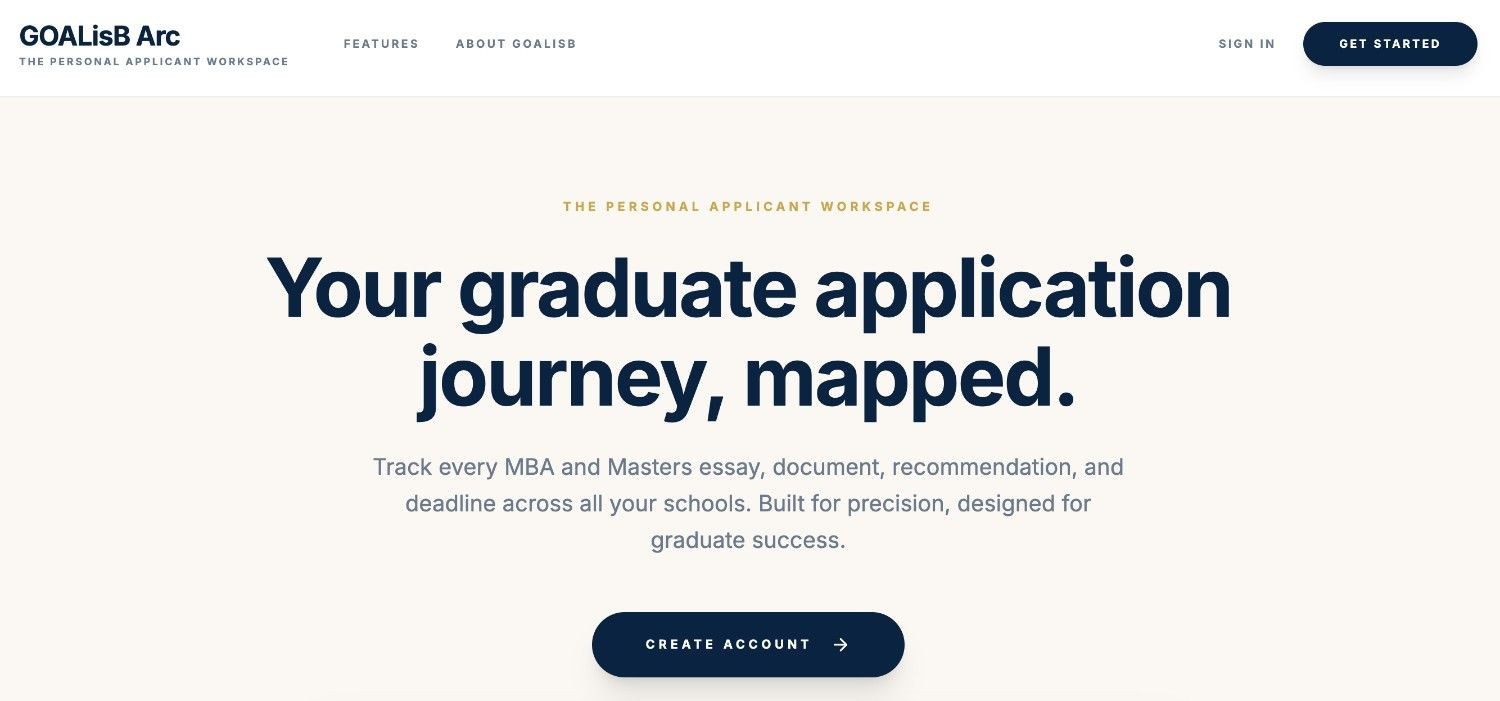
Whatever system you use, keep one authoritative list of what's outstanding — and check it weekly, not monthly.
Step 5: Interview Until It's Boring
Once invitations arrive, run mock interviews repeatedly. The goal is not memorization; it's fluency, so that under pressure you're recalling a structure rather than inventing one.
"Run three consecutive mock interview rounds — behavioral, why-this-school, and a hostile follow-up round on my career switch — then give me consolidated feedback."
Results & Use Cases
📊 The Career Switcher With a Coherence Problem
Scenario: An engineer targeting product management has strong technical credentials but no obvious narrative connecting past to future.
Traditional Approach: Multiple paid consulting sessions, spread over weeks, to arrive at a positioning statement.
MBA Admissions Consultant: Profile review and positioning work in a single working session, then continuous refinement as essays develop.
- Identifies transferable evidence already in the resume
- Builds one consistent thesis reused across all schools
- Flags where the switch story sounds aspirational rather than earned
💼 The Reapplicant
Scenario: Dinged in round two last cycle, with no feedback on why.
Traditional Approach: Guesswork, or paying for a post-mortem review.
MBA Admissions Consultant: A full teardown of last cycle's application to isolate the likely failure point — profile, positioning, school fit, or execution.
- Diagnoses whether the gap was substance or presentation
- Sets a concrete improvement plan for the intervening year
- Rebuilds the school list against updated competitive position
📱 The Deadline-Night Draft Review
Scenario: Round one closes in fourteen hours. The final essay is written but reads flat.
Traditional Approach: No consultant is answering at 1 a.m.
MBA Admissions Consultant: Immediate structural critique from your phone — full feature parity across web, iOS, and Android, with your entire application history and prior drafts already in context.
- Identifies the specific paragraphs weakening the piece
- Suggests cuts that create room for concrete evidence
- Preserves your voice rather than rewriting it
🎯 The Test Score Bottleneck
Scenario: A 680 GMAT is capping the realistic school list, with ten weeks until round two.
Traditional Approach: Buy a prep course, hope the schedule fits around work.
MBA Admissions Consultant + GMAT Tutor: The consultant quantifies how much a score improvement would actually change the list; GMAT Tutor builds the ten-week plan to get there.
- Clear decision on whether retaking is worth the time cost
- Diagnostic-driven study plan aimed at the specific score delta
- Application timeline adjusted around the retake date
FAQ
Is an AI graduate admissions consultant free?
The MBA Admissions Consultant is available on Jenova's free tier with all core features and limited monthly usage. Paid plans start at $20/month for substantially higher usage and custom model selection. For applicants comparing this against traditional consulting packages, the cost difference across a full application cycle is significant.
Is it against the rules to use AI in my graduate application?
It depends entirely on how you use it. Rackham Graduate School permits GenAI for researching the application process and checking grammar, but prohibits using it to outline, draft, or write essay content — and requires an attestation of sole authorship. Use AI for strategy, critique, and rehearsal. Write your own essays. Always read each program's specific policy before submitting.
How is this different from ChatGPT?
The MBA Admissions Consultant is a purpose-built agent with admissions-specific domain knowledge, structured across profile review, school selection, application critique, and interview practice. It maintains persistent memory of your profile and drafts across sessions, so feedback on your fifth essay reflects everything it learned from the first four.
Can it help with non-MBA graduate programs?
Yes for admissions strategy fundamentals — profile assessment, school selection, statement of purpose critique, and interview prep transfer across program types. For medical school specifically, the Medical School Admissions Consultant handles AMCAS positioning and MCAT-specific guidance. For undergraduate applications, use the College Admissions Consultant.
Will it actually tell me if my application is weak?
Yes. Candid assessment is the entire value proposition — a consultant that praises everything is worse than no consultant, because it costs you the time you could have spent fixing real problems. Ask directly for the weakest element of your candidacy and you will get a direct answer.
Does it work on mobile?
Yes. Jenova offers full feature parity across web, iOS, and Android, with everything synced. You can review a draft on your laptop and run mock interview reps from your phone on the commute.
Conclusion
Graduate admissions rewards candidates who start early, get honest feedback, and iterate. The structural challenge has never been access to advice — it's been access to good advice, on your timeline, at a price that doesn't compete with your tuition fund. An AI graduate admissions consultant closes that gap: candid profile assessment, strategic school selection, rigorous essay critique, and unlimited interview reps, available whenever you're actually working.
Use it the way admissions offices permit and intend — as an advisor, not an author. You write the essays. It tells you the truth about them.
Try the MBA Admissions Consultant now. Explore more at Jenova.
For Developers: MBA Admissions Consultant is available programmatically via the Jenova API — integrate expert admissions advising into your edtech or applicant-services product with a single API call. Full documentation →