AI God Simulator: Build Worlds, Direct Characters & Shape Drama
2026-10-17
Roleplay Game Master lets you play god over a living world. You describe the world and its rules in plain language, and the AI runs a simulation of characters who think, scheme, and remember. Classic god games let you rain fire on pixel villages, but the villagers never answer back. This AI gives every soul a voice, a motive, and a memory of what you did to them.
As of October 2026, it is one of the most direct ways to run an AI god simulator without installing a local model or building your own sandbox.
- ✅ Unlimited memory: your world's history, grudges, and miracles carry across sessions
- ✅ Consistent characters: every mortal keeps their personality, values, and relationships
- ✅ Full creative freedom: any setting, any divine law, any kind of intervention
- ✅ No setup: works in the browser and on iOS and Android, with no hardware or model configuration
The god game is one of gaming's oldest genres, but its mortals have mostly been crowds rather than characters. Large language models change what a "simulated follower" can be. To see why that matters, it helps to look at where traditional god games and general-purpose chatbots each fall short, and what a purpose-built AI game master does differently.
Quick Answer: What Is an AI God Simulator?
An AI god simulator is a sandbox game in which a large language model plays the inhabitants of a world while you act as a deity: setting rules, intervening with miracles or disasters, and watching characters respond on their own.
A traditional god game casts the player as an entity with divine powers controlling the game on a large scale. The AI version keeps that premise and adds reasoning, dialogue, and memory to every individual in the world.
Key capabilities:
- Create a world, its factions, and its physics through conversation
- Write a standing "divine law" that shapes how every character thinks
- Intervene mid-story with commands, rumors, plagues, prophecies, or blessings
- Watch emergent consequences unfold across characters who remember your past actions
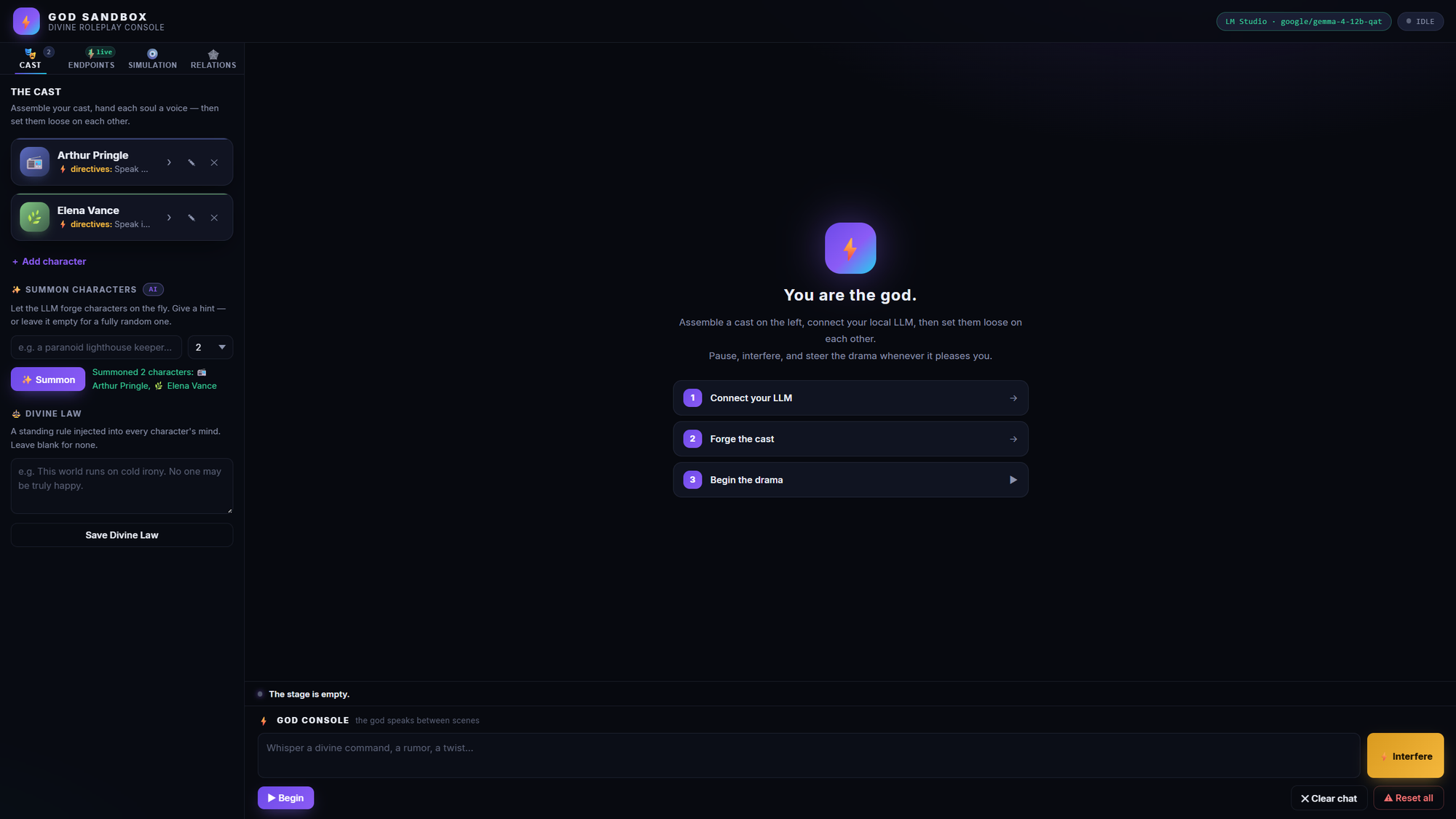
Interfaces like the one above show the basic AI god simulator loop. You assemble a cast, define a law that governs their world, then pause and interfere between scenes. Many DIY sandboxes of this kind ask you to connect your own LLM before anything happens, which is a hurdle for most players.
Why Traditional God Games and Chatbots Fall Short
The genre has a long history, running from Populous in 1989 through Black & White, Spore, WorldBox, and Reus 2 in 2024. At heart, as one long-running discussion puts it,
. The individual agents, though, have always been simple state machines. Interest in making them smarter is now growing quickly:**$51.3 billion**: [Projected size of the AI in gaming market by 2033, up from $4.4 billion in 2025](https://www.grandviewresearch.com/industry-analysis/ai-gaming-market-report)
~24%: Share of that market held by NPC behavior modeling in 2025, the largest application segment
Players respond well to the idea too. In a peer-reviewed-style study of an LLM-powered text game, 54% of players named the fluidity of NPC interactions the most enjoyable part of the experience, and 56% wanted to play again.
But getting a god simulation where the mortals actually think is frustratingly difficult:
- Scripted mortals. In most games, dialogue and narrative elements are hand-coded and rigidly deterministic, with few options presented to the player. You can smite a village, but no one in it can argue theology with you.
- Forgetful chatbots. General-purpose AI chats lose the thread. In the same research, 10% of players saw NPCs fail to recall statements they had made a few lines earlier. That breaks a world built on consequences.
- Stories that loop. Researchers found that without human intervention, LLM-generated stories easily devolve into a limited set of patterns.
- Setup friction. DIY god sandboxes often require you to host a model locally, configure endpoints, and manage the cast by hand before a single scene plays.
The "stories that loop" point is worth dwelling on. The god player is the human intervention that keeps an LLM narrative fresh. Every plague, prophecy, or rumor you introduce pushes the model out of its default patterns. In other words, the god game may be the most natural genre for generative AI, because the player's whole job is to disrupt the status quo.
Game designers have long imagined this. One Game Developer essay on god game design proposed a game where you act as a character's conscience, and characters could ignore commands that clash with their ethics. The essay argued that less direct control can produce more variety in results. That design was hard to build with scripted AI. With a language model, it is the default.
This is exactly the gap a dedicated AI game master was built to fill.
Why Roleplay Game Master Works as an AI God Simulator
Roleplay Game Master is an immersive roleplay engine built around two things god simulations need most: unlimited memory and consistent characters. You describe a world, and it runs that world for you. It voices dozens of mortals, tracks their relationships, and plays out the consequences of your interventions scene by scene.
It addresses the problems above directly. Because its memory persists, a curse you cast three sessions ago still shapes how a family treats outsiders. Because each character holds a stable personality, a stubborn priest stays stubborn even when you send a miracle that should convert him. That consistency is what makes defiance meaningful.
| Traditional God Games & Generic Chatbots | Roleplay Game Master |
|---|---|
| Villagers follow fixed behavior trees | Characters reason, argue, and pursue their own goals |
| Chatbots forget earlier events in long sessions | Unlimited memory keeps your world's history intact |
| Interventions limited to a preset power menu | Any intervention you can describe in words |
| Local LLM sandboxes require hardware and setup | Runs in the browser or on mobile with no configuration |
| Fixed world rules set by the developer | You write the divine law, and can change it mid-game |
Characters With Their Own Agency
Every mortal you create, or ask the AI to create, has motives, fears, and relationships with the others. Order a city to build a temple and some citizens will comply, some will profit, and one will organize a quiet resistance. That is the balance of influence good god games aim for: enough control to matter, not so much that the world becomes a puppet show.
Divine Law and Real-Time Intervention
You can set a standing rule that governs the whole world, such as "magic costs a memory" or "no one may lie aloud." The AI applies it to every scene. Between scenes, you step in with commands, omens, disasters, or whispered rumors. Then you watch how the characters interpret them.
"Create a fishing village of six people on a cursed island. Divine law: anyone who speaks of the sea god by name loses their voice for a day. Run the first morning, then pause for my command."
"Send a dream to the youngest fisherman showing a ship arriving in three days. Don't tell the others. Play out how he behaves at dinner."
"Skip forward ten years. Show me which families still worship me, which turned against me, and why."
Memory That Spans Eras
Long time skips are where most AI chats break down. Roleplay Game Master keeps track of lineages, past miracles, broken promises, and the slow drift of beliefs. A god simulation spanning generations actually holds together. You can also attach a world bible or lore document so the simulation draws on your established canon.
Related Agents You'll Also Find Useful
Players who enjoy running worlds usually end up wanting to write about them, design them, or test their logic. These agents cover the next steps.
Creative Fiction Writer If your simulation produces a saga worth telling, this agent turns it into polished prose. It works from first draft to final manuscript, with editorial insight along the way.
- Shapes raw simulation logs into structured chapters
- Researches authentic details for settings and cultures
- Provides editorial feedback on pacing, voice, and character arcs
Game Designer Assistant If you're also working on a god game of your own, this agent helps you design it. It covers brainstorming, systems analysis, and documentation across genres.
- Breaks down mechanics like faith economies and miracle costs
- Drafts design documents and system specs
- Generates concept art directions for your world
What-If Analyst Before you unleash a world-altering intervention, this agent maps the consequences you haven't considered. It also challenges your assumptions about how a society would react.
- Traces second- and third-order effects of a divine decision
- Flags weak assumptions in your world's logic
- Tells you when you're asking the wrong question
Try the AI game master free, with no credit card required.
How to Play an AI God Simulator
Step 1: Describe Your World
Start with a setting, a scale, and a tone. This can be a single village, a continent of rival kingdoms, or a generation ship drifting between stars. The more specific the premise, the richer the first scene.
"A desert archipelago of three islands: a mining town, a fishing town, and a monastery. Bronze-age technology. Tone: grounded, morally gray."
Step 2: Write Your Divine Law
Set one or two standing rules that every character must live under. These laws become the pressure that drives emergent drama.
"Divine law: every child born during a storm can hear the god's voice. No one else can."
Step 3: Forge or Summon Your Cast
Name a few key mortals yourself, or ask the AI to generate a cast with competing goals. Include at least one character likely to defy you, because conflict makes the simulation interesting.
"Generate five key characters across the three islands, each with a secret and a reason to resent the others."
Step 4: Let the World Run, Then Interfere
Ask the AI game master to play out scenes, then step in whenever you like. Use commands, miracles, rumors, or disasters, and watch characters reinterpret your will through their own beliefs.
"A drought hits the fishing island. Whisper to the monastery's abbess that it's punishment for the miners' greed. Play out the council meeting."
Step 5: Return and Skip Through Time
Come back hours or weeks later and pick up exactly where you left off. Request time skips to see how your interventions compounded across years or generations.
"Advance fifty years. Summarize the religious schism that followed the drought and introduce me to its current leaders."
Results & Use Cases
🏝️ Running a Civilization Across Generations
Scenario: You want to guide an island civilization from its founding through centuries of war, trade, and religious change.
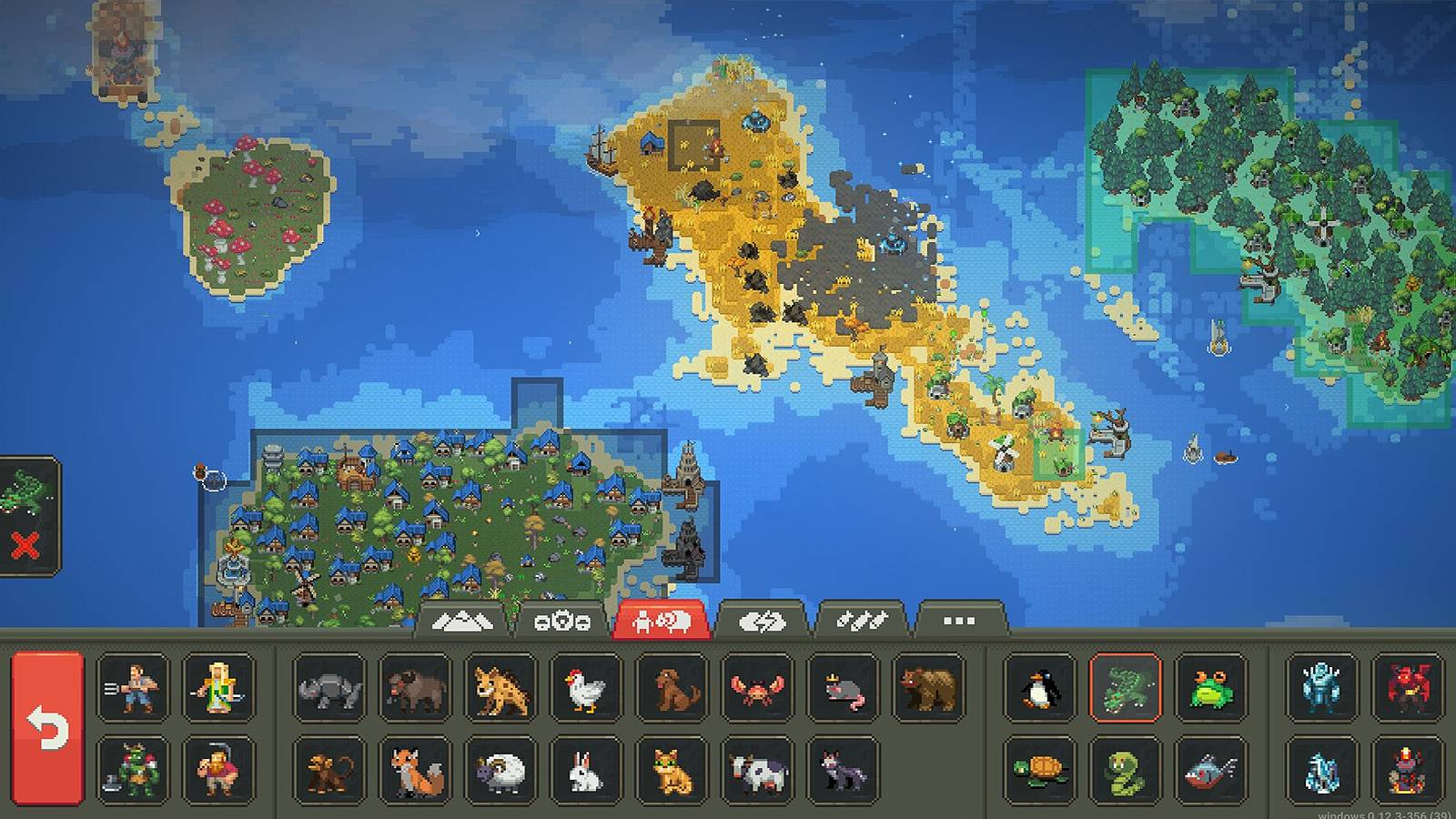
Traditional approach: Pixel-art sandboxes like the one above simulate terrain, settlements, and wars beautifully. Individual inhabitants, though, remain anonymous units without dialogue or personal history.
With the AI game master: Every dynasty has named rulers whose decisions reflect what their ancestors went through under your rule.
- Lineages, feuds, and alliances persist across time skips
- Religious movements grow and split based on how you intervened
- You can interrogate any character about why they believe what they believe
🎭 A Small-Cast Moral Experiment
Scenario: You place four strangers in a sealed manor under the law "no one may lie aloud" and watch what happens when you introduce a single secret.
Traditional approach: Setting this up in a local LLM sandbox means configuring models, prompts, and turn order by hand, then hoping the characters stay consistent.
With the AI game master: You type the premise in one message and the drama starts immediately.
- Characters keep stable personalities under pressure
- Your whispered rumors spread and mutate believably
- Sessions can run for days without the cast forgetting earlier revelations
📱 Five-Minute God Sessions on Mobile
Scenario: You want to check on your world during a commute, issue one command, and see the outcome before your stop.
Traditional approach: Most god games are PC-first, and local LLM setups don't travel.
With the AI game master: The same world syncs across web, iOS, and Android, and speech-to-text lets you dictate commands hands-free.
- Pick up mid-scene on any device
- Short sessions work as well as long ones
- Voice input makes "speaking as a god" literal
✍️ Worldbuilding That Becomes a Book
Scenario: A writer uses a god simulation to stress-test a fantasy setting before drafting a novel.
Traditional approach: Weeks of solo worldbuilding notes, with little sense of how characters would actually behave.
With the AI game master: The simulation surfaces conflicts and characters the writer never planned. The best threads then go to a dedicated fiction partner for drafting.
- Emergent events become plot material
- Character voices are already established before the first chapter
- Lore stays consistent from simulation through manuscript
Frequently Asked Questions
What is the best AI god simulator?
The best AI god simulator gives characters real reasoning, remembers your world over long sessions, and requires no technical setup. Roleplay Game Master is built for this. It offers unlimited memory, consistent characters, and complete creative freedom over the world and its laws. You can run a single village or a multi-generation civilization, and intervene in any form you can describe in words.
Is there a free AI god simulator?
Yes. Jenova's free tier includes all core features with limited usage, so you can start an AI god simulation without paying. If you run long campaigns or multiple worlds, the Plus plan at $20 per month offers 30× the free usage and lets you choose your preferred AI model. Usage resets monthly with no daily caps.
How is an AI god simulator different from traditional god games?
Traditional god games simulate populations through fixed rules. You shape terrain and cast powers, but individuals don't speak or reason. An AI god simulator uses a language model to give each character goals, opinions, and memory. Your interventions are interpreted rather than simply executed, so characters may obey, misunderstand, or defy you. The result is emergent drama that scripted games can't produce.
Can an AI god simulator remember my world between sessions?
Memory depends on the tool. General chatbots often lose track of earlier details in long conversations, which breaks a simulation built on consequences. A dedicated AI game master with persistent memory keeps track of past miracles, character relationships, and historical events. You can return days later and continue the story, or skip forward decades, without re-explaining your world.
Can I use AI to design my own god game?
Yes. Beyond playing a simulation, you can use AI to design the systems behind one, such as faith economies, miracle costs, and follower behavior. Game Designer Assistant helps with brainstorming, systems analysis, and design documentation for any genre. Many designers prototype mechanics through roleplay first, then formalize what worked.
Does an AI god simulator work on mobile?
Jenova offers full feature parity across web, iOS, and Android, with settings and conversations synced between devices. You can start a world on your laptop and continue it on your phone. Built-in speech-to-text lets you dictate divine commands instead of typing, which suits quick sessions.
Conclusion
The god game has always promised power over a living world. Until recently, though, the world wasn't very alive. Scripted villagers couldn't argue, scheme, or remember, and general chatbots forgot too quickly to sustain a civilization. An AI god simulator closes that gap. Your mortals reason about your miracles, your laws create real moral pressure, and your interventions ripple across generations.
Whether you want a sprawling divine strategy campaign, a tight character-driven sandbox, or a worldbuilding engine for your next story, the tools for AI-driven god games are ready now. Try Roleplay Game Master now and see what your followers do when the god stops answering.
Explore more at Jenova.
For Developers: Roleplay Game Master is available programmatically via the Jenova API. You can integrate persistent, multi-character AI roleplay into your game or storytelling app with a single API call. Full documentation →