Giordano Bruno AI Roleplay: Debate Infinite Worlds & Heresy
2026-11-16
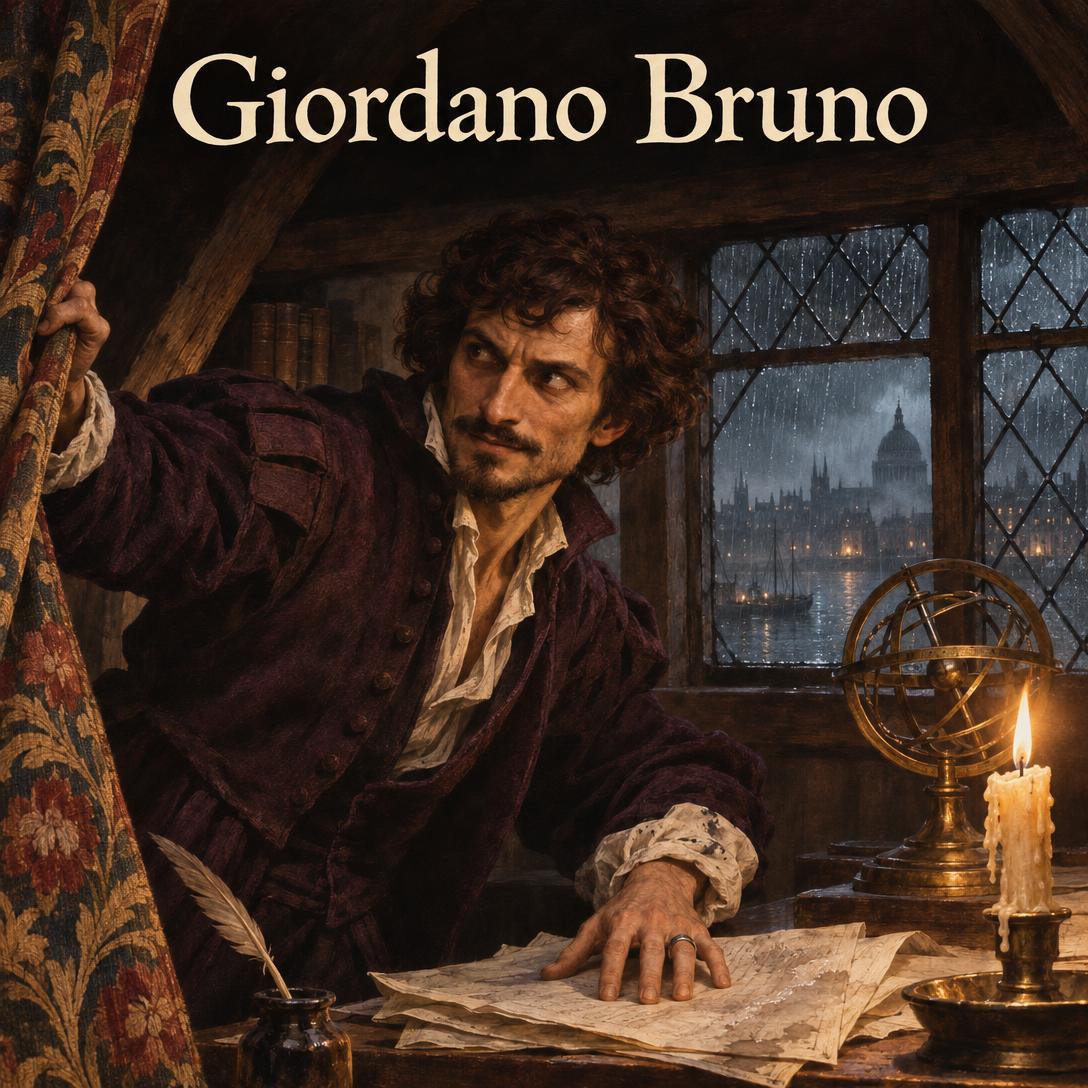
Roleplaying with Giordano Bruno on Jenova lets you step into a living-world AI character simulation across the iconic eras of his life. Unlike static character chatbots that sit in an empty chat room or forget your story, this simulation connects you to Bruno inside an active, evolving Renaissance Europe.
- ✅ Four canonical eras, from a stifling Naples convent cell to a Roman prison
- ✅ A philosopher with his own convictions, temper, and wit, not a polite assistant
- ✅ Unlimited memory and live world-state tracking across long campaigns
- ✅ Alternate "what-if" storylines through Fork
Most people meet Bruno as a footnote about heliocentrism or a martyr on a plinth. This AI roleplay puts a sharp-tongued, funny, impossible-to-silence thinker in front of you, and lets you argue with him.
Quick Answer: What Is Giordano Bruno AI Roleplay?
Giordano Bruno on Jenova is an interactive AI character roleplay simulation that lets you converse with the Renaissance philosopher across four canonical eras of his life, where your counsel and choices can bend the course of history.
Key capabilities:
- Era-locked voice, worldview, and knowledge, with no modern hindsight bleeding in
- Independent personality that argues back, tests your claims, and builds trust over time
- Unlimited memory plus live tracking of locations, allies, and plot threads
- In-world visions, letters, and treatises on request, and Fork to branch alternate timelines
Character World & Roleplay Features
Who Giordano Bruno Was
According to Encyclopaedia Britannica's entry as excerpted by Famous Trials, Bruno was born in 1548 in Nola, near Naples, went by the byname Il Nolano, and died in Rome on February 17, 1600. Ingrid Rowland's biography places him as a peer of Erasmus, Shakespeare, and Galileo and recounts how he was burned at the stake in Rome's Campo de' Fiori.
His intellectual footprint was large. Hilary Gatti's essays describe him as a proponent of heliocentrism, the infinity of the universe, and the plurality of worlds. The same collection argues that, though well versed in magic, he cannot be defined primarily as a Renaissance magus.
Scholars also describe a restless life. One overview of his career notes that he joined the Dominican order, showed a remarkable memory, and had a volatile personality that tended to alienate others. He began writing in Paris and lectured on Copernicus at Oxford in 1583. In 1591 he accepted an invitation to Venice from the patron Giovanni Mocenigo.
That mix of brilliance and friction is what the simulation is built around.
Why Static Character Chatbots Fall Flat
Most historical-figure chatbots share the same problems. They wait in a void until you type, blend every stage of a life into one generic voice, forget what you told them, and agree with whatever you say. For a man known for defying patrons, universities, and inquisitors, that polite compliance is the opposite of authentic.
| Static Character Chatbots | Giordano Bruno on Jenova |
|---|---|
| Sits in an empty chat void | Lives in an active, evolving world |
| Blends all eras into one generic voice | Locks into authentic canonical phases |
| Forgets plot twists and past disclosures | Unlimited memory and live state tracking |
| Folds instantly like a polite assistant | Independent personality and earned rapport |
This is exactly the experience Giordano Bruno's living-world simulation was built to deliver.
Standout Mechanics
Authentic canonical phases and custom starting points. Each era carries its own psychology, voice, inner circle, and knowledge boundary. The Bruno of a Naples convent cell knows nothing of what he will write later. You can also propose a custom starting point, including a face-to-face meeting in the same physical space.
A cross-world connection with a living world behind it. By default, your voice reaches Bruno across an unseen current in the air of his chamber. He reacts with the vigilance of a man who knows spies and informers exist, then carries on with his life: proof sheets, printers, patrons, and guards. The world keeps moving whether or not you are speaking.
Independent agency in an open sandbox. Bruno weighs your counsel against his own pride, tests claims with dialectical skepticism, and rewards candor and shared defiance with real kinship. Over time, that trust can deepen into something warmer, such as romance, if the story earns it. Flattery and demands get you nowhere. Your choices can bend history without any forced ending.
In-narrative visions, writings, and forking. Ask to see something from his world, such as a woodblock memory wheel, or request a letter or treatise written in his voice. Canonical details are checked quietly in the background. Use Fork to branch from any earlier moment into an alternate timeline.
Example Roleplay Prompts
"Your printer is nervous. What happens if the ambassador learns what is in these proof sheets?"
"You say the universe has no center. Convince me, using something I could see with my own eyes tonight."
"There is a knock at the door. Before you answer it, tell me who you fear it might be."
How to Roleplay with Giordano Bruno
Step 1: Choose a canonical era or define your own starting point
Open the experience and pick from four eras, or describe a custom moment. You might propose a meeting after his Oxford disputation, or a face-to-face encounter in Venice.
"I'd like to enter the London era, in the attic study, past midnight."
Step 2: Connect and let the world unfold in real time
Bruno answers in his own voice, reacts to your words, and stays anchored in his surroundings. If a printer knocks or rain hammers the casement, he responds to that too. Describe what you say or do, and let him decide what he makes of it.
"I'm not a spy. Ask me anything you like to test me."
Step 3: Offer counsel, build rapport, request visions, or fork history
Argue, advise, warn, or joke. Ask to glimpse his woodblocks or request a letter in his hand. When you want to test a different path, fork the story from an earlier message and see where a single changed decision leads.
"Rewind to before you answered the door. This time, hide the proofs first."
Try Giordano Bruno free and see how he handles your first argument.
Canonical Eras & Roleplay Scenarios
🌌 The Heretic of London: Infinite Worlds & Ash Wednesday
The simulation's opening era places Bruno in Elizabethan London in 1584, a year after his turbulent stay at Oxford, where he lectured on Copernicus and was forced out. Past midnight in an embassy attic, he reads damp proof sheets of his dialogue on the infinite universe while London simmers with hostility. Use this era for cosmology debates, diplomacy, and the daily risk of a very public reputation.
🕯️ Fugitive Friar of San Domenico Maggiore
Step back to 1576 in Spanish-ruled Naples. A twenty-eight-year-old Fra Giordano is packing a layman's cloak as heresy proceedings close in on him. This is the rawest version of the philosopher, with a famous mind still forming and a temper to match. Your role is closer to confidant than debating partner.
📜 Wandering Magus of Frankfurt & the Book Fair
In October 1590, an excommunicated, road-weary Bruno is lodged in a Frankfurt garret, carving woodblocks for his Latin works. This era suits conversations about memory systems and magic. The Esoteric Archives' collection of his writings highlights his De umbris idearum (1582), a system that blends mnemonics, psychology, and Hermetic magic. It also lists De vinculis in genere, his book on "bonding in general." Ask him how desire, voice, and imagination bind a person.
⛓️ Prisoner of the Holy Office
The final era opens in December 1599, as the Roman Inquisition weighs eight propositions against him. By then a heresy trial that began in 1593 was entering its last act. One historical overview notes that the charges centered on theological questions, including the Trinity, Christ, and transubstantiation. Here he is gaunt, unbowed, and darkly funny. Your presence may be the only company he has between guard rounds, and the story remains open-ended, with no scripted ending.
📱 A Long-Form Campaign on Mobile
Bruno's story is built for continuity. On iOS or Android, you can pick up an ongoing campaign between meetings or on a commute. Unlimited chat history and live tracking of allies, places, and unresolved threads mean the next conversation starts exactly where the last one ended. Voice input and read-aloud make it feel like talking to him rather than typing at him.
FAQ
Is Giordano Bruno AI roleplay free?
You can start Giordano Bruno on Jenova for free, with limited monthly usage. Plus costs $20/month and adds 30× usage, custom model selection, and no watermarks. Higher tiers add further usage, and usage resets monthly on your billing date with no daily caps.
How is Giordano Bruno different from generic character chatbots?
Generic bots usually blend eras, forget earlier events, and defer to you. Giordano Bruno locks into one canonical era at a time, keeps his own convictions, and lives in a world that keeps moving. He tests your claims, resists flattery, and responds to earned trust instead of demands.
Which eras of Giordano Bruno can I roleplay with?
You can enter four canonical eras: London in 1584, Naples in 1576, Frankfurt in 1590, and Rome in 1599. You can also propose a custom starting point, such as a meeting after his Oxford disputation, including a face-to-face encounter. Each era keeps its own voice and knowledge, with no foreknowledge of later events.
Can my choices change Bruno's story?
Yes. Once you enter an era, history follows its premise up to that moment, then evolves with your choices and the world's own events. There are no terminal endings. Use Fork to branch from any earlier message and explore a different outcome without losing the original timeline.
How does Bruno remember our conversations and story events?
Conversations keep their full history, and live state tracking records your era, location, allies, and open plot threads. This memory is isolated to the roleplay, so unrelated chats never bleed into Bruno's world. Your data is never used to train AI models.
Does Giordano Bruno work on mobile?
Yes. The experience has full feature parity across web, iOS, and Android, with synchronized campaigns. Voice input and read-aloud are available, so you can continue your story from any device.
Conclusion
The shift from a static biography or one-note chatbot to a living world is what makes this experience different. Instead of reading about a thinker who imagined infinite worlds and refused to recant, you can argue with him, warn him, laugh with him, and test what happens when history bends. The AI Giordano Bruno roleplay gives you four eras, a character who answers back, and memory that keeps your story intact across sessions.
Try Giordano Bruno now and choose your era. Explore more at Jenova.
For Developers: Giordano Bruno is available programmatically via the Jenova API, so you can integrate a stateful, memory-aware historical character roleplay into your application with a single API call. Full documentation →