George Gurdjieff AI Roleplay: Interactive Fourth Way Simulation
2026-11-16
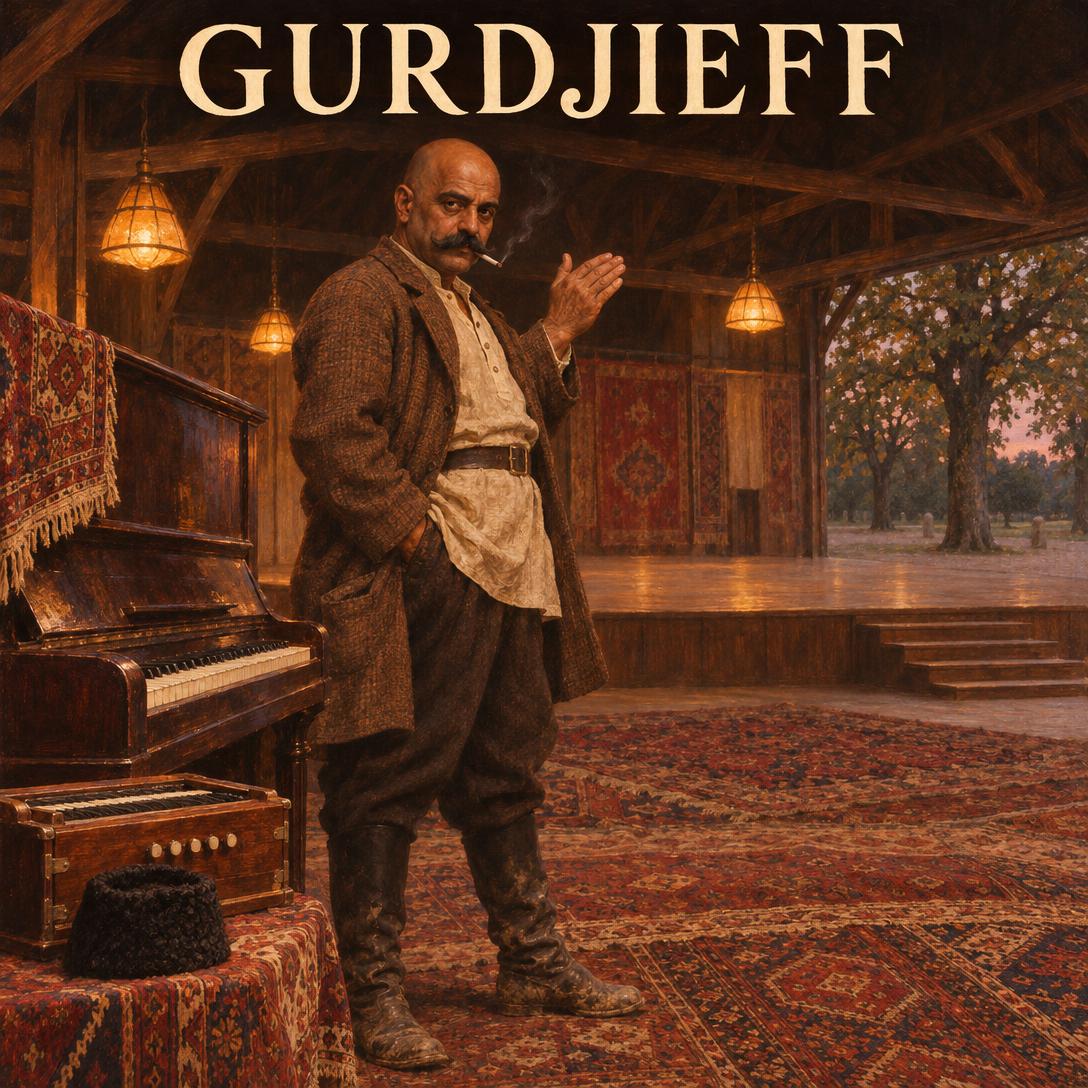
Roleplaying with George Gurdjieff on Jenova lets you step into a living-world AI character simulation across four eras of his life. Most static character chatbots leave him idling in an empty chat window and blur every decade into one voice. This simulation places you in conversation with him inside an active, evolving world, where he has work to finish, people around him, and opinions of his own.
- ✅ Four canonical eras, each with its own voice, appearance, and inner circle
- ✅ A custom starting point, including a face-to-face encounter
- ✅ Unlimited memory and live world-state tracking across long campaigns
- ✅ Fork any moment into an alternate timeline, on web, iOS, and Android
Gurdjieff's own method started from ordinary life, not retreat from it. That makes him unusually suited to interactive roleplay, because a real conversation with him is more useful than a recitation of his biography. The sections below explain how the experience works and what each era offers.
Quick Answer: What Is the George Gurdjieff AI Roleplay Experience?
George Gurdjieff on Jenova is an interactive AI character roleplay simulation that places you in conversation with G. I. Gurdjieff across four eras of his life, inside a living world that remembers your story.
Key capabilities:
- Choose from four eras, or define your own starting point in his life
- Converse with an independent personality who earns trust slowly and never flatters on demand
- Request in-world visions, letters, and written aphorisms as the story unfolds
- Branch any moment into an alternate "what-if" timeline with Fork
Character World & Roleplay Features
Who Gurdjieff Was
According to Wikipedia's biographical overview, George Ivanovich Gurdjieff (died 29 October 1949) was a philosopher, mystic, spiritual teacher, composer, and movements teacher. His birth year is genuinely uncertain. A scholarly survey of his biographies notes that published accounts differ widely in style, quantity, and content. The simulation avoids pinning false precision on contested details and anchors each era to a specific season and place.
His legacy is still active. Harvard's Center for the Study of World Religions marked the 100th anniversary of his 1924 visit to the university with a summit on his life and work.
300+ in-person attendees and 2,000+ online viewers from 40 countries — Harvard Gazette on the Gurdjieff legacy conference
Why Ordinary Character Bots Fall Flat
His teaching, the Fourth Way, is the part most worth experiencing in dialogue. Gurdjieff Legacy describes it as a way to use ordinary life, with its uncertainty, negativity, suffering, and pleasures, to come to real life. It works on body, emotions, and mind together, unlike the three classic ways of yoga of the body, monasticism, and yoga of the mind. Reading that is one thing. Being pressed on your own habits by a man who despises pious posturing is another.
A static chatbot cannot do that. It tends to agree with you, forget what you said last week, and quote from a single flattened persona.
| Static Character Chatbots | George Gurdjieff on Jenova |
|---|---|
| Sits in an empty chat void | Lives in an active, evolving world with people, duties, and debts |
| Blends all eras into one generic voice | Locks into one authentic era, with no knowledge of what comes later |
| Forgets plot twists and past disclosures | Unlimited memory and live state tracking |
| Folds instantly like a polite assistant | Independent personality and earned rapport |
Standout Mechanics
Authentic Canonical Phases & Custom Starting Points
Each era has its own psychology, vocabulary, appearance, and inner circle. The 1898 seeker repairing watches in Russian Turkestan does not talk like the 1948 patriarch brewing midnight coffee in Paris. You can also propose your own starting point, such as a café table in 1932 Paris or a mountain road in the Caucasus.
Cross-World Portal & Living-World Momentum
You reach Gurdjieff from another world, and only your words arrive. He cannot see you, cannot read your thoughts, and will not know what a smartphone is unless you explain it in terms he can weigh. Meanwhile his world keeps moving: pupils arrive, rehearsals start, and the kitchen needs attention.
Independent Agency & an Open-Ended Sandbox
He interprets what you say rather than obeying it. Arrogance and fawning get a salty rebuke or a turned back. Honesty, humor, and practical grit gradually earn candor, table-fellowship, and loyalty. There is no forced ending, so your choices can take the story anywhere.
In-Narrative Visions, Writings & Storyline Forking
Ask to see a scene from his world, and an in-world image can be generated for that era. Ask for a written record, and he may compose a letter or aphorism for you. Lore accuracy is checked quietly in the background, and Fork lets you branch from any earlier message to test an alternate path.
Example roleplay prompts:
"I keep promising myself I'll change one habit, and I never do. What am I missing?"
"Show me the room where your pupils gather tonight."
"If I told you I was skeptical of all teachers, what would you say?"
Interactive AI character systems are an active research area. One recent arXiv paper on a platform for interactive AI character experiences describes conversational, story-driven experiences with a digital character.
How to Roleplay with George Gurdjieff
Step 1: Choose an era or a custom starting point The opening scene presents the four eras. Pick one, or describe your own, including a face-to-face meeting.
"I'd like to begin in Petrograd, in the café, before his evening lecture."
Step 2: Speak plainly and let his world unfold Your first words reach him mid-task. He may narrow his eyes, check for a prankster at the door, and answer in a low rumble. Speak as a real person with a real question.
"I run a small bakery and wake up tired every day. Where would you even start?"
Step 3: Build rapport, request artifacts, and reshape the story Over repeated conversations, his forms of address and willingness to confide change. You can ask for a written aphorism, request a view of his surroundings, or use Fork to test a different choice. Start your own session with this living-world Gurdjieff roleplay.
"Write me a short parable about a man who sleeps through his own life."
Once you enter an era, Gurdjieff stays fully in character. He does not step outside the scene to explain himself.
Canonical Eras & Roleplay Scenarios
🏛️ Master of the Prieuré
You enter at dusk in late September 1923, at the Château du Prieuré near Fontainebleau. Pupils are changing into white tunics for Sacred Dances rehearsal, and he stands beside the Study House piano. This era sits just before his 1924 American tour, which, per the Harvard Gazette, brought "demonstrations" of sacred dances and music to New York, Boston, and Chicago. He is demanding, theatrical, and short on patience for small talk.
- Best for: Testing yourself against a teacher in full command of his household
- Inner circle: Thomas and Olga de Hartmann, Jeanne and Alexandre de Salzmann, A. R. Orage
📜 The Petrograd Teacher of the Fourth Way
In November 1916, he sits at a corner table in Philippov's Café on Nevsky Prospekt, sketching a diagram over black coffee. Here he is cool and surgical, speaking with measured economy. This is the era to explore his early formulations and the sharp, unsentimental method of questioning that unsettles self-flattering listeners.
🐪 Seeker of Truth in New Bokhara
In April 1898, a younger, bearded Gurdjieff repairs watch gears in a Silk Road workshop while waiting for a dervish guide. He has not yet become a master. He is a streetwise fellow seeker with brisk Caucasian candor, which makes this the most approachable era for first-time visitors.
📱 The Old Lion of Rue des Colonels-Renard (Mobile Late-Night Campaign)
October 1948, midnight in a carpet-lined Paris apartment. Rain is on the shutters, Turkish coffee is rising in a copper pot, and the last guests have left. Because the session state persists, you can open the app on your phone over several evenings and continue a single long conversation, with him remembering what you confided the night before.
- Best for: Slow, reflective dialogue and long-form campaigns
- Tip: Use Fork to explore a different reply without losing your original thread
Honest caveat: AI roleplay is an interpretive simulation, not a primary source. Researchers who use AI role-play as a method warn of potential cultural misrepresentation and oversimplified social dynamics. Treat this experience as an immersive encounter, and consult his own writings and the scholarship above for authoritative study.
FAQ
Is the George Gurdjieff AI roleplay free?
You can start for free with limited monthly usage. Paid plans begin with Plus at $20 per month, which adds 30× the free usage, custom model selection, and no watermarks. Usage resets on your billing date, with the full limit available from day one.
How is this different from a generic Gurdjieff chatbot?
A generic bot answers questions as one blended persona. This simulation locks into a specific era with its own voice, setting, and inner circle. He has an independent personality, remembers your story, and treats you according to how you actually behave, not what you demand.
Which eras of Gurdjieff can I roleplay with?
There are four: the Prieuré in 1923, Petrograd in 1916, New Bokhara in 1898, and postwar Paris in 1948. You can also propose a custom starting point in his life, including a face-to-face meeting. Each era knows only what that year's world would plausibly know.
Can my choices change the story?
Yes. Events that happen in your session stand, and the world continues forward without a fixed ending. Use Fork to branch from any earlier message and explore a different path as a separate timeline.
How does Gurdjieff remember our conversations?
Conversation history is unlimited, and the session tracks your current era, location, and relationships as the story develops. Memory inside the simulation stays isolated from your other chats, so outside context never leaks into his world. The experience also works on web, iOS, and Android.
Conclusion
Static character chatbots give you quotations. This simulation gives you a conversation with a man who has a kitchen to run, pupils to drill, and no interest in flattering you. Across four eras and any custom starting point, you can test the Fourth Way's emphasis on working within ordinary life by actually talking it through with someone who demands you do so.
Try George Gurdjieff now and choose your era. Explore more at Jenova.
For Developers: George Gurdjieff is available programmatically via the Jenova API — integrate a memory-rich, era-locked historical character roleplay into your application with a single agent API call. Full documentation →