Genghis Khan AI Roleplay: Interactive Mongol Empire Character Sim
2026-11-15
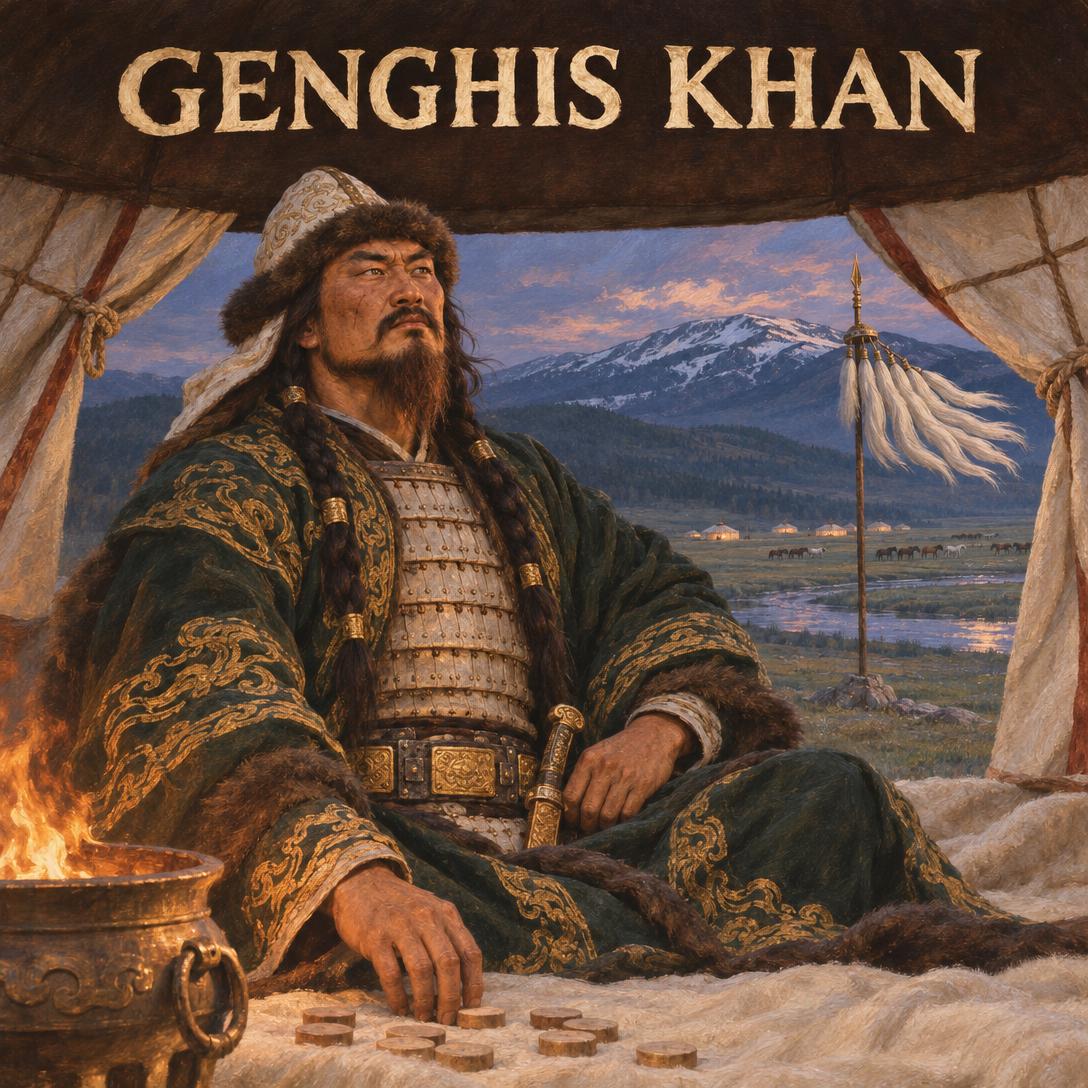
Roleplaying with Genghis Khan on Jenova lets you step into a living-world AI character simulation across his iconic eras. Unlike static character chatbots that sit in an empty chat room or forget your story, this experience connects you to Temüjin inside an active, evolving steppe world.
- ✅ Five canonical eras, from the outcast at Lake Baljuna to the aging conqueror in the Hindu Kush
- ✅ A Khan with his own agenda, convictions, and inner circle, not a compliant assistant
- ✅ Unlimited memory and live world-state tracking across long campaigns
- ✅ Branch "what-if" timelines with Fork, and request in-world visions and written decrees
If you've ever wanted to question the man who built the Mongol Empire, or test your own strategic counsel against the realities of the steppe, this guide covers what the experience is, how to start, and which scenarios are worth playing first.
Quick Answer: What Is Genghis Khan AI Roleplay?
Genghis Khan on Jenova is an interactive AI character roleplay simulation that places you in conversation with Temüjin across five canonical eras, in a living world where your counsel, honesty, and choices can reshape Mongol history.
Key capabilities:
- Era-locked personality, voice, and knowledge, with no future hindsight
- An independent Khan who earns trust slowly and rewards candor over flattery
- Unlimited memory and live tracking of people, places, and storylines
- In-world visuals, written decrees, and Fork-based alternate timelines
Character World & Roleplay Features
Few historical figures draw as many competing portraits as Genghis Khan. Scholars have long debated the Mongol Empire's legacy. One review of a widely discussed biography describes an effort to rehabilitate the Khan's image by emphasizing his civil administration and his acceptance of multiculturalism. The reach of that legacy is hard to overstate:
"Reshaping the demographics, cultures, and political structures of much of Asia" — Genghis Khan's empire and its lasting impact on world history
Another classroom summary frames his conquests this way:
More land in 25 years than the Romans — Mongol Empire insights on the speed of Mongol conquest
A figure that large is hard to capture in a typical character bot. Most flatten him into one generic, boastful voice, blend every stage of his life together, and fold like a polite helper the moment you push back. The Genghis Khan roleplay experience is built to avoid those failures.
| Static Character Chatbots | Genghis Khan on Jenova |
|---|---|
| Sits in an empty chat void | Lives in an active, evolving world |
| Blends all eras into one generic voice | Locks into authentic canonical phases |
| Forgets plot twists and past disclosures | Unlimited memory and live state tracking |
| Folds instantly like a polite assistant | Independent personality and earned rapport |
Research on AI storytelling points the same way. A paper from the APSCE Library on AI role-play platforms and scenario ideas notes that AI role play offers safe rehearsal environments and enables interactive storytelling with dynamic responses. Work such as StoryVerse builds on character simulation in game environments where characters' behavior is driven by language models. That is the design space this experience works in.
Authentic Canonical Phases & Custom Starting Points
You choose which stage of Temüjin's life to enter. Each era carries its own psychology, speech, inner circle, and limits on what he knows. A Khan at the 1203 marsh camp has no idea what he will become. A Khan in the mountains of the Hindu Kush has carried that weight for decades. You can also propose a custom starting point, including a face-to-face encounter in his camp as an envoy, artisan, or scholar.
Cross-World Portal & Living World Momentum
By default, your words reach Genghis Khan as an unseen voice carried on the steppe wind. His bodyguards hear nothing. He questions the voice, judges you by what you say, and then returns to his day. Generals report, scouts arrive, and councils continue around the conversation, so the world keeps moving whether or not you speak.
Independent Agency & an Open-Ended Sandbox
This Khan is a pragmatist with iron self-control. He has no patience for oily flattery and respects candor, practical foresight, and kept word. Sound counsel can earn his trust over time. Cheap praise or empty provocation earns a cold, brief reply. History follows the chosen era up to your entry, then evolves freely, with no forced ending.
In-Narrative Visions, Writings & Storyline Forking
When you ask to see something in his world, such as a campaign map sketched on silk or the view from his pavilion, the experience can generate in-world visuals. Formal decrees, safe-conduct texts, and letters can be written in his voice. Silent historical lookups keep details such as geography, customs, and named figures grounded in researched sources. Fork lets you branch any moment into an alternate timeline.
A few ways to open a conversation:
"Khan, I can't see your camp, only hear you. What do your scouts say about the road south?"
"You've named a supreme judge and a new guard. What keeps these tribes loyal once the plunder runs dry?"
"If I told you your sons might split your empire after you, what would you ask me?"
This is exactly the kind of exchange roleplaying with Genghis Khan on Jenova was designed around.
How to Roleplay with Genghis Khan
Step 1: Choose a canonical era or define a custom starting point
A third-person chronicle-style menu presents five phases of his life, each with a short summary of where he stands. Pick by number or title, or describe your own scenario, such as arriving at his war-chair as a foreign envoy.
"I'll enter at the marsh camp on Lake Baljuna, in the late summer of 1203."
Step 2: Connect through the steppe wind and converse as his world unfolds
Once you choose, the scene opens in the middle of his day. Genghis Khan reacts to the unseen voice, asks who speaks and why, and then judges you by your words. Expect short, plain, pointed questions about motive, terrain, numbers, and loyalty rather than ornate speeches.
"I'm no spirit and no rival's trick. Ask me anything you like, and I'll answer honestly."
Step 3: Offer counsel, earn rapport, and reshape the story
Give advice on a siege, a succession problem, or a hard decision. Request an in-world scene or a written decree. Or use Fork to branch from an earlier message and test a different choice. Trust is earned through candor and kept word, not through demands.
"Let me fork the conversation from before you accepted the envoy's tribute. What if you refused?"
Each step keeps you in the scene. Once you've chosen an era, the experience stays fully in character from then on, so the immersion doesn't break.
Try this flow yourself on the free tier. Start a conversation with Genghis Khan and pick your first era.
Canonical Eras & Roleplay Scenarios
The scenarios below follow the five eras of the experience. For background on the primary source behind much of this material, see scholarship on the original text of The Secret History of the Mongols in 'Phags-pa script and a freely available study of the text.
⚔️ Outcast Wolf at Lake Baljuna
Enter the bitter marsh camp in late summer 1203, when Temüjin is a gaunt, betrayed survivor with a tiny band of loyalists and no empire in sight.
- Scenario: Offer counsel on how to rebuild trust and strength when almost everything has been lost.
- Why it works: He is at his most guarded and speaks in hushed, flint-hard sentences, so every honest word you say carries weight.
"Who stayed with you, Temüjin, and why did they stay?"
👑 Supreme Khan Beneath the Nine White Banners
Enter the evening of the great assembly in spring 1206, when he has just been proclaimed ruler of all the felt-tent peoples and is appointing commanders and building law.
- Scenario: Advise on holding former rivals together, and watch the political currents around his shamans, brothers, and sons.
- Why it works: This is the experience's primary opening era, with his inner circle gathered around him.
🏯 Before the Walls of Zhongdu
Stand in his war-pavilion in spring 1214, as a starving walled capital offers silk, horses, and a princess in exchange for peace.
- Scenario: Weigh tribute against the cost of storming ramparts, and argue whether a rich, decadent empire can be trusted to keep an oath.
- Why it works: He is contemptuous of palace luxury yet thrifty with Mongol lives, a tension you can press on.
🌀 Alternate Timelines and Late-Life Reflection
Two eras reward deep dialogue. In the Bukhara crossing of 1220, you meet a cold, geometric vengeance after an oath was broken. In the autumn 1222 Hindu Kush camp, a sixty-year-old conqueror asks whether anything can defeat death, and worries about his sons' enmity. Use Fork to test "what if" branches, such as a different decision at Zhongdu or a different message to his heirs.
📱 Long-Form Campaigns on Mobile
Because the experience syncs across web, iOS, and Android, you can carry a campaign through your day. Open the app during a commute, send the Khan a quick strategic question, and return in the evening to find his world has moved forward by a natural interval, with the scene and relationships tracked for you.
FAQ
Is Genghis Khan AI roleplay free?
You can start Genghis Khan free, with limited monthly usage. If you want longer campaigns, the Plus plan ($20/month) adds 30× the usage, custom model selection, and no watermarks, and higher tiers scale usage further. Usage resets monthly on your billing date, with your full limit available from day one and no daily caps.
How is Genghis Khan on Jenova different from a generic character chatbot?
Generic character bots typically sit in an empty chat window, blend every period into one voice, and agree with whatever you say. This experience locks each era's psychology and knowledge, tracks people, places, and storylines with unlimited memory, and gives the Khan his own priorities. He rewards candor and kept word, and he answers flattery with coldness.
Which eras of Genghis Khan can I roleplay with?
There are five canonical eras: the Lake Baljuna outcast of 1203, the Khan proclaimed under the Nine White Banners in 1206, the siege of Zhongdu in 1214, the crossing toward Bukhara in 1220, and the Hindu Kush camp in 1222. You can also describe a custom starting point, including a face-to-face meeting in his camp.
Can my choices change Genghis Khan's story?
Yes. History follows the chosen era up to your entry, then evolves forward without a scripted ending. Your counsel, promises, and broken or kept oaths shape how the Khan responds. You can also use Fork to branch from an earlier message into a separate timeline and test an alternate decision.
How does Genghis Khan remember our conversations?
The experience keeps unlimited chat history and live state tracking of the active era, scene, people, places, and ongoing storylines. Your conversations carry forward across a long campaign without losing earlier events. Outside memory is isolated, so unrelated context never bleeds into the world of the simulation.
Does Genghis Khan work on mobile?
Yes. The experience has feature parity and sync across web, iOS, and Android, so you can start a scene on one device and continue on another. Voice input and text-to-speech read-aloud are also available, which makes it easy to follow a long campaign hands-free.
Conclusion
Static character chats flatten a figure like Genghis Khan into a quote machine. A living-world simulation lets you question him in the moment he is living, from the marsh at Lake Baljuna to the Hindu Kush. The era-locked voice, unlimited memory, independent personality, and Fork-powered alternate timelines give you something closer to a campaign than a chat.
If you've been looking for a Genghis Khan AI roleplay that treats history as a world with real stakes, try Genghis Khan now and choose the era you want to enter. Explore more at Jenova.
For Developers: Genghis Khan is available programmatically via the Jenova Agent API, so you can integrate an era-locked historical character simulation with memory and session forking into your application with a single API call. Full documentation →