AI Game Narrative Generator: Branching Stories & Dialogue Trees
2026-09-11
Game Designer Assistant helps you generate playable game narrative by turning a premise into branching plots, quests, NPC dialogue, and consequence maps. While most teams still write a linear script and bolt choices on later, this AI provides story structures that hold up when a player refuses the obvious path, skips a companion, or kills the quest-giver. As of September 2026, that rigor is no longer optional. Studios are shipping into a market where 90% of games developers already use AI in their workflows, and 36% personally use it for dialogue writing alongside other creative tasks.
✅ Linear, branching, and procedural story structures matched to your genre ✅ Quest lines, character arcs, and NPC dialogue that share one canon ✅ Choice-and-consequence maps you can implement, not just pitch ✅ Documentation writers, designers, and VO teams can actually share
To understand why a dedicated game narrative generator matters, look at where interactive story usually fails—long before a player reaches an ending. The problem is not a shortage of plot ideas. It is the gap between a written scene and a system of choices, states, and consequences that still feels authored.
Quick Answer: What Is a Game Narrative Generator?
Game Designer Assistant is an AI game narrative generator that builds branching plots, quests, and NPC dialogue so you can ship playable story in hours instead of weeks. It treats narrative as a system, not a cutscene script.
Key capabilities:
- Story spines for linear, branching, and procedural campaigns
- Decision points with real consequences, not cosmetic dialogue options
- NPC conversations that track relationship state, secrets, and prior choices
- Quest structure that survives player improvisation
- Implementation notes writers and designers can drop into a narrative bible
Why Game Narrative Breaks in Production
Narrative design is the craft of deciding how a player encounters story: when a choice appears, what it costs, and how the world remembers it. That work sits at the intersection of writing, systems, and player psychology. When it is treated as “just writing,” you get beautiful scenes that cannot be played.
The pressure is rising from both sides. Google Cloud research found 89% of developers already see AI changing player expectations, with players hunting for worlds that feel alive and NPCs that adapt. At the same time, the GDC 2025 State of the Game Industry survey found narrative roles were the hardest hit by layoffs, at 19%. Fewer writers are being asked to produce more reactive story.
But turning a premise into playable narrative is still frustratingly difficult:
- Linear scripts get “branching” bolted on after the fact, creating fake choices
- Dialogue trees explode combinatorially and nobody owns the state variables
- Quests assume the player did the obvious thing, then break on a villain run
- Cinematics, VO, and UI copy drift from the same character’s spoken lines
Fake choices and combinatorial explosion
A binary decision every few minutes looks generous in a pitch deck. Ten independent binaries is 1,024 endings. Most teams cannot write that, so they funnel every path back to the same beat and hope players do not notice. Players always notice. A game narrative generator has to design which choices matter, what they set, and which scenes are allowed to reconverge without feeling like a trap.
Dialogue that does not remember the player
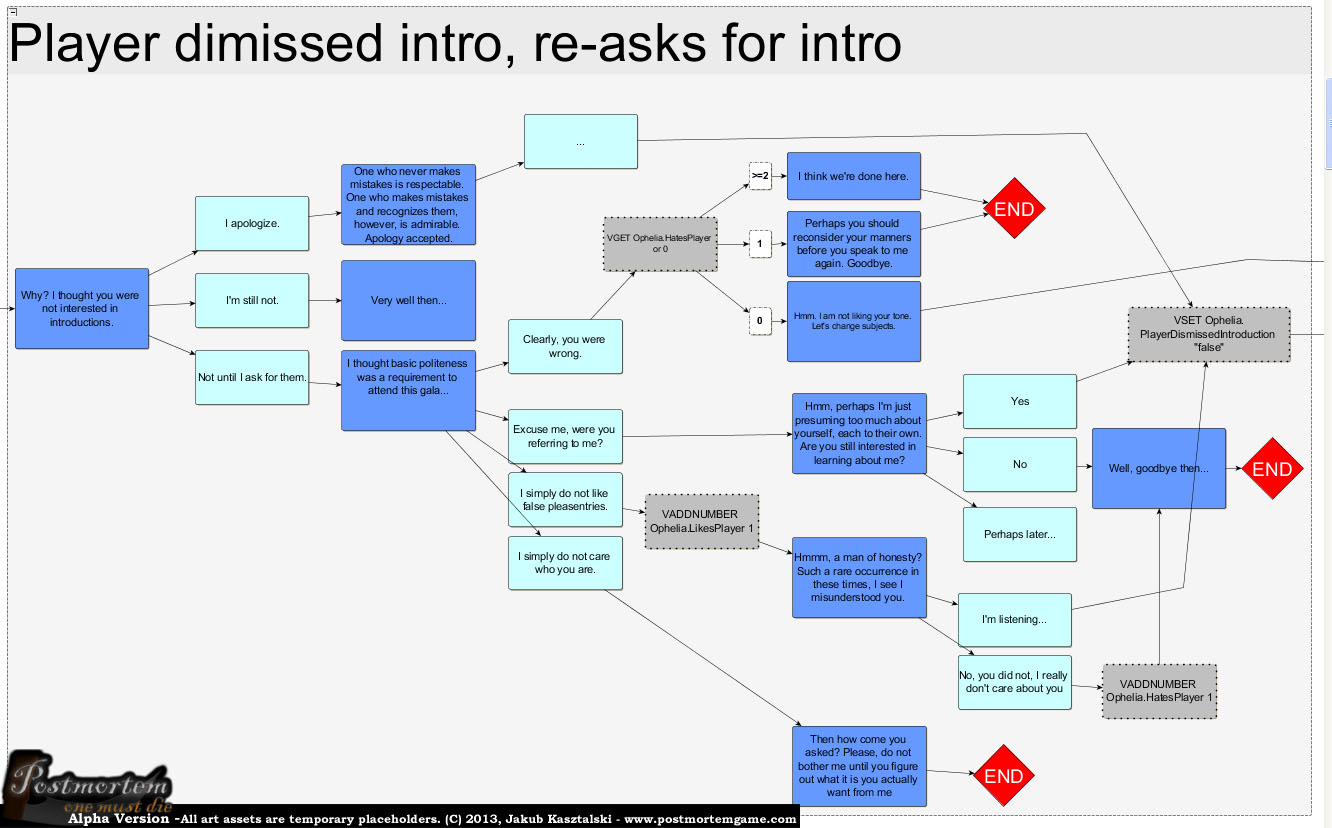
A conversation system is not a list of lines. It is a graph of conditions: who is present, what the player already confessed, whether the NPC hates them, whether an introduction was skipped. Without those flags, every greeting resets. Research on generative tools in game design notes that studios already use language models for first-draft NPC dialogue and interactive branching—the unsolved problem is keeping that dialogue coherent with game state.
Quests that cannot survive agency
If the only way to learn the duke’s secret is to accept his dinner invitation, a player who pickpockets the letter instead has no story. Narrative that cannot survive improvisation is content, not design. The plot has to be a set of facts in the world, with multiple routes to discover them.
No shared document for implementation
Writers think in scenes. Designers think in flags, costs, and fail states. VO directors think in line counts. If those three views never meet in one bible, you ship a story that cannot be built—or a build that cannot be performed.
This is exactly what Game Designer Assistant was built for.
Why Game Designer Assistant
Game Designer Assistant is a dedicated AI game narrative generator for people who have to ship a playable story, not just describe one. You give it the genre, camera, player fantasy, and the narrative model you can actually afford—linear campaign, authored branches, or procedural storylets. It returns a spine, decision points, dialogue that carries state, and quest logic that still works when the player is rude, thorough, or homicidal.
It is built for brainstorming, systems analysis, and documentation across genres and platforms. That combination is the difference between a story treatment and a narrative design doc a production team can implement.
| Traditional Approach | Game Designer Assistant |
|---|---|
| A linear script with “choice” written in the margin | A structure that declares linear, branching, or procedural up front |
| Dialogue that resets every conversation | Lines gated by relationship, knowledge, and prior scenes |
| Ten branches that secretly reconverge | Explicit reconvergence points, and flags for the ones that do not |
| Weeks to outline before a vertical slice | Hours from premise to a reviewable narrative bible |
| Writers and designers working from different assumptions | Scenes, states, and fail conditions in one document |
Pick a narrative model before you write a scene
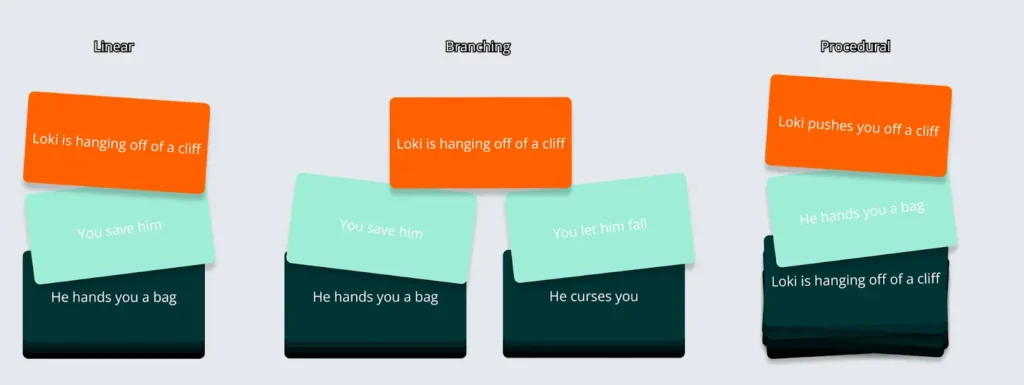
Interactive stories fail when the team has not chosen a model. Linear delivers a authored arc with almost no replay. Branching spends budget on divergence. Procedural spends it on rules that can recombine. The generator starts there: what the player can change, what must stay authored, and which beats are allowed to loop. You should be able to point at a cliffside scene and say whether saving someone is the only path, one of two authored outcomes, or a storylet that can fire in any order.
Choices that set state, not flavor
A useful choice changes who is alive, who trusts you, what the next quest-giver knows, or which resource you no longer have. Cosmetic personality quizzes are cheaper to write and cheaper to forget. Ask for decision maps that name the variable, the values, and the later scene that actually reads them. If no later scene cares, delete the choice.
Dialogue as a graph, not a monologue
NPC talk has to survive interruption, repetition, and hostility. That means conditions on every node: has the intro been dismissed, does this character already hate the player, did honesty raise affection. The output should look like something you could drop into Ink, Yarn, or a dialogue table—speaker, line, condition, effect—not a screenplay that pretends the player will sit still.
Quests as discovery machines
A quest is a fact plus several ways to learn it, plus a failure that is still a story. The generator writes the public objective, the private truth, the evidence in the world, and what happens if the player never talks to the intended NPC. That is how you keep a “rich narrative” from collapsing the moment someone loots the study instead of attending the briefing.
Documentation both disciplines can ship from
Lore without implementation notes is unfinished. Alongside the plot, request flag lists, reconvergence maps, VO line budgets, and “this scene cannot fire if X.” That is the artifact a narrative designer can defend in a production meeting.
Use prompts like these when you want a system instead of a synopsis:
"Tactical RPG, 20-hour campaign, low fantasy. Design a branching Act 1 in a border duchy. The player can support the empire, the theocracy, or neither. Give me the spine, four decision points that set lasting flags, and the scenes those flags change in Act 2. No fake choices."
"Write an NPC conversation for a courtier who already dismissed the player during introductions. Include hostile, polite, and blunt paths. Track relationship with likes/hates variables. Every line needs a condition and an effect I can implement."
"Audit this quest: 'Recover the relic from the abbey.' List three ways a clever player completes it without talking to the abbess, then rewrite the quest so those paths still teach the same secret and still change the ending."
Related Agents You'll Also Find Useful
If you are generating game narrative, you are one step away from cinematic scenes, quest prose, and illustrated recaps that carry that story to players. These agents extend the same workflow.
Film Screenwriter
Once the decision map exists, Film Screenwriter turns locked beats into playable drama: cold opens, companion arguments, and betrayal scenes that obey the flags you already set. Use it when a branch needs a two-handed conversation that still cuts as a cinematic.
- Structure, dialogue, and character development from outline through revision
- Visual storytelling notes that match established geography and blocking
- Scene work that stays inside the political and mechanical constraints of the game
Writing Assistant
Quest text, item flavor, journal entries, and UI strings are where canon usually dies. Writing Assistant adapts to the voice you set—grimdark briefing, cozy farm notice, corporate sci-fi memo—so the barks in combat do not sound like a different writer from the main plot.
- Voice-matched copy across bibles, barks, and player-facing logs
- Editorial passes when a branch is clever but unreadably long
- Format flexibility from one-line tooltips to multi-page codex entries
Comic Creator
Some narrative is better shown than voiced. Comic Creator builds sequential recaps, origin one-shots, and in-world propaganda so a patch story or a founding myth is something players read instead of a wall of quest text.
- Sequential layouts for battles, betrayals, and companion backstories
- Visual styles that can match illuminated manuscripts, wartime posters, or pulp covers
- Issue-to-saga structure for lore comics that ship beside the game
Try this narrative generator free — no credit card required.
How to Generate Game Narrative Step by Step
You do not need a finished GDD to start. You need a player fantasy, a genre, and the narrative model you can staff. This AI narrative generator works best when you treat each pass like a design review, not a one-shot wish.
Step 1: State the game, the player fantasy, and the model Name the genre, camera, length, and whether story is linear, branching, or procedural. Then list what the player is allowed to break. A detective game that cannot miss a clue is not a detective game. A tragedy that allows resurrection is not a tragedy.
"Isometric tactics, 15 missions. Authored branching with two mid-game reconvergence points. The player can spare or execute every named captain. Death is permanent. I need a civil-war campaign where the ‘heroic’ path is not the default."
Step 2: Generate the spine and the load-bearing decisions Ask for the throughline a player would feel in the first hour, plus the decisions that actually fork the world. If a choice does not change a later scene, cut it. If every path returns to the same speech, say so and redesign.
"Give me a five-beat spine, three load-bearing choices, the flags they set, and one reconvergence scene that still respects those flags. Keep it short enough to review in a stand-up."
Step 3: Write branches, conversations, and quest logic Expand only the nodes you will ship. Request NPC graphs with conditions and effects, quests with alternate discovery paths, and companion reactions that fire off the same flags. Insist on line counts if you have VO.
"Write the harbor master’s conversation as a tree. Gates: player stole the ledger, player returned it, player never found it. Include a blunt path that raises respect and a flattery path that lowers it. Output speaker, condition, line, effect."
Step 4: Attack your own story Run a completionist, a speedrunner, a mute protagonist, and a villain. Ask which flags never get read, which scenes orphan, and which “choices” are lies. Patch the minimum number of nodes.
"Find three ways a player makes this Act 1 narrative incoherent: skipped intro, killed the quest-giver, or told the truth too early. Rewrite the graph so those runs still produce a authored ending."
Step 5: Lock documentation the rest of the team can use Compile a narrative bible: spine, flag list, reconvergence map, VO budget, and “do not write” constraints. That is what moves into Ink, Yarn, or your engine’s dialogue table without a second translation.
"Compile a production narrative doc: beat list, flag dictionary, conversation graph summary, and a VO line budget per character. Flag anything still ambiguous."
Results & Use Cases
📊 Indie RPG vertical slice with real branches
- Scenario: A three-person team has a combat prototype and a 12-page treatment. Playtesters keep asking why every “choice” returns to the same campfire speech.
- Traditional Approach: The writer spends two weekends adding extra paragraphs that still reconverge, then the designer implements none of the new flags.
- The AI narrative generator: One constrained pass produces a spine, three load-bearing decisions, and a flag list the engineer can wire before the next build.
Key benefits:
- Choices that change Act 2, not just the next subtitle
- A document combat and narrative can share
- Less rewriting after the first playtest
💼 Studio dialogue volume before VO lock
- Scenario: A 15-person team needs companion barks, a traitor confrontation, and 40 ambient NPC lines before a recording session. Narrative headcount is already thin after industry-wide cuts to writing roles.
- Traditional Approach: A lead writes the cinematic, juniors fill barks in a spreadsheet, and the traitor’s VO contradicts a flag set two quests earlier.
- Game Designer Assistant: One brief yields a conversation graph with conditions, a bark table keyed to the same flags, and a line budget. Cinematic polish then moves to a film screenwriting pass without reopening the plot.
Key benefits:
- State-aware lines instead of generic greetings
- VO that matches implemented flags
- Faster first drafts without surrendering authorship on the lock pass
📱 Live-service patch copy from a phone
- Scenario: A narrative designer is on a train. Tomorrow’s event needs a 120-word setup, a vendor who remembers last season’s war, and a reason the new faction will not talk to players who sided with the old one.
- Traditional Approach: Recycle last season’s speech, hope the wiki search works on mobile, and ship copy veterans poke holes in within an hour.
- The generator: Voice or type the patch constraints, extend the existing timeline, and produce an event that reads the old flag instead of overwriting it. Send the recap to Comic Creator for a six-panel briefing players will actually read.
Key benefits:
- Canon-safe event copy without opening a dozen docs
- Full feature parity on iOS and Android, including speech-to-text
- Season stories that accumulate instead of resetting
🎯 Visual novel or tabletop session that has to survive player improvisation
- Scenario: A solo developer (or a GM) needs a three-route romance or sandbox mystery where ignoring the obvious NPC is a valid path.
- Traditional Approach: Write Route A fully, sketch B and C, and pray nobody combines flags you never tested.
- The narrative generator: Builds the relationship variables, the scenes that read them, and the failure states that are still a story. Writing Assistant then matches journal voice to the route the player actually earned.
Key benefits:
- Routes that are authored, not copy-pasted with a name change
- Failures that teach the world instead of hard-locking
- Prep you can extend between sessions or builds
FAQ
What is an AI game narrative generator?
An AI game narrative generator is a design tool that turns a brief into playable story—spines, branches, quests, and NPC dialogue—rather than a synopsis. Unlike a generic chatbot that invents disconnected scenes, a dedicated game design partner keeps choices, flags, and later scenes causally linked so implementation and writing share one canon. The output is documentation you can revise, not a one-off paragraph of atmosphere.
Is Game Designer Assistant free?
Yes. You can use it on the free tier with no credit card. Paid plans increase monthly usage if you are generating full bibles, iterating conversation graphs, and producing VO tables in the same week. Start with a spine and three load-bearing choices, then expand dialogue and quest logic as the vertical slice hardens.
How is this different from using a general chatbot for game story?
General models will happily write a monologue, a twist, and a companion speech that do not share flags. A game narrative generator is structured around production constraints: genre, camera, narrative model, line budgets, and exploit-resistant quest logic. You can ask it to attack its own branches the way a narrative designer would, then rewrite the minimum nodes so the fantasy still holds.
Can it generate branching dialogue trees and quests?
Yes. That is the core job. Specify the conversation as a graph—conditions, lines, effects—and the quest as a fact with multiple discovery paths. For existing projects, paste the current flag list or GDD excerpt and instruct the tool to extend canon rather than replace it. Always mark what is locked so new material cannot overwrite shipped names.
Does a game narrative generator work on mobile?
Yes. You can brief a branch, dictate a companion rewrite, or generate patch copy from iOS or Android with the same capabilities as desktop. That matters for live-service teams and GMs who need a consistent answer between sessions, not just at a desk. Speech-to-text makes it practical to capture a design argument the moment it happens.
Is AI-generated narrative consistent enough for production?
It is as consistent as your constraints and review pass. The right workflow is generate, attack, patch, then lock. Use the tool to find fake choices, unread flags, and quests that collapse if the player is silent—before those problems reach VO or cinematics. Human direction still chooses theme, tone, and what the game is actually about. Google’s own game-development guidance treats generative AI as a partner for ideation, world-building, and dialogue, not as an unsupervised replacement for authorship.
Conclusion
Players do not remember a list of twists. They remember the moment a game remembered them: the NPC who would not forgive a skipped introduction, the quest that still made sense after they robbed the study, the ending that belonged to the flags they actually set. Building that by hand, across scattered scripts and spreadsheets, is how interactive story dies in production.
An AI game narrative generator gives you a single, revisable source of truth: a narrative model you can staff, choices that set state, and conversations that can be implemented. Game Designer Assistant is built for that job—brainstorming, systems analysis, and documentation in one place. Generate the spine, stress-test the graph, and hand the bible to the rest of the team before the vertical slice, not after the retcon.
Try it with the campaign you have been postponing. Then explore more at Jenova.
For Developers: Game Designer Assistant is available programmatically via the Jenova API — integrate AI game narrative generation into your dialogue pipeline or editor with a single API call. Full documentation →