AI Game Mechanics Generator: Design Core Loops That Stick
2026-09-11
Game Designer Assistant helps you invent playable systems with a game mechanics generator workflow: you bring a fantasy, a genre, and hard constraints, and it returns verbs, objects, and loops a player can actually execute. While random idea lists stall at slogans like “add crafting,” this AI writes the grammar of play — who acts on what, what increases, and what fails. In September 2026, most studios already run AI through art and code; the scarce skill is generating mechanics that survive contact with a player.
- ✅ Noun-verb maps, core loops, and failure states from a one-page brief
- ✅ Combat, progression, and economy systems that share the same grammar
- ✅ GDD-ready write-ups, not a pile of disconnected “cool features”
- ✅ Genre-aware passes for arcade, 4X, F2P, tabletop-inspired, and live-service work
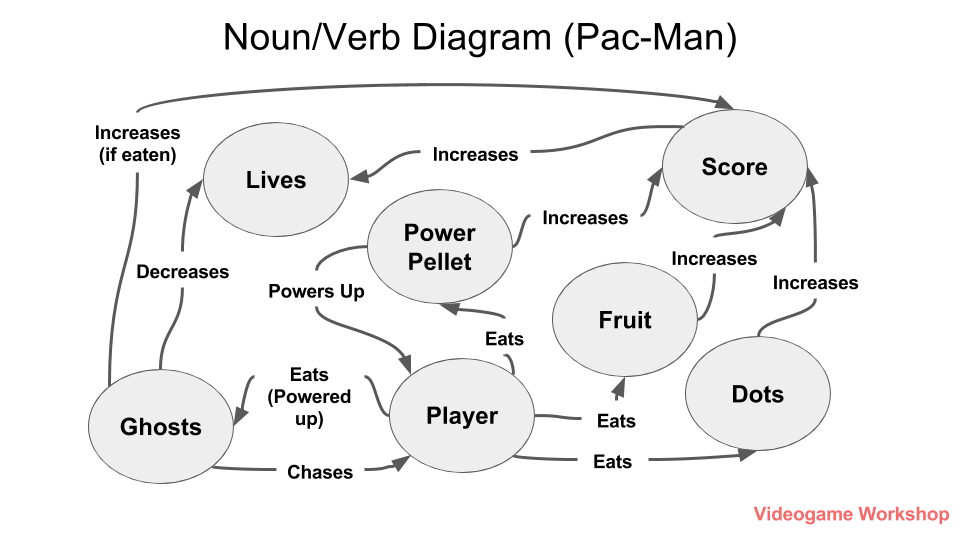
To understand why a generator has to output systems rather than slogans, look at that Pac-Man map. Every circle is a noun. Every arrow is a verb. Score, lives, and power-up state are not flavor text — they are the only reasons the verbs matter. If your generator cannot draw that picture, it is brainstorming, not design.
Quick Answer: What Is a Game Mechanics Generator?
Game Designer Assistant is a game mechanics generator that turns a fantasy and constraints into verbs, objects, and core loops you can playtest. It works from the same inputs a systems designer uses: player fantasy, win conditions, resources, and failure.
Key capabilities:
- Noun-verb maps that define what the player can actually do
- Core-loop and session-loop design (engage, reward, reset, return)
- Economy, progression, and social-system sketches that share one grammar
- Documentation you can drop into a GDD, vertical-slice plan, or pitch
Why Original Game Mechanics Are So Hard to Ship
Procedural generation can fill a world with rooms, loot, and planets. It does not invent the verbs those rooms obey. A dungeon that regenerates forever is still the same game if the only actions are “walk, hit, pick up.” Designers who confuse content volume with mechanical invention ship large games that feel small.
That distinction has a cost. Boston Consulting Group describes AI as a force that can shorten production and cut development cost — which is useful for assets and pipelines, and dangerous if teams use the same shortcut on rules. Rules are the product.
90% — of games developers already using AI in their workflows, per a Google Cloud / Harris Poll survey
But turning that adoption into original play is frustratingly difficult:
- Feature lists pretend to be mechanics (“PvP arena,” “crafting,” “sticker economy”) without a verb the player can execute this second.
- Procgen expands volume, then collapses into repetition when towns, quests, and planets share one thin action set.
- Generic chat models dump tropes. They rarely name what increases, what decreases, and what the player is allowed to refuse.
- Teams still need a document someone can implement, not a mood board.
That skepticism is earned. GDC’s 2026 industry report, drawn from more than 2,300 professionals, sits next to Steam-side disclosure research: at least 7% of shipped titles already flag some AI use. Players can feel the difference between a generated texture and a generated game. A useful mechanics generator has to output the Pac-Man picture — nouns, verbs, and state — not another paragraph about “engaging gameplay.”
This is exactly what this design partner was built for.
Why Game Designer Assistant
Game Designer Assistant treats mechanics as a language. You describe the fantasy (“I am a thief who only wins by being seen at the wrong time”), the platform, the session length, and the things you refuse to copy. It answers like a systems designer: here are the nouns, here are the verbs, here is the loop, here is what breaks if you add a second currency.
You do not need a simulation graph before you get a useful pass. You need a clear brief — and, when you have them, fail states, resources, and a competitor you do not want to clone.
| Traditional Approach | Game Designer Assistant |
|---|---|
| Wiki-trawling “100 board game mechanics” until one sounds fresh | A noun-verb map tied to this fantasy and these constraints |
| Procgen for rooms, loot, and planets with the same three verbs | New verbs first, content generators second |
| Generic chatbot tropes (“soulslike but cozy”) | Failure states, resources, and loops a build can implement |
| Economy diagrams drawn after the feature list is already wrong | Sources, sinks, and gates derived from the same grammar |
| Design notes trapped in Slack | GDD-ready documentation of loop, risks, and first playable |
Start with nouns and verbs, not features
The Pac-Man diagram is the whole method. Player, ghosts, dots, fruit, power pellet, score, lives. Eats, chases, powers up, increases, decreases. Once those arrows exist, “content” is just more instances of the same grammar.
Ask for that map before you ask for modes, cosmetics, or a battle pass. If a proposed feature does not add a noun, a verb, or a state change, it is decoration.
"Fantasy: I’m a courier in a city that rearranges streets while I run. Platform: mobile, five-minute sessions. Give me a noun-verb map with one resource, one timer, and one way the city can cheat. No combat."
Design the loop the verbs create
A core loop is not “play, reward, repeat” written on a whiteboard. It is the shortest path through your verbs that produces a decision, a cost, and a reason to enqueue another attempt. Session loops and live-ops loops are the same grammar at a longer clock.
Google Cloud’s games research found developers already using AI heavily for repetitive production work, including 95% automating repetitive tasks and 44% using it for code and script support. That is the wrong layer for original mechanics. Code can implement a loop. It cannot tell you whether the loop is the game.
"From the noun-verb map, write the 30-second core loop, the 5-minute session loop, and the one reward that must never be skippable. Flag anything that turns into a fetch quest."
Expand the grammar into economies and modes
Once the verbs are stable, you can grow a progression graph without inventing a second game. XP, level, streaks, soft currency, premium currency, packs, and leaderboards only work if each node is a verb the player already understands: earn, spend, risk, unlock, compete.
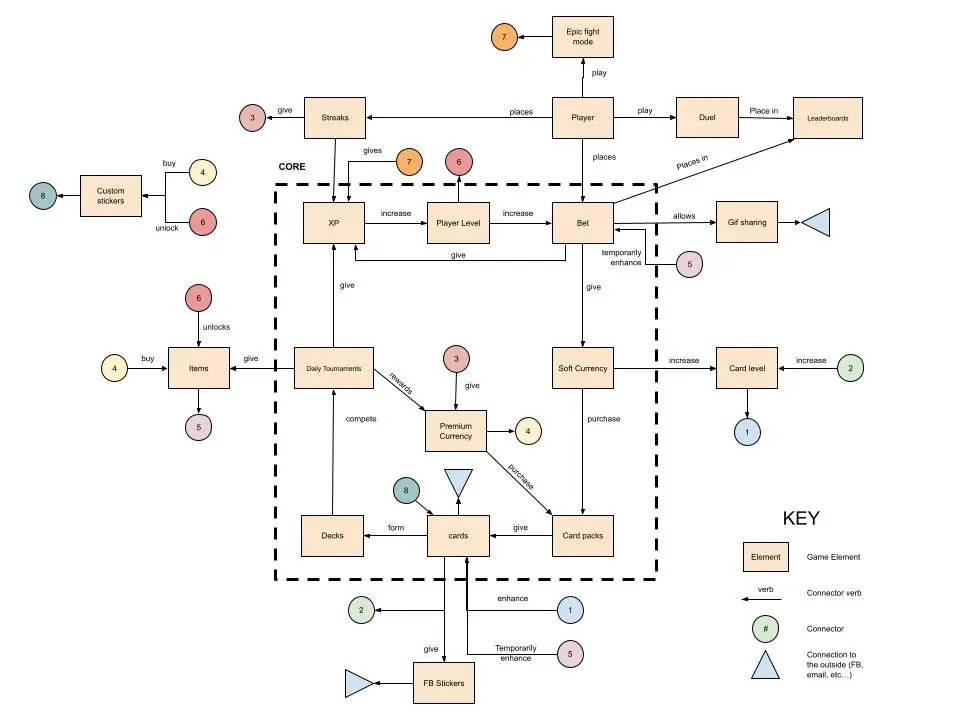
The map above is what a generator should produce after the arcade grammar, not instead of it. Notice the verbs on the arrows — buy, unlock, give, compete, increase. Those are the design. The boxes are just inventory.
"Using this core loop, draft a F2P economy: one soft sink, one premium sink, one fair competitive mode, and one cosmetic that cannot buy power. Call out any arrow that creates pay-to-skip."
Write it so a team can build it
A mechanic that cannot be implemented is a pitch, not a system. The same session should end with a loop diagram in words, a risk list (“if we add a second resource, the timer dies”), and a first-playable checklist. That is the difference between a clever sentence and a vertical slice.
Standalone idea mills and studio-scale PCG builds solve different jobs — one dumps tropes, the other can run six figures and a quarter to stand up level or quest pipelines. This design partner sits in the gap: invent the rules, then decide whether you even need a generator for content.
Related Agents You'll Also Find Useful
If you are generating mechanics this sprint, you will usually need research, a playtest-in-prose, a GDD pass, and an honest look at incentives.
Deep Research
Before you “invent” a stealth-economy hybrid, find out what already shipped and where it broke. Deep Research pulls a wide source set and returns a cited brief you can hand to design.
- Synthesizes academic and industry sources with inline citations
- Useful for “has this verb already been done, and did players keep it?”
- Turns a vague “make it original” into a scoped constraint list
Roleplay Game Master
A loop can be consistent and still feel miserable. Roleplay Game Master lets you play the verbs — the drought, the power pellet, the bad beat — with stable rules and long memory.
- Stress-tests pacing and fairness as experienced, not only as drawn
- Holds the new rules still across a long session
- Catches “balanced on paper, boring at the table”
Writing Assistant
Once the grammar exists, someone has to put it in the GDD, the pitch, and the vertical-slice brief without drifting back into slogans. Writing Assistant is the editor for that pass.
- Turns a noun-verb map into sectioned design documentation
- Keeps audience and tone stable across pitch vs. production docs
- Useful when the mechanic is done and the writing is the bottleneck
Machiavelli Mentor
Players optimize the reward you actually pay. Ranked resets, streaks, and premium sinks are political systems, not just spreadsheets.
- Incentive decoding and multi-move campaign structure
- Useful for “does this leaderboard create camping or aggression?”
- Keeps cosmetics, skill, and status from collapsing into one dominant path
Try this game mechanics generator free — no credit card required.
How to Use a Game Mechanics Generator Step by Step
Step 1: Name the fantasy and the refusal
State who the player is, what they wish they could do, and what you will not copy. “No crafting,” “no second currency,” and “sessions under eight minutes” are design, not pessimism.
"Premium puzzle-action on phones. Fantasy: I am a lockpicker who wins by listening, not by seeing. Refuse: stamina as a monetization gate, and any mechanic that is just match-3 with flavor text."
Step 2: Demand a noun-verb map before features
Ask the generator for objects, actors, resources, and the arrows between them. If a box has no verb, delete it. If two verbs do the same job, merge them.
"Give me a Pac-Man-style noun-verb diagram in text: 6–8 nouns, labeled arrows, and the one state that flips the power relationship. No modes yet."
Step 3: Derive the shortest playable loop
From those arrows, request the 20–40 second core loop, the session loop, and the fail state. A loop that cannot be lost is a toy. A loop that can only be lost to a timer you sell is a cashier.
"Write the core loop as player actions only. Then write the cheapest way this loop becomes unfair, and the smallest rule that prevents it."
Step 4: Grow economy and social systems from the same verbs
Only now add XP, packs, duels, or stickers. Every new box must reuse an existing verb or justify a new one. If “compete” does not touch the core loop, it is a second game glued on.
"Draft a progression graph. Soft currency must sink into the core verb, not into a side grind. Premium may buy cosmetics and convenience, never the win condition."
Step 5: Freeze a first-playable document
End with nouns, verbs, loops, risks, and a build list a programmer can estimate. That document is what design, production, and QA share — and what you take into a playtest, including a Roleplay Game Master session if you want to hear the loop before you code it.
"Turn this into a two-page first-playable: verbs, resources, win/fail, non-goals, and the three metrics that tell us the loop is the game we meant."
Results & Use Cases
📊 Arcade-style original from a one-line fantasy
Scenario: A solo designer has a sentence — “Pac-Man, but the maze is a rumor mill” — and a weekend. Feature lists keep producing social-deduction clones.
Traditional Approach: A mechanics wiki, three abandoned GDD outlines, and a prototype that is still “eat dots.”
Game Designer Assistant: A noun-verb map where rumors are objects, listening is a verb, and “being believed” is the score. Ghosts become rival stories that chase the player’s last public claim.
- Forces originality at the verb layer, not the setting layer
- Produces a first-playable smaller than a content bible
- Pairs with a quick Deep Research pass if you need to prove the verb is not already a known genre trap
📱 Mobile F2P session loop on a commute
Scenario: A live-ops team wants a new daily mode that “uses the existing cards.” The last three modes were reskins of duel. Commute sessions are five minutes. Retention is flat.
Traditional Approach: Another leaderboard, another pack sink, another streak.
This AI: A session loop that reuses collect / wager / resolve, then a mode whose only new verb is “decline” — skip a duel without losing streak if you can read the opponent’s tell.
- Fits phone sessions you can run on iOS or Android during standup
- Keeps cosmetics and stickers off the win condition
- Gives live-ops a mode that is a rule, not a calendar skin
💼 Live-service economy that accidentally became two games
Scenario: A card battler’s “CORE” graph has XP, bets, premium currency, packs, stickers, and Facebook gifts. New users learn a different game than veterans. Design wants one more sink.
Traditional Approach: Add a sink. Inflation moves. Community calls it greedy and boring at once.
The design partner: A verb audit. Every arrow that does not serve collect-build-compete is marked optional. Premium is restricted to cosmetics and queue convenience. Daily tournaments keep “compete”; gif sharing leaves the core.
- Separates social connectors from power
- Writes the patch as a grammar change, not a stealth nerf
- Leaves incentive politics to a follow-up with Machiavelli Mentor when ranked rewards start shaping the meta
🎯 Tabletop analog that has to become a digital verb
Scenario: A designer is adapting a beloved bluffing board game. Digital prototypes keep adding timers and juice until the bluff is a UI animation.
Traditional Approach: More VFX, same missing verb.
With a systems pass plus play-in-prose: You restore “commit without seeing” as the only verb that matters, then play the hand as a scene to hear where the digital medium cheats.
- Protects the analog decision from “helpful” interface
- Produces GM-facing and HUD-facing notes from the same grammar
- Avoids the procgen trap Game Developer documented: more instances of a thin action set, dressed as variety
FAQ
What is a game mechanics generator?
A game mechanics generator is a tool that invents the rules of play — nouns, verbs, resources, and loops — rather than filling a world with extra rooms or loot. Game Designer Assistant does that as a design partner: you bring a fantasy and constraints, it returns a map you can playtest and a document a team can build from.
Is Game Designer Assistant free?
Yes. You can use it on the free plan with limited usage and no credit card. Paid plans raise monthly usage if you are running daily systems workshops or long GDD sessions. Pricing is cumulative by tier, usage resets on the billing date, and core design features are available without a separate “mechanics module” SKU.
How is a game mechanics generator different from procedural generation?
Procedural generation algorithms create instances — levels, items, planets — from rules you already have. A mechanics generator proposes those rules. Procgen is powerful for scale and replay and weak when the verb set is thin. Use this AI to invent the grammar; use procgen later if the grammar needs many rooms.
Can AI generate original game mechanics, or only tropes?
It can do either. Generic prompts produce tropes. Constrained prompts — fantasy, refusals, session length, “no second currency” — produce original verbs. Nearly nine in ten developers already say AI is changing what players expect; originality still comes from the brief you refuse to water down, plus a human playtest.
Does Game Designer Assistant work on mobile?
Yes. Sessions work on web, iOS, and Android with the same project context, which matters when a designer wants to capture a loop on a train. Voice input is available when your hands are full; paste the GDD slice when you sit down. Mobile is also where many of your players will meet the loop, so a commute-length session is a legitimate test, not a downgrade.
Can this AI design combat, economy, and social systems together?
Yes, if you sequence them. Start with the arcade grammar, derive the loop, then grow economy and social arrows from the same verbs. It will not replace a live economy experiment, and it will not see unpublished telemetry unless you paste it. For ranked incentives especially, follow a systems pass with a look at what players will actually optimize.
Ship Verbs, Not Feature Lists
A game mechanics generator will not delete the hard part of design. Interconnected systems, thin procgen, and the temptation to ship a slogan as a mode are still there. What it deletes is the week you spend discovering that your “new game” is three old verbs in a new coat.
The evidence is not vague. Studios already use AI across the pipeline. Industry surveys show both heavy adoption and a sharp rise in distrust when generation replaces craft. Worlds can be enormous and still feel identical. Your job is to invent the grammar — nouns, verbs, state — and to grow loops and economies only from that grammar.
Try Game Designer Assistant on your next core loop, economy map, or first-playable. Explore more at Jenova.
For Developers: Game Designer Assistant is available programmatically via the Jenova API — integrate noun-verb mapping and core-loop generation into your toolchain with a single API call. Full documentation →