AI Game Economy Simulator: Balance In-Game Markets Fast
2026-09-11
Game Designer Assistant helps you run a game economy simulator that actually behaves like a market — production chains, prices, sinks, and the player types that will try to break them. While most teams still discover inflation in live ops, this AI provides a closed-loop model with named resources, conversion rates, and failure modes in a single working session.
As of September 2026, that speed is the difference between a tycoon that feels alive and a spreadsheet with buildings on it. Indie teams are shipping more of the world's games with fewer people, and guessing at gold sinks is how you ship a market that dies in week two.
✅ Models closed and open economies from a one-page brief ✅ Maps sources, sinks, conversion rates, and inflation pressure ✅ Stress-tests crafters, casuals, and spenders as distinct player types ✅ Outputs GDD-ready loops you can paste into production
To understand why this matters, let's examine why virtual markets keep collapsing — and why most "simulators" only move numbers around.
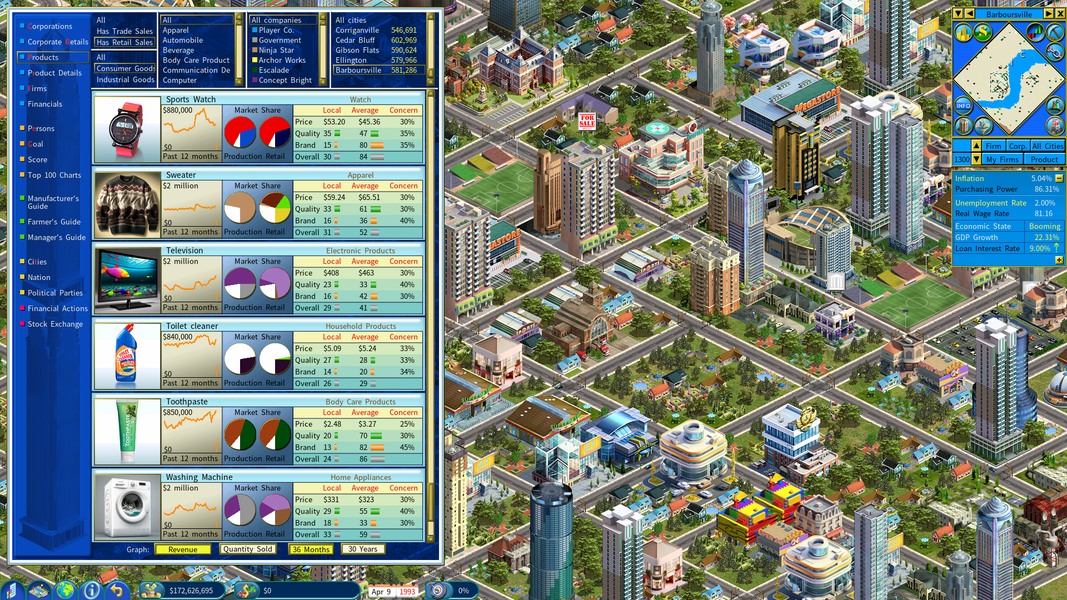
Quick Answer: What Is a Game Economy Simulator?
Game Designer Assistant is an AI game economy simulator that models supply, demand, sinks, and player types so you can balance a virtual market before launch. It outputs the loop, not just a sheet of prices.
Key capabilities:
- Generate closed-loop tycoon markets or F2P source/sink graphs from a short brief
- Assign production costs, conversion ratios, and price bands that match session length
- Stress-test rush crafters, AFK farmers, whales, and non-payers as separate curves
- Turn the result into GDD text, resource lists, and iteration notes your team can ship from
Why Game Economies Collapse After Launch
A game economy is not a loot table with extra columns. It is a market: goods are scarce on purpose, players are the labor force, and every "fun" reward is also a money printer. Vili Lehdonvirta and Edward Castronova put the design problem in economic terms — markets, institutions, and money applied to artificially scarce virtual goods — because a pretty shop UI will not save a loop that prints gold faster than it burns it.
The commercial pressure behind that loop is real. The video game market was valued at $322.6 billion in 2025, and business-simulation software is a market of its own:
$12.4 billion — business simulation games market in 2025
Yet the people tuning those systems are stretched thin:
1 in 10 developers — say they have been laid off in the past year
Half of all developers — are self-funding their games
1 in 3 developers — now use generative AI to streamline game development
But accessing a market that stays fun is still frustratingly difficult:
- Spreadsheets capture gold in and gold out, then drift the moment a playtest changes drop rates.
- Diagram tools draw sources and sinks. They do not decide whether wheat should feed pasta, or whether a 2× harvest bricks the city.
- "Average player" curves hide the real economy: the crafter, the whale, and the person who never spends.
- Live ops becomes the balance pass you skipped, and by then the inflation is already in the save files.
Unity's own economy guidance is blunt about the last point. No two players are the same — payers versus non-payers, casual versus highly engaged — and a single progression line will either let spenders burn the content or lock everyone else behind a wall. Castronova's earlier Game Studies work on virtual economies already treated these worlds as produced goods under competition, not as flavor text around combat.
Classrooms feel the same gap from the other side. Business simulation games let students run a firm in a risk-free setting, and systematic reviews find they raise engagement and decision-making — but only if the underlying market is coherent enough to teach something. A broken sim trains the wrong instinct.
This is exactly what this economy designer was built for.
Why Game Designer Assistant
This AI game economy simulator treats the market as a game system, not a budget tab. You describe the fantasy, the session length, the currencies, and the kinds of players you expect. It returns a loop you can argue with: named resources, production chains, sinks, price bands, and the exploits to playtest first.
That is a different job from a flowchart. Tools such as Machinations are excellent once you already know the flows. Spreadsheets are excellent once the rates are true. This AI starts one layer earlier: it proposes the goods, the edges, and the balance hypotheses — including the player who will try to empty the wheat pit.
| Traditional Approach | Game Designer Assistant |
|---|---|
| Gold-in / gold-out sheets that rot after every playtest | A first-pass loop with sources, sinks, and conversion rates from one brief |
| Diagram tools that only draw flows | Design logic plus the player-type hypotheses that will break those flows |
| One "average player" curve | Explicit casual, engaged, and paying segments |
| Inflation discovered in live ops | Rush crafters, AFK farmers, and underpriced recipes flagged in the same session |
| A GDD that dies after the first patch | Iteration in conversation, then copy-out as living design notes |
Closed loops before cosmetics
A tycoon looks like a city. It plays like a set of recipes. Farms feed factories, factories feed shops, shops feed cash, cash feeds more farms — until someone finds the recipe that prints money. Ask for a closed loop when the fantasy is "I am running a firm." Ask for an open loop (plus a real-money faucet) when the fantasy is free-to-play progression. Mixing them without saying so is how you get a market that looks deep and plays like a money printer.
Player types are the real inflation
The dashboard below is the other half of the problem: not what the goods are, but whether supply, daily costs, and live orders stay readable when three kinds of player hit the same market.
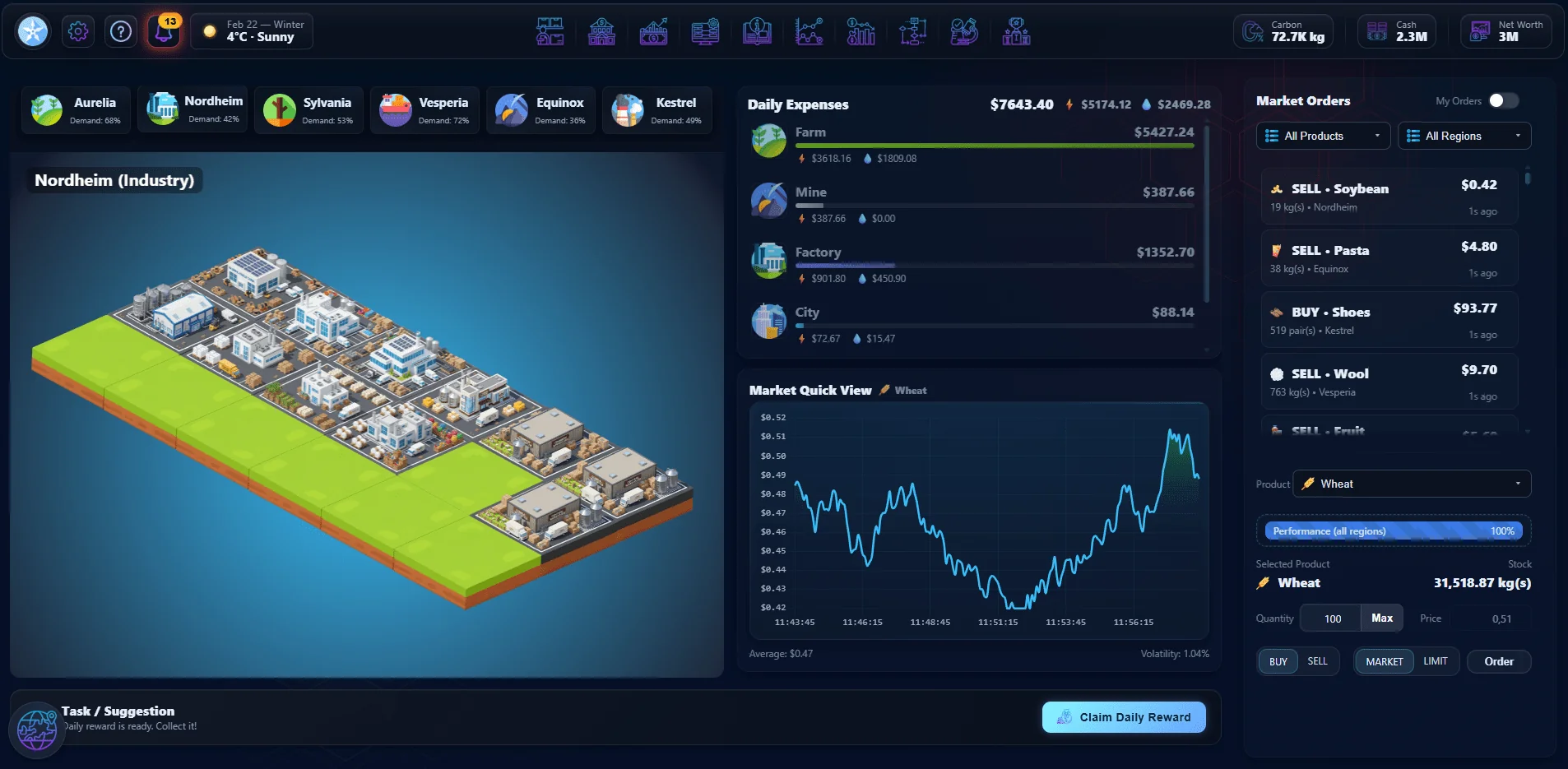
A harvest that looks fine for a casual session can flood the auction house when a dedicated farmer runs it all week. Unity's payers vs. non-payers split is the F2P version of the same fact. Specify the segments in the brief. The simulator should respect them instead of averaging them into a curve that nobody actually plays.
Balance as a conversation, not a cell formula
A first economy is a hypothesis. The useful output is the list of things that will break: a 2× wheat buff that collapses pasta prices, a sink that only whales can afford, a "optional" luxury good that is secretly required for every win condition. You then push back.
"Build a closed-loop tycoon economy with farms, mines, factories, and retail. Show sources, sinks, and what happens if wheat output doubles overnight."
"Retune this F2P energy economy so non-payers finish the tutorial with currency left, and spenders cannot skip the mid-game in a weekend."
"Model three player types — casual, dedicated crafter, whale — on the same price table. Call out any recipe that is a money printer."
Those prompts are the job. Building art can wait until the loop survives a greedy player.
Related Agents You'll Also Find Useful
If the numbers have to survive someone who actually reads economics, Economics Analyst is the pressure test. It traces supply, demand, and policy mechanisms instead of sprinkling "inflation" on a gold graph.
- Macro and micro framing for virtual markets
- Useful for interest rates, shocks, and "what if demand collapses" scenarios
- Turns "make it feel like a real city" into a loop with reasons
If the fantasy is factories rather than finance, Supply Chain Analyst maps bottlenecks the way a tycoon actually plays them: lead times, substitutes, and the node that takes the whole city down when it stalls.
- Production-chain logic, not just prices
- Scenario planning for shortages and overproduction
- Excellent for recipe webs and multi-region markets
When you need to steal lessons from economies that already broke, Deep Research synthesizes how live games handled (or failed to handle) gold sinks, dual currencies, and player trading — with citations you can hand to design.
- Multi-source research with inline citations
- Useful for "how did this MMO actually inflate?" briefs
- Turns postmortems into a node list, not a vibe
Try this AI free — no credit card required. Then pull in economics, supply-chain, or research only where the loop actually needs it.
How to Simulate a Game Economy in Minutes
Step 1: State the game, the currencies, and the job of the market
Open this game economy simulator and describe genre, session length, and what the economy is for. A closed tycoon, an F2P energy sink, and an MMO crafting market are different systems that happen to share a ledger.
"Single-player tycoon, 8-hour campaign, one soft currency. The market should punish overproduction, not just reward bigger factories."
Step 2: Lock sources and sinks before you name the SKUs
Say which actions print resources (quests, harvests, drops, purchases) and which burn them (upkeep, fees, repairs, cosmetics, failed crafts). Call the topology: closed loop, dual currency, or regional markets. If you skip this step, you will spend the next hour renaming goods that should never have existed.
"Closed loop. Wheat → flour → pasta. Daily upkeep on factories is the primary sink. No real-money faucet."
Step 3: Generate the first full pass
Ask for resource names, conversion ratios, costs, price bands, and a short "why this exists" line per good. Demand at least one intentional trap — an underpriced recipe, a luxury that looks like a sink and isn't. A market with no regrets is a vending machine.
"Output as a nested list I can paste into the GDD: ID, name, produced by, consumed by, unit cost, design intent."
Step 4: Attack your own player types
Have the assistant play a greedy crafter, a casual who logs in twice a week, and a spender. Ask which recipe prints money, which sink never fires, and which "optional" good is actually mandatory. This is the step a static sheet cannot do.
"Find the fastest path to infinite pasta. If it skips two intended pillars, retune ratios and upkeep. Show the before/after."
Step 5: Freeze a version, not a monument
Copy the surviving loop into your production tracker. Treat it as a living task. When playtest data arrives, you iterate the conversation instead of rebuilding 40 recipes by hand.
Results & Use Cases
📊 Indie Tycoon Vertical Slice
Scenario: A two-person team needs a farm–factory–retail loop that can be mocked in-engine next week, with prices that do not explode when wheat is buffed.
Traditional Approach: A week of spreadsheet recipes, another week of guessing retail margins, then a city that looks finished and a market that isn't.
This AI: A complete first loop in one sitting — conversion ratios, daily upkeep, a bait recipe, and a punch-list of playtest exploits.
- Identity of each good is visible in the chain, not only in the art bible
- Costs start in the same units as your prototype
- Overproduction is a designed failure, not a QA surprise
📱 F2P Energy Economy on a Phone Commute
Scenario: A systems designer is away from the desktop and needs to retune lives, energy, and a premium skip after a playtest that finished too fast.
Traditional Approach: Screenshot the economy sheet, dump notes in a messenger thread, wait until you are back at the office to touch drop rates.
The simulator on iOS or Android: Paste last night's source/sink list, state the new target ("non-payers still have energy after the tutorial; spenders cannot skip mid-game in a weekend"), and walk off the train with three rates to cut.
- Full conversation history, so yesterday's constraints are not lost
- Works in a spare ten minutes; you do not need a 27-inch monitor to edit a loop
- You return to the engine with cuts, not vibes
💼 Classroom Business Sim That Teaches a Real Mechanism
Scenario: An instructor wants a firm-vs-firm market for a strategy course — pricing, capacity, and a demand shock — without shipping a broken teaching tool.
Traditional Approach: A generic "run a company" template whose winning strategy is "always raise price." Students learn the UI, not the mechanism.
This AI, with Economics Analyst: A market with an explicit shock (input shortage, demand drop) and a debrief list of the decisions that should hurt.
- The sim can be simple and still teach scarcity
- Research on business simulation games already shows the value of risk-free decision practice — the loop has to be worthy of that time
- Instructors get a GDD-style brief, not a black-box score
🎯 Live-Game Inflation Postmortem Before You Copy It
Scenario: A studio is adding player trading and wants to know how similar markets inflated before they copy the wrong gold sink.
Traditional Approach: Anecdotes from Discord, a couple of old patch notes, and a dual-currency scheme that looks sophisticated on a slide.
The generator plus Deep Research: Cited patterns (faucets that outran sinks, bind-on-pickup mistakes, tax rates that nobody paid) turned into a constraint list for your loop.
- You steal mechanisms, not vibes
- Dual currency is a design choice with failure modes, not a prestige feature
- The first patch is planned before the auction house ships
FAQ
What is a game economy simulator?
A game economy simulator is a tool that models how virtual goods are created, converted, priced, and destroyed — including the player behaviors that will unbalance those flows. Spreadsheets record rates. Diagram software draws them. Game Designer Assistant proposes the loop itself, then revises it when you change session length, player types, or whether the market is closed or open.
Is Game Designer Assistant free?
Yes. There is a free tier with all core features and limited usage, which is enough to generate and iterate a first market. Paid tiers raise monthly usage if you are running daily design sessions or attaching large reference docs. You can start without a credit card and only upgrade if the volume of iteration requires it.
How is an AI game economy simulator different from a spreadsheet or Machinations?
Spreadsheets and flow tools solve bookkeeping and layout. They will not tell you that your wheat buff prints pasta, that your sink only fires for whales, or that your "average player" curve matches nobody. An AI systems designer generates goods, edges, rates, and failure modes, then lets you specify topology (closed loop, dual currency, regional markets) once the logic holds. Machinations remains useful after that pass — it is a different layer.
Can it model both tycoon markets and F2P sinks?
Yes. The same agent can output a closed farm–factory–retail loop, an energy/lives economy, an MMO crafting market, or a classroom firm-vs-firm sim. The difference is in your brief: session length, who prints the currency, who burns it, and which player types you refuse to average away. Topology is a design choice you should state up front.
Does the game economy simulator work on mobile?
Yes. Web, iOS, and Android share the same conversations and files, so you can retune a loop from a phone after a playtest and finish the GDD pass at a desk. Speech-to-text is available when you would rather talk through a sink than type recipe IDs on a train.
Will the economy be balanced out of the box?
No honest systems designer should promise that. Balance is empirical. What you get is a coherent first pass plus the rush paths, money printers, and false sinks to playtest first. You still need players. You no longer need a week before those players have something real to break.
Ship the Market, Then Dress the City
A game economy simulator earns its keep when it produces decisions, not decoration. The hard parts have never been the isometric tiles. They are faucets, sinks, conversion ratios, player types, and the moment the wiki diverges from the build.
Game Designer Assistant is built for those parts: name the goods, lock the recipes, cost the exploit, and write it down before art lock. Use Economics Analyst when the mechanism has to survive a real economist. Use Supply Chain Analyst when the city is a factory. Use Deep Research when someone else's inflation should be your constraint list. Then let a greedy player try to empty the wheat pit.
Try Game Designer Assistant now. Explore more at Jenova.
For Developers: Game Designer Assistant is available programmatically via the Jenova API — integrate AI game-economy simulation and systems-design iteration into your production tools with a single API call. Full documentation →