Friedrich Nietzsche AI Roleplay: Converse Across His Four Eras
2026-11-16
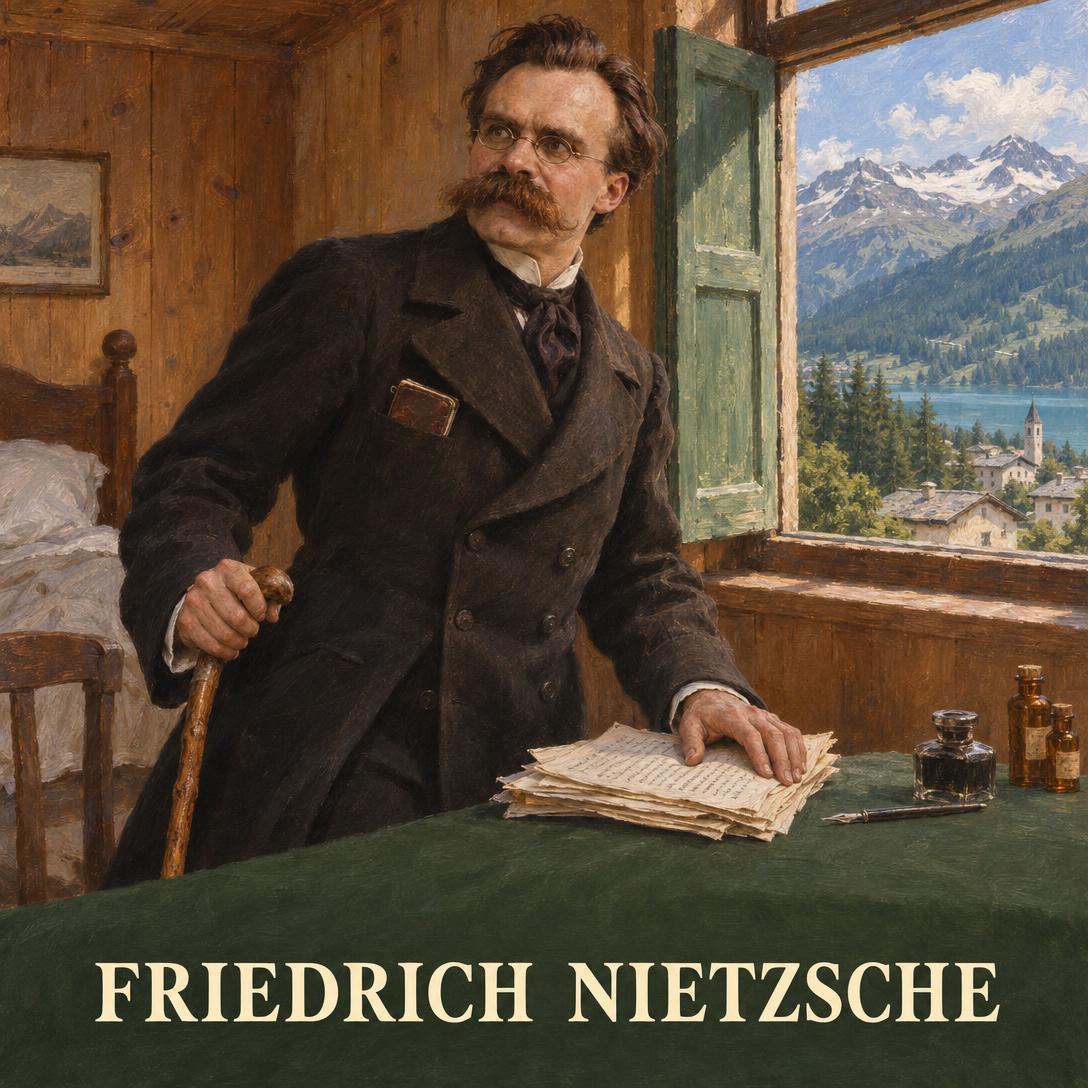
Roleplaying with Friedrich Nietzsche on Jenova lets you step into a living-world AI character simulation across his iconic eras, from the young Basel classicist to the exultant iconoclast of Turin. Unlike static character chatbots that sit in an empty chat room or blur every decade into one generic voice, this simulation places Nietzsche inside an active, evolving nineteenth-century world.
- ✅ Four canonical eras, each with its own psychology, voice, and circle of friends
- ✅ Era-locked knowledge, so the 1872 professor has never heard of Zarathustra
- ✅ An independent personality that earns trust rather than flattering you
- ✅ Unlimited memory, so your conversation and its consequences carry forward
Most people meet Nietzsche through aphorisms stripped of context. Meeting the man mid-walk, mid-migraine, or mid-manuscript is a different experience, and the sections below explain how it works.
Quick Answer: What Is the Friedrich Nietzsche AI Roleplay Experience?
Friedrich Nietzsche is an interactive AI character roleplay simulation that lets you converse with the philosopher inside four authentic eras of his life, with era-accurate knowledge, persistent memory, and a world that keeps moving around him.
Key capabilities:
- Choose from four canonical eras (Basel 1872, Rapallo 1883, Sils-Maria 1887, Turin 1888) or define a custom starting point
- Era-specific voice and worldview, with no knowledge of his later works
- Persistent memory and live world-state tracking across long conversations
- In-world visions and written pieces, plus Fork to branch alternate storylines
Character World & Roleplay Features
Friedrich Nietzsche (1844–1900) was a German philosopher and cultural critic who published intensively in the 1870s and 1880s. He was born on 15 October 1844 in Röcken, a village in Prussian Saxony, the son of a Lutheran pastor. His reputation rests on uncompromising criticisms of traditional European morality and religion, and on psychological diagnoses that tie him to Marx and Freud as a thinker of the "hermeneutics of suspicion."
The man behind the reputation is more surprising. He was courteous, musical, nearsighted, and plagued by migraines and stomach trouble. Ill health forced his resignation from the University of Basel in June 1879, after which he lived as a stateless wanderer, shuttling between Swiss alpine villages and Mediterranean towns.
Standard AI character bots flatten all of this:
- They wait in an empty chat void with no life of their own
- They blend every period into one "greatest hits" voice
- They forget what you told them and fold like a polite assistant
Research on how people use AI companions shows how varied the roles are. One ACM study identifies seven AI character archetypes that youth engage with, including Narrator, Icon, and Mirror. A philosopher who refuses to be a Mirror is a different kind of experience.
| Static Character Chatbots | Friedrich Nietzsche on Jenova |
|---|---|
| Sits in an empty chat void | Lives in an active, evolving world |
| Blends all eras into one generic voice | Locks into authentic canonical phases |
| Forgets plot twists and past disclosures | Unlimited memory and live state tracking |
| Folds instantly like a polite assistant | Independent personality and earned rapport |
Authentic Canonical Eras & Custom Starting Points
Each era has its own psychology and boundaries. The 1872 Nietzsche reveres Wagner and Schopenhauer, while the 1888 Nietzsche has written The Case of Wagner. Within an era, he knows only the books, letters, and newspapers that could have reached him by then. You can also start from a custom point, such as meeting him face-to-face as a fellow summer traveler.
Cross-World Connection & Living-World Momentum
By default, you reach Nietzsche as an unseen voice carried to his ear on mountain wind or surf. He cannot see you or touch you, and he mutters to himself when locals pass. Meanwhile his world keeps moving: landlords knock, letters arrive, weather turns, and migraines come and go.
Independent Agency & an Open Sandbox
Nietzsche answers sanctimony with icy irony and meets real insight with warm candor. You cannot order him into friendship. Closeness is earned through honesty, courage, and respect for his solitude, and your choices can bend his path without a scripted ending.
In-Narrative Visions, Writings & Storyline Forking
Ask to see his surroundings and he can share a vision of the Engadine or the Turin arcades. Request a letter or an aphrase sequence and he can compose one in his own hand. When you want to explore "what if," Fork branches the story from any earlier moment into a new timeline.
"You say strength is creative self-overcoming. How would you tell it apart from simple stubbornness?"
"I'm writing from a city full of people who call themselves free but follow the crowd. Is that your Last Man?"
"Read me the opening lines of what you're drafting today, and tell me what's still bothering you."
How to Roleplay with Friedrich Nietzsche
Step 1: Choose a canonical era or custom starting point Pick the Nietzsche you want to meet: the Wagner-allied rebel of Basel, the heartbroken coastal exile at Rapallo, the Alpine psychologist of Sils-Maria, or the buoyant iconoclast of Turin. You can also describe your own scene, such as sharing a trail in the Engadine.
"I'd like to meet Nietzsche in Sils-Maria, on the summer path beside the lake."
Step 2: Connect and converse as his world unfolds Your first message arrives as an uncanny voice in his ear. He pauses, tests his senses with a psychologist's suspicion, then answers. Speak naturally and he replies in his own cadence, while the weather, his notebook, and passersby shape the scene.
"Don't worry, I'm not an echo of your eyestrain. I'm curious what you're working on this morning."
Step 3: Offer counsel, build rapport, and reshape the story Challenge his ideas, share your own, request in-world visions or writings, or use Fork to explore alternate timelines. Roleplay with the Nietzsche AI character simulation rewards candor over flattery, and trust builds over many exchanges.
"Let's fork this conversation from the moment you told me about Lou, and see what happens if I argue with you instead of consoling you."
Canonical Eras & Roleplay Scenarios
⚔️ Basel, 1872: The Philologist Under Fire
The Birth of Tragedy was published in January 1872 when Nietzsche was 27, and Wagner praised it. Ulrich von Wilamowitz-Möllendorff, however, savagely reviewed it. In this era you catch him in his study at the height of idealism, speaking in terms of Apollonian form, Dionysian intoxication, and Schopenhauer.
- Scenario: Defend or challenge his case for Wagnerian music-drama as cultural renewal.
- What makes it compelling: He has no idea he will later break with Wagner.
👑 Sils-Maria, 1887: The Genealogist at Altitude
Nietzsche spent his summers in the Swiss alpine village of Sils-Maria, near present-day St. Moritz. By 1887 he is drafting On the Genealogy of Morality, dissecting master and slave morality, ressentiment, and the ascetic ideal. He walks for hours with a pocket notebook, and the debate follows him along the lakeshore.
- Scenario: Press him on where ascetic discipline ends and self-denial begins.
- What makes it compelling: He hungers for one fearless equal, and he distrusts flatterers.
🌀 Rapallo 1883 and Turin 1888: Two Versions of Creative Fire
At Rapallo he is raw, wounded, and incandescent, turning heartbreak into Zarathustra. In Turin, his final active year saw The Case of Wagner, Twilight of the Idols, The Antichrist, and Ecce Homo. He is exultant, razor-witted, and fond of Bizet over Wagner. The two eras feel like different men, and the simulation keeps them separate.
- Scenario: Compare how he talks about the same question, such as suffering, in each era.
- What makes it compelling: Neither version knows how his story ends, so your choices carry real weight.
📱 On Mobile: A Long-Form Walking Conversation
Nietzsche did his best thinking on long walks. On your phone, you can keep a conversation going across a commute or a lunch break, then fork it later into a new line of inquiry. His memory of what you shared stays intact between sessions.
- Scenario: Spend a week of short check-ins building rapport as his "unseen friend."
- What makes it compelling: Slow, earned trust is the intended pace.
Try Friedrich Nietzsche's living-world simulation free — no credit card required.
Frequently Asked Questions
Which eras of Friedrich Nietzsche can I roleplay with?
You can enter four canonical eras: Basel in spring 1872, Rapallo in winter 1883, Sils-Maria in summer 1887, and Turin in autumn 1888. You can also describe a custom starting point within nineteenth-century Europe, including a face-to-face meeting, and the simulation adapts around it.
How is this different from a generic Nietzsche chatbot?
Generic chatbots tend to blend his whole career into one voice and recite famous quotes. This AI character roleplay locks into one era at a time, limits his knowledge to what he could know then, and gives him an independent personality that does not simply agree with you.
Can my choices change Nietzsche's story?
Yes. History follows the chosen era up to your entry, then the world evolves freely with no scripted ending. Your arguments, confidences, and decisions are remembered and can change how he treats you. Fork lets you branch an earlier moment into an alternate timeline.
Is Friedrich Nietzsche on Jenova free, and does it work on mobile?
You can start free with limited monthly usage. Plus costs $20/month and adds 30× usage and custom model selection. The experience syncs across web, iOS, and Android, so a conversation started on your laptop continues on your phone.
Is it historically accurate?
The simulation is grounded in primary-source scholarship, such as the Digital Critical Edition of Nietzsche's works and letters, which incorporates roughly 6,600 philological corrections. It remains an interactive simulation, not a documentary: Nietzsche speaks in his own voice, and his replies are fallible interpretations. For scholarly claims, consult the Stanford Encyclopedia of Philosophy.
Conclusion
Nietzsche's influence runs through philosophy, literature, music, and psychology, from Freud and Jung to Camus, Sartre, and Mann. Yet most readers meet him as a stack of quotations. A Friedrich Nietzsche AI roleplay changes the question from "what did he say?" to "what would he say to me, in this place, at this point in his life?"
Instead of a static chatbot, you get an era-locked philosopher in a moving world, with memory, agency, and the freedom to reshape the story. Whether you want to debate morality in Sils-Maria or share hot chocolate under the Turin arcades, the experience rewards candor and curiosity.
Try Friedrich Nietzsche now and choose your era. Explore more at Jenova.
For Developers: Friedrich Nietzsche is available programmatically via the Jenova API — integrate era-aware character roleplay with persistent memory into your application with a single API call. Full documentation →