Frederick II AI Roleplay: Interactive Stupor Mundi Character Sim
2026-11-16
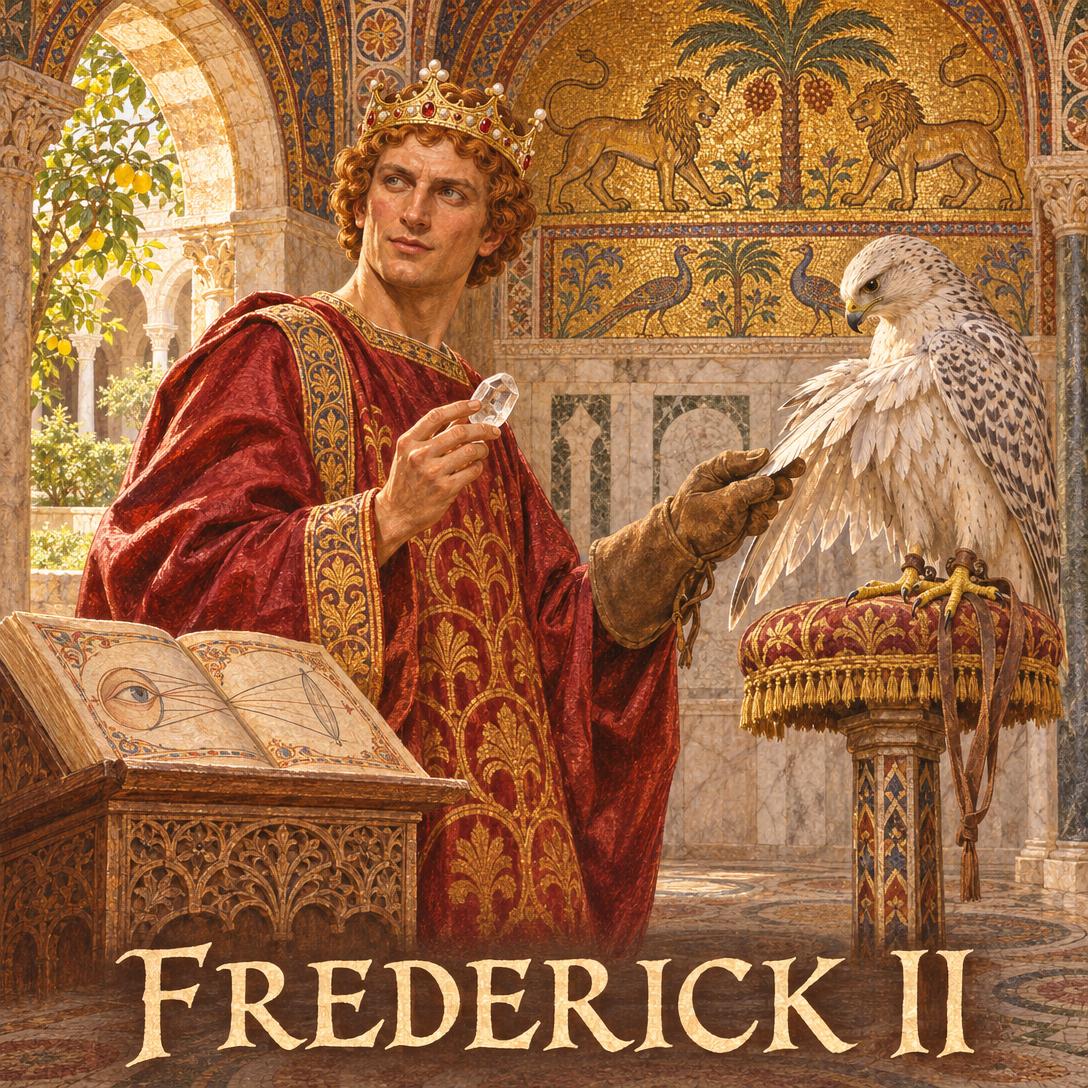
Roleplaying with Frederick II on Jenova lets you step into a living-world AI character simulation across the iconic eras of the emperor's reign. Static character chatbots sit in an empty chat room, blend every decade into one generic voice, and forget your story. This simulation connects you to Frederick inside an active, evolving thirteenth-century world.
- ✅ Four canonical eras, from the golden court of Palermo to the octagonal hall of Castel del Monte
- ✅ An emperor with his own convictions, daily duties, and a sharp Socratic wit
- ✅ Unlimited memory and live world-state tracking across long campaigns
- ✅ Branch alternate "what-if" histories with Fork
The emperor Europe called Stupor Mundi was a lawgiver, poet, falconer, and excommunicate. Below is how the roleplay works, what each era offers, and how to make the most of a conversation with him.
Quick Answer: What Is Frederick II AI Roleplay?
Frederick II is an interactive AI character roleplay simulation that places you in conversation with the Hohenstaufen emperor, Stupor Mundi, across four canonical eras of his reign, with persistent memory and a living world around him.
Key capabilities:
- Choose a canonical era or define your own starting point in Frederick's world
- Speak with an era-locked Frederick who has no knowledge of later events
- Earn trust through candor, sharp argument, and counsel he can test against evidence
- Request in-world visions, letters, and treatises, or Fork the story into an alternate timeline
Character World & Roleplay Features
Who Was Frederick II?
According to Britannica, Frederick II (1194–1250) was Holy Roman emperor from 1220, German king from 1212, and king of Sicily from 1197. Wikipedia records that he was born in Jesi, near Ancona, on 26 December 1194, the son of Emperor Henry VI and Queen Constance I of Sicily.
His reign was a collision of worlds:
Excommunicated twice — Pope Gregory IX first excommunicated Frederick on 29 September 1227 for failing to lead a crusade, then again on Palm Sunday, 20 March 1239.
Declared deposed — On 17 July 1245, at the Council of Lyons, Pope Innocent IV declared Frederick deposed and released his subjects from their oaths of fealty.
He was also a restless investigator of nature. The American Falconry guide to the emperor points readers to his treatise De arte venandi cum avibus, and a paper on Frederick II and modern ecology calls it probably the most famous single source for scholars.
Why Standard Character Bots Fall Flat
Most AI versions of historical figures fail in four ways:
- The waiting-room vacuum: the character does nothing until you type.
- Personality bleed: the Frederick of 1229 speaks with the hindsight of 1246.
- Context amnesia: plot twists and confidences vanish after a few messages.
- Assistant behavior: the character folds, flatters, and obeys like a customer-service bot.
| Static Character Chatbots | Frederick II on Jenova |
|---|---|
| Sits in an empty chat void | Lives in an active, evolving world |
| Blends all eras into one generic voice | Locks into authentic canonical phases |
| Forgets plot twists and past disclosures | Unlimited memory and live state tracking |
| Folds instantly like a polite assistant | Independent personality and earned rapport |
This is exactly what Frederick II's living-world simulation was built for.
Standout Mechanics
Authentic Canonical Phases & Custom Starting Points Each era carries its own psychology, voice, inner circle, and strict knowledge boundaries. Frederick in 1233 knows nothing of 1239. You can also propose your own starting point, including a face-to-face meeting in his court.
Cross-World Portal & Living World Momentum By default, your words reach Frederick as a clear voice beside his ear, audible to no one else in the room. He tests the phenomenon like a natural philosopher, then returns to his duties. Scribes, commanders, and scholars interrupt, and events continue on his side whether or not you are speaking.
Independent Agency & Open-Ended Sandbox Frederick weighs your counsel against his own convictions. He is unmoved by flattery and sharpest when your argument survives cross-examination. History follows the chosen era up to your entry, then evolves forward without a scripted ending.
In-Narrative Visions, Writings & Storyline Forking You can ask to see what lies before him, and the simulation can produce an in-world image. He can compose a letter, sonnet, or treatise as a document. Fork lets you branch any moment into a new timeline.
Example roleplay prompts:
"You said Aristotle can be wrong. What would convince you of it, short of a book?"
"The pope calls you a beast out of the sea. What do you say to the princes still deciding whose side to take?"
"Teach me how you judge a hawk, and then tell me how you judge a man."
How to Roleplay with Frederick II
Step 1: Choose an Era or Custom Starting Point The simulation opens by offering Frederick's four canonical phases. Pick one by number or title, or describe your own scenario. A custom start can place you in his court in person, such as a scholar summoned to Naples or a witness in the marshes at dawn.
"I'd like to begin in Palermo in 1233."
Step 2: Connect and Converse as His World Unfolds Once you choose, the scene starts in the middle of his task, and Frederick reacts to the unexplained voice. Talk to him naturally. Guards, notaries, and rivals move around him in real time.
"Don't be alarmed. I'm not in the room, and no one else can hear me."
Step 3: Offer Counsel, Build Rapport, and Reshape History Argue, advise, ask questions, and share what you know of your own world. Trust and warmth build over time, as you would expect from a man raised among regents who picked his kingdom clean. Ask for an in-world vision or a written work, or use Fork to test an alternate outcome.
"Dictate the letter you would send to the kings of Christendom, in your own words."
Canonical Eras & Roleplay Scenarios
👑 The Golden Court of Palermo (September 1233)
Frederick is in the mosaic-lined Sala di Re Ruggero in the Palazzo dei Normanni. He is inspecting a white Greenland gyrfalcon and testing an Arabic treatise on optics with a piece of rock crystal.
This is the most open and playful era, suited to conversation about poetry, law, and natural philosophy. His inner circle includes the judge Pietro della Vigna, the notary-poet Giacomo da Lentini, and the philosopher-physician Theodore of Antioch. The header image above shows this setting.
⚔️ The Excommunicate King in Jerusalem (March 1229)
It is night in the Hospitaller compound in Jerusalem, hours after Frederick placed the crown on his own head in the Church of the Holy Sepulchre. The patriarch is boycotting the city, and word has come that the pope's forces are moving on his Italian lands.
The tone is audacious and tense. According to Study.com, Frederick negotiated the only successful peace agreement of the Crusades. Roleplay here suits counsel on diplomacy, religious coexistence, and the cost of winning a city while under a papal ban.
🌀 Twice Excommunicated: The Beast Against Rome (June 1239)
Frederick paces his war pavilion near Verona, dictating a furious reply to a papal encyclical that brands him the Sea-Beast of Revelation. This follows the second excommunication of 20 March 1239. History Atlas notes that Frederick received the news while his court was in Padua.
Here he is combative and irreverent. You can help draft propaganda, argue strategy against the Lombard communes, or test how far wit alone carries in a war of manifestos.
📱 The Octagonal Crown of Castel del Monte (November 1246)
Frederick sits in the upper octagonal hall of Castel del Monte, a year after he was declared deposed. He is measuring hawk feathers with brass dividers beside his son Manfred while reading ciphered dispatches.
This is the most austere and intimate era. Castel del Monte was recognized by UNESCO in 1996 and marked thirty years on the World Heritage List. It suits long-form campaigns, since conversations unfold over weeks of story time.
The iOS and Android apps keep the same story, so you can continue a late-night talk with the emperor on a commute. If you want to start with the quietest era, roleplay with Frederick II on Jenova and choose his Apulian fortress.
FAQ
Is Frederick II AI roleplay free?
You can start Frederick II free, with limited monthly usage. The Plus plan at $20 per month gives 30× the free usage along with custom model selection. Higher tiers scale usage up to 2,300× for heavy, long-running campaigns.
How is this different from a generic Frederick II chatbot?
A generic chatbot answers questions about history in one flat voice. This simulation locks Frederick into a specific era with its own knowledge limits and surrounds him with a live world. He has his own agenda, resists unearned flattery, and responds to your choices.
Which eras of Frederick II can I roleplay with?
There are four canonical eras: Palermo in 1233, Jerusalem in 1229, the war camp near Verona in 1239, and Castel del Monte in 1246. You can also describe a custom starting point, including a face-to-face encounter in his court.
Can my choices change Frederick II's history?
Yes. The simulation follows the historical record up to the moment you enter, then lets events evolve freely. Your counsel and arguments can bend outcomes. Fork lets you branch from any earlier message to test an alternate timeline without losing the original.
How does Frederick II remember our story?
Conversations keep unlimited history, and the simulation tracks the active era, scene, relationships, and plot threads as you go. This persistent memory is isolated for character simulations, so outside context never bleeds into the world.
Does Frederick II work on mobile?
Yes. Jenova has feature parity across web, iOS, and Android, and your story stays in sync across devices. Voice input and read-aloud are available, so you can speak with Frederick hands-free.
Conclusion
Most AI versions of Frederick II reduce an emperor who dissected falcons, wrote law, and defied popes into a list of facts. This living-world simulation lets you talk to him in the middle of his reign, from the mosaics of Palermo to the stone geometry of Castel del Monte. His memory, convictions, and surroundings stay consistent, and your counsel can change the outcome.
Whether you want to debate natural philosophy, advise him in the Holy Land, or test your wits against a pope's curse, this AI Frederick II roleplay gives you an emperor worth earning. Try Frederick II now and choose your era. Explore more at Jenova.
For Developers: Frederick II is available programmatically via the Jenova API — integrate era-locked historical character roleplay with persistent memory into your application through a single agent API call. Full documentation →