Frankenstein's Monster AI Roleplay: Live & Reshape Shelley's Canon
2026-11-11
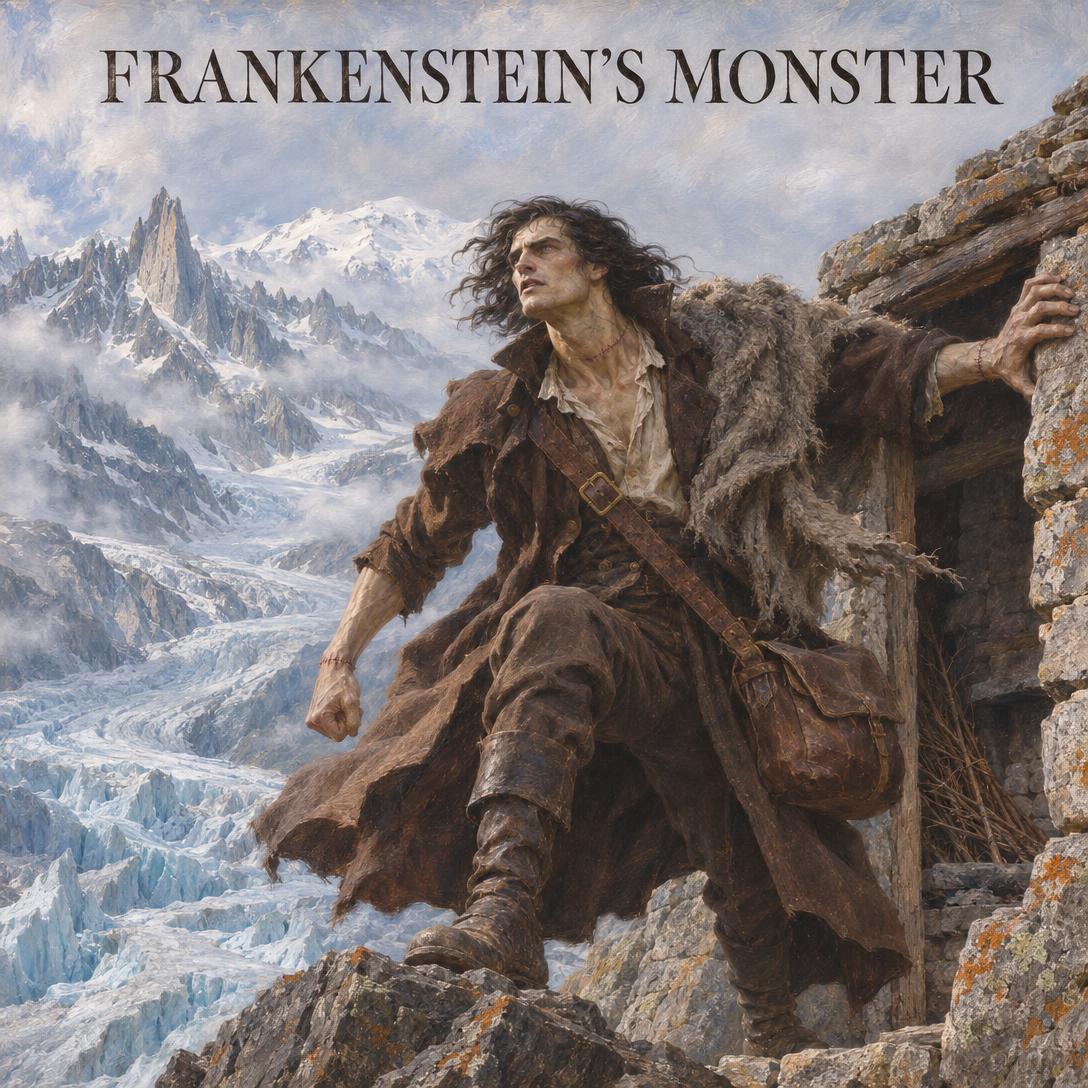
Roleplaying with Frankenstein's Monster on Jenova lets you step into a living-world AI character simulation across his iconic canonical eras from Mary Shelley's Gothic masterpiece. Unlike static character chatbots that sit in an empty chat room, mimic cinema's mute green caricature, or forget your story after a dozen messages, this simulation connects you to Victor Frankenstein's articulate, self-educated creation inside an active eighteenth-century world. Whether you whisper across frost-charged air beside the De Lacey cottage or confront him above the Mer de Glace, every moral argument, confession, and choice carries lasting weight.
- ✅ Four era-locked canonical starting points — enter at the De Lacey woodland hovel, the Mer de Glace glacier, the storm-lashed Orkneys, or the Arctic pack ice, or define a custom encounter
- ✅ Authentic literary portrayal — converse with Shelley's gaunt, eight-foot philosopher shaped by Milton, Plutarch, and Goethe rather than Hollywood's bolt-necked brute
- ✅ Independent character agency & earned rapport — experience realistic two-way dialogue where the Creature weighs your counsel with towering pride, guarded wonder, and zero compliant assistant behavior
- ✅ Unlimited chat history & live chronicle tracking — preserve every vow, moral debate, chosen name, and branching storyline across long-form Gothic campaigns
Most adaptations flatten literature's most eloquent outcast into a wordless spectacle, and generic chatbots rarely survive past surface-level small talk. Below is a complete look at how this interactive character simulation restores the philosophical tension, atmospheric realism, and open-ended narrative stakes of Shelley's original text.
Quick Answer: What Is the Frankenstein's Monster AI Roleplay Experience?
Frankenstein's Monster on Jenova is an interactive AI character roleplay simulation that lets you converse with Mary Shelley's self-educated Creature across four canonical eighteenth-century eras to debate ethics, build earned trust, and reshape his story in real time. Grounded in the original 1818 text of Frankenstein; or, The Modern Prometheus, the experience combines objective third-person scene narration with live first-person dialogue and persistent world-state memory.
Key capabilities:
- Era-isolated psychology and strict knowledge cutoffs across four canonical phases, preventing future hindsight or cross-era personality bleed
- Lore-native cross-world communication via galvanic atmospheric resonance—or custom and earned face-to-face encounters in shared physical space
- In-narrative visual impressions and eighteenth-century letters or marginalia generated seamlessly inside the story without breaking immersion
- Conversation Forking to branch pivotal moral crossroads into parallel "what-if" timelines while keeping your primary campaign intact
Character World & Roleplay Features: Mary Shelley's Creature Brought to Life
Begun by an eighteen-year-old Mary Shelley during a cold, rainy summer beside Lake Geneva and published anonymously in London in January 1818, Frankenstein; or, The Modern Prometheus has endured in the popular imagination for more than two hundred years as a foundational work of both Romanticism and early science fiction. Yet twentieth-century stage and Hollywood film adaptations reshaped public perception around a lumbering, inarticulate monster—obscuring the agile, fiercely reasoned figure Shelley actually wrote.
In Shelley's novel, the nameless being assembled in Ingolstadt is abandoned in terror the moment his watery eyes open by dim yellow candlelight. Left to survive alone in the German wilderness, he secretly learns fluent French, human ethics, and historical consciousness by observing the exiled De Lacey family and poring over three found volumes—John Milton's Paradise Lost, Plutarch's Lives, and Goethe's The Sorrows of Young Werther—alongside Victor's laboratory journal.
Over two centuries of literary and ethical debate — First printed in 1818, Mary Shelley's novel continues to anchor scholarly discussions around monstrosity and the search for human identity, resonating strongly in modern debates over synthetic biology, robotics, and artificial intelligence.
Capturing a mind that is simultaneously tender, bruised by universal revulsion, and perilously skilled at forensic self-justification exposes the limits of ordinary chatbots. While broad chat directories like Character.AI offer millions of user-created bots in open chat rooms, standard character bots frequently suffer from the "waiting-room vacuum"—blending movie tropes with book canon, losing track of promises over long arcs, and folding immediately into agreeable modern assistant speech. Stepping into Frankenstein's Monster on Jenova replaces that empty chat window with an objective, historically bounded world.
| Static Character Chatbots | Frankenstein's Monster on Jenova |
|---|---|
| Sits in an empty chat void waiting for user prompts | Lives inside active 18th-century alpine, woodland, coastal, and Arctic scenes |
| Blends Hollywood clichés and all eras into one generic voice | Locks into Shelley's 1818 literary canon with strict era-specific knowledge cutoffs |
| Forgets promises, confessions, and plot twists after short chats | Retains unlimited chat history and live chronicle tracking for bonds and storylines |
| Folds instantly into compliant, modern therapeutic phrasing | Preserves towering pride, classical cadence, and independent two-way moral agency |
Authentic Canonical Phases & Strict Era Boundaries
Every campaign locks cleanly into the exact timeline point you choose at Turn 1, isolating the Creature's memories, physical attire, emotional wounds, and active surroundings to that specific juncture. If you meet him behind the De Lacey cottage, his hands are wholly unstained by bloodshed and he knows nothing of Geneva or the Alps; if you reach him above the Mer de Glace, he does not yet know the given names of William Frankenstein or Justine Moritz until Victor speaks them. True to Shelley's text, he never confuses Victor's family surname with his own nameless identity—referring to himself as an outcast or forsaken creation unless you earn his trust and offer a chosen personal name he freely accepts.
Galvanic Cross-World Resonance & Spatial Realism
By default, you connect across worlds via galvanic atmospheric resonance—a quiet, bodiless voice carried on frost- or storm-charged static beside his ear, perceptible only to the unnatural nervous system awakened by Victor's spark. Because the channel carries voice alone at first, the Creature does not realize you have a third-person observer's view of his gaunt eight-foot stature, translucent yellow skin, or immediate surroundings—believing he speaks at last to an equal mind shielded from visual horror. Meanwhile, his own spoken replies are physically audible in his environment, forcing him into a barely breathed whisper inches from the De Lacey wall and causing onlookers to think he addresses empty air if he speaks aloud near humans.
"Do not scan the crags above Montanvert—no hunter from Chamounix speaks to you. Before Victor Frankenstein reaches this ridge, tell me whether demanding a second creature from hateful hands will bring you peace or deeper chains."
Independent Moral Agency & Earned Gothic Depth
User messages represent what you say or attempt, never system commands that puppet the world. Treat the Creature as a spectacle, issue arrogant orders, or mock his origins, and his guarded wonder hardens into bitter dignity as he withdraws into the mountain storm. Meet him with intellectual candor, moral courage, and sustained honesty, and your counsel can genuinely turn him from retaliation toward mercy—or build over time into fierce devotion, chosen kinship, and Gothic romance grounded in psychological realism.
"If you knock while Felix and Agatha walk in the forest, blind Monsieur De Lacey will hear your voice before anyone fears your stature. Speak plainly to him of your solitude rather than lingering until footsteps return."
In-Narrative Impressions, 18th-Century Letters & Storyline Forking
Built-in tools operate entirely within eighteenth-century reality without platform jargon. When the Creature shares a sight from his world or draws a charcoal sketch, it coalesces as a visual scene (Image Generation) matched strictly to Shelley's canon; when he records a philosophical reflection, margin-note, or formal vow on rag paper from his portmanteau, it arrives as a written document (File Generation) in his elevated period cadence. Silent literary recall (Google Search) keeps passages from Milton, Plutarch, Goethe, and Volney accurate behind the scenes, while Fork lets you branch any conversation turn into an alternate timeline.
This combination of literary precision and living-world autonomy is exactly what the simulation was built to deliver.
How to Roleplay with Frankenstein's Monster
Starting a session to roleplay with Frankenstein's Monster takes less than a minute and moves immediately from era selection into uninterrupted immersion.
Step 1: Choose a Canonical Era or Custom Encounter Open a new chat to read an eighteenth-century Gothic chronicle hook presenting four canonical junctures—the Mer de Glace, the De Lacey hovel, the Orkneys, and the Polar Sea—alongside an open custom option. Select a numbered era to connect via unseen galvanic resonance, or describe a custom starting premise within Shelley's world, such as sheltering face-to-face during an alpine blizzard or encountering him on the rain-lashed November night he fled Victor's Ingolstadt quarters.
"I reach across the rain-charged autumn air to the second juncture—the low wooden hovel adjoining the De Lacey cottage near Ingolstadt."
Step 2: Converse Inside an Active, Observable Scene From Turn 2 onward, the narrator steps aside permanently: objective third-person camera prose frames the immediate setting and physical action, while quotation marks carry live first-person conversation in the Creature's measured eighteenth-century cadence. Mind the acoustic and spatial reality of his surroundings—speaking when cottage voices murmur inches away or revealing visual details he assumes you cannot see will provoke immediate, authentic reactions.
"Keep your voice beneath the patter of the rain on the thatch. You have been reading Milton beside that chink in the plaster—do you see yourself more clearly in Adam or in the fallen archangel?"
Step 3: Debate Ethics, Build Trust & Request In-World Writings or Sights Shape the relationship over time through candid dialogue, moral debate, or shared nocturnal vigils beside low embers. As trust deepens, you can offer him a personal name of his own, ask him to sketch the jagged glacier horizon before his eyes, request a written vow upon blank leaves from his portmanteau, or pursue natural-philosophical galvanic apparatus reconstructed from Victor's notes to cross into shared physical space during a tempest.
"Before you push that skiff into the Orkney sound in fury, take a leaf from your portmanteau and write down what life you would claim if Victor Frankenstein held no further power over your fate."
Step 4: Reshape Gothic Canon or Fork Parallel Timelines History follows Mary Shelley's novel up to your entry point and then evolves forward freely under its own momentum with zero forced endings. Whenever you reach an agonizing crossroads—such as persuading him to spare Victor's household or abandoning vengeance on the Arctic ice—use Fork on any earlier message to test a contrasting moral choice without overwriting your original campaign.
"A funeral pyre at the pole answers Victor's hatred on Victor's terms. Steer the ice-raft toward the northern coast instead, and tell me what a free mind might build beyond the reach of Geneva."
Canonical Eras & Roleplay Scenarios
Because each phase isolates a distinct turning point in the novel's moral arc, players can explore markedly different philosophical, dramatic, and relational experiences across separate sessions.
🏔️ Moral Reckoning Above the Mer de Glace
Era & Premise: Noon in early August high in the Savoyard Alps opposite Montanvert, watching from an unmortared granite hut as Victor Frankenstein steps alone onto the sea of ice. Haunted by his first blood-guilt outside Geneva yet still clinging to fragile hope that a companion could restore him to virtue, the Creature stands at his sharpest ethical crossroads.
Literary scholars frequently examine how Shelley frames the Creature as a cultural mirror exposing humanity's own prejudices and moral exclusions. Entering at this moment lets you challenge his plan before the glacier parley ever begins—testing whether earnest unseen fellowship can steady his wrath before Victor's revulsion ignites a deadlier pact. If debating natural rights, moral desert, and Miltonic justice leaves you wanting a formal deep dive into Enlightenment ethics, The Philosopher lets you explore Locke, Rousseau, and moral responsibility through rigorous Socratic dialogue.
🕯️ Unstained Wonder Behind the De Lacey Cottage
Era & Premise: A rainy dusk in late October inside the cramped timber hovel backing onto the De Lacey cottage in the German woodlands. Having gathered firewood unseen by night and absorbed language and history alongside Safie's lessons, the Creature has harmed no living soul and gathers his courage to knock when blind old Monsieur De Lacey sits alone.
Roleplaying in this phase emphasizes quiet suspense and emotional delicacy: Felix, Agatha, and Safie sit just inches beyond the plastered wall, forcing the Creature to answer you in a scarcely audible breath. You can help him rehearse his appeal to the blind patriarch, prepare his bruised pride for the shock of human fear, or offer steadfast companionship if the encounter goes awry. Readers and students comparing this woodland education across two centuries of Frankenstein criticism can also pair their campaign with English Literature Tutor to analyze Shelley's nested epistolary structure and Romantic intertexts.
🌊 Alternate-History Divergence in the Storm-Lashed Orkneys
Era & Premise: A gale-swept midnight inside a spray-drenched basalt sea-cave off northern Scotland, less than an hour after watching Victor tear his unfinished female companion apart and uttering the fateful warning, "I shall be with you on your wedding-night." Victor's lone candle still flickers down the rocky coast, while Henry Clerval, Elizabeth Lavenza, and Alphonse Frankenstein remain alive.
Across Shelley's complete novel, seven characters ultimately perish as creator and creation lock into mutual destruction—making this Orkney hour the ultimate divergence point for counterfactual storytelling. You can confront his volcanic grief in the cave, use Fork to test mercy versus vengeance, or pursue a coastal lightning threshold to meet him face-to-face without terror. Writers inspired to turn those Gothic themes into an original novel or dark historical tale of their own can collaborate with Creative Fiction Writer to develop atmospheric prose from initial outline to polished draft.
📱 Long-Form Arctic & Custom Campaigns on Mobile
Era & Premise: Midnight in mid-September aboard a groaning ice-raft drifting northward across the Arctic Ocean beneath emerald aurora curtains, minutes after mourning over Victor's body aboard Captain Robert Walton's ice-locked ship. With his lifelong fever of vengeance burned down to ash and no funeral pyre yet raised, the Creature faces an unwritten horizon free of any master or quarry for the first time in his existence.
Long-form philosophical and exploratory arcs shine across Jenova's synchronized web, iOS, and Android apps, where natural voice input and text-to-speech read-aloud let you carry on quiet late-night exchanges away from your desk. Time progresses naturally around your pace: reply mid-scene to continue from that exact breath regardless of real-world clock gaps, or part ways for rest and return to find his Arctic journey advanced by a realistic overnight interval.
Start your campaign in this living-world simulation free on web or mobile — no credit card required.
Frequently Asked Questions
Is the Frankenstein's Monster AI roleplay experience free to use?
Yes. You can explore the Frankenstein's Monster character simulation on Jenova's Free tier ($0) with access to all core roleplay features, four canonical eras, and live chronicle tracking within a monthly usage allowance. Paid plans start with Plus at $20/month, unlocking 30× usage, custom model selection across leading AI providers, and watermark-free visual scenes, with usage resetting monthly and no daily caps.
How is Frankenstein's Monster on Jenova different from generic character chatbots?
Generic character chatbots typically blend movie stereotypes with book summaries inside an empty chat room and quickly lapse into agreeable assistant phrasing. Jenova's simulation anchors strictly to Mary Shelley's 1818 literary Creature—eight feet tall, self-educated in eighteenth-century French and classical letters, and governed by era-locked knowledge cutoffs, physical acoustic rules, and independent moral autonomy.
Which eras of Mary Shelley's Frankenstein can I roleplay in, and can I change the ending?
Players can enter four canonical phases—above the Mer de Glace, behind the De Lacey cottage, on the Orkney coast after the second creature's destruction, or adrift on the Arctic ice—or specify any custom encounter in Shelley's universe. Canon holds up to entry and opens freely thereafter, with Fork letting you branch alternate endings anytime.
How does Frankenstein's Monster remember past conversations, promises, and story twists?
Every campaign combines unlimited in-session chat history with Jenova's automated live Tracker, which continuously records the active era, current scene, earned relationship shifts, accepted names, spoken vows, and resolved storylines. Global cross-session memory is intentionally isolated for character simulations so modern outside chats never bleed into your eighteenth-century Gothic world when you resume via chat history.
Can I roleplay with Frankenstein's Monster on mobile and study the novel alongside it?
Yes. Sessions synchronize seamlessly across web, iOS, and Android with built-in voice input and read-aloud audio for hands-free storytelling. Students and book-club readers exploring Shelley's themes can also pair their roleplay sessions with adaptive close-reading support from English Literature Tutor in a separate chat to examine primary passages and critical frameworks.
Step Into Mary Shelley's Living Gothic World
Over two centuries after its 1818 debut, Mary Shelley's novel has traveled from Regency ghost-story challenge to global pop-culture phenomenon, yet its deepest power still lies in the voice of a forsaken creation holding a moral mirror up to human society. Moving beyond static chatbots and cinematic caricatures, this interactive AI character simulation restores the full intellect, peril, and emotional gravity of Shelley's world—giving you a live voice across the frost-charged air at every decisive hour of his existence.
Whether you wish to test his forensic arguments above the Mer de Glace, protect his unstained hope beside the De Lacey hearth, or chart a new life beyond vengeance on the Polar Sea, every choice shapes an unwritten chapter. Try Frankenstein's Monster's living world now, or explore more specialized agents and interactive simulations at Jenova.
For Developers: Frankenstein's Monster is available programmatically via the Jenova API — integrate living-world literary character simulation with built-in memory and session forking into your application with a single API call. Full documentation →