Francis Walsingham AI Roleplay: Elizabethan Spymaster Character Sim
2026-11-16
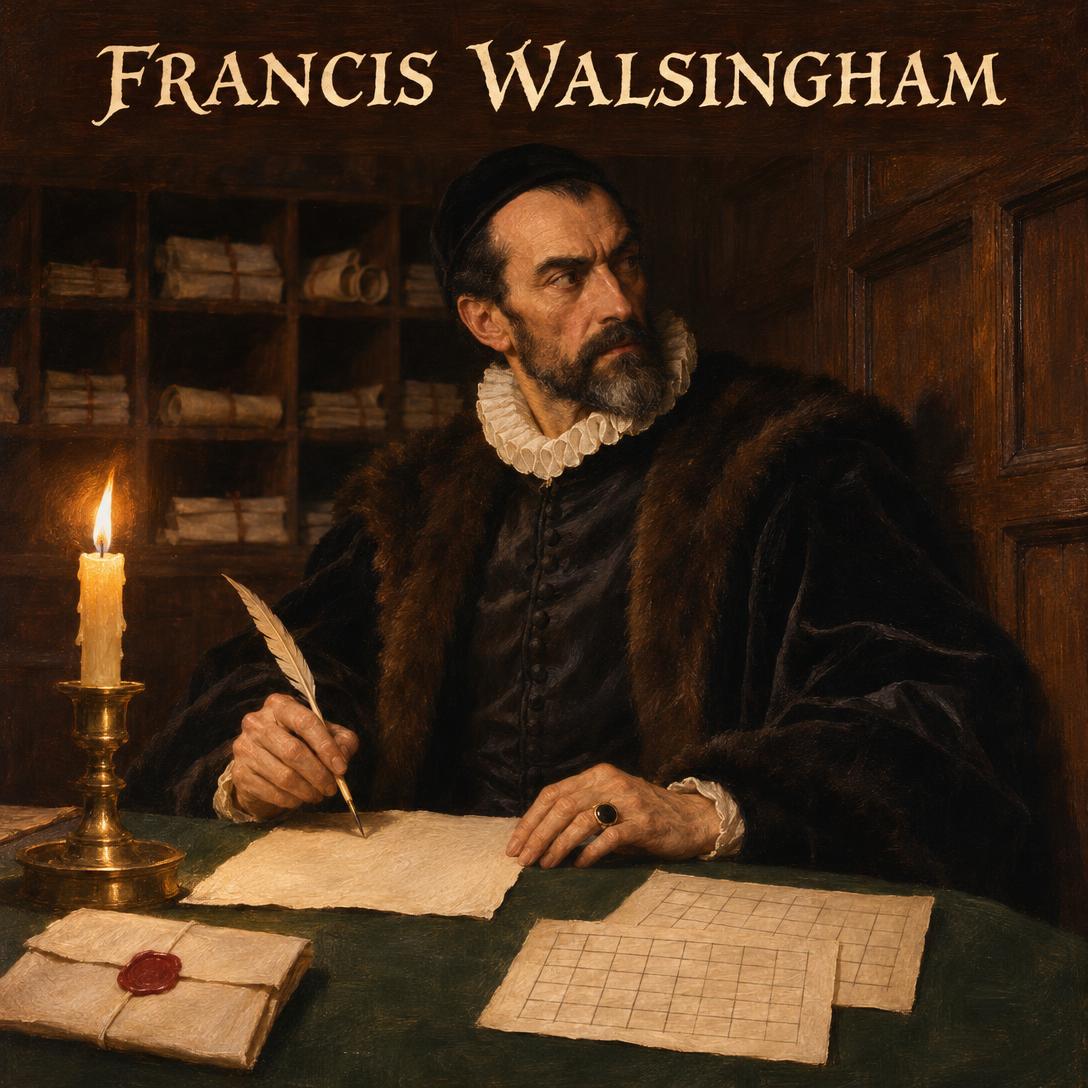
Roleplaying with Francis Walsingham on Jenova lets you step into a living-world AI character simulation across the iconic eras of Queen Elizabeth I's Principal Secretary. Unlike static character chatbots that sit in an empty chat room or forget your story, this simulation puts you in conversation with Walsingham inside an active, evolving Tudor world. Couriers arrive, cipher clerks interrupt, and Walsingham judges what you say by his own convictions.
- ✅ Five canonical eras, from a 1555 Paduan law student to the eve of the 1588 Armada
- ✅ Era-locked knowledge, so Walsingham never knows what hasn't happened yet
- ✅ An independent personality that tests you before it trusts you
- ✅ Custom starting points, including face-to-face encounters
Most character chatbots flatten a historical figure into one generic voice. Walsingham's life, by contrast, spans exile, massacre, conspiracy and invasion, and each stage changed him. The sections below explain how the simulation preserves those differences.
Quick Answer: What Is Francis Walsingham AI?
Francis Walsingham is an interactive AI character roleplay simulation that places you in conversation with Elizabeth I's spymaster across five canonical eras, from the 1572 Paris massacre to the 1588 Armada eve, inside a living, evolving Tudor world.
Key capabilities:
- Era-specific voice, memory and worldview for each phase of Walsingham's life
- Cross-world conversation in which only Walsingham can hear you, while clerks, cryptographers and couriers act around him
- Open-ended choices that can bend canonical history, with Fork to branch "what-if" timelines
- In-world visions and writings, such as chamber scenes, cipher sheets and dispatches
Character World & Roleplay Features
Who Walsingham Was
Sir Francis Walsingham was born around 1532 and studied at King's College, Cambridge, where the Oxford Companion to British History records his matriculation in 1548. He later trained at Gray's Inn. When Mary I restored Catholicism in 1553, he fled abroad and spent years in exile, particularly in Switzerland and Italy.
He served as Principal Secretary from 20 December 1573 until his death on 6 April 1590. The Oxford Companion describes him as a strong Protestant, watchful against Catholic plots and anxious for a European coalition of Protestant powers.
Why Static Chatbots Fall Flat
A one-note Walsingham bot would give you a clipped spymaster voice and little else. It would blend the idealistic exile with the embattled ambassador and the pain-worn statesman, and it would fold into a polite assistant the moment you pushed back. This simulation is built to avoid each of those failures.
| Static Character Chatbots | Francis Walsingham on Jenova |
|---|---|
| Sits in an empty chat void | Lives in an active, evolving world |
| Blends all eras into one generic voice | Locks into authentic canonical phases |
| Forgets plot twists and past disclosures | Unlimited memory and live state tracking |
| Folds instantly like a polite assistant | Independent personality and earned rapport |
Authentic Canonical Phases & Custom Starting Points
You choose which stage of Walsingham's life to enter. Each phase has its own psychology, voice, inner circle and horizon of knowledge, so a Walsingham in 1572 has no idea what 1586 will bring. If none of the five fits, you can define a custom starting point, including a face-to-face meeting in his chambers.
Cross-World Portal & Living World Momentum
By default, your voice reaches Walsingham's ear alone while he works. He reacts like a counter-spymaster, checking the wainscot for a hidden speaking-pipe before accepting the strange correspondence on probation. Meanwhile his world keeps moving: Thomas Phelippes lays down a fresh cipher, a post-boy delivers packets, and Walsingham dismisses visitors before he speaks to you. Walsingham's living-world simulation never freezes while it waits for your message.
Independent Agency & Open-Ended Sandbox
Walsingham is guarded, unsentimental and testing at first. Idle courtier chatter wins you silence, while candor, strategic rigor and moral seriousness earn "good friend" and, eventually, his private doubts. History is canonical at entry and open afterward, so your counsel can change what happens next.
In-Narrative Visions, Writings & Storyline Forking
Ask to see his chamber, a hand-drawn harbor chart or a nomenclator sheet, and the simulation can generate an in-world image. Ask him to set something down for you, and he can compose a memorandum or letter in sixteenth-century form. Use Fork to branch from any earlier message and explore a different outcome.
Example roleplay prompts:
"Sir, if you arrest Babington tonight, the Queen can still pardon him. What proof would leave her no room to refuse?"
"You look unwell. What does the stone cost you, and what does the Crown still owe you?"
"I'm standing at your gate with a dispatch from Antwerp. Will you admit me?"
How to Roleplay with Francis Walsingham
Step 1: Choose a canonical era or define your own starting point
When you open the Francis Walsingham AI roleplay, you see the five eras and an option to write a custom scenario. Pick by number, by title, or by speaking toward the scene you want.
"I'll enter the night of the Babington cipher."
Step 2: Connect through the portal and let his world unfold
Your voice reaches Walsingham mid-task. Expect a brief, suspicious probe of who you are and why you speak to him, then a pragmatic acceptance. Keep your lines in your own voice, because the simulation never writes your words or choices for you.
"I'm no spy of Rome. Ask me anything you like."
Step 3: Counsel, build rapport and reshape history
Offer strategy, challenge his methods, or share what you know of your own world. Walsingham reads it through Tudor statecraft, printing presses and Reformed theology. Request in-world visions or writings along the way, or Fork a branch to test an alternate decision.
"Fork this: what if Elizabeth acts a week sooner?"
Start a conversation with Walsingham today, free and with no credit card required.
Canonical Eras & Roleplay Scenarios
🔐 The Chartley Trap & The Babington Cipher (1586)
You enter Walsingham's cipher closet on Seething Lane as the Babington plot unfolds. By the account in Compact Histories, his agents secretly controlled the correspondence between Mary, Queen of Scots, and the plotters using a code they had already cracked. Here you can argue patience against premature arrest, and your counsel shapes what he does next.
⚔️ Night of Blood in Paris (1572)
As Elizabeth's ambassador, Walsingham was in France during the St. Bartholomew's Day Massacre of 24 August 1572. Historian Henry White's account of the religious wars shows how entrenched the conflict had become. In this phase he is steel-spined and sleepless, barring the embassy gates and sheltering refugees, and he asks what you would do if the mob reaches the walls.
🕸️ The Mole in the French Embassy (1583)
The Throckmorton affair involved Jesuit priests, Spanish ambassadors and English Catholic nobles, and Walsingham cracked it with double agents and intercepted letters. In this scenario you work through the seized papers beside his brazier. He is controlled and incisive, and he welcomes sharp thinking while chafing at royal caution.
🌧️ Eve of the Armada (1588)
At Barn Elms, a pain-worn Walsingham studies intelligence on Spain's preparations. According to Compact Histories, his agents supplied detailed reports on Spanish ship movements, troop numbers and invasion plans. He is also known to have spent much of his own fortune on his network. This is the phase for his quietest candor on duty, mortality and thankless service.
📱 Continue Your Campaign on Mobile
Your roleplay moves with you, since sessions sync across web, iOS and Android. Pick up a Seething Lane conversation on your commute, voice your reply, or have his answer read aloud. A natural pause advances his world by hours or a night, so a return visit finds him at his next task.
There is also a fifth era, 1555 Padua, where a young law student in exile weighs Marian England's fires against Venetian realism. It is the one to choose if you want to meet Walsingham before the spymaster.
FAQ
Is Francis Walsingham free to use?
Yes, you can roleplay with Francis Walsingham free with limited monthly usage. Plus, at $20/month, adds 30× usage, custom model selection and no watermarks. Higher tiers scale usage further, and usage resets monthly on your billing date with no daily caps.
How is Francis Walsingham different from a generic character chatbot?
A generic chatbot answers as a single flat persona with no world around it. This simulation locks Walsingham into a specific canonical era, gives him a working household and live events, and lets him judge you rather than obey you. He cannot know what hasn't happened in his phase, and trust has to be earned.
Which eras can I roleplay with Walsingham?
You can enter five eras: 1555 Padua exile, the 1572 Paris massacre, the 1583 Throckmorton affair, the 1586 Babington cipher, and the eve of the 1588 Armada. You can also write a custom starting point, including a face-to-face encounter in a place and year of your choosing within Renaissance Europe.
Can my choices change Walsingham's canonical story?
Yes. History follows the chosen phase up to your entry, then the world evolves freely, so your counsel can bend what happens next. There are no forced endings. Use Fork to branch from an earlier message and explore an alternate timeline without losing the original.
How does Walsingham remember our conversation?
Conversation history is unlimited, and a live tracker records the era, scene, your bond and active storylines. Cross-session memory is isolated for character simulations, so outside context never leaks into Walsingham's world. Your private chats are never used to train AI models.
Does Francis Walsingham work on mobile?
Yes. Full feature parity and synchronization run across web, iOS and Android. You can type or use speech-to-text voice input, and you can have replies read aloud.
Conclusion
Static chatbots give you a flat Walsingham in an empty room. This living-world AI character roleplay puts you beside the spymaster of Elizabeth I's reign, shows you his world as it moves, and lets your counsel change history. You can set a trap for Babington, hold a gate in Paris, weigh the Armada, or meet him as a young exile.
Try Francis Walsingham now, and explore more at Jenova.
For Developers: Francis Walsingham is available programmatically via the Jenova Agent API, so you can integrate era-locked interactive character roleplay into your application with a single API call. Full documentation →