AI Football Betting Analyst: Find xG Edges Across Global Leagues
2026-08-28
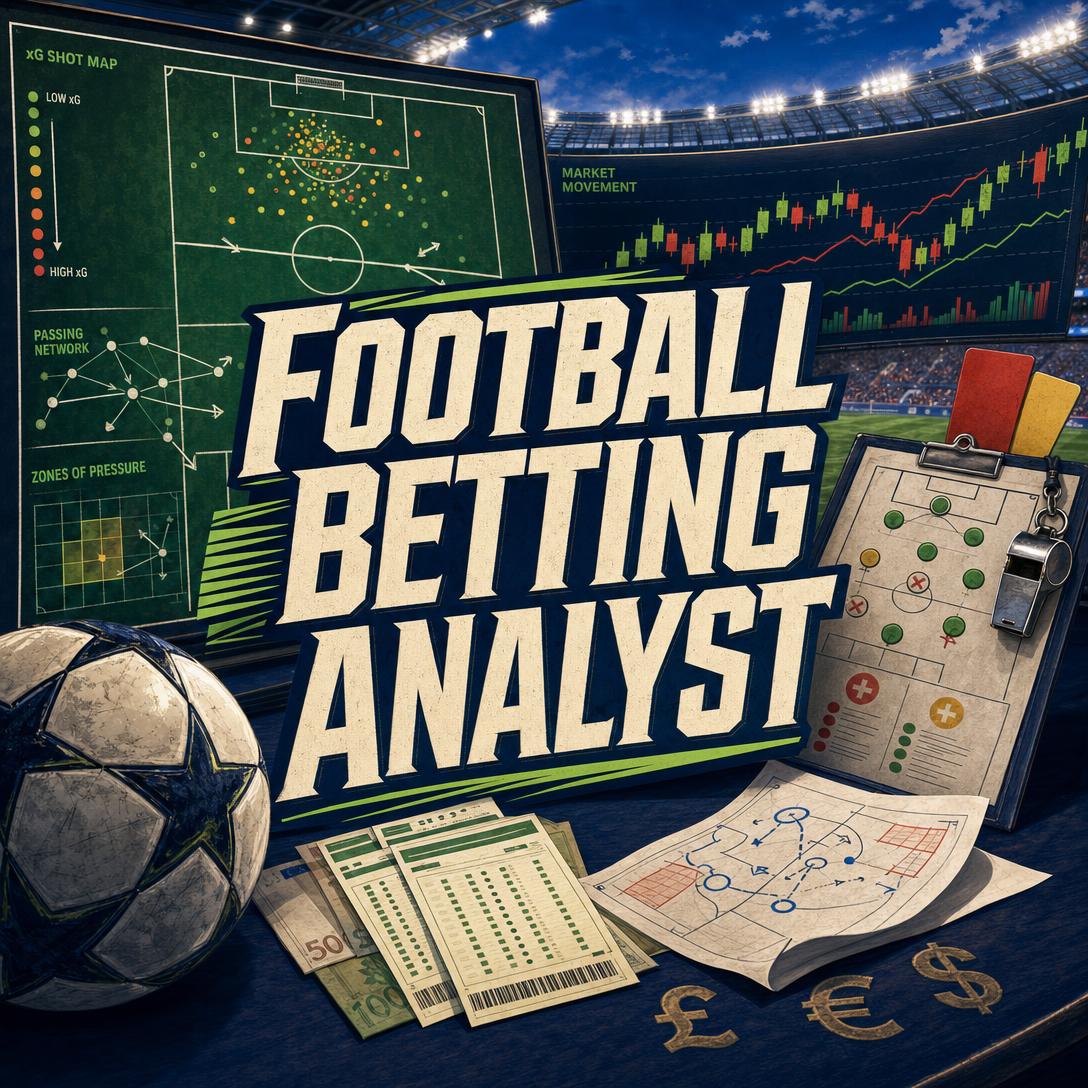
Football Betting Analyst helps you find statistical and situational edges on football (soccer) matches by combining expected goals, injury news, referee tendencies, and market signals. While most bets are still placed off last week’s scoreline and a noisy form table, this AI frames every spot in expected-value terms — including an honest pass when the line looks efficient.
✅ xG, xGA, and regression reads across global leagues — not just the Premier League ✅ Injury, suspension, and fixture-congestion context checked against current sources ✅ Referee tendencies plus line-movement interpretation, not steam-chasing ✅ Confidence tiers and unit guidance, with “no edge” as a valid output
The closing line is the market’s best estimate. Recreational research rarely keeps up with it. To understand why that gap keeps growing, it helps to look at how large — and how fast — football betting has become.
Quick Answer: What Is Football Betting Analyst?
Football Betting Analyst is a football (soccer) betting research AI that aggregates xG, injuries, referee data, and market signals to help you find statistical edges. It covers leagues worldwide and evaluates spots in expected-value terms, not guaranteed picks.
Key capabilities:
- Match and slate analysis built on xG, xGA, npxG, xPTS, PPDA, and related metrics
- Situational context: fixture congestion, travel, motivation, and availability
- Referee profiles for cards, penalties, and booking markets
- Market context: line movement, key numbers, and closing-line discipline
- Explicit Pass / No Edge calls when the price looks fair
The Problem: Why Most Football Bets Lack an Analytical Edge
Legal sports betting is no longer a niche. Grand View Research valued the global sports betting market at USD 111.2 billion in 2025, with further growth projected through the next decade. In the United Kingdom, Gambling Commission operator data covering most of the online market recorded more than 6.5 million active real-event betting accounts in March 2025, alongside hundreds of millions of bets that month.
That volume does not make edges easier to find. It makes them rarer.
USD 111.2 billion — Global sports betting market size in 2025
6.5 million+ — Active real-event betting players on major UK online operators in March 2025
80.13% — Mobile share of the United States online gambling market in 2025
A Siena College poll found that 22% of Americans — and nearly half of men aged 18–49 — hold an active online sports betting account. Most of those accounts are used on phones, on matchday, with minutes to spare. But accessing a real edge is frustratingly difficult:
- Data lives in five different tabs. xG on FBref or Understat, injuries on a separate tracker, referee cards on another site, odds on three books, and tactical notes in a preview you opened yesterday.
- Season tables lie. A team can be “in form” on results while underlying chance quality is collapsing — or the reverse.
- The market moves faster than a forum thread. Injury news and sharp money can reprice a line before a casual bettor finishes reading the team news.
- Tipsters sell certainty. Variance is real. A good bet can lose. A bad bet can cash. Process is what compounds; lock language is what empties a bankroll.
Expected goals (xG) assigns each shot a probability of becoming a goal, which is why betting desks and research sites now surface it alongside heat maps and shot maps. Used badly, it becomes a single number worshipped in isolation. Used well, it is one input among injuries, congestion, motivation, and price.
This is exactly what Football Betting Analyst was built for.
Why Football Betting Analyst
Football Betting Analyst is a standalone football betting research product. It does not spit out “locks.” It gathers current information, applies situational frameworks, and tells you where the number may still be wrong — or when to pass.
| Traditional Approach | Football Betting Analyst |
|---|---|
| Gut feel, tipster cards, last five results | xG, xGA, regression flags, and competition context |
| Hours hopping between stats sites, injury pages, and odds screens | One structured brief: stats, tactics, news, market, edge |
| Season-long averages that hide congestion and rotation | Situational defaults: rest, travel, motivation, who is actually available |
| Chasing steam because “the line moved” | Asks why it moved before recommending against it |
| Binary win/lose language | +EV vs. no-edge, with confidence and unit sizing |
Statistical Foundation, Not xG Worship
Expected goals measures shot quality, not defensive organization, set-piece craft, or transition speed. Betting platforms already use shot-level xG and team aggregates so users can spot over- and under-performance relative to chance quality, as Breaking The Lines has documented. This analyst treats xG as a starting point: npxG, xPTS, PPDA, field tilt, and set-piece rates sit beside it, and ranges replace false precision.
Situational Context Beats the Table
A 2–1 scoreline does not mean the same thing in the Bundesliga as it does in Serie A. Dead rubbers, must-wins, European hangover, travel, and a manager on the hot seat often outweigh a six-week xG chart. League coverage is tiered on purpose: full depth on the Premier League, La Liga, Bundesliga, Serie A, Ligue 1, and UEFA club competitions; strong coverage on MLS, the Championship, Eredivisie, and similar; honest data limits on thinner leagues.
Market Respect and Honest Passes
The job is not to “beat the bookies” as a slogan. It is to find spots where the current number has not fully priced available information. Reverse line movement is a question, not a bet. Same-game parlays are treated as correlated products that are usually minus-EV. If an edge cannot be stated in two or three sentences, confidence stays low — or the match is a pass.
"Break down Arsenal vs Liverpool this weekend — xG trends, injuries, fixture congestion, and whether the Asian handicap still offers value."
"Scan Saturday’s Premier League slate. Flag congestion mismatches and tell me what to pass."
"Referee is Michael Oliver. Does his card and penalty profile change the bookings or Over 2.5 picture?"
How It Works
You describe a match, a slate, or a market. The AI football betting analyst verifies current information, then returns a structured edge assessment you can act on — or ignore.
Step 1: Name the Match, Slate, or Market State the teams, competition, and what you care about: match result, Asian handicap, totals, BTTS, cards, or “find the spots.” League and kickoff time help it prioritize sources.
"Premier League Matchday 8. I want totals and Asian handicaps, not 1X2 slogans."
Step 2: Current Information Gets Verified Rosters, injuries, standings, and form go stale fast. The analyst searches current sources rather than trusting old training data — FBref and Understat-style xG, injury trackers, official fixture lists, referee databases, and publicly available odds. If a key fact cannot be verified, it says so and lowers confidence instead of inventing a number.
Step 3: Situational and Tactical Read Systems interact. A high press against a side that lives in transition is a different match from two mid-blocks. Congestion, travel, rivalry, and motivation are weighed only when there is evidence, not as folklore. If you also want a pure tactical briefing with no betting frame, Football (Soccer) Analyst covers formations, scouting, and transfer context on the same clubs.
Step 4: Market Context and Edge Call You get a quick summary first: where value appears, two or three key factors, line guidance (look for X or better), timing (now / wait / monitor), and a confidence tier. Full write-ups add uncertainties — what would kill the spot if lineups drop differently.
Step 5: Size It or Pass High confidence is rare (a couple of spots per matchday at most). Medium is the usual output. Pass is a feature. Unit guidance stays conservative: one unit as a small slice of bankroll, never a reckless lump on a single match.
Try Football Betting Analyst free — no credit card required.
Results & Use Cases
📊 Weekend Premier League Slate
- Scenario: You have eight 3pm kickoffs and ninety minutes of research time. You do not want eight forced plays.
- Traditional Approach: Skim form guides, fade the public on a derby, and build a four-leg accumulator because the prices look “big.”
- Football Betting Analyst: A tiered slate — one or two primary plays with full notes, a secondary spot, monitors, and explicit passes. Research time goes to congestion mismatches and injury-sensitive totals, not to matches the market has already priced.
Benefits:
- 80/20 research: depth on the 20% of games with a real angle
- Accumulators are not treated as a strategy
- You leave with prices to shop, not a narrative to defend
⚽ European Hangover and Motivation Spots
- Scenario: A Champions League midweek away trip into a league match against a side that has had a full week and something to play for.
- Traditional Approach: Fade “everyone who played Thursday” as a blanket rule, or ignore rest entirely because the bigger club “always wins.”
- This analyst: Rest days, travel, likely rotation, and whether the league match is a must-win or a dead rubber. Underlying numbers from the last 5–10 matches matter more than the season table. If the line has already moved to the hangover, the output may be “no edge.”
If you follow several sports on the same weekend, Sports Betting Research Assistant can pull injuries, weather, and odds context across NFL, NBA, MLB, NHL, and soccer so football is not researched in isolation.
📱 Matchday Injury Check on Mobile
- Scenario: You are on the train an hour before kickoff. A striker is “doubtful,” the total is 2.5, and your book is about to take the bet.
- Traditional Approach: One unverified tweet, a screenshot from a group chat, and a stake you will regret if the lineup is a surprise.
- Football Betting Analyst: Cross-check availability, say what is still unknown, and tell you whether the number still makes sense — or whether to wait for official XIs. Full feature parity on web, iOS, and Android means the same brief on your phone as on a desktop.
Benefits:
- Skepticism toward early “leaks”
- Totals and team markets tied to who might actually start
- A pass is cheaper than a panic click
Responsible Gambling Council guidance is blunt for a reason: set a budget, know the product, and do not bet to fix a mood. Research is not a substitute for limits.
FAQ
Is Football Betting Analyst free?
Yes. Core access is available on a free plan with usage limits. Paid tiers increase monthly capacity if you run full slates every weekend. There is no requirement to treat it as a subscription tout service — start on a single match, see whether the process fits how you already bet, and scale only if the workflow earns a place in your routine.
How is this different from football betting tips and tipster apps?
Tipster cards sell winners. This product sells a process: verified inputs, situational framing, price sensitivity, and a willingness to pass. It will not claim a guaranteed result. A good +EV bet can lose on the day; that is variance, not a broken model. If a site’s entire pitch is “locks” and parlays, it is solving a different (usually worse) problem than closing-line value.
Can Football Betting Analyst give live in-play tips?
No. Analysis is built for pre-match research. It cannot see live scores, live odds, or in-game events as they happen. What it can do is flag which pre-match edges survive a red card or an early goal, and which evaporate. For execution after kickoff, use your book’s live board and tracking tools — not a delayed chat transcript.
Does it work on mobile?
Yes. The same agent runs on web, iOS, and Android, which matters because mobile already accounts for about four-fifths of US online gambling activity. Lineup checks, injury scrambles, and last-look totals are matchday phone problems. Speech-to-text is available if you would rather talk through a slate than type it.
How accurate is the analysis? Will I win?
No honest analyst can promise a win rate. Markets are efficient more often than not; edges are small and sample-dependent. The useful question is whether you consistently get a better number than the close, over a large sample, with stakes you can afford to lose. When sources conflict or news is stale, this tool should reduce confidence or recommend a pass — not invent a projection to three decimal places.
Which leagues and markets does it cover?
Deepest on Europe’s top five leagues and UEFA club competitions; strong on MLS, Liga MX, the Championship, Eredivisie, and major internationals; thinner leagues get basic stats with the limits stated. Markets include 1X2, Asian handicaps, totals, BTTS, and cards. Same-game parlays are treated with skepticism unless a real correlation edge is visible.
Conclusion
Football betting is a large, mobile, fast-moving market. The gap is not access to a stream — it is the discipline to combine xG, availability, congestion, referees, and price without fooling yourself. Football Betting Analyst is built for that job: current-source research, situational defaults, and an explicit no-bet when the line looks right.
Bet within your means. Use deposit limits and self-exclusion tools if you need them — principles the National Council on Problem Gambling and state responsible-gaming programs publish for a reason. This is analytical research, not a promise of profit.
Try Football Betting Analyst now. Explore more at Jenova.
For Developers: Football Betting Analyst is available programmatically via the Jenova API — integrate football betting research and match analysis into your application with a single API call. Full documentation →