AI Food Safety Expert: Instant Verdicts on What's Safe to Eat
2026-09-09
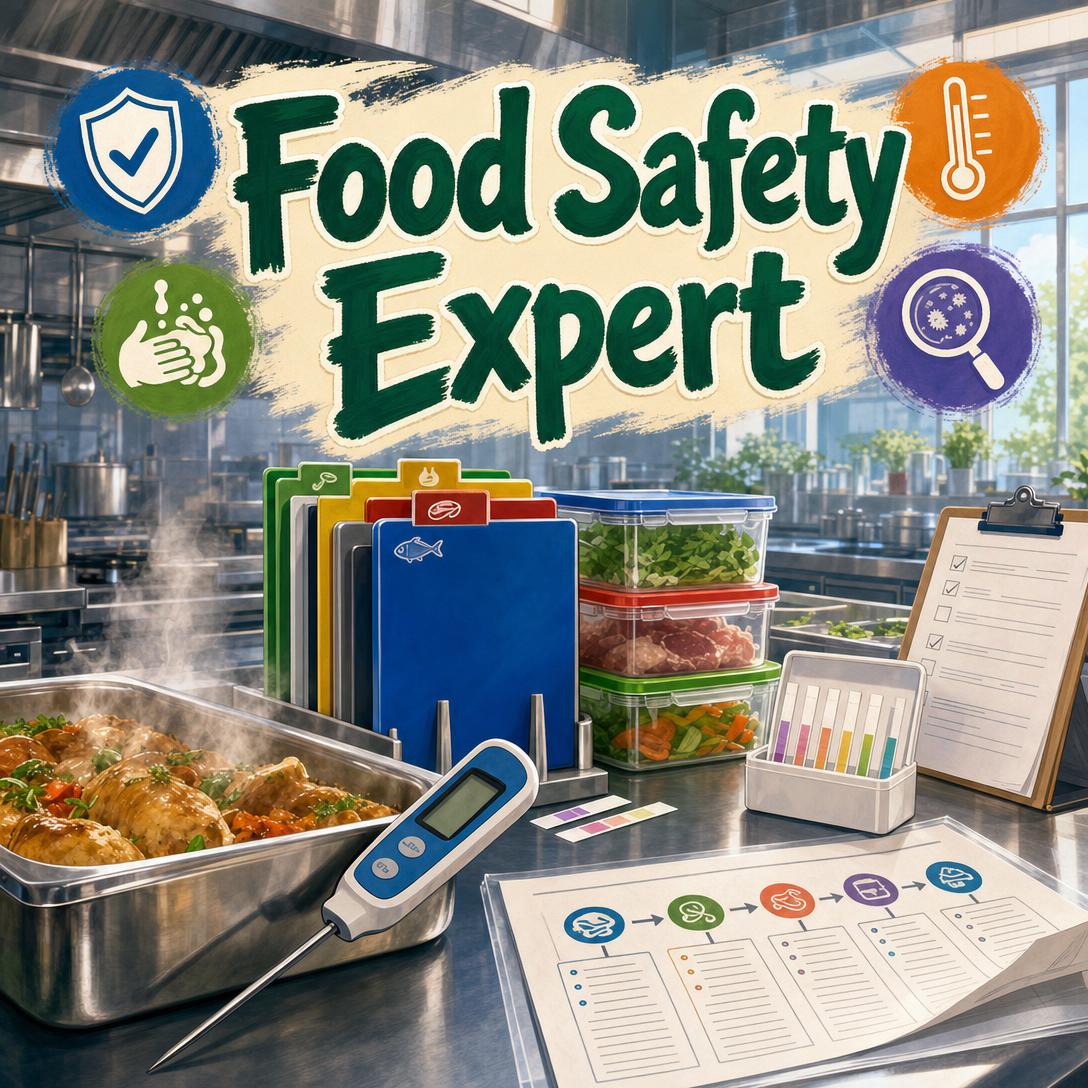
Food Safety Expert helps you decide what is safe to eat, store, cook, or throw out by applying food microbiology, HACCP logic, and regulatory temperature rules to your exact situation. While guesswork, smell tests, and generic search results leave dangerous gaps, this AI gives a clear verdict, explains the science, and tells you the next step.
✅ Instant safe / unsafe / depends verdicts — not vague maybes ✅ Photo review of fridges, prep lines, labels, and food condition ✅ Cooking, cooling, holding, and leftover rules aligned to FDA and USDA guidance ✅ HACCP, allergen, and inspection support for restaurants and manufacturers
To understand why this matters, it helps to look at how often food safety fails in ordinary kitchens — and how expensive those failures are when the answer should have been simple.
Quick Answer: What Is Food Safety Expert?
Food Safety Expert is an AI food scientist that delivers a clear safe/unsafe verdict, the science behind it, and specific next steps for home kitchens, restaurants, and food production. It covers pathogens, temperatures, allergens, storage, sanitation, and HACCP — then tells you what to do now.
Key capabilities:
- Verdict-first answers to “Is this still safe to eat?”
- Photo scans of food, refrigerators, prep areas, and labels
- Cooking, cooling, thawing, and leftover time-temperature rules
- HACCP plans, allergen controls, and inspection prep
- Population-specific guidance for pregnancy, young children, older adults, and immunocompromised people
The Hidden Cost of Getting Food Safety Wrong
Most people treat food safety as common sense: if it smells fine, it is probably fine. Pathogens rarely cooperate with that rule. They often produce no off-odor, no slime, and no visible warning before they cause illness.
The CDC estimates that 48 million people get sick from foodborne illness every year in the United States. A more recent CDC analysis of seven major pathogens found:
9.9 million illnesses, 53,300 hospitalizations, and 931 deaths — CDC burden estimates for major foodborne pathogens
Those numbers are not abstract. Norovirus alone accounts for an estimated 5.5 million domestically acquired foodborne illnesses. Salmonella is the leading cause of death among those pathogens. Produce is linked to nearly half of foodborne illnesses, while meat and poultry contribute a disproportionate share of deaths.
The economic damage is just as concrete:
$74.7 billion — USDA ERS estimate of U.S. foodborne illness costs in 2023 dollars
Nontyphoidal Salmonella alone accounts for about $17 billion of that burden. Globally, the WHO estimates 866 million people fall ill from contaminated food each year.
Surveillance is not slowing the problem down. In 2024, FoodNet sites reported 24,624 infections, 6,746 hospitalizations, and 178 deaths — a reminder that these pathogens are still circulating in everyday food.
But getting a trustworthy answer in the moment is frustratingly difficult:
- Search results mix consumer myths with commercial rules and rarely apply the 2-hour / 4-hour time-temperature test to your leftover.
- Smell, color, and the “5-second rule” do not detect Salmonella, Listeria, or heat-stable toxins from Staphylococcus aureus.
- Restaurant operators juggle FDA Food Code temperatures, local inspectors, allergen rules, and incomplete logs without a specialist on staff.
- Home canning, garlic-in-oil, bulk cooling, and deli meats for pregnant people sit in a high-risk zone where a wrong call can be severe.
- Consultants, lab tests, and delayed health-department callbacks are too slow when dinner is already on the counter.
This is exactly what Food Safety Expert was built for.
Why Food Safety Expert
Food Safety Expert treats your question the way a working food scientist would: verdict first, science second, action third. It does not stop at “cook it well.” It asks how long the food sat out, who will eat it, whether a toxin (not just a live bacterium) could already be present, and whether the safe move is to serve, reheat, refrigerate, or discard.
| Traditional Approach | Food Safety Expert |
|---|---|
| Smell test, color, or “it was only out for a bit” | Time × temperature verdict using danger-zone rules |
| Generic blog advice that mixes home and restaurant standards | Context-specific guidance for home cooks, restaurants, manufacturers, and students |
| Waiting on a consultant, inspector, or forum thread | Immediate next steps, including “throw it out” when that is the only safe answer |
| HACCP and Food Code buried in long manuals | Principle-by-principle walkthroughs, CCPs, and inspection-ready corrective actions |
| No way to check a fridge, label, or prep line visually | Photo-based hazard scans with severity ranking |
Clear verdicts instead of food-safety folklore
The AI is built to kill common myths quickly. Freezing pauses growth; it does not sterilize food. Washing raw chicken spreads bacteria. Cooking will not destroy every toxin. Leftovers are not automatically fine for a week. When the food has been in the danger zone too long, the answer is discard — not “heat it extra.”
“I left cooked chicken on the counter from 6 p.m. to midnight. The house was about 72°F. Is it safe to refrigerate and eat tomorrow?”
Temperature, cooling, and storage without the guesswork
Safe cooking is not a color change. CDC guidance is specific: poultry to 165°F, ground meats to 160°F, and whole cuts of beef, pork, lamb, and veal to 145°F with a three-minute rest. Refrigerator leftovers are generally safe for three to four days. The AI applies those limits to the dish you actually have — soup in a deep stockpot, rice held for hours, or deli meat in a pregnant person’s fridge.
“Walk-in is reading 43°F, raw chicken is on the top shelf above prepped salads, and the soup well is at 128°F. Rank the risks for tomorrow’s inspection.”
HACCP, allergens, and the rules professionals actually use
For operators and QA teams, the same product walks through hazard analysis, critical control points, monitoring, corrective actions, and record-keeping. It distinguishes biological, chemical, and physical hazards. It treats the U.S. Big 9 allergens as a control system — dedicated equipment, scheduling, labeling — not a footnote. That prevention mindset matches the direction of FDA’s FSMA framework: stop problems before they become outbreaks.
How Food Safety Expert Works
You do not need a food science degree to use it. You describe the food, the time, the temperature, and who will eat it — or you upload a photo. The AI returns a decision you can act on.
Step 1: Describe the Food, the Clock, and the People Start with what happened, not with a textbook question. Include how long the item sat out, whether it was refrigerated continuously, and whether anyone involved is pregnant, very young, older, or immunocompromised. Those details change the verdict.
“I’m 28 weeks pregnant. Can I eat this unheated turkey sandwich from the deli counter, or do I need to steam it first?”
Step 2: Get the Verdict Before the Lecture Food Safety Expert leads with safe, unsafe, or depends on a specific factor. Then it explains why — spore-formers that survive boiling, Listeria that grows in the refrigerator, norovirus that is a hygiene problem rather than a thermometer problem. You leave with an action: serve, cook to a named temperature, cool in shallow pans, relabel, or throw it out.
Step 3: Upload a Photo When Words Are Not Enough A picture of a swollen can, a crowded fridge, a prep table, or a thermometer reading often reveals hazards people do not mention. The AI looks for drip contamination, uncovered food, chemicals stored near ingredients, missing date marks, holding temperatures, and mold or packaging failure. Findings come back with severity so you fix the dangerous items first.
“Here is a photo of my home fridge. Tell me what is unsafe, what is merely sloppy, and how to reorganize it top to bottom.”
Step 4: Turn One Answer Into a Repeatable Control If you run a kitchen, ask for cooling methods, receiving checks, sanitizer ranges, or a HACCP outline for a specific process. If you cook at home, ask for leftover timelines and reheating to 165°F. The goal is a rule you can reuse — not a one-off guess.
When the next step is actually cooking the meal correctly, Master Chef Coach can walk through technique, doneness, and timing while you keep the safety limits this tool already set.
Try Food Safety Expert free — no credit card required.
Real Kitchens, Real Verdicts
🧊 Power Outage and Leftover Panic
-
Scenario: A home cook opens the fridge after a six-hour outage. Milk is still cool to the touch. Cooked rice, leftover chili, and raw chicken are inside. Guests are arriving in an hour.
-
Traditional Approach: Internet threads, a hand on the milk jug, and a hope that “it stayed cold enough.”
-
Food Safety Expert: Item-by-item verdicts using time, temperature, and food type — including foods that must be discarded even if they still look fine.
-
Applies the 2-hour / 4-hour rule instead of a smell test
-
Flags rice and chili as higher-risk for toxin-forming bacteria
-
Tells you what can go to the freezer now versus what cannot be saved
If you are rebuilding the week’s menu after throwing food out, Meal Planner can rebuild grocery lists and prep schedules around what is still safe to keep.
🍽️ Restaurant Inspection in 48 Hours
-
Scenario: A small restaurant’s walk-in has been drifting to 43°F. Line cooks are date-labeling inconsistently. The soup well held at 128°F during Saturday service.
-
Traditional Approach: A binder of SOPs nobody reread, plus last-minute scrubbing that does not fix temperature control.
-
Food Safety Expert: Inspection-priority list — immediate discards, same-day corrections, and documentation an inspector will actually ask for.
-
Separates 🔴 stop-now hazards from 🟡 process gaps
-
Maps findings to Food Code issues: cold holding, hot holding, cooling, date marking
-
Drafts corrective actions you can assign before the visit
📱 Phone Photo at a Picnic
-
Scenario: You are at a park, not a desk. Potato salad and grilled chicken have been in a cooler that is no longer icy. You snap a photo of the spread and the cooler thermometer.
-
Traditional Approach: “It’s been in the cooler” — even though the cooler is above 40°F and the salad has been open for hours.
-
Food Safety Expert: A mobile verdict you can use before anyone takes another plate.
-
Works on iOS, Android, and web with the same guidance
-
Uses the photo plus your time estimate, not just the recipe
-
Makes the conservative call for kids, pregnancy, or heat above 90°F, when the safe window shrinks to one hour
🥜 Allergen Cross-Contact on a Shared Line
- Scenario: A cafe wants to add a sesame bun and a peanut sauce without a dedicated fryer or prep table. Staff are unsure whether “may contain” language is enough.
- Traditional Approach: Verbal warnings and shared utensils, which fail at milligram exposure levels.
- Food Safety Expert: A control hierarchy — dedicated tools, scheduling allergen-free prep first, fryer oil management, labeling, and staff scripts.
When the question shifts from kitchen controls to a specific person’s reactions, testing, or cross-reactivity, Personal Allergy Advisor can take the medical-history side while this tool stays on the food-handling side.
FAQ
Is Food Safety Expert free?
Yes. Food Safety Expert is available on Jenova’s free plan with core features and limited usage. Paid plans increase usage — Plus starts at $20/month — if you run longer HACCP sessions, frequent photo reviews, or team-level consultation. No credit card is required to try it.
How is Food Safety Expert different from a generic chatbot or a ServSafe course?
A general chatbot often hedges, mixes home and commercial rules, or repeats myths. A ServSafe or Food Code course teaches the framework but cannot look at your leftover, walk-in photo, or cooling log. This AI is built as a food scientist: it gives a verdict, cites the relevant control (time, temperature, pH, water activity, hygiene), and tells you the next step for home, restaurant, or manufacturing context.
Can it tell me if leftovers are still safe to eat?
That is one of its primary jobs. Share what the food is, how it was cooled, how long it sat out, and how it was stored. The AI applies danger-zone timing and typical leftover limits — three to four days in the refrigerator for most cooked dishes — and will tell you to discard food that has been abused, even if it still looks normal.
Does Food Safety Expert work on mobile?
Yes. It works on web, iOS, and Android with full feature parity, so you can check a cooler at a picnic, a prep line during service, or a swollen package in the grocery aisle. Speech-to-text is available when your hands are not free to type.
Is the food safety advice accurate enough to trust?
Guidance is grounded in established science and sources such as CDC, USDA, and FDA Food Code principles — not social-media rules of thumb. It is still guidance, not a laboratory result or an official inspection. For active illness, contact a clinician. For legal compliance, confirm requirements with your local health authority. When the facts are incomplete, the AI says what the verdict depends on rather than inventing certainty.
Can it help with HACCP plans and health inspections?
Yes. Ask it to walk through the seven HACCP principles for a specific process, identify likely CCPs (cooking, cooling, holding, receiving), or review photos of a kitchen the way an inspector would. It can also help students preparing for food-safety exams by explaining why a cooling curve or sanitizer concentration matters.
Get a Clear Answer Before the First Bite
Foodborne illness is common, costly, and often preventable. The hard part is not finding a temperature chart — it is applying the right rule to the rice on your counter, the walk-in that drifted overnight, or the sandwich in a high-risk pregnancy.
Food Safety Expert closes that gap with a scientist’s verdict: safe, unsafe, or dependent on one factor you can check. Use it for leftovers, cooking temperatures, allergens, HACCP, and inspection prep — then act while the decision still matters.
Try Food Safety Expert now. Explore more at Jenova.
For Developers: Food Safety Expert is available programmatically via the Jenova API — integrate science-backed food safety verdicts, HACCP guidance, and photo-based kitchen assessments into your application with a single API call. Full documentation →