AI First Contact Game: Decode Alien Signals & Build Your Own Story
2026-10-16
An AI first contact game puts you at the moment humanity receives a message it cannot read, and the story responds to every guess you make. As of October 2026, Jenova lets sci-fi fans and designers play and build these experiences. You can create a custom first contact scenario in minutes, give your alien a language that stays consistent, and keep the mystery going across sessions. Most signal-decoding games ship with a fixed set of puzzles and one ending. An AI-driven version changes its transmissions, characters, and consequences based on how you interpret them.
- ✅ Custom agents written in plain language. No game engine is required to stage your own first contact scenario.
- ✅ Persistent memory. Your alien lexicon, crew relationships, and decoded signals carry over between sessions.
- ✅ Multi-model access. Run your game on models from OpenAI, Anthropic, Google, DeepSeek, xAI, and more.
- ✅ Full feature parity across web, iOS, and Android, with built-in speech-to-text.
First contact is one of science fiction's most durable premises. Yet players who want to decode rather than fight have had few options. Before looking at how AI changes that, it helps to see why the genre has stayed so small, and why the games that do exist often end too soon.
Quick Answer: What Is an AI First Contact Game?
An AI first contact game is an interactive sci-fi story in which an AI plays the alien intelligence, the crew, and the narrator. It generates signals, dialogue, and consequences based on how you interpret and answer an unknown message. On Jenova, you can build a dedicated first contact game as a custom agent or play related AI narrative games.
Key capabilities:
- Design the premise, puzzle logic, and win conditions with Game Designer Assistant
- Create alien envoys, skeptical linguists, and anxious mission directors with Character Creator
- Ground your alien's biology in real science with Biology Tutor
- Run the finished game as a custom agent with persistent memory and attached lore files
The Problem With Today's First Contact Games
When games portray alien contact, they usually make it a war. A recent roundup of the top UFO games is led by tactical titles like XCOM 2, XCOM: Enemy Unknown, and Phoenix Point. Communication-focused games do exist and are well loved:
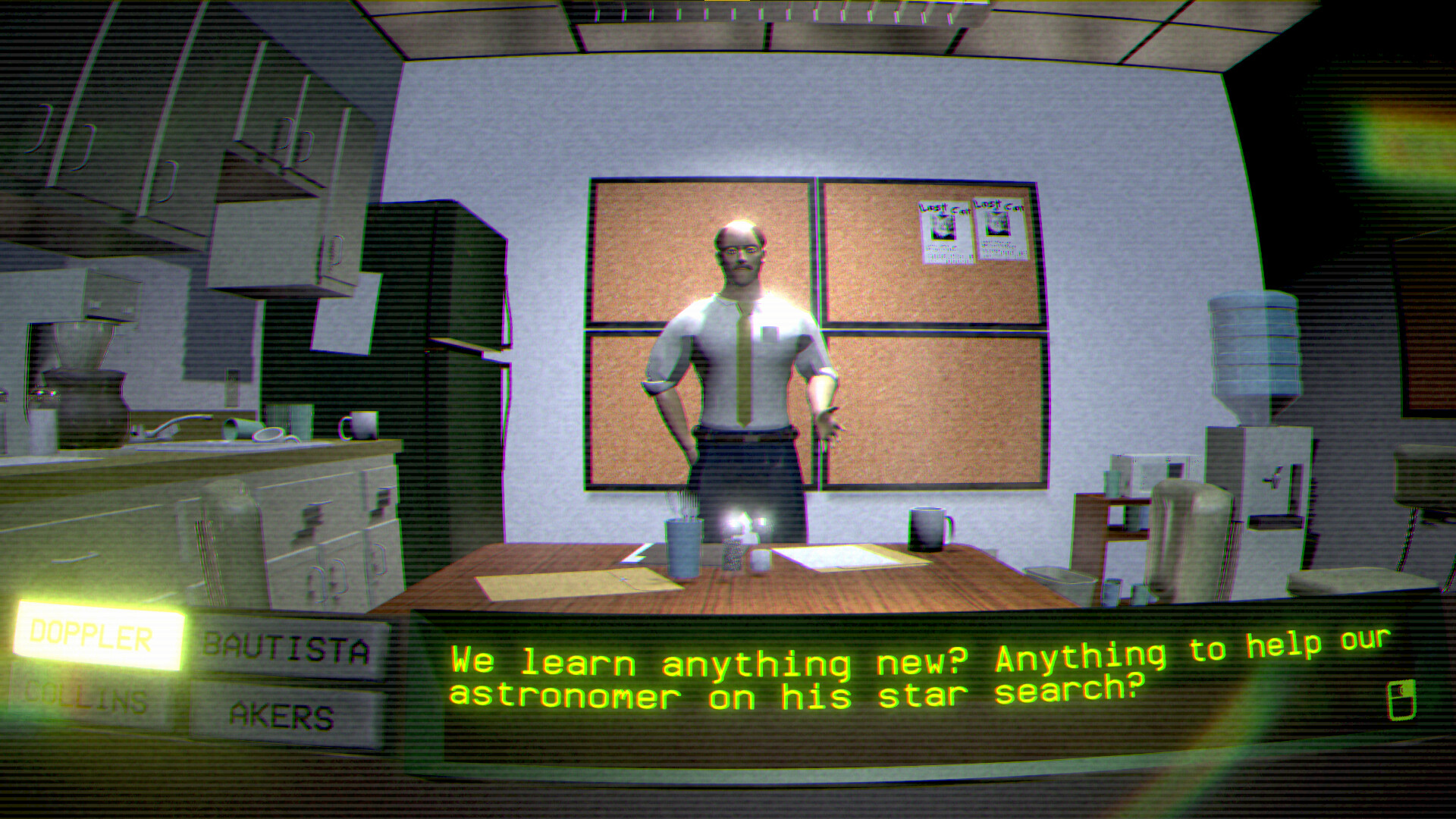
- The Message from Deep Space was described by Thinky Games as stirring up buzz in the puzzle scene as "a game about making first contact with extraterrestrials." Its Steam page casts you as the mission's Translator, working alongside "a scrappy band of scientists."
- Indie developers are experimenting with where each alien planet follows a different logic style.
But finding a satisfying first contact experience, and keeping it going, is frustratingly difficult:
- The genre is easy to miss. Communication-focused sci-fi competes with thousands of new releases.
- Scripted ciphers have one answer. Once you've solved a puzzle, it can't surprise you again.
- Alien characters can't really listen. Dialogue trees limit what you can say to the other side.
- Building your own is expensive. Indie development costs make niche concepts risky to fund.
14,000+ new titles — Listed on Steam in 2024, diluting storefront visibility
30–50% of total project spend — Now consumed by marketing for indie games, up from a historical 10–20%
$30,000–$60,000 — Median indie game development cost in 2026, including the developer's own time
The Genre Is Easy to Miss
Niche concepts struggle in crowded storefronts. According to Mordor Intelligence, store algorithms increasingly reward proven engagement, so unreleased games "fight uphill battles against entrenched hits."
For a sub-genre as specific as signal translation, that makes discovery largely a matter of luck. Players often find these games through word of mouth, long after launch.
Scripted Ciphers Have One Answer
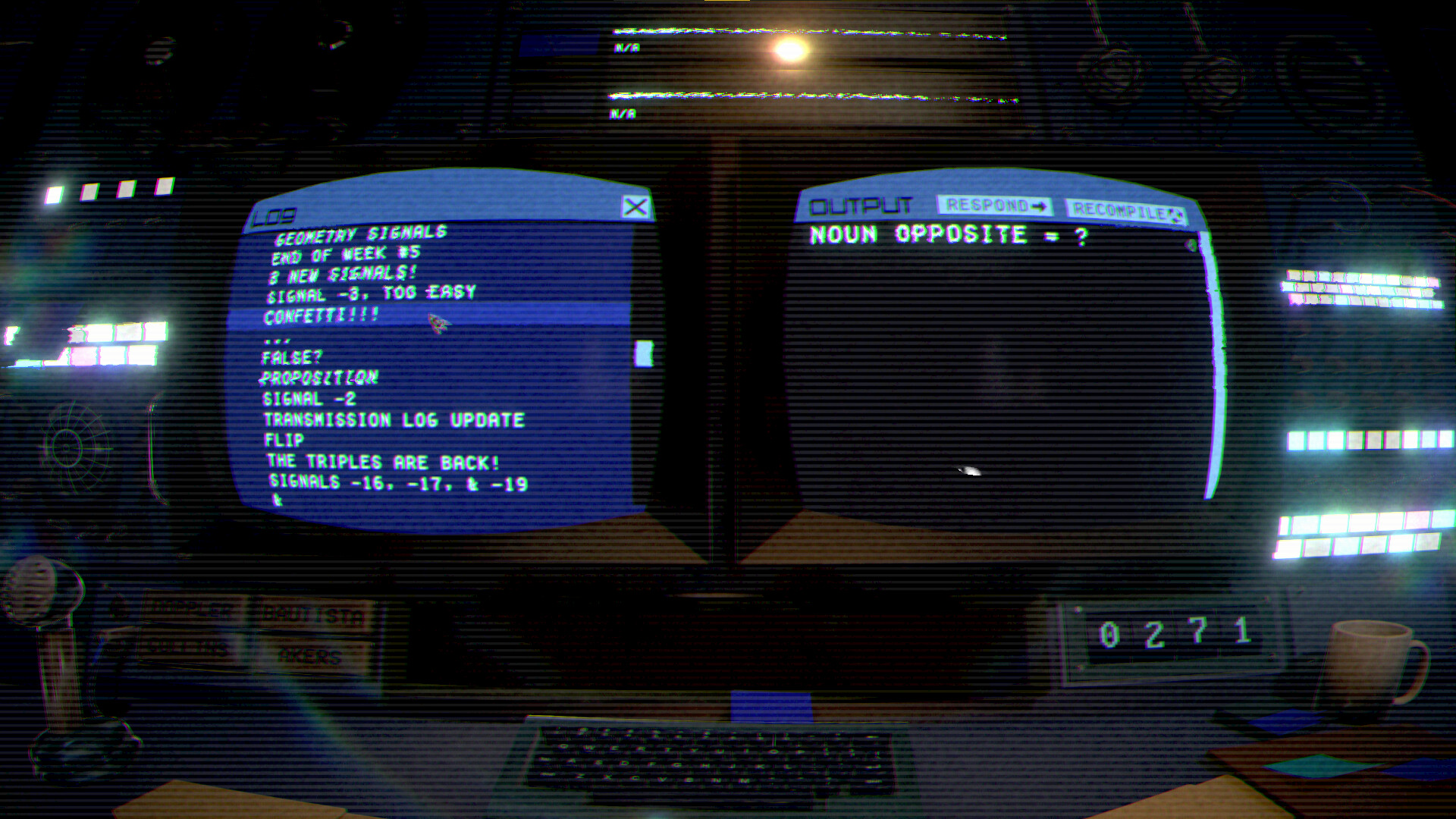
A hand-built signal puzzle is satisfying because a designer crafted each step. Picture a terminal asking you to resolve "NOUN OPPOSITE = ?" after a week of logged transmissions.
The tradeoff is that the content runs out. Once you've decoded every glyph, replaying means walking through solutions you already know. The alien language is fixed, so your theories can be right or wrong but never interesting in a new way.
Alien Characters Can't Really Listen
First contact is fundamentally about negotiation under uncertainty. A 2026 ACM study on player agency analyzed players' self-reported connection during a high-stakes negotiation scene. That is exactly the kind of moment first contact stories depend on.
Branching dialogue can only anticipate so many responses. Separate research on player engagement in indie games identifies Creativity as one of five core engagement constructs. Player creativity is the first thing a fixed script limits.
Building Your Own Is Expensive
Many sci-fi fans have a first contact story they want to play. Making it as a traditional game is a serious financial commitment.
GamesIndustry.biz highlights hidden costs such as QA, localization, and porting. Porting alone can take "anywhere between six weeks to six to ten months." Publishers also typically advise adding 10–20% to a budget for contingencies.
This is exactly what Jenova was built for.
The Jenova Solution: A First Contact Game That Responds
Jenova approaches the AI first contact game differently. Instead of shipping a fixed puzzle set, you describe the scenario, and an AI agent runs it. It plays the alien, the crew, and the world, and keeps the rules consistent as you go.
| Traditional First Contact Game | First Contact Game on Jenova |
|---|---|
| Fixed set of hand-authored ciphers | New transmissions generated around your theories |
| Branching dialogue with preset options | Free-form replies to alien envoys in your own words |
| Replay means repeating known solutions | Each campaign can use a different alien grammar and culture |
| $30K+ budget to build your own concept | Custom agent written in plain-language instructions |
| Progress lives in one save file | Persistent memory across sessions and devices |
Build the Game as a Custom Agent
Jenova's custom agents let you set the instructions, preferred model, private knowledge base, and tool configuration. For a first contact game, this means you can write the rules directly:
- How the alien language works
- What the crew knows
- What happens when you mistranslate a key word
You can also attach a lore document or an alien dictionary. The agent then grounds its transmissions in your rules instead of improvising contradictions.
Memory Makes Learning a Language Possible
Decoding only works if the language stays the same. Jenova's persistent cross-session memory remembers your past work and long-running projects. A glyph you decoded in week one still means the same thing in week five, and the envoy remembers that you insulted their homeworld three sessions ago.
Science Grounding for Hard Sci-Fi
If you prefer plausible aliens, Deep Research searches across many sources and produces reports with inline citations. Use it to research topics such as:
- Signal detection
- Exoplanet environments
- Theories of non-human communication
Then feed the findings into your game's knowledge base.
Related AI Narrative Games to Play Now
Jenova's game agents share the same emergent design: characters pursue their own goals, and the story unfolds from your choices.
- One Among Us is a detective mystery where the killer is hiding among the group.
- The Asylum sends you as an investigator into a shuttered institution full of hidden stories.
- The Mansion is an escape-and-uncover-the-truth mystery.
- Civilization puts you in charge of a nation while rivals pursue their own ambitions.
All of them run on Jenova's multi-model infrastructure, support MCP tool integration, and keep your progress in persistent memory.
Specialized AI Agents for Building a First Contact Game
These agents cover each stage of building your own game, from concept to playable session.
Concept & Systems
Treat it as a design partner for the parts that make first contact games work: puzzle pacing, how difficulty ramps up, and what counts as "winning" a negotiation. It works across genres and platforms, so it can help shape both a text-based AI game and a pitch for a full release.
- Brainstorming and systems analysis for decoding mechanics
- Design documentation you can turn into custom agent instructions
- Concept art for alien interfaces, ships, and signal visuals
Characters & Voice
A first contact story depends on its cast: the alien envoy, the overconfident project lead, the junior astronomer who notices the pattern first. This agent builds them through quick generation or guided step-by-step creation.
- Detailed character profiles for roleplay and fiction
- Research into existing media for genre-accurate tropes
- Character portraits across visual styles
Use it to structure the overall story. It helps plan where the big reveal lands, how dialogue escalates tension, and how scenes tell the story visually, even if the final format is an interactive game rather than a screenplay.
- Story structure and outlining
- Dialogue and character development
- Revision passes on key scenes
Play & Inspiration
Play these before building your own. One Among Us shows how an AI can keep a mystery's secret consistent across many questions. Civilization shows rival factions acting on their own goals, which is a useful model for alien diplomacy.
- See how hidden information is kept consistent over a long session
- Watch emergent consequences unfold from your choices
- Study pacing you can adapt to your own scenario
Try Jenova free — no credit card required.
How to Play or Build an AI First Contact Game
Step 1: Define the Premise and Win Conditions
Start by deciding what kind of first contact story you want. Options include a decoding puzzle, a diplomatic negotiation, or a slow-burn mystery about whether the signal is even real. Work it through with a design agent before writing any game rules.
"Help me design a first contact game where players decode a repeating signal over five in-game weeks. Each week should introduce one new grammar rule, and one mistranslation should have a lasting consequence."
Step 2: Build the Alien and the Crew
Give the other side a perspective of its own. An alien that wants something, and misreads you, is far more interesting than one that simply waits to be decoded. Write down the crew members' personalities so their reactions stay consistent.
"Create an alien envoy that communicates through geometric patterns and believes humans are a single collective mind. Also create three researchers with conflicting theories about the signal."
Step 3: Ground the Science
For hard sci-fi, have Deep Research compile real background material. This could cover how signals might be distinguished from noise, or what a plausible exoplanet ecology looks like. Save the report as a knowledge base file.
"Research how scientists distinguish artificial signals from natural radio sources, with citations I can use as worldbuilding notes."
Step 4: Create Your Custom Agent
In Jenova, create a custom agent. Paste in your game rules as instructions, attach the alien lexicon and research files, and choose your preferred model. The agent becomes your game master.
"You are the narrator of a first contact game. Generate one new transmission per session using only the grammar rules in the attached lexicon. Never reveal a rule directly. Track every translation the player has proposed."
Step 5: Play, Decode, and Continue Across Sessions
Start a session and propose your first translation. Then negotiate with the envoy and watch the consequences unfold. Persistent memory keeps your progress intact, so you can continue on your phone the next day exactly where you stopped.
"I think the triple-pulse symbol means 'origin.' Send a reply using it and tell me how the envoy reacts."
Results & Use Cases
📡 The Solo Sci-Fi Puzzle Fan
Scenario: You've just finished a signal-translation puzzler and want another one.
Traditional Approach: Search storefronts for similar games, wait for a sequel, or replay puzzles you've already solved.
With Jenova: A custom first contact agent generates fresh transmissions built on a new alien grammar each campaign.
- New linguistic logic with every campaign
- Your theories shape the story instead of being simply marked right or wrong
- A campaign can last as long as you want to keep playing
📱 Decoding Signals on Your Commute
Scenario: You have twenty minutes on the train and want to make progress on your campaign.
Traditional Approach: Wait until you're back at your PC, since most narrative puzzle games are tied to one platform.
With Jenova on mobile: Open the same session on iOS or Android and speak your translation theory using speech-to-text.
- Full feature parity with the web version
- Settings and memory sync across devices
- Short sessions still move the story forward
🎲 The Tabletop GM Prepping a First Contact One-Shot
Scenario: You're running a sci-fi tabletop session and need a convincing alien delegation by Saturday.
Traditional Approach: Hours of writing NPC notes, inventing a language, and hoping players don't ask questions you haven't prepared for.
With Character Creator: Generate the envoy and the human negotiating team with full profiles. Then rehearse the scene with a custom agent playing the alien.
- Ready-to-run character profiles and portraits
- A practice run that reveals gaps before the table does
- Consistent alien behavior when players improvise
🔬 The Teacher Running an Astrobiology Lesson
Scenario: A science teacher wants students to reason about what life on another world might look like.
Traditional Approach: Textbook readings followed by a speculative discussion with little structure.
With Biology Tutor and Chemistry Tutor: Students build a plausible alien using real biological and chemical constraints. Then they "make contact" through a classroom game agent.
- Speculation grounded in real structure-and-function reasoning
- Gamified engagement with core science concepts
- Students defend their alien designs using evidence
🛠️ The Indie Developer Testing a Concept
Scenario: A solo developer wants to know whether a first contact concept is fun before committing a budget.
Traditional Approach: Build a prototype in an engine, even though median indie budgets run $30,000–$60,000 once your own time is counted.
With Jenova: Write the core loop as a custom agent, playtest the decoding mechanic with friends, and refine the design documentation before writing any code.
- Test the core idea in days rather than months
- Collect real player reactions to puzzle difficulty
- Arrive at production with a tested design
Frequently Asked Questions
What is an AI first contact game?
An AI first contact game is an interactive science fiction story where an AI plays the alien intelligence, the human crew, and the narrator. Instead of choosing from scripted options, you interpret signals and reply in your own words, and the AI generates consequences in response. On Jenova, you can build one as a custom agent with your own alien language, characters, and rules.
Is there a free AI first contact game?
Jenova's free plan includes all core features with limited usage, so you can try building and playing a first contact scenario at no cost. If your campaign grows, the Plus plan costs $20 per month and adds 30× usage and custom model selection. Higher tiers offer more capacity. Usage resets monthly on your billing date, with no daily caps.
How is an AI first contact game different from The Message from Deep Space or XCOM?
Hand-built games like The Message from Deep Space offer carefully designed signal puzzles with deliberate pacing. XCOM-style games frame contact as tactical combat. An AI first contact game focuses on open-ended communication: transmissions and alien responses are generated around your specific theories. That allows unlimited campaigns, though without the polish of a hand-tuned puzzle sequence.
Can I build my own first contact game without coding?
Yes. Jenova custom agents are configured with plain-language instructions, a preferred model, optional knowledge base files, and tool settings. You describe the game's rules, attach an alien lexicon, and start playing. Game Designer Assistant can help turn a rough idea into clear rules your agent can follow.
Will the AI remember my alien language between sessions?
Yes. Jenova includes persistent cross-session memory and unlimited chat history, so decoded words, past negotiations, and character relationships carry forward. Attaching a written lexicon to your custom agent's knowledge base adds a second layer of consistency, so the alien grammar follows your rules throughout a long campaign.
Does an AI first contact game work on mobile?
Yes. Jenova offers full feature parity across web, iOS, and Android, and your settings and memory sync across devices. Built-in speech-to-text lets you speak translation theories aloud, which is useful for short sessions away from your desk.
Conclusion
The first contact genre has always been limited by how it's built. Hand-made ciphers run out, branching dialogue can't really listen, and building your own game has meant committing tens of thousands of dollars. An AI first contact game removes those limits. Alien transmissions change with your theories, envoys respond to what you actually say, and a campaign lasts as long as you want it to.
Start by shaping your concept with Game Designer Assistant. Ground it with Deep Research, and play One Among Us to see how an AI keeps a mystery consistent. Then build your custom agent and receive your first transmission.
Explore the full agent library at Jenova.
For Developers: Every agent in this article is available programmatically through the Jenova API, so you can build AI-driven narrative and game features into your application with a single integration. Full documentation →