AI Fictional History Timeline Generator: Build Eras, Wars & Dynasties
2026-10-24
Creative Fiction Writer helps you build a complete fictional history timeline, including founding myths, succession crises, wars, and collapses, by drafting events where each one has a clear cause and a consequence. Many worldbuilders spend months stitching together scattered lore notes. This AI acts as your fictional history timeline generator and turns a premise into a coherent chronology in a single working session.
As of October 2026, writers, game masters, and screenwriters increasingly use AI for structural planning while keeping the prose in their own voice. History-building is one of the planning tasks where that support helps most.
- ✅ Generates multi-century chronologies with linked causes and effects
- ✅ Works with your custom calendars, month names, and era labels
- ✅ Tracks dynasties, character lifespans, and faction rivalries
- ✅ Checks your manuscript against the timeline to catch continuity errors
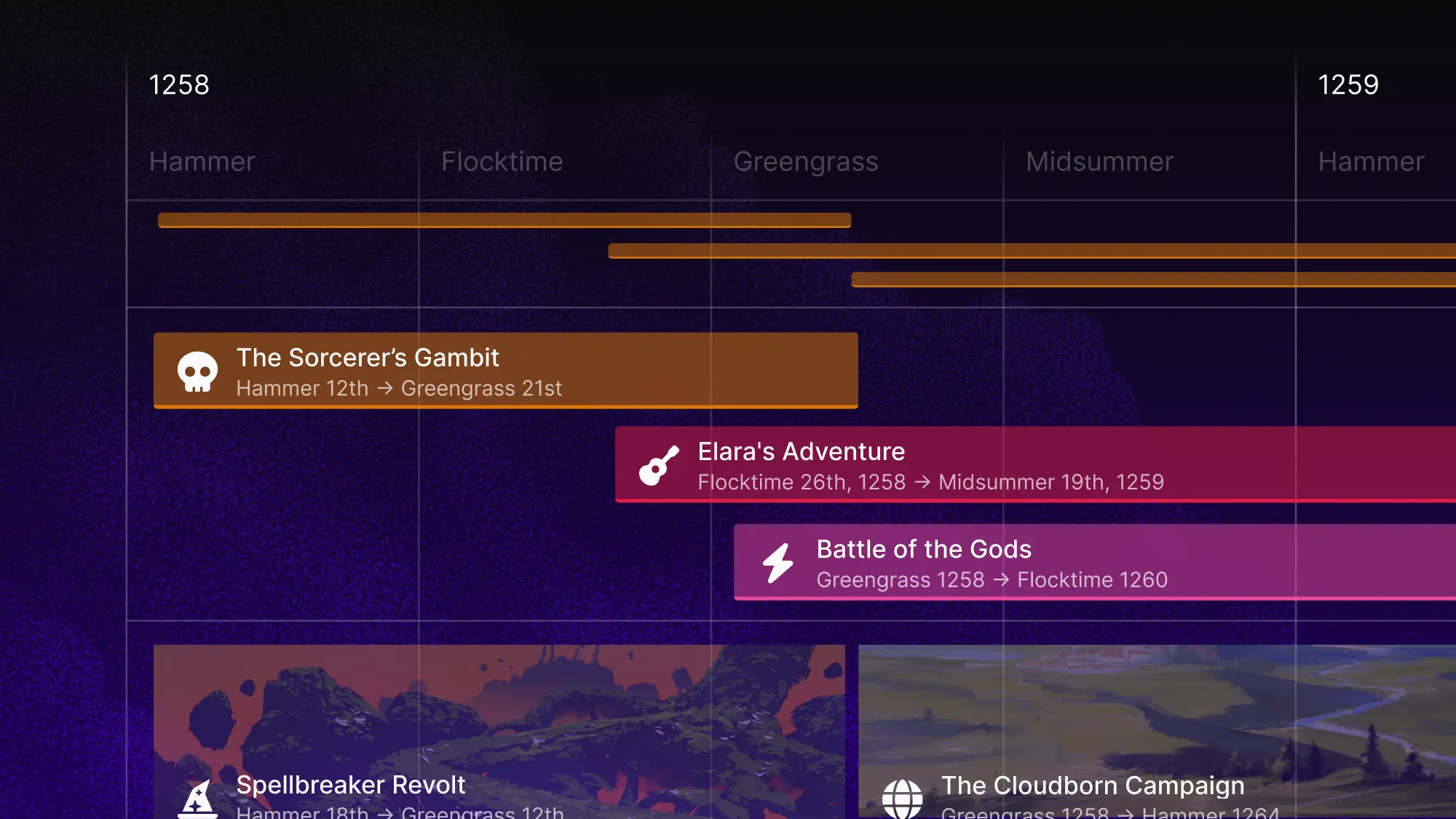
A good invented history gives a story weight. Readers sense when a kingdom's fall was earned and when it was invented the night before a chapter deadline. To see why a dedicated generator matters, it helps to look at where traditional worldbuilding workflows break down. Most of the problems come from the gap between having ideas and organizing them into something consistent.
Quick Answer: What Is a Fictional History Timeline Generator?
A fictional history timeline generator is an AI tool that drafts a chronological history for an invented world, including eras, wars, dynasties, and turning points, while keeping cause and effect consistent across centuries. Writers use it to replace scattered notes with a reliable chronology.
Key capabilities:
- Drafting eras and major events from a short world premise
- Building royal lines, faction histories, and character lifespans that line up with each other
- Supporting invented calendars, custom month names, and era labels (for example, "Third Age" or "After the Sundering")
- Flagging contradictions between your timeline and your draft chapters
The Problem: Invented Histories Collapse Under Their Own Weight
Fiction writers are adopting AI quickly, but mostly for support work rather than prose. A BookBub survey of 1,200 authors found that 45 percent use generative AI in some form, whether for writing, marketing, or research. The University of Cambridge's 2025 study of published novelists shows where writers draw the line:
97% — of novelists felt "extremely negative" about AI writing whole novels
The message from writers is clear. They want help with scaffolding, and they want to keep authorship. A fictional history fits that category well. It is foundational reference material that shapes the story without replacing your voice.
But building that history by hand is frustratingly difficult:
- Notes scatter faster than you can organize them. As one author at Writers Helping Writers put it, keeping worldbuilding consistent and story logic intact gets much harder when the information you need is buried across files, apps, and notebooks.
- Timeline software assumes you already have the history. Visual tools are built for placing events you have already decided on. Some require heavy upfront setup. In Aeon Timeline, for example, calendars can't be fully customized after any dated events have been added.
- Chronology and reading order diverge. Your reader meets events through flashbacks, prophecies, and unreliable narrators, so you end up needing one line for chronological order and a second for the order the reader encounters events.
- Plausibility takes research. Real histories have economic pressures, succession disputes, and slow cultural shifts. Inventing that texture across hundreds of years is the step where most worldbuilders stall.
This is exactly the problem Creative Fiction Writer was built to solve.
Why Creative Fiction Writer Works as a Fictional History Timeline Generator
Creative Fiction Writer is a storytelling partner built for original fiction in any genre, with deep research for authentic worlds and editorial insight. In practice, it generates the history itself rather than only displaying it. Give it a premise, and it returns a sequence of events where each war has a trigger, each dynasty has a succession problem, and each era ends for a reason.
Dedicated timeline apps take a different approach. World Anvil lets you track your world's history and create parallel timelines for different perspectives. Aeon Timeline's worldbuilding template has you create each event and drag it into place. Both are strong for visualizing material you have already written. Creative Fiction Writer covers the step before that: producing the material.
| Traditional Approach | Creative Fiction Writer |
|---|---|
| Brainstorming centuries of events from a blank page | Generates a full chronology from a one-paragraph premise |
| Lore spread across notebooks, docs, and apps | One coherent, structured history you can revise in conversation |
| Calendar systems locked in before you start | Invented months and eras that can be adjusted at any stage |
| Manual cross-checking of dates against chapters | Continuity review that flags contradictions in your draft |
| Events with no clear causes | Each event connected to what caused it and what followed |
Cause-and-Effect History, Not Random Events
Weak timelines read like lists. Strong ones read like arguments. The AI connects events causally. A drought shifts trade routes, which enriches a port city, which funds a rebellion three generations later. When you ask why something happened, you get an answer that holds up.
Custom Calendars, Eras, and Dating Systems
Your world doesn't have to use Earth's calendar. The AI works with invented month names (as with Hammer, Flocktime, and Greengrass in the timeline above), regnal years, era resets after cataclysms, and multiple competing calendars used by rival cultures.
Dynasties, Lifespans, and Faction Lineages
Succession is where invented histories most often break. The AI tracks who ruled when, how long they lived, who married whom, and which claimants were passed over. It catches problems such as a war chief who would have been eleven years old at a battle you say they led.
Genre-Aware Worldbuilding
Epic fantasy, space opera future history, alternate history, and post-apocalyptic settings each need different historical texture. The AI draws on real historical patterns, such as imperial overextension, religious schisms, and technology diffusion, so invented events feel grounded.
Example prompts:
"Generate a 700-year history for a desert empire built on control of water rights. Include three dynasties, two civil wars, and the event that ends the empire."
"My calendar has 10 months and resets after each Great Eclipse. Build a timeline of the last three eclipse cycles with major political events."
"Here's my chapter 4 draft. Check every date and age reference against our timeline and flag contradictions."
Related Agents You'll Also Find Useful
Once your history exists, these agents help you populate it, organize it, and share it.
Name Generator
If you're also inventing rulers, houses, cities, and battles, Name Generator brings the cultural and linguistic depth to make names feel like they come from the same language family.
- Culturally consistent naming conventions for invented peoples
- Character, dynasty, and place names with linguistic logic
- Name sets for rival cultures that sound distinct from each other
HTML Generator
When you want readers, players, or collaborators to see your history, HTML Generator turns your chronology into a polished, self-contained web page.
- Responsive design that opens in any browser
- Good for player handouts and author websites
- No coding required
Excel Generator
For writers who prefer a sortable chronology, Excel Generator builds a structured workbook from your timeline with columns for date, era, faction, characters, and consequences.
- Professionally formatted sheet layout
- Filter by era, faction, or character
- Easy to import into other timeline tools
Try Creative Fiction Writer free, with no credit card required.
How to Generate a Fictional History Timeline in 5 Steps
Step 1: Describe Your World's Premise and Scope
Start with the core facts: genre, central conflict, and how far back the history should go. A short paragraph is enough for your AI fiction partner to begin.
"High fantasy world. Two tribal confederations unify into a single kingdom after a century of war. I need history from 1500 to 1725."
Step 2: Define Your Calendar and Eras
Tell the AI how time works in your world: month names, year count origins, and era boundaries. If you haven't decided yet, ask for options that fit your world's culture.
"Suggest a calendar system for a seafaring culture that dates years from the founding of their first lighthouse."
Step 3: Generate the Core Chronology
Request the major events first, such as wars, successions, disasters, and discoveries, each with a cause and a consequence. Review the output and push back on anything that doesn't fit your story's needs.
"List the war chiefs of both tribes with reign dates, and the key events between 1538 and 1602 that lead to unification."
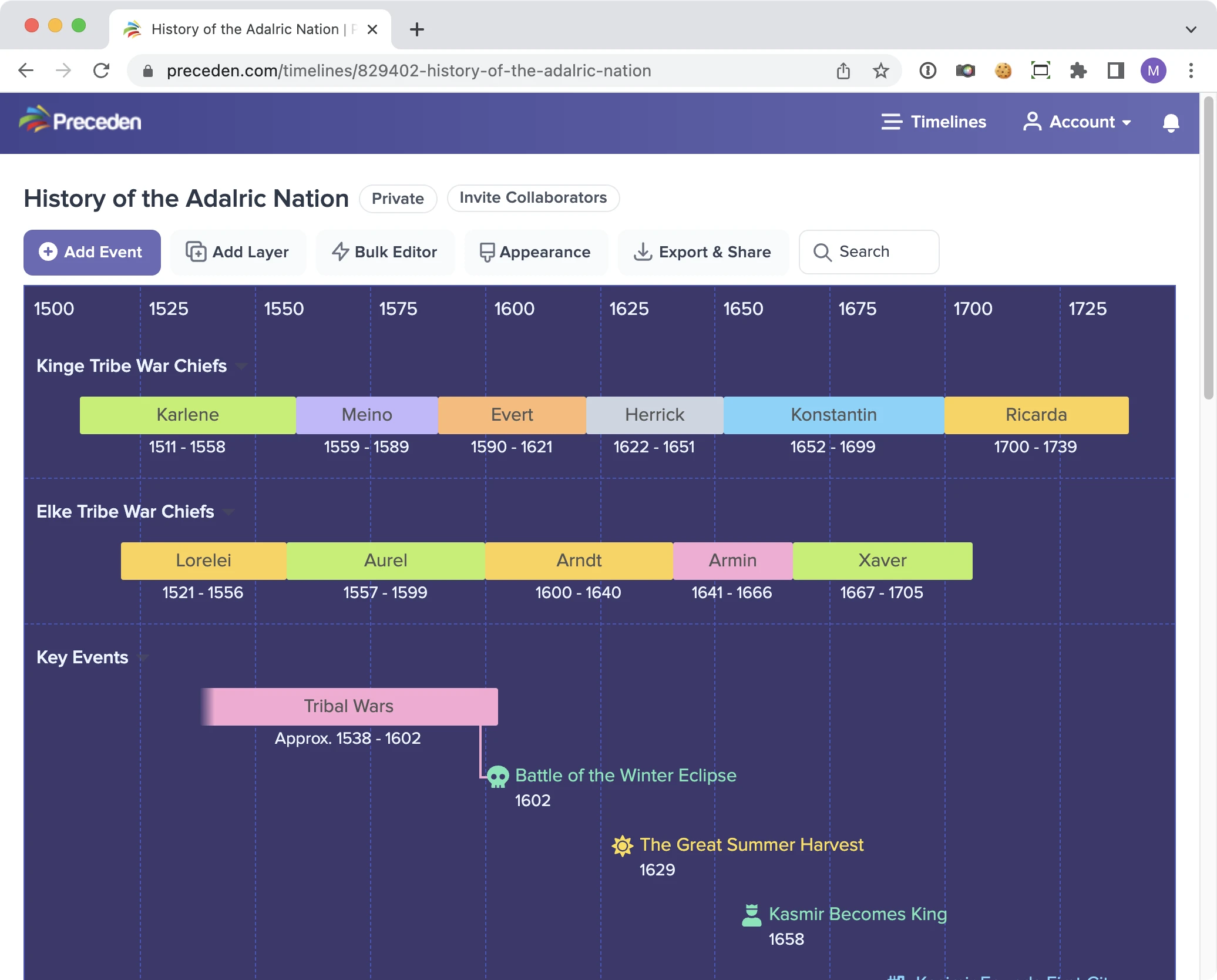
The structure in the image above, with parallel lines of succession above a track of key events, is the kind of output a well-prompted generator produces before you chart it visually.
Step 4: Deepen Pivotal Events and Test Continuity
Expand the three or four events your story depends on most into detailed accounts. Then paste in draft chapters and ask the AI to check ages, dates, and who knew what, and when.
"Expand the Battle of the Winter Eclipse: who commanded, what triggered it, and what each faction believed afterward."
Step 5: Export and Visualize
Ask for the final chronology as a clean table, then move it into a spreadsheet, a visual timeline app, or a shareable HTML page. Your history is now a single, reliable reference.
"Format the full timeline as a table with columns for year, era, event, factions involved, and long-term consequence."
Results & Use Cases
📜 Fantasy Novelist Planning a Trilogy
Scenario: An author needs 600 years of backstory so that prophecies, ruins, and family grudges in Book One pay off in Book Three.
Traditional Approach: Days spent cross-referencing notebooks, with contradictions often discovered only during revisions or by beta readers.
With Creative Fiction Writer: A layered chronology where each ruin and grudge traces back to a specific event.
- Planted foreshadowing that connects to real historical causes
- Continuity checks run against each new manuscript chapter
- A history that grows with the series instead of fighting it
🎲 Game Master Building a Campaign Setting
Scenario: A tabletop GM runs overlapping story arcs, much like the campaign timeline at the top of this article, and needs the world's past to explain the present-day conflicts.
Traditional Approach: Improvising lore at the table and then trying to remember what was said three sessions ago.
With AI drafting: A campaign-ready history with faction motives players can uncover. The GM then turns it into a player-facing handout with HTML Generator.
- Faction histories that produce natural quest hooks
- Separate "player-known" and "GM-only" versions of events
- Consistent answers when players ask about the past
📱 Worldbuilding From Your Phone
Scenario: A screenwriter gets an idea for a rebellion's origin while commuting and wants it in the timeline before it's forgotten.
Traditional Approach: A rushed note in a phone app that never makes it into the master document.
With the AI on mobile: The writer dictates the idea using speech-to-text, and the AI slots it into the existing chronology and flags any conflicts with established events.
- Capture lore anywhere, on iOS, Android, or web
- New events checked against the existing history right away
- The project syncs across devices
🚀 Science Fiction Future History
Scenario: A novelist plotting a space opera needs 400 years of interstellar expansion, including colonization waves, wars, and the collapse of Earth's authority.
Traditional Approach: Researching real colonial and economic history to make the invented version feel plausible.
With AI drafting: A future history grounded in real historical patterns, such as supply-line overextension and independence movements, adapted to faster-than-light travel constraints.
- Realistic pacing of technological and political change
- Distinct cultural histories for each colony
- Clear dating that holds across multiple point-of-view characters
Frequently Asked Questions
What is the best fictional history timeline generator?
The best choice depends on your task. Visual timeline apps like Aeon Timeline and World Anvil are good for displaying and organizing events you have already decided on. If you need the history itself generated, with causes, consequences, dynasties, and eras, an AI writing partner is the stronger option because it produces and revises the content in conversation. Many writers use both: an AI to generate the history and a visual tool to chart it.
Is Creative Fiction Writer free to use?
Yes. Creative Fiction Writer is available on a free tier that includes all core features with limited usage. Writers building large, multi-century worlds may prefer the Plus plan at $20 per month, which offers 30 times the free usage plus custom model selection. Usage resets monthly, with no daily caps.
Can an AI timeline generator handle custom calendars and month names?
Yes. A capable AI timeline generator works with invented month names, regnal dating, era resets after cataclysms, and multiple calendars used by different cultures in the same world. Unlike some timeline software that locks calendar settings once events are added, an AI lets you rename months or restructure eras at any stage and then updates the chronology to match.
How do I keep names consistent across a fictional history?
Decide on naming conventions for each culture before generating rulers and places, then apply them throughout the timeline. Name Generator builds culturally consistent name sets, so a dynasty's monarchs, cities, and battles sound like they come from one language. This makes your invented history feel lived-in rather than assembled.
How do I turn a generated timeline into a visual chart?
Ask the AI to format your chronology as a table with year, era, event, and faction columns. You can import that into a visual timeline app or a spreadsheet, or convert it into a shareable web page with HTML Generator. The web page option works well for player handouts, author websites, and sharing with collaborators.
Will an AI-generated history make my world feel generic?
It can if you accept the first draft without changes. The best results come from treating the AI as a collaborator: give it a specific premise, reject events that feel familiar, and ask it to justify every major turning point. You stay the author, deciding which events matter and how your story reveals them.
Conclusion
Invented histories fail for predictable reasons: scattered notes, events with no causes, calendars that don't hold together, and continuity errors that surface late. A fictional history timeline generator addresses each of these by giving you one coherent chronology that develops alongside your story.
Whether you're a novelist planning a series, a game master building a campaign setting, or a screenwriter mapping a franchise's backstory, AI worldbuilding support turns months of lore assembly into structured, revisable reference material. You keep full creative control over what the history means and how readers discover it.
Try Creative Fiction Writer now and generate the first era of your world's history. Explore more at Jenova.
For Developers: Creative Fiction Writer is available programmatically via the Jenova API, so you can add AI worldbuilding and fictional timeline generation to your writing app or game tool with a single API call. Full documentation →