AI Fashion Sketch Creator: Illustrate Looks, Flats & Full Collections
2026-10-06
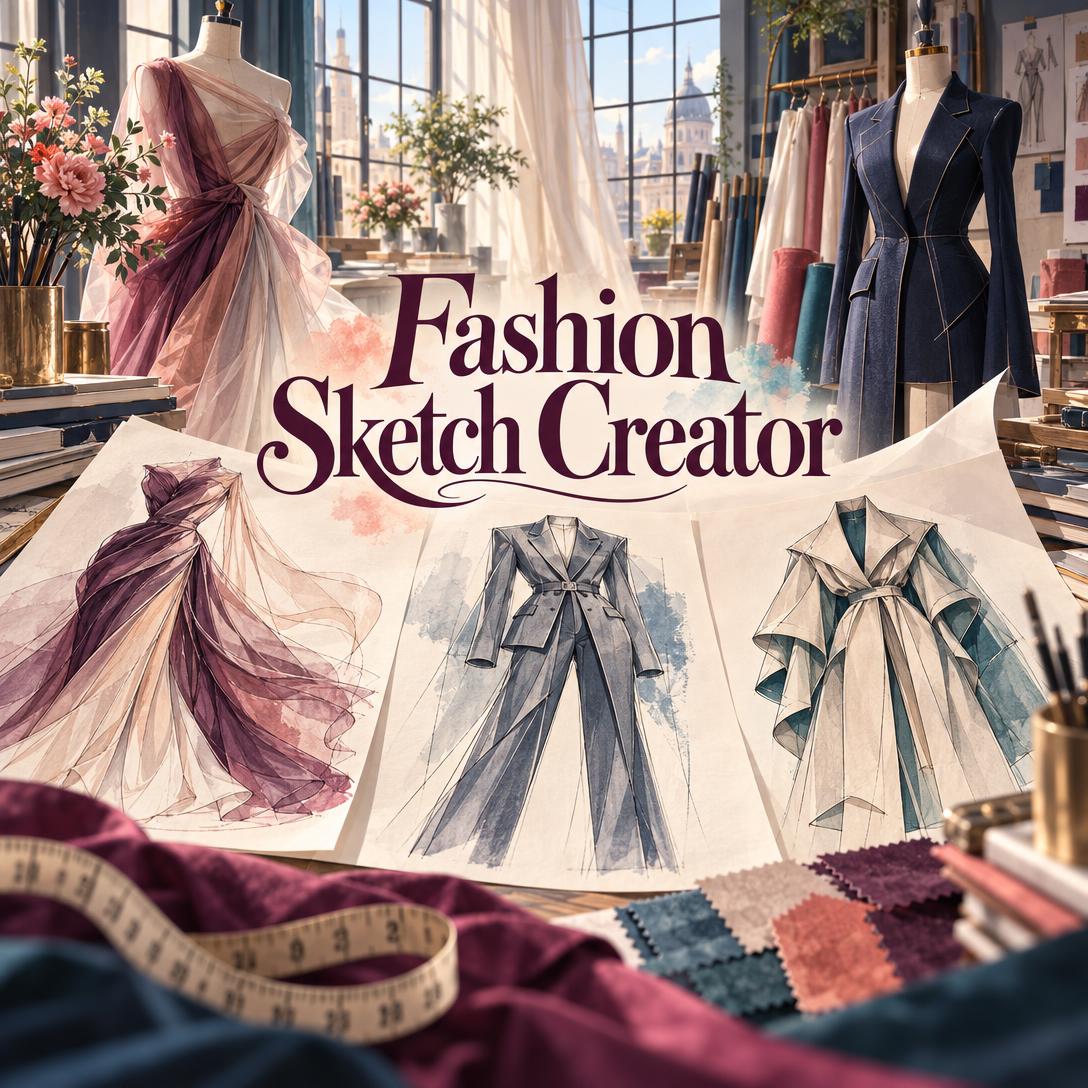
Fashion Sketch Creator helps you turn garment ideas into polished fashion illustrations by reasoning through silhouette, fabric behavior, and proportion before a single image is drawn. Most image generators produce attractive pictures of clothes. This AI works like a design collaborator, making sure each look reads as something that could actually be cut, sewn, and worn.
✅ Covers every category: womenswear, menswear, bridal, streetwear, activewear, costume, and accessories
✅ Fabric-aware rendering: chiffon drapes, gabardine creases, and organza holds its shape
✅ Collection consistency: locks a silhouette strategy, color story, and fabric palette across looks
✅ Explains every decision: silhouette, proportion, and construction rationale with each illustration
Fashion illustration has always been the bridge between an idea and a garment. That bridge, however, takes years of figure drawing, rendering practice, and garment-construction knowledge to build. To understand why a design-literate AI matters, it helps to look at the pressures facing designers, students, and independent labels today, and at the gaps that general-purpose AI tools leave open.
Quick Answer: What Is Fashion Sketch Creator?
Fashion Sketch Creator is an AI fashion illustrator that turns written ideas or reference images into editorial fashion illustrations, technical flats, and collection looks. It applies real silhouette, fabric, and proportion logic so every design reads as a wearable garment.
Key capabilities:
- Full-look fashion illustrations in editorial, commercial, or technical figure styles
- Mood boards, color stories, fabric studies, and close-up detail studies
- Distinct design variants for exploration, plus precise refinements that change only what you ask for
- Constructive critique of your own uploaded sketches, with an improved version on request
The Creative Challenges of Fashion Illustration Today
AI is moving quickly into fashion design studios. Market analysts project substantial growth in AI adoption across the industry:
**$9.45 billion by 2030**: [AI in fashion market projection, up from $2.47 billion in 2026 at a 39.8% CAGR](https://www.thebusinessresearchcompany.com/report/ai-in-fashion-global-market-report)
$96.5M → $2.23B: Projected growth of generative AI in fashion between 2023 and 2032
The stakes extend well beyond creativity. Getting designs right before production matters enormously:
25% of items never sold, 40% sold only at discount: McKinsey State of Fashion data, cited by IFA Paris
~80% of discarded clothing landfilled or incinerated in 2024: BCG analysis reported by Sustainability Magazine
Visualizing and testing ideas on the page is the cheapest point in the process to kill a weak design. But producing illustrations that are good enough to judge is frustratingly difficult:
- The skill barrier is steep. Rendering croquis proportions, fabric drape, and garment construction convincingly takes years of practice.
- General image AI demands prompt expertise. As Shima Seiki's fashion technology team notes, crafting effective prompts for tools like Midjourney is tricky, and many people give up after a few failed attempts.
- Pretty is not the same as wearable. Generic outputs often ignore how fabric behaves or where seams would sit, which produces images that cannot become garments.
- Outputs tend to converge. Critics warn of aesthetic homogenization, because AI trained on similar datasets drifts toward the same dominant visual standards.
Where AI Fits in a Real Design Workflow
Industry practice suggests that AI performs best at the front of the process. Browzwear describes a team exploring 20 variations of a jacket silhouette within minutes, then moving the strongest options into precise 3D development. G-Star RAW followed a similar pattern. According to Shima Seiki's coverage, the brand generated 12 denim designs with Midjourney, and its team refined one into a real cape made from Japanese selvedge denim.
The lesson is consistent. AI accelerates ideation, while design judgment turns ideas into garments. A tool that brings that judgment into ideation itself closes the gap that generic generators leave open.
How It Works: From First Idea to Finished Collection
Using this AI fashion illustrator feels less like operating software and more like working with a senior designer who can draw quickly. The steps below walk through the process.
Step 1: Describe the Look or Upload a Reference
Start with a garment and a direction. Include the occasion, mood, era, or fabric if you have them. If your request is very bare, such as "a dress," expect one quick question about the occasion and vibe before the first illustration.
"A black-tie gown for a winter gala, 1950s New Look waist, but in a modern matte crepe with a dramatic cape sleeve"
Step 2: Read the Design Rationale
Each illustration comes with a short explanation of the key choices: why the silhouette family fits, how the fabric will move, and where the visual waist sits. Professionals get peer-level construction detail. Enthusiasts get the same reasoning in plain language.
"Why did you choose a column silhouette instead of A-line for this look?"
Step 3: Explore Genuinely Different Variants
Ask for options and you get distinct silhouettes, fabric choices, or proportions, not three versions that differ only in color. This mirrors how design teams filter weak ideas early.
"Show me three directions for an oversized men's overcoat: cocoon, architectural shoulder, and deconstructed raw-edge"
Step 4: Refine With Precision
Once a look is close, request targeted edits. Everything you don't mention stays intact, so a sleeve change won't quietly redesign the collar.
"Keep everything, but drop the hem to ankle length and change the lining to deep oxblood"
Step 5: Build Out the Collection
When you approve a look, its silhouette strategy, color story, fabric palette, and construction language become the locked direction for later looks. Fashion Sketch Creator also suggests what to design next for balance, such as a missing outerwear piece or a closing statement look. To present the finished line, PowerPoint Generator can turn your looks and design notes into a structured presentation deck for buyers, professors, or investors.
"Lock this direction and design Look 4, a daytime knit piece that fits the palette"
You can start on the free plan and work through all five steps in a single conversation.
Creative Showcase: Fashion Sketch Creator in Action
The scenarios below show how the AI fashion sketch studio fits into different design workflows.
🎓 Fashion Student Portfolio Development
Scenario: A second-year student needs six cohesive looks for a "1970s Halston minimalism meets contemporary streetwear" portfolio brief.
Traditional Approach: Evenings of croquis drafting, repeated marker renders whenever a proportion feels wrong, and the constant risk that look six no longer matches look one.
Fashion Sketch Creator: Six illustrations built on one locked direction of column silhouettes, fluid jersey, and a sand-and-rust palette. Each look comes with rationale the student can adapt for presentation boards.
- Faster proportion testing before committing to hand-rendered final boards
- Era references translated into specific design vocabulary
- Honest critique when an uploaded hand sketch has a fabric-silhouette mismatch
👗 Indie Label Capsule Planning
Scenario: A small womenswear label is planning an eight-piece resort capsule and wants to see the full range before paying for samples.
Traditional Approach: Commissioning a freelance illustrator or sampling blind, which means paying for physical prototypes of pieces that may not make the final cut.
Fashion Sketch Creator: Look-by-look illustrations in washed linen and silk habotai, with collection rhythm guidance on opening looks, transitional pieces, and silhouette variety.
- Weak pieces get cut on the page, not after a sample is sewn
- Technical flats clarify construction intent before tech-pack work begins
- Color stories and fabric studies support supplier conversations
If the label is also refining its identity, Brand Kit Generator can build a matching logo, palette, and typography system so the capsule launches with a cohesive brand.
📱 Mobile Inspiration Capture
Scenario: A designer finds an extraordinary 1920s beaded panel at a vintage market and wants to see it reimagined in modern eveningwear before leaving.
Traditional Approach: Snap a photo, jot notes, and hope the idea still feels alive back at the studio days later.
Fashion Sketch Creator: On a phone, the designer uploads the photo and dictates a request with speech-to-text. A first illustration is ready on the spot, with the reference's geometry adapted rather than copied.
- Full feature parity on iOS and Android
- Conversation history syncs across devices for later refinement
- Reference qualities such as pattern, palette, and era are explicitly extracted
🎭 Costume Design for Stage and Screen
Scenario: A community theater costume designer needs period-accurate looks for a 1960s Mod production on a tight timeline.
Traditional Approach: Hours of archive research, then sketching each character by hand for director approval.
Fashion Sketch Creator: Character-specific illustrations using era-correct shift silhouettes, mini hemlines, and graphic color blocking. Proportions are adjusted for each performer's movement on stage.
- Era vocabulary applied with accuracy rather than as a generic "retro" look
- Quick variants for director feedback sessions
- Designs consider whether actors can move, sit, and change quickly
Frequently Asked Questions
Is Fashion Sketch Creator free to use?
Yes. You can try Fashion Sketch Creator on the free plan, which includes all core features with limited usage. Designers producing full collections often move to Plus at $20/month for 30× the free usage and custom image model selection. Higher tiers scale further. Usage resets monthly with no daily caps, so you can run an intensive design sprint whenever a deadline hits.
How is an AI fashion illustrator different from Midjourney or general image generators?
General image generators are versatile across every subject, but getting garment-specific results usually depends on your prompting skill. Fashion Sketch Creator specializes in fashion design. It reasons through silhouette, fabric behavior, proportion, and construction before generating an image, explains its choices, and keeps a locked direction consistent across collection looks. You describe the design in plain language, and it handles the visual translation.
Can it create technical flats and spec sheets?
Technical flats, which are flat garment drawings showing construction, are a strong output. Detailed annotated spec sheets are more limited because image models still render text unreliably, so labeled measurements should be finalized in dedicated software. The tool focuses on design and illustration. It does not handle pattern drafting, grading, sewing instruction, or fabric sourcing.
Does Fashion Sketch Creator work on mobile?
Yes. It works on web, iOS, and Android with full feature parity. You can upload reference photos straight from your camera roll, dictate design ideas using built-in speech-to-text, and pick up the same conversation later on desktop. All settings and history sync across devices, which suits designers who find inspiration in markets, museums, and fabric stores.
Can it critique my own fashion sketches?
Yes. Upload a hand-drawn or digital sketch and you receive structured feedback. It starts with what works, then covers proportion balance, fabric-to-silhouette fit, construction logic, and surface detail, in that priority order. Each issue comes with an actionable fix, and you can request an improved illustration of your design that preserves your original intent.
Can I turn my illustrations into photorealistic model photos?
Fashion Sketch Creator focuses on illustration. For the next stage, Fashion Mockup Studio places garments on models with studio-grade lighting and styling, which helps with lookbook previews, pitch decks, or pre-launch social content. Many designers illustrate first to settle the design, then create mockups once the look is final.
Conclusion: Design With Intent, Illustrate at the Speed of Ideas
Fashion illustration has long demanded a rare combination of drawing skill and garment knowledge. Generic AI tools solved the speed problem but often skipped the design thinking. An AI fashion sketch tool built around silhouette, fabric, and construction logic brings both together, so students, independent labels, costume designers, and seasoned professionals can explore boldly and still end up with designs that work on the body.
Whether you're testing a single gown or building a 10-look collection, design-literate illustration lets you evaluate more ideas, cut weak ones early, and present your vision clearly. Try Fashion Sketch Creator now, and explore more at Jenova.
For Developers: Fashion Sketch Creator is available programmatically via the Jenova API. You can integrate design-aware fashion illustration into your design, e-commerce, or edtech application with a single API call. Full documentation →