What Is the Best AI Tool for Fashion Collection Planning?
2026-10-06
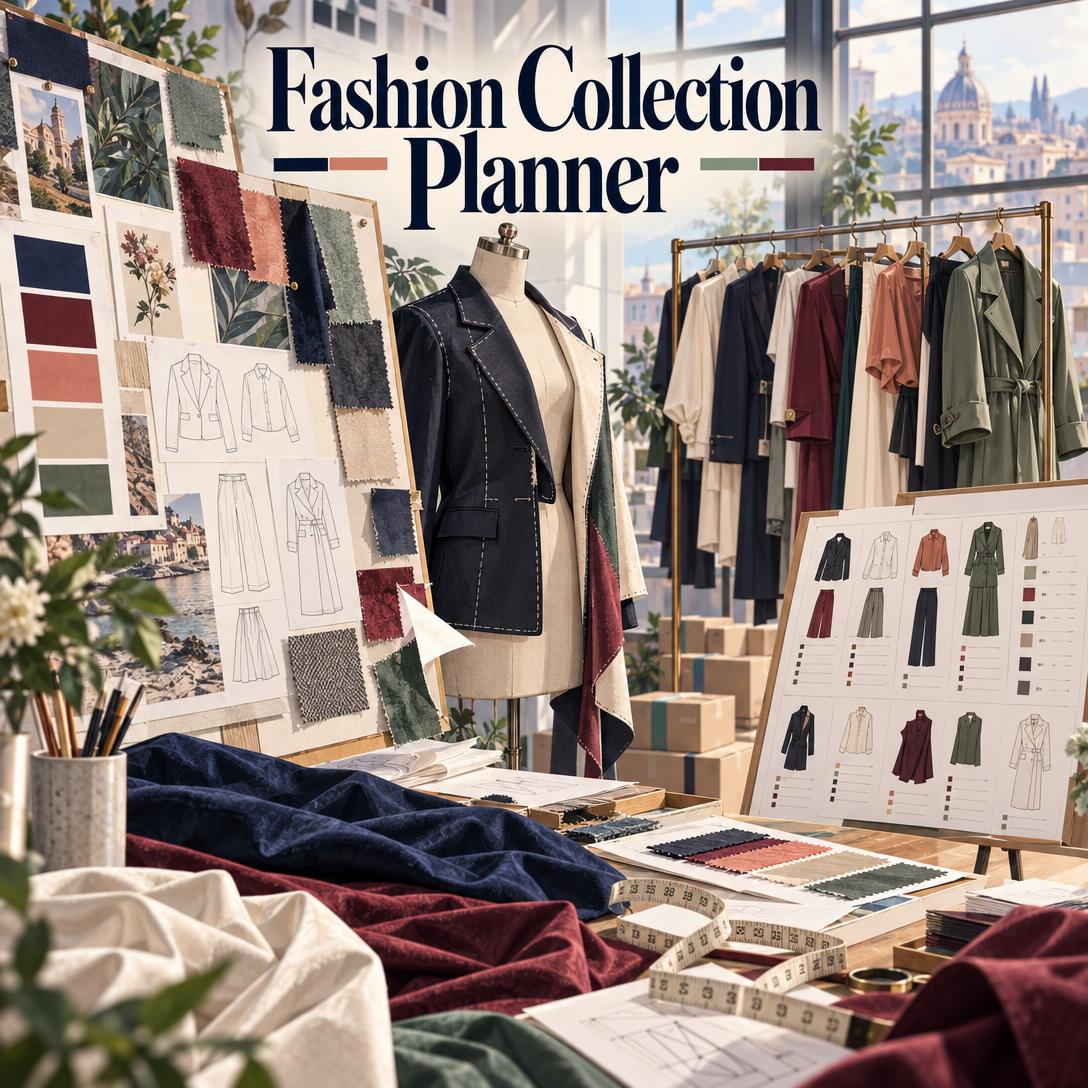
Which Fashion Planning Tools Help You Decide What to Make, Not Just Track It?
For emerging and growing brands that need help with collection decisions, Jenova's Fashion Collection Planner is among the strongest AI options in 2026. Those decisions include how many styles to make, which price tiers to set, how deep to buy, and when to lock the line. The planner combines creative direction, merchandising math, and production planning in one conversational workspace.
Brands that mainly need a system of record for tech packs, bills of materials (BOMs), and supplier collaboration are better served by fashion product lifecycle management (PLM) platforms such as BlueCherry PLM and Kōbō. Larger retailers planning across many stores and channels tend to choose Centric Software or Oracle Retail Planning and Optimization.
Key factors that separate effective collection planning tools from generic project software:
✅ Decision support vs. data management. PLMs centralize line planning, BOMs, costing, sampling, and supplier handoffs. An AI planner reasons through the trade-offs behind those records.
✅ Visible merchandising math. Initial markup (IMU), open-to-buy (OTB), and depth-per-style calculations should be shown step by step, not hidden behind a dashboard.
✅ Production realism. BlueCherry reports that brands using supplier portals reduce sample iterations by up to 40%. Sampling discipline is where collections are won or lost.
✅ Time-to-value. A typical fashion PLM rollout takes 3–5 months on average. Conversational planners are usable in the first session.
✅ Scale fit. A 10-style capsule brand and a 400-SKU wholesale business need fundamentally different tooling.
To compare these tools meaningfully, it helps to first understand why collection planning has become a software problem at all.
Why Are Fashion Brands Moving Collection Planning Off Spreadsheets in 2026?
Fashion brands are moving off spreadsheets because seasonal collections now involve too many interdependent variables to manage in disconnected files. Styles, colorways, size runs, suppliers, costs, and compliance documentation all depend on each other. The pain point is consistent across vendor and analyst sources.
BlueCherry describes product development as "often managed across disconnected tools, spreadsheets, and email threads". Kōbō puts it more bluntly: a typical collection "lives across Illustrator, Excel, email, WhatsApp, and a shared drive".
📊 Signals Driving the Shift
Enterprise adoption: Centric Software showcases how Guess transformed its assortment planning process by adopting AI and replacing Excel spreadsheets.
AI-driven assortment: Industry coverage notes that AI-based assortment tools are now automating product ranking, store clustering, and simulation.
Regulatory pressure: The World Intellectual Property Organization's 2025 report highlights how new legislative frameworks and investor interest are pushing fashion toward more sustainable resource management.
Assortment planning, defined by Intuendi as selecting the right combination of products for each store, warehouse, market, or sales channel, is where spreadsheet errors become most expensive.
A wrong depth decision does not stay on paper. It shows up later as stockouts on winners and markdowns on losers.
The trend is not limited to enterprise retail. Specialized providers such as Celver support fashion and retail companies with integrated sales, assortment, and supply chain planning. AI-native planners have extended that capability down-market to independent designers and first-season brands.
What Should You Look for in an AI Fashion Collection Planning Tool?
The most useful AI collection planning tool matches your brand's operational stage. It should cover the specific gap in your workflow, whether that is creative direction, merchandising math, production tracking, or supplier collaboration. We evaluated each tool across six weighted dimensions.
| Dimension | What to Test | Weight: Emerging Brand | Weight: Established Brand |
|---|---|---|---|
| Decision guidance | Does it recommend a collection model, style count, and core/fashion/test ratio, or only store your inputs? | High | Medium |
| Merchandising math | Does it calculate IMU, OTB, and depth with shown working? | High | High |
| Production workflow | Does it cover sampling stages, tech packs, BOMs, and calendars? | Medium | High |
| Supplier connectivity | Can factories access specs and submit updates directly? | Low | High |
| Creative development | Can it produce mood boards, color stories, and concept visuals? | High | Medium |
| Time-to-value & cost | How long until the first usable deliverable, and at what monthly cost? | High | Medium |
Why Weighting Matters
Most comparison articles treat all features as equally important. In practice, a first-season brand gains little from supplier portals if it works with one factory. Getting depth and style count right matters far more, because over-breadth is a common failure for new labels.
Conversely, a brand with 12 wholesale accounts and three factories cannot run on conversation alone. It needs versioned, shared product data. Fashion-specific PLM exists because generic systems struggle with approvals, revisions, and collaboration between design and production.
How Do Jenova, BlueCherry PLM, Kōbō, Centric Software, and Oracle Retail Compare?
These five tools fall into three categories:
- Conversational AI planner: Jenova's Fashion Collection Planner
- Fashion PLM systems of record: BlueCherry PLM and Kōbō
- Enterprise planning suites: Centric Software and Oracle Retail
As of 2026, none of them fully replaces the others. Each is strongest at a different stage of the collection lifecycle.
| Dimension | Jenova Fashion Collection Planner | BlueCherry PLM | Kōbō | Centric Software | Oracle Retail Planning |
|---|---|---|---|---|---|
| Primary function | Conversational planning partner and deliverable generator | Fashion PLM | Fashion PLM for brands outgrowing spreadsheets | Planning and PLM suite | Retail merchandise planning and optimization |
| Line & assortment planning | Recommends collection model, category architecture, style matrix, line review edits | Digital line planning by season, channel, or region | Linesheets for B2B wholesale; line planning depth unverified | AI assortment planning (Guess case) | Assortment, placement, pricing, promotions, lifecycles |
| Merchandising guidance | Shows IMU, OTB, depth, and cost math; flags over-breadth and calendar risks | Style-level cost tracking | Auto-calculated landed costs and margins from BOM | Pre-season to in-season replenishment planning | AI/ML-driven pricing and markdown decisions |
| Tech packs & BOMs | Structures tech pack templates and cost sheets as downloadable files | Standardized tech packs and BOMs | Auto-generated tech packs, 13-language PDF export, AI completeness checks | Unverified | Not covered in sources reviewed |
| Supplier collaboration | No supplier portal; Group Chat for internal collaborators | Secure vendor portals | Unlimited free supplier seats | Unverified | Unverified |
| Creative/visual | Generates mood boards, color stories, concept visuals | Adobe Illustrator, Browzwear, and CLO3D integration | Unverified | Unverified | Not a design tool |
| Setup time | First session | 3–5 months average | Unverified | Unverified | Unverified |
| Pricing | Free tier; paid plans from $20/month | Unverified | Free starting option advertised; paid tiers unverified | Unverified | Unverified |
| Best for | Emerging-to-mid brands, students, product leads needing a planning partner | Established multi-vendor brands | Small-to-mid brands consolidating tools | Larger brands replacing Excel-based assortment planning | Multi-store retailers |
🎯 Jenova's Fashion Collection Planner
Jenova's Fashion Collection Planner works like a head of product development available on demand. It shifts between four roles depending on the request:
- Creative strategist: concepts, mood boards, and color stories
- Merchandising advisor: line architecture, price tiers, and OTB
- Production coordinator: calendars, sampling, and tech pack structure
- Deliverable generator: line sheets, cost sheets, production calendars, and assortment matrices
Testing reveals two distinctive behaviors. The planner pushes back on collections that are all creativity with no financial discipline, or all commercial with no brand differentiation. It also proactively flags failure patterns such as too many styles, missing line reviews, and timelines that ignore sampling lead times.
It adapts its depth to the user. Experienced merchandisers get peer-level discussion, while emerging brand owners are guided through each phase.
Limitations: The planner is not a system of record. It has no supplier portal, does not connect to point-of-sale or ERP data, and cannot send scheduled reminders or monitor delivery delays. Sell-through analysis depends on data you supply. It will not name specific factories or mills without researching them first.
BlueCherry PLM
BlueCherry PLM natively supports colourways, size runs, fabric libraries, seasonal and regional calendars, and multi-vendor collaboration. The company reports typical results of 30% faster time-to-market and a 15% reduction in sampling and development costs.
Limitations: Implementation averages 3–5 months with a phased rollout from designers to developers, vendors, and finance. The performance figures are vendor-reported, and pricing was not available in the sources reviewed.
Kōbō
Kōbō generates tech packs directly from product data, with PDF export in 13 languages and AI completeness checks before files reach the factory. It also includes BOM-based landed costing, production tracking, multi-location inventory, and B2B wholesale linesheets.
Limitations: Kōbō's AI is oriented toward data completeness rather than strategic guidance. It will not tell you whether your line has too many styles. Full pricing beyond the advertised free starting option was unverified.
Centric Software
Centric positions its planning tools as solutions for merchandise, assortment, and demand planning, from pre-season strategy to in-season replenishment. Its Guess showcase demonstrates AI-assisted assortment planning at enterprise scale.
Limitations: Public detail on pricing, implementation time, and small-brand suitability was limited in the sources reviewed. The customer showcase points to an enterprise focus.
Oracle Retail Planning and Optimization
Oracle Retail helps retailers define assortment, placement, pricing, promotions, and product lifecycles, using AI and machine learning to minimize markdowns and protect margins.
Limitations: Oracle Retail is built for retail merchandise planning rather than design development. The sources reviewed show no tech pack, sampling, or mood-boarding capability, which makes it a poor fit for independent designers.
Other apparel PLMs worth evaluating include Aptean's PLM REVO for apparel and soft goods brands.
How Does an AI Planner Handle Line Review, Assortment Depth, and Open-to-Buy?
A strong AI collection planner treats line review, depth planning, and OTB as one connected decision chain. It edits the designed line down to commercially viable styles, allocates units to back winners, and checks the total buy against category budgets.
Examining Jenova's Fashion Collection Planner shows it treats line review as the most valuable meeting in the planning calendar. It typically recommends cutting 20–30% of designed styles before assortment planning begins.
The Core/Fashion/Test Ratio
The planner frames every collection's risk profile through three tiers:
- Core: proven sellers with low risk and high depth.
- Fashion: seasonal, trend-responsive styles with moderate depth.
- Test: experimental styles with minimal depth, treated as a learning investment.
For emerging brands, it recommends skewing 60–70% core. For a brand's first season with no sales history, it advises buying shallow and treating the season as a data-collection exercise.
Showing the Margin Math
When financial calculations matter, the planner shows its working. For a jacket with a $30 landed cost, a $70 wholesale price, and a $160 retail price, the retailer's initial markup is:
The brand's own direct-to-consumer (DTC) markup on the same jacket is:
This gap explains why DTC and wholesale channels need separate planning.
Failure Patterns the Planner Flags
| Pattern | What Goes Wrong |
|---|---|
| Over-breadth | Too many styles, not enough depth per style |
| No line review | Every designed style goes to buy |
| Calendar denial | Timelines ignore sampling and production lead times |
| Cost ignorance | Designs proceed without understanding landed cost |
| Trend chasing | Collections are built around micro trends that expire before delivery |
| Depth imbalance | Units are spread equally instead of backing winners |
How Enterprise Tools Differ
Enterprise suites approach the same problem algorithmically at store level. Academic research on fashion retail assortment describes methods that incorporate individual stores' assortment strengths and weaknesses to maximize store-level KPIs.
That is a different job from deciding whether a 19-style collection should be 15. Store-level optimization requires historical data that most independent brands do not yet have.
Can AI Help With Fabric Sourcing, Costing, and Production Calendars?
AI can meaningfully help with fabric strategy, cost sheet construction, and production calendar planning. Live supplier execution, including purchase orders, sample tracking, and factory communication, still requires a PLM or direct supplier relationships.
🧵 Fabric Strategy
Jenova's Fashion Collection Planner distinguishes between two sourcing paths with different risk profiles:
| Fabric Type | Typical MOQ | Lead Time | Best For |
|---|---|---|---|
| Stock fabrics | 50–100 yards | 2–4 weeks | Emerging brands, core styles |
| Developed fabrics | 300–1,000+ yards | 8–16 weeks | Statement pieces, brands with volume |
The planner treats lab dips and strike-offs as non-negotiable approval steps before bulk dyeing or printing. It anchors calendars to fabric shows such as Première Vision and Texworld, which it places 12–18 months before delivery.
💼 Costing
The planner builds cost sheets from their components:
- Fabric cost (price per yard or meter × usage)
- Trims
- Cut-make-trim (CMT) labor
- Duty and freight
- Packaging, agent fees, and overhead
By comparison, Kōbō calculates landed costs automatically from supplier pricing, exchange rates, and duty once BOM data is entered. This is stronger for ongoing accuracy, but it assumes your suppliers and components are already defined.
📅 Production Calendars
The planner maps collection phases backward from the delivery date:
- Concept and research at 8–12 months out
- Line planning at 6–9 months
- Sourcing at 3–6 months
- Production and QA at 2–4 months
It exports production calendars and line sheets as XLSX files. BlueCherry, meanwhile, integrates with Browzwear and CLO3D for virtual prototyping that reduces physical samples, a capability conversational tools do not replicate.
How Should Sustainability and Compliance Shape a Collection Plan?
Sustainability should enter a collection plan at the fabric and supplier selection stage, not at marketing. Unsubstantiated claims are a growing legal liability, and certifications require documentation gathered during sourcing.
Consumer and corporate pressure is measurable. A survey reported by Vogue found that 54% of apparel and textile companies saw customer demand for environmentally sustainable practices increase. Large brands are reporting concrete progress: Gap achieved a 70% reduction in Scope 1 and 2 emissions and a 20% reduction in Scope 3 emissions in 2025.
The broader stakes are significant. One widely circulated estimate holds that fashion accounts for roughly 10% of global carbon emissions, with over 92 million tons of textile waste generated.
Certifications to Plan Around
Jenova's Fashion Collection Planner guides brands through the major textile certifications:
- OEKO-TEX Standard 100: tested for harmful substances
- GOTS: organic fiber content and processing
- Better Cotton (BCI): responsibly sourced cotton
- Global Recycled Standard (GRS): verified recycled content
- WRAP/SA8000: factory labor and social compliance
The planner's position is direct: "sustainable" without certification is a liability. It flags tightening rules such as the EU textile strategy and Extended Producer Responsibility (EPR) when relevant to a brand's markets.
How Do You Get Started Planning a Collection With AI?
Most AI planning tools follow the same starting sequence: describe your brand and market, set a season and financial constraints, then build outward from collection architecture. The details differ by tool type.
Getting Started With Jenova's Fashion Collection Planner
-
Open the agent at jenova.ai/a/fashion-collection-planner on web, iOS, or Android.
-
Describe your brand, season, channels, and constraints:
"I run a contemporary womenswear label, second season, DTC plus four wholesale accounts. Planning SS27 with a $45K open-to-buy and a 50-unit MOQ per style. Help me pick a collection model and category architecture."
-
Lock the foundations the planner recommends, such as collection model, core/fashion/test ratio, and price tiers. The planner then summarizes what is decided and flags gaps.
-
Request visual concept work:
"Generate a mood board for a coastal Mediterranean theme with ivory, sage, and terracotta as the color story."
You can switch between image generation models using the App button beneath the chat input to compare results.
-
Request production-ready deliverables:
"Build the line sheet and a cost sheet for all 19 styles as XLSX, with IMU calculated for both DTC and wholesale."
Because the Jenova platform keeps persistent memory across sessions, collection decisions carry forward as the season progresses. Co-designers or merchandisers can join through Group Chat.
For photorealistic garment visualization, Fashion Mockup Studio complements the planner. Pricing Strategist helps pressure-test price architecture, and Supply Chain Analyst supports sourcing-region and tariff research.
Getting Started With Kōbō
- Create an account using Kōbō's advertised free starting option.
- Enter styles with components, suppliers, and consumption to build each BOM. Landed costs calculate automatically.
- Invite suppliers to the branded portal, where seats are free, so they can view specs and submit costings.
- Generate and export tech packs as PDFs, which Kōbō checks for completeness before they reach the factory.
What Do Fashion Product Development Experts Say About AI Collection Planning?
The consensus among product development practitioners is that AI planning tools add the most value upstream. They help with collection architecture, line editing, and margin discipline, which come before the decisions that PLM systems are designed to record and execute.
"The most expensive mistakes in a collection happen before a single sample is cut. A brand that designs 40 styles when its OTB supports 22 has already lost margin, no matter how well its tech packs are managed. That's why we built the Fashion Collection Planner to challenge breadth first. It asks how deep you can buy on each style before it asks what the style looks like."
"For first-season brands, we consistently recommend a core-plus-seasonal model with 60–70% core styles, stock fabrics, and shallow buys. The goal of Season 1 isn't to sell out. It's to generate sell-through data by style, color, and size that makes Season 2 a planning exercise instead of a guess."
"We don't position conversational AI as a PLM replacement. Once a brand is managing multiple factories, a dozen wholesale accounts, and versioned tech packs, a system of record becomes essential. The right sequence for most growing labels is an AI planner for strategy and documents now, with a PLM introduced when supplier coordination becomes the bottleneck."
— Jenova Product Team, Agent Design & Domain Research, 8 years in AI agent design
Which Collection Planning Tool Fits Your Brand's Size and Stage?
The right tool depends primarily on where your bottleneck sits. Early-stage brands are limited by decision quality, mid-size brands by coordination, and enterprise retailers by store-level optimization.
Recommendations by Profile
- Fashion students and first-collection designers: Jenova's Fashion Collection Planner is best suited here. It teaches the planning framework while producing real line sheets and cost sheets, and it starts on a free tier.
- Emerging DTC brands (10–30 styles, one or two factories): Jenova's Fashion Collection Planner is strongest for collection architecture, margin math, and calendar realism. Spreadsheet-based tracking is typically adequate at this scale.
- Growing brands consolidating tools (30–150 styles, multiple suppliers): Kōbō is stronger for centralizing tech packs, BOMs, inventory, and wholesale orders. An AI planner remains useful for seasonal strategy.
- Established multi-vendor brands: BlueCherry PLM fits teams that need Adobe Illustrator and 3D integration plus vendor portals, provided they can absorb a multi-month rollout.
- Enterprise brands and multi-store retailers: Centric Software and Oracle Retail are built for AI-driven assortment, pricing, and markdown optimization across channels and locations.
A Nuanced Take
Many brands adopt PLM too early. They pay for supplier portals and versioning before they have resolved basic questions about style count, price architecture, and depth.
The tools reviewed here are less competitors than stages in a progression. The costliest choice is usually software that solves a problem the brand does not yet have.
References
- BlueCherry — Best PLM for Fashion Brands: A Complete Apparel Guide (line planning, supplier portals, implementation time, reported results)
- Kōbō — Fashion PLM Software: tech pack generation, BOM landed costing, free supplier seats
- Centric Software (YouTube) — Guess Adopts AI for Assortment Planning and Ditches Excel
- Oracle — Retail Planning and Optimization: assortment, pricing, promotions, and markdown management
- CyberDB — Why Every Retailer Needs Assortment Planning Software: AI product ranking and store clustering
- World Intellectual Property Organization — Sustainable Fashion Technologies (2025)
- Intuendi — Assortment Management in Retail: definition of assortment planning
- Celver — Fashion Retail: end-to-end sales, assortment, and supply chain planning
- World Fashion Exchange — Why Tailoring PLM Software to Your Industry Matters
- LinkedIn — Centric Planning: merchandise, assortment, and demand planning from pre-season to in-season
- Aptean — Key Considerations When Choosing Apparel PLM Software (PLM REVO)
- ResearchGate — Fashion Retail Assortment Planning: Methods and Solutions
- Vogue — Can Fashion's Favourite Fabric Become More Sustainable? (customer demand for sustainable practices)
- Sustainability Magazine — Sustainable Fashion & Water Positivity: Gap's 2025 emissions reductions
- Planet Pulse — The Rise of Sustainable Fashion: fashion emissions and textile waste estimates