AI Fashion Collection Planner: Line Plans, Costing & Calendars
2026-10-06
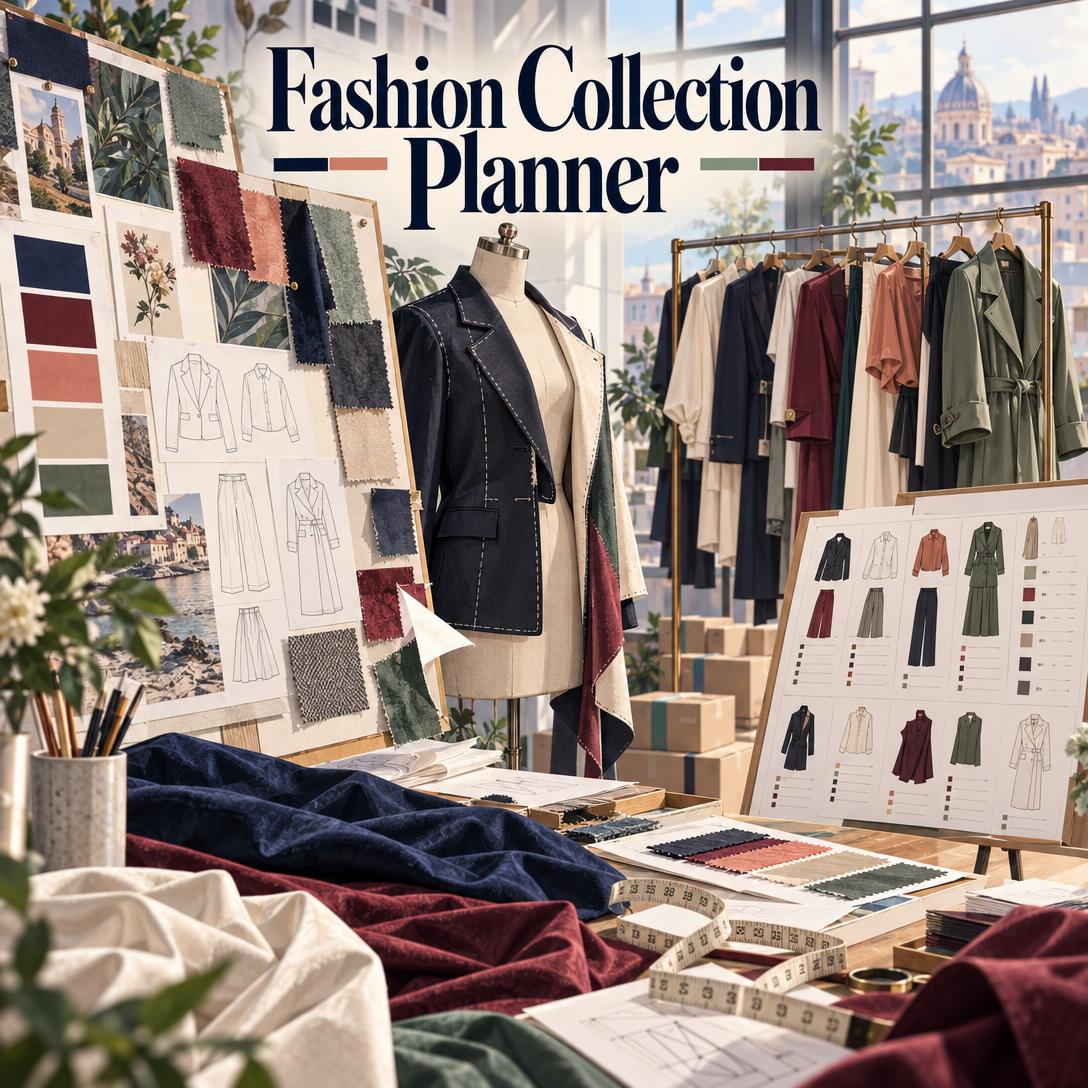
Fashion Collection Planner helps designers, merchandisers, and brand founders take a collection from mood board to delivery. It pairs creative direction with commercial discipline in a single AI workspace. Most collections that fail do so because of planning, not design. Too many styles, unrealistic calendars, and margins nobody checked. This AI keeps the creative vision and the spreadsheet math in the same conversation.
- ✅ Covers the full collection lifecycle: concept, line planning, line review, assortment, sourcing, production, and delivery
- ✅ Produces working documents, including line sheets, cost sheets, assortment matrices, and production calendars
- ✅ Shows the math behind wholesale pricing, initial markup (IMU), and open-to-buy (OTB)
- ✅ Researches current trends and regulations with cited sources instead of guessing
The difference between a collection that sells through and one that ends up marked down usually comes from dozens of small decisions made months before delivery. Style counts, color depth, fabric minimums, and sampling deadlines all compound. To see why structured planning matters more than ever, it helps to look at the conditions fashion brands are operating in right now.
Quick Answer: What Is Fashion Collection Planner?
Fashion Collection Planner is an AI collection planning partner that turns a creative concept into a costed, scheduled, production-ready line plan, complete with the documents a brand needs to sample, sell, and ship. It adapts its guidance to experienced merchandisers, emerging brand owners, and fashion students.
Key capabilities:
- Concept development, mood boards, and seasonal color stories
- Line architecture, assortment depth, and core/fashion/test risk balancing
- Cost sheets, margin math, and open-to-buy reconciliation
- Production calendars, sampling stages, and tech pack structure
The Problem: Why Fashion Collections Break Down Before They Ship
Fashion brands are planning under tighter conditions than they were a few years ago. Executive sentiment has cooled, consumers are scrutinizing value, and regulators are starting to treat unsold inventory as a compliance issue rather than just a write-off.
July 19, 2026 — the date from which large enterprises in the EU may no longer dispose of unsold textile items
$1.9 trillion → $2.6 trillion — projected growth of the global apparel industry from 2025 to 2035
The market is still growing, but the margin for planning error is shrinking. Industry analysts expect success in 2026 and 2027 to depend less on aggressive expansion and more on disciplined, intelligent growth. Consumers are also weighing value for money and choosing experiences over apparel purchases.
But planning a collection that is both distinctive and profitable is frustratingly difficult:
- Over-breadth: Too many styles and too little depth per style. Winners sell out early, and slow sellers end up on markdown.
- Calendar denial: Timelines that ignore fabric lead times, lab dips, and multiple sampling rounds.
- Cost blindness: Styles designed before anyone has calculated landed cost, duty, and freight.
- Trend whiplash: Building around micro trends that expire before the product lands.
Overproduction Is Now a Regulatory Risk
The European Commission adopted measures on 9 February 2026 under the Ecodesign framework to stop the destruction of unsold clothing and shoes. Brands selling into Europe are also preparing for Digital Product Passport requirements, with a registry storing unique product identifiers. Advocacy groups argue that overproduction and overconsumption are driving a global textile waste crisis. For brands, over-buying is no longer only a margin problem. It is an exposure problem.
Trend Calls Move Faster Than Production
A collection planned today might not reach stores for six months or longer. Meanwhile, seasonal trend calls shift quickly. One Fall 2026 shopping roundup put satin on the buy list and linen on the skip list. Planning against that kind of volatility requires a clear rule for how much of the line can take trend risk.
Why Fashion Collection Planner Works for Modern Brands
This is exactly the gap that a dedicated collection-planning AI was built to close. Fashion Collection Planner works the way a seasoned head of product development would. It shifts between creative strategist, merchandising advisor, production coordinator, and document builder depending on what the collection needs next.
It is not a trend feed or a generic chatbot with fashion vocabulary. It understands why line reviews exist, why lab dips cannot be skipped, and why first-season brands should treat their opening collection as a data-gathering exercise.
| Traditional Approach | Fashion Collection Planner |
|---|---|
| Line plans scattered across spreadsheets, decks, and email threads | One conversation holds the concept, line plan, costs, and calendar, and it remembers them across sessions |
| Freelance merchandisers or consultants billed by the project | Planning guidance available on demand, including late nights before a line freeze |
| Margins calculated after samples are made | Cost sheets and IMU math built during line planning, before sampling begins |
| Timelines built backward from a launch date, ignoring lead times | Calendars mapped against realistic fabric, sampling, and production windows |
| Failure patterns spotted after the season ends | Over-breadth, depth imbalance, and calendar risk flagged as they emerge |
Creative Direction That Survives Line Review
The planner develops themes, color stories, and mood boards, then tests them against commercial reality. When a concept calls for twelve colorways on a hero dress, it names the trade-off between breadth and depth and recommends a resolution.
Merchandising Discipline: Assortment, Depth, and OTB
It structures the line by category, silhouette, fabrication, and price tier. It then balances the core, fashion, and test mix to fit your risk tolerance. For emerging brands, the default guidance leans heavily toward proven core styles, with a core-plus-seasonal model until operations can support full-season complexity.
Production Calendars and Sampling Workflow
It maps the season from fabric shows such as Première Vision through development, fit, pre-production, and top-of-production samples. It also flags when a target date conflicts with realistic lead times for stock fabrics versus custom-developed ones.
Documents That Run the Business
It can produce line sheets, style matrices, cost sheets, assortment plans, and delivery schedules as spreadsheet, PDF, or slide files. You can update them in place as the collection evolves.
"I'm launching a 15-style contemporary womenswear capsule for SS27, DTC only. Help me set the category architecture and core/fashion/test split."
"Here are my landed costs for six styles. Build a cost sheet showing wholesale at 2.5× and DTC retail, with IMU for each."
"My launch is March 1. Work backward and tell me if my sampling timeline is realistic for developed fabrics."
How Fashion Collection Planning Works with AI: Step-by-Step
Here is a typical path from first message to finished documents with the collection planner.
Step 1: Brief Your Brand and Season
Share your positioning, target customer, channels (DTC, wholesale, or both), season, and budget. The planner calibrates its depth to your experience level. Students get frameworks explained, and veteran merchandisers get peer-level shorthand.
"Menswear brand, premium positioning, customers aged 30–50. AW27 with 3 stores, DTC, and 12 wholesale accounts. OTB is around $380K."
Step 2: Build the Line Plan
Define categories, style counts, color palette, fabric direction, price architecture, and delivery flow. The planner builds a style matrix that captures the full scope of the collection in one view.
"Propose a color palette with carry-forward neutrals, two seasonal statement colors, and one accent, and tell me how many colorways each category should carry."
Step 3: Run a Line Review
Before anything goes to sampling, the planner pressure-tests every style for margin, redundancy, production feasibility, and fit with the brand story. It recommends specific cuts and explains its reasoning, so the designed line does not quietly become the purchased assortment.
"Here's my 46-style draft line. Act as the commercial voice in my line review and tell me which styles to cut and why."
Step 4: Cost the Collection and Set Depth
Using fabric usage, trims, CMT labor, duty, and freight, the planner builds cost sheets and shows the math. For example, a style with a $32 landed cost sold at $80 wholesale and $200 retail produces:
It then allocates units by style, color, and size to fit your open-to-buy, backing proven winners instead of spreading units evenly.
Step 5: Lock the Calendar and Generate Deliverables
The planner produces a production calendar covering tech pack handoff, lab dips, fit sessions, PP samples, and ship dates. It can then export the line sheet, cost sheet, and calendar as files you can send to your team, buyers, or factory.
"Turn the approved line into a wholesale line sheet and a production calendar spreadsheet."
Start on the free plan and build your first line plan in a single conversation.
Fashion Collection Planner Use Cases
📊 Emerging DTC Brand Planning Its First Collection
Scenario: A founder wants to launch 28 styles across tops, dresses, bottoms, and outerwear on a $40K budget, with a 50-unit factory minimum per style.
Traditional Approach: Weeks of spreadsheet work, plus a consultant to explain why 28 styles at 50 units each leaves almost no room for color or size depth.
Fashion Collection Planner: The collection planner flags over-breadth immediately. It proposes a tighter edit weighted toward core pieces and rebuilds the assortment so the strongest styles carry full size runs.
- Avoids the most common failure in emerging brands: too many styles with too little depth
- Treats Season 1 as a data-collection exercise with a deliberately conservative buy
- Produces a line sheet ready for pre-launch marketing
Once the line is locked, Fashion Mockup Studio can render the approved garments on models with studio-grade lighting. That is useful for pre-selling or for a lookbook before production samples arrive.
💼 Established Brand Reconciling Assortment with OTB
Scenario: A head of product has 46 styles in review and three deliveries to plan across stores, DTC, and wholesale.
Traditional Approach: Multiple review meetings, version-control headaches across line sheet drafts, and a manual top-down versus bottom-up OTB reconciliation.
With the planner: It allocates channel assortments, applies historical size curves, and highlights where depth on a slower-turning, high-price coat competes with a proven knit for the same budget.
- Keeps channel-exclusive test styles separate from the wholesale core
- Surfaces depth-allocation trade-offs with the math shown
- Keeps every revision in one ongoing conversation
📱 Checking MOQs on Your Phone at a Fabric Show
Scenario: A designer walking a fabric show finds a developed fabric with a 600-yard minimum and a long lead time.
Traditional Approach: Write notes, wait until returning to the studio, and rebuild the cost model to see whether the fabric works.
With the planner on mobile: Using the iOS or Android app (with full feature parity and speech-to-text), the designer dictates the fabric details. Within minutes, they know how many styles would need to share the fabric to absorb the minimum, and whether the lead time breaks the delivery date.
- Decisions made at the booth instead of weeks later
- Stock versus developed fabric trade-offs explained in context
- Everything syncs back to the desktop session
🌱 Preparing a Collection for Tighter Sustainability Scrutiny
Scenario: A brand selling into the EU wants to reduce overproduction risk and document its sustainability claims.
Traditional Approach: Hire a compliance consultant after the line is designed.
With the planner: It builds shallower initial buys with reorder triggers, recommends certifications that match each claim (such as GOTS for organic content or GRS for recycled content), and researches current regulations with cited sources. The demand side is real: the sustainable fashion market is projected to reach $48.4 billion by 2032. Transparency still lags, with only 10% of brands disclosing supply chain renewable electricity targets.
- Certification-backed claims instead of vague "sustainable" language
- Buy plans designed to limit unsold inventory
- Compliance considerations built in during planning, not added after
Frequently Asked Questions
Is Fashion Collection Planner free to use?
Yes. You can start on the free plan, which includes all core features with limited usage. Paid plans start at $20/month (Plus) for 30× the free usage and custom model selection, with higher tiers for teams and heavy users. Usage resets monthly on your billing date, with no daily caps, so a brand can work intensively through a line review week.
How is an AI fashion collection planner different from PLM software or spreadsheets?
PLM systems and spreadsheets store product data. The planner reasons about it. It recommends style counts, flags depth imbalances, checks your calendar against realistic lead times, and explains trade-offs. Many brands use both: the AI shapes the plan and generates documents, while existing systems manage the records long-term.
Can it calculate margins and set price architecture?
Yes. It builds cost sheets from fabric usage, trims, labor, duty, and freight, then shows the wholesale and retail math, including IMU, for each style and tier. If you need pricing strategy beyond a single collection, such as tiering across product lines or subscription models, Pricing Strategist is built specifically for that.
Does Fashion Collection Planner work on mobile?
Yes. It works across web, iOS, and Android with full feature parity, and settings and conversations sync across devices. Speech-to-text makes it practical at trade shows, factory visits, or fit sessions. You can dictate measurements or fabric details and continue the same planning session later on your desktop.
How reliable is its trend and sourcing advice?
Planning frameworks, calendars, costing, and production workflows are built into its expertise. Current trends, regulations, and market data are researched live and cited. It treats trends as input rather than instruction, and it will not invent supplier names or factory details. Always confirm specifications and costs with your actual mills and factories.
Can it help after the collection launches?
Yes. It analyzes sell-through, rate of sale, weeks of supply, and markdown rate to inform next season's color depth and size curves. If you sell DTC on Shopify, Shopify Store Advisor can compare your store against competitors and identify growth opportunities while the collection is live.
Conclusion: Plan Collections That Sell Through
Fashion brands are designing into a cautious market, value-conscious consumers, and regulations that penalize overproduction. In that environment, the costliest mistakes happen long before samples arrive: too many styles, too little depth, unchecked margins, and calendars that ignore reality.
An AI fashion collection planner closes that gap. It keeps creative direction and merchandising discipline in the same conversation, so line planning, assortment building, costing, and production scheduling support each other instead of colliding. The result is a tighter collection with backed winners and documents your factory and buyers can act on.
Try Fashion Collection Planner now. Explore more at Jenova.
For Developers: Fashion Collection Planner is available programmatically via the Jenova API. You can integrate line planning, costing, and production scheduling into your fashion tech or PLM application with a single API call. Full documentation →