AI Fantasy Heraldry Generator: Design Sigils & Coats of Arms
2026-10-24
Logo Generator helps you design fantasy heraldry by turning plain-language descriptions of your houses, guilds, and kingdoms into finished coats of arms and sigils. Worldbuilders don't need to learn blazonry or settle for clip-art charges. As of October 2026, this AI works as a fantasy heraldry generator that understands what your faction means. You describe a house's history, values, and colors, and it gives you emblem concepts you can refine in conversation.
- ✅ No blazonry required: describe your house in everyday language, not heraldic French
- ✅ Custom charges: request creatures and symbols that exist only in your world
- ✅ Style matching: choose woodcut, illuminated manuscript, grimdark, or flat game-icon looks
- ✅ Works anywhere: use it on web, iOS, and Android
Most worldbuilders reach the same point. The map is drawn and the political factions are named, but every great house still needs a banner. Traditional heraldry tools are powerful, but they were built for people who already know the system. To see why an AI-driven approach changes the workflow, start with the friction fantasy creators face today.
Quick Answer: What Is a Fantasy Heraldry Generator?
A fantasy heraldry generator is a design tool that creates coats of arms, sigils, and house emblems for fictional worlds, either by picking from preset elements or by producing original designs from a description. AI-powered versions build the shield from your lore instead of from a fixed menu.
Key capabilities:
- Turning faction descriptions such as values, history, and rivalries into symbolic shield designs
- Creating original charges (moth-winged wyrms, broken crowns, star-forged anvils) that preset libraries don't include
- Applying classic conventions like metal-on-color contrast when you ask for them
- Producing a matching set of emblems for an entire kingdom, so rival houses look like they belong to the same world
Why Fantasy Heraldry Is Harder Than It Looks
Fantasy heraldry has a large audience. Tabletop gaming has grown well beyond a niche hobby, and nearly every campaign, novel, and indie game needs visual identities for its factions.
About 13% — Share of people in the US who say they collect and play tabletop RPGs or wargames
**$22.5 billion** — [Projected role-playing games market by the end of 2026, up from about $14.6 billion in 2021](https://www.cognitivemarketresearch.com/role-playing-games-market-report)
USD 34.10 billion — Projected tabletop games market by 2030, up from USD 19.50 billion in 2024
But designing heraldry that looks authentic and fits your story is frustratingly difficult:
- Blazonry has a steep learning curve. Precise heraldry tools often expect you to write in a centuries-old technical language.
- Preset libraries limit originality. Your world's signature beast is rarely in the dropdown menu.
- Random generators produce shields without meaning. Rerolling gives you variety, but not symbolism tied to your lore.
- Contrast rules are easy to break. A design that looks fine at full size can become unreadable on a map token or book spine.
The Blazon Barrier
Blazon is the formal language of heraldry. DrawShield describes it as "part English, part French", used to precisely describe the colors, shapes, and objects on a shield. DrawShield is one of the most respected free tools, and a
. Even so, its own homepage admits that to get the best results "you really need to learn blazonry", and that the language "can be difficult to learn and frustrating to use."Preset Menus vs. Your World
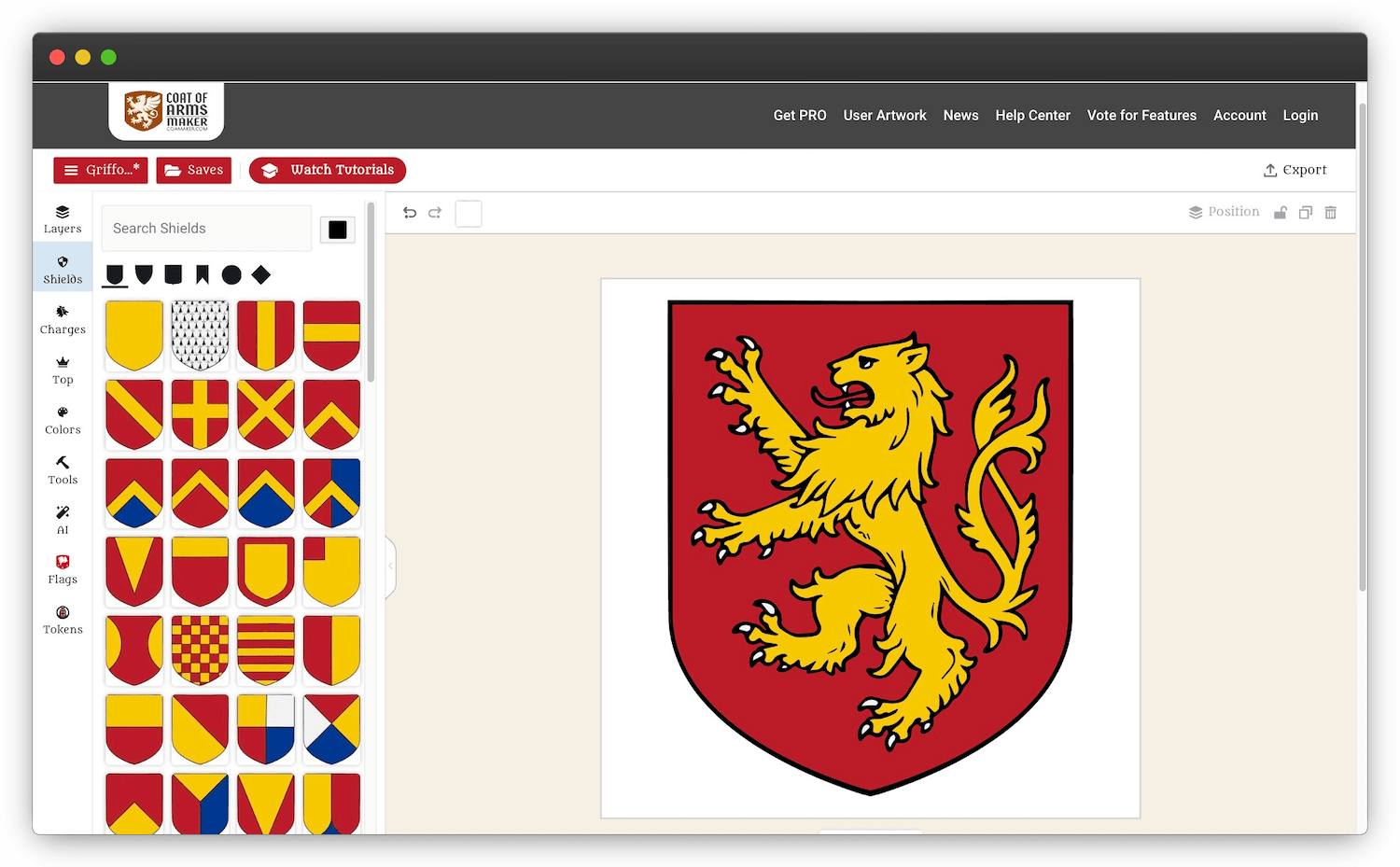
Click-to-build editors are faster to pick up. CoaMaker offers more than 1,000 symbols, and the Fantasy Name Generators coat of arms tool lets you combine 60 shields, 130 crests, and 38 color schemes. Those are generous libraries. Still, every charge in them is pre-drawn. If your setting's ruling dynasty claims descent from a three-eyed heron, you will be choosing the closest substitute.
Rerolls Without Reasons
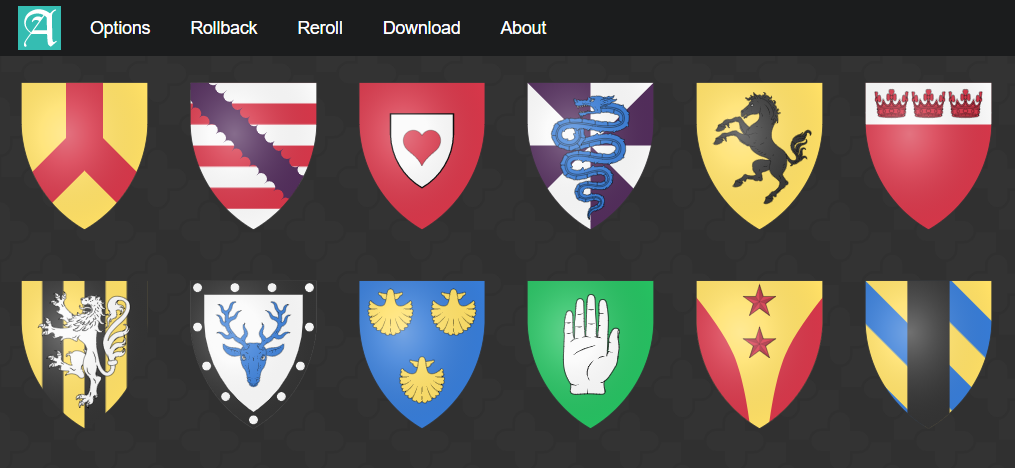
Procedural generators such as Armoria are excellent for quick inspiration, and they export finished shields as SVG or PNG. The trade-off is that a reroll doesn't know your Serpent Lords are disgraced former priests, or that the House of the Open Hand swore an oath of peace. You still have to supply the meaning yourself.
This is exactly the gap that describing your heraldry, rather than assembling it, is designed to close.
Why Logo Generator for Fantasy Heraldry
Logo Generator is an expert emblem designer with intelligent style matching, which makes it a natural fit for heraldic work. A coat of arms is the original logo: a compact visual identity designed to be recognized at a distance. You bring the lore, and the AI handles composition, symbolism, and style.
Analysis of the common heraldry workflows shows the core shift. Traditional tools ask you to translate your idea into their vocabulary. This one starts from your vocabulary.
| Traditional Approach | Logo Generator |
|---|---|
| Learn blazon terms like "gules, a lion rampant Or" | Describe it as "a gold lion rearing up on a red shield" |
| Pick the closest pre-drawn charge | Request any creature or object your world contains |
| Reroll until something looks right | Explain the house's story and get symbolism that fits it |
| Rebuild each house from scratch | Create a cohesive set across rival houses and factions |
| Fixed art style per tool | Match the style to your setting, from medieval woodcut to modern game UI |
Describe Lore, Get Emblems
Start with narrative instead of geometry. Tell the AI that House Varrow rose from salt-marsh smugglers to royal admirals, and it can propose charges like crossed oars, an eel, or a ship's lantern. It can also arrange those elements on a field that reflects the family's rise.
"Design a coat of arms for House Varrow, a family of former smugglers who became the king's admirals. Keep a hint of their criminal past."
Style Matching for Your Setting
A grimdark setting and a cozy fantasy setting shouldn't share the same visual language. You can ask for engraved linework for a historical-feeling novel, bold flat shapes for a video game HUD, or painted illumination for a campaign handout.
"Render the same crest in three styles: illuminated manuscript, black-and-white woodcut, and a flat icon that reads clearly at 64 pixels."
Heraldic Conventions on Request
The heart of classic heraldry is legibility. The SCA heraldry primer explains the rule of tincture: metals (gold and silver) go on colors (red, blue, green, purple, black), and colors go on metals, because "the purpose of heraldry is identifiability." You can ask Logo Generator to follow this rule, deliberately break it for a rogue faction, or explain why a design reads poorly.
Consistency Across a Whole Realm
Building a kingdom means designing a family of emblems, not a single shield. Persistent memory lets the AI keep your established palette, motifs, and house relationships across sessions. When you add a cadet branch three weeks later, it can keep the visual connection to the main line.
Related Agents You'll Also Find Useful
Heraldry rarely exists in isolation. It sits inside a larger worldbuilding workflow. These agents cover the steps around it.
Creative Fiction Writer
If you're also writing the histories behind your houses, this storytelling partner helps develop the lore your heraldry represents, from founding myths to dynastic feuds.
- Deep research for authentic, internally consistent worlds
- Editorial insight on pacing, voice, and character
- Polished prose from first draft to final manuscript
Name Generator
Every coat of arms needs a house name, and often a motto to go with it. This naming consultant draws on linguistic and cultural fluency to craft names that sound like they belong to your world.
- Character, place, and faction names with cultural depth
- Strategic thinking about tone and memorability
- Variations that fit an existing naming convention
Trading Card Game Creator
For game designers, faction heraldry often becomes card frames, set symbols, and lore text. This TCG studio picks up where emblem design leaves off.
- Mechanics, lore, and card art in one workflow
- Balance testing from first concept to playable set
- Faction identity carried consistently across a full card set
Try Logo Generator free, with no credit card required.
How to Generate Fantasy Heraldry With AI
Step 1: Define the House Before the Shield Write two or three sentences about who the faction is: its origin, values, region, and enemies. Good heraldry comes from good lore, and the AI needs this context to choose meaningful symbols.
"House Calder holds a mountain pass. They're stubborn, honorable, and poor. Their enemies call them 'the goats.' They've adopted the insult with pride."
Step 2: Request Initial Concepts Open Logo Generator and ask for several directions at once. Comparing options side by side is faster than refining a single idea too early.
"Give me three coat of arms concepts for House Calder: one traditional, one minimalist, one that leans into the goat insult."
Step 3: Refine Tinctures and Charges Pick a favorite and adjust the details: swap colors, add a border (a bordure), or divide the field. Use plain language. Blazon terms are optional, and the AI handles them either way.
"Keep concept two, but use silver on deep blue, and put the goat's horns over a split mountain peak."
Step 4: Match the Style to Your Output Tell the AI where the heraldry will appear. A banner for a campaign map, a chapter header in a novel, and a faction icon in a game each need different levels of detail and contrast.
"Make a simplified version that stays readable as a small token on a hex map."
Step 5: Expand Into a Full Heraldic System Once one house is finished, build its allies and rivals so they share a recognizable visual logic. That includes regional palettes, vassal houses that echo their liege, and enemies that invert key motifs.
"Now design the arms for House Calder's two vassal families, keeping the mountain motif but changing the colors."
Results & Use Cases
🎲 Dungeon Master Building Rival Houses
Scenario: A DM is preparing a political intrigue campaign with five noble houses competing for a vacant throne.
Traditional Approach: Hours of clicking through preset editors, then hand-sketching the charges the library didn't have, and still ending up with shields that look unrelated.
Logo Generator: The DM describes each house's ambitions and secrets, then receives a matching set of five coats of arms in one session.
- Player handouts look polished and consistent
- Hidden symbolism gives sharp-eyed players clues
- Simplified versions work as map and initiative tokens
📖 Novelist Designing Sigils for an Epic Fantasy Series
Scenario: An author drafting a multi-book saga needs house sigils that stay consistent from the manuscript through cover concepts and the book's map.
Traditional Approach: Commissioning illustrators early, before the world is settled, or relying on placeholder art that never matches the prose.
Logo Generator: The author develops each sigil alongside the story. They pair it with Creative Fiction Writer so the emblem described on page 40 matches the visual exactly.
- Text and image tell the same story
- Designs evolve as the lore evolves, with memory preserving earlier decisions
- Concept art is ready to brief a professional illustrator later
📱 Mid-Session Faction Design on Mobile
Scenario: Players unexpectedly found a mercenary company during a game, and the group wants a banner right away.
Traditional Approach: Promising to "make something later," which often never happens.
Logo Generator: The DM opens the AI emblem designer on their phone at the table, voice-dictates the company's name and backstory, and shows the group a banner before the session ends.
- Full feature parity across web, iOS, and Android
- Speech-to-text input means no typing at the table
- The design syncs to desktop for later refinement
🛡️ Indie Game Developer Creating Faction Icons
Scenario: A solo developer needs six faction emblems that read clearly in a strategy game's UI at small sizes.
Traditional Approach: Exporting shields from a heraldry editor and then manually redrawing each one for screen legibility.
Logo Generator: The developer requests flat, high-contrast versions built for screen use from the start. They apply the rule of tincture to keep every icon distinguishable.
- Clear shapes that hold up at icon scale
- A cohesive set that signals which factions are allied
- Fast iteration when playtesters confuse two factions
Frequently Asked Questions
Is there a free fantasy heraldry generator?
Yes. Several free tools exist. DrawShield renders shields from written blazon, Armoria generates random fantasy arms with SVG and PNG export, and CoaMaker offers a layer-based editor. For AI-driven design from plain-language descriptions, Logo Generator is available on Jenova's free tier with limited usage. The Plus plan at $20/month increases usage 30× and removes watermarks.
What is the rule of tincture in heraldry?
The rule of tincture states that a metal should not be placed on a metal, or a color on a color. According to the SCA heraldry primer, the metals are gold (Or) and silver (Argent), and the colors include red (Gules), blue (Azure), green (Vert), purple (Purpure), and black (Sable). Heraldry also uses furs, for a total of nine tinctures in common use. The rule exists so emblems stay recognizable at a distance.
What is the difference between a sigil and a coat of arms?
A coat of arms traditionally refers to the full heraldic design centered on a shield, often with additions like a crest, helm, supporters, and motto. "Sigil" is a looser term popular in fantasy fiction for a house's main emblem, such as a single animal on a field. A fantasy heraldry generator can produce both: a simple sigil for banners and tokens, and a full achievement for formal documents.
Can I use an AI heraldry generator to create arms for my real family?
You can design one for personal or creative enjoyment, but it carries no official standing. DrawShield notes that the use of heraldic devices is restricted in many countries, and that granting a coat of arms is solely the right of the relevant heraldic authority. For fictional houses, campaigns, and games, these restrictions don't apply in the same way.
Does Logo Generator work on mobile?
Yes. The AI works with full feature parity on web, iOS, and Android, with settings and conversation history synced across devices. Speech-to-text lets you describe a house's heraldry out loud, which is useful at a gaming table. Designs you start on your phone can be refined on desktop later, and persistent memory keeps your established palette and motifs available.
Can AI help name my noble houses and write their mottos?
Yes. Heraldry and naming work best together. Name Generator creates house names, place names, and character names with cultural and linguistic consistency, so a dynasty's name sounds like it comes from the same world as its banner. Once you have the name, bring it back into your heraldry design to inspire canting arms, where the shield puns on the family name.
Conclusion
Fantasy heraldry used to force a choice. You could learn blazon well enough to get precise results, or accept generic shields from preset menus and random rerolls. An AI fantasy heraldry generator removes that trade-off. You describe your houses in your own words, and you get coats of arms, sigils, and faction emblems that carry the meaning of your lore.
Whether you're running a campaign, writing a series, or shipping a strategy game, the workflow is the same: define the house, generate concepts, refine the tinctures, and build out the realm. Your world's heraldry should be as original as the world itself.
Start designing your first house with Logo Generator. Explore more at Jenova.
For Developers: Logo Generator is available programmatically via the Jenova API, so you can integrate AI emblem and heraldry design into your worldbuilding app or game tools with a single API call. Full documentation →