AI Fantasy Food Generator: Invent Dishes & Cuisines for Your World
2026-10-24
Creative Fiction Writer works as an AI fantasy food generator. It invents dishes, drinks, and full cuisines based on your world's climate, history, and social order. Most random generators produce a name like "Glimmerberry Tart" with nothing behind it. This AI explains the reasoning instead: why a culture eats what it eats, who gets the best cut of the roast, and what is never served at the table. As of October 2026, writers, game masters, and designers are using AI to build fictional cuisines that make a setting feel lived-in.
- ✅ Generates dishes tied to your world's geography, crops, livestock, and magic system
- ✅ Writes sensory, in-scene food descriptions in your story's voice and tone
- ✅ Builds full cuisines, from peasant staples and street food to feast dishes, drinks, and taboos
- ✅ Keeps your food lore consistent across chapters, campaigns, and sequels
Food often separates a convincing fantasy world from a painted backdrop. A stew can reveal a trade route, a wine can mark a social class, and a forbidden fruit can start a war. To see why a dedicated generator matters, start with how much a single meal communicates and why getting it right is harder than it looks.
Quick Answer: What Is an AI Fantasy Food Generator?
An AI fantasy food generator is a creative writing tool that invents fictional dishes, drinks, and cuisines, including names, ingredients, flavors, and cultural meaning, so writers, game masters, and designers can build believable worlds faster. The best tools generate food that follows the internal logic of your setting rather than producing random names.
Key capabilities:
- Inventing staple foods based on a region's climate, terrain, and available crops
- Designing feast menus, street food, travel rations, and ritual dishes
- Writing sensory descriptions (taste, smell, texture, presentation) ready for prose or read-aloud text
- Connecting food to class, religion, trade, and magic so every dish carries story weight
Why Fantasy Food Is Harder to Write Than It Looks
Anthropologists have long treated food as a core expression of identity. The term cuisine refers to specific cultural traditions of cooking, preparing, and consuming food. Anthropologist Sidney Mintz described how foods shaped by habitat and history became a vivid marker of difference, serving as symbols of belonging and of exclusion. Fantasy readers notice this too. As one analysis of fantasy worldbuilding puts it, food and drink are demonstrations of the world's culture, history, and environment, not just sustenance for characters.
But building a convincing fictional cuisine is frustratingly difficult:
- Random name generators lack logic. They produce evocative words without explaining why a dish exists or who eats it.
- Real-world borrowing gets lazy fast. Without care, every tavern serves the same "hearty stew and crusty bread," a cliché that flattens distinct cultures.
- Consistency breaks down at scale. A coastal city that eats dolphin steak in chapter three shouldn't import it inland at peasant prices in chapter twenty.
- Food has to carry story weight. Writers need dishes that reveal class tension, trade, faith, or magic. Decorative menus don't do that.
The worldbuilding community discusses this problem constantly. Guides like Mythic Scribes' foodbuilding primer argue that what people eat reflects the society they've built. Writers regularly ask for help with the process itself:
Creators have also moved toward AI for exactly this kind of early-stage ideation:
The same research found that creators prefer a human-in-the-loop experience, where AI speeds up ideas and the creator keeps creative control. That matches how good fantasy food generation works: the AI proposes and reasons, and you decide what belongs in your world.
A dedicated AI fiction partner is built to fill this gap.
Why Creative Fiction Writer Works as a Fantasy Food Generator
Creative Fiction Writer treats food as worldbuilding, not decoration. You describe your setting's climate, peoples, economy, and magic. It then generates dishes that follow from those facts, explains the reasoning behind each one, and writes them into scenes with real sensory texture. The result reads like a cuisine that developed over centuries rather than a list of invented words.
| Traditional Approach | Creative Fiction Writer |
|---|---|
| Random name generators with no context | Dishes derived from your world's climate, crops, and history |
| Hours researching real food history for inspiration | Instant synthesis of historical foodways adapted to your setting |
| Generic "stew and bread" tavern scenes | Distinct regional cuisines with staples, street food, and feast dishes |
| Food lore scattered across notes and drafts | Consistent food rules you can reference throughout the project |
| Lists of dishes with no narrative function | Food tied to class, ritual, conflict, and character |
🌾 Food That Follows Your World's Logic
Convincing fantasy cuisines start with environment. Brandon Sanderson's Roshar centers on Lavis grain, a hardy staple suited to a storm-ravaged world, used for everything from flatbread to beer. The AI applies the same principle to your world. It asks what grows there, what can be preserved, what animals survive the terrain, and what trade brings in from elsewhere.
"My world has a volcanic archipelago with black-sand beaches and mineral hot springs. Generate a staple grain or root, three everyday dishes, and one festival food that only appears after eruptions."
👑 Culture, Class, and Conflict at the Table
Food is one of the fastest ways to show inequality. In Mistborn, the meals of nobles and skaa highlight the social divide. In Westeros, fine vintages like Arbor Gold signal power, and poisoned wine becomes a tool of political intrigue. The AI can design parallel food systems for rulers and laborers, invent prestige ingredients, and suggest how a meal might become a plot device.
"Design the food culture of a merchant republic where spice is currency. What do the guild masters eat at their annual feast, what do dockworkers eat, and what dish would be a deadly insult to serve a rival?"
✨ Magic That Plays by the Rules
If magic touches food, it should obey your magic system. Sanderson's Soulcast food solves scarcity but lacks the taste of naturally grown ingredients. That tradeoff carries a theme. The AI helps you build similar consequences, such as enchanted preserves that spoil emotionally, or alchemical brews with real costs.
📜 What a Well-Built Cuisine Looks Like
The illustration below, a Matuzan cuisine reference sheet by DeviantArt artist the-greys, shows what strong food worldbuilding implies without stating it directly. Palm wine suggests a tropical climate. Dolphin steak points to a coastal or seafaring culture. Sugared locusts hint at insect harvests and perhaps arid seasons. Setsiki brain soup signals a local creature and a cuisine comfortable with offal. When you ask the AI to generate a cuisine, it reasons in these same layers, so you can reverse-engineer a culture from its menu.
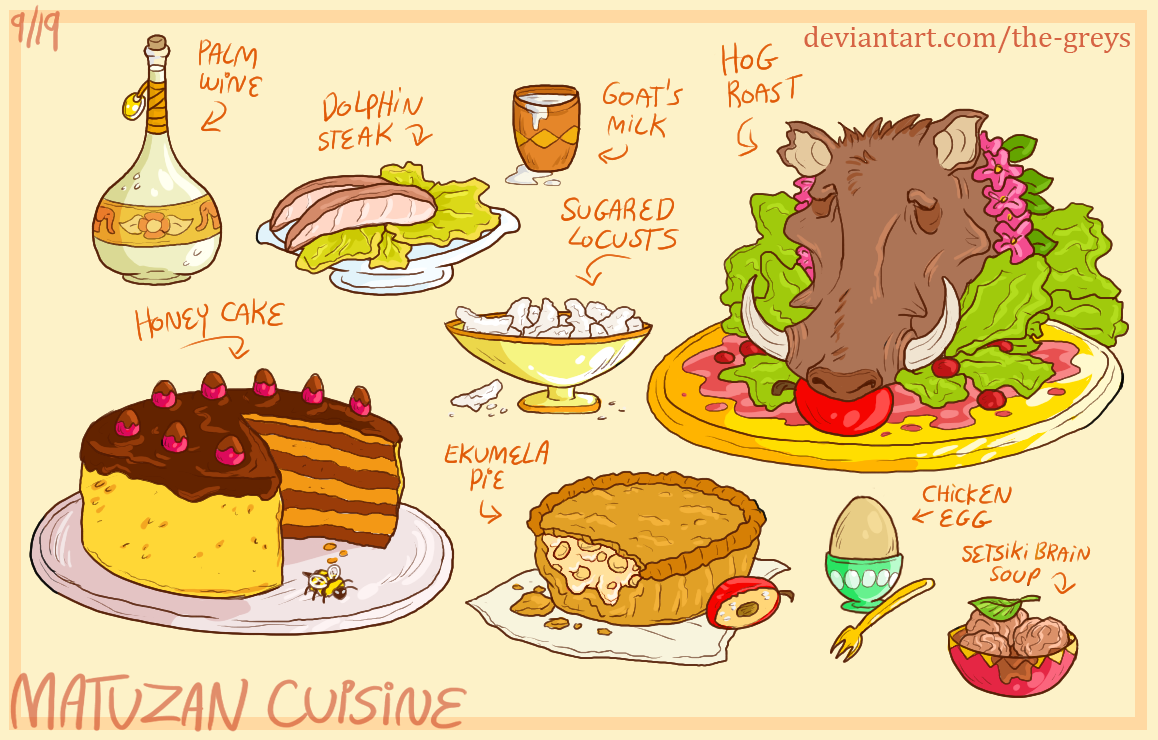
"Here's a list of dishes from my fictional culture: palm wine, dolphin steak, sugared locusts, and brain soup. What does this menu imply about their geography, religion, and economy? Suggest five more dishes that fit."
Related Agents You'll Also Find Useful
Fantasy food rarely lives in a vacuum. If your project extends into games, naming, or real-world cooking, these agents fit naturally into the same workflow.
Game Designer Assistant If you're building a video game or tabletop RPG, Game Designer Assistant can turn your fictional cuisine into mechanics and visuals. It is useful for crafting systems, buff foods, and concept art for item sheets.
- Brainstorming and systems analysis for cooking, crafting, and survival mechanics
- Game design documentation for food items and recipes
- Concept art support for visual food reference sheets
Name Generator Dish names are hard to get right. They need to sound like they came from your invented language and culture. This naming consultant brings linguistic and cultural fluency to character, place, and item names.
- Names that match a culture's phonetic style
- Options for dishes, taverns, ingredients, and characters
- Strategic reasoning behind each name choice
Master Chef Coach If you're hosting a themed campaign night or writing a companion cookbook, Master Chef Coach helps translate fantasy dishes into real recipes. It brings technique-first guidance across global cooking traditions.
- Adapting fictional dishes into cookable recipes
- Technique guidance across all cooking traditions
- Real-time help while you cook
Try Creative Fiction Writer free, no credit card required.
How to Use an AI Fantasy Food Generator: Step by Step
Step 1: Describe Your World's Environment
Start with the facts that shape food: climate, terrain, water sources, and what grows or grazes there. The more specific you are, the more grounded the cuisine. Open Creative Fiction Writer and set the scene.
"My setting is a cold steppe crossed by nomadic horse clans, with a walled river city at its southern edge. Short summers, long winters, and salt trade with the coast."
Step 2: Generate Staples, Street Food, and Feast Dishes
Ask for a tiered cuisine: what ordinary people eat daily, what's sold in markets, and what appears at celebrations. This tiering creates the texture real food cultures have.
"Create three daily staples for the horse clans, three street foods sold in the river city, and one feast dish served when clans and city sign a treaty."
Step 3: Layer in Ritual, Class, and Taboo
Ask what's sacred, what's forbidden, and who gets what. These rules generate conflict and character moments for free.
"What food is taboo for the horse clans, and why? What would happen if a city diplomat unknowingly served it at the treaty feast?"
Step 4: Write the Food Into a Scene
Turn the lore into prose. Ask for a scene with specific sensory detail in your story's point of view and voice, so the food reveals character instead of interrupting the plot.
"Write a 300-word scene where my protagonist, a clan scout, eats city food for the first time. Show her discomfort through taste and smell, in close third person."
Step 5: Stress-Test for Consistency
Ask the AI to check your food lore against the rest of your world: trade routes, seasons, and economics. This catches contradictions before readers or players do.
"Review the cuisine we built. Are there any ingredients that wouldn't realistically be available in winter or this far inland?"
Results & Use Cases
📖 Novelist Building a Desert Empire
Scenario: A fantasy author needs distinct cuisines for three provinces of a desert empire before drafting book one.
Traditional Approach: Days of reading food history, sketching notes, and second-guessing whether dishes feel derivative.
With the AI fiction partner: In one session, the author gets regional staples based on oasis agriculture, caravan trade foods, and a palace cuisine built on imported luxuries, along with the reasoning behind each.
- Each province feels culturally distinct
- Food differences reinforce existing political tensions
- Sensory notes are ready to use in scenes
📱 Game Master Improvising on Mobile
Scenario: Mid-session, players walk into an unplanned tavern and ask what's on the menu.
Traditional Approach: Freeze, improvise "stew and ale," and lose immersion.
With an AI fantasy food generator on your phone: The GM types a quick prompt and reads out a five-item menu with prices, a house specialty, and a rumor tied to one dish, all within a minute.
- Keeps the session moving
- Adds a hook the party can follow
- Works from the same phone the GM already has at the table
🎮 Indie Developer Designing Buff Foods
Scenario: A solo developer is building a cozy survival game with a cooking system.
Traditional Approach: Placeholder items like "Health Potion" that feel generic and disconnected from the world.
With Creative Fiction Writer plus Game Designer Assistant: The developer generates a regional cuisine with lore, then uses the game design agent to map dishes to buffs, crafting trees, and item descriptions.
- Food lore and mechanics stay aligned
- Item descriptions carry world flavor
- Faster documentation for the cooking system
🍳 Fan Feast for a Campaign Finale
Scenario: A tabletop group wants to cook dishes from their homebrew world for the final session.
Traditional Approach: Guess at real-world equivalents and hope they taste right.
With Master Chef Coach: The group translates three invented dishes into cookable recipes using real techniques and accessible ingredients.
- A memorable real-world payoff for the campaign
- Recipes that stay faithful to the fictional lore
- Technique help for less experienced cooks
Frequently Asked Questions
Is the AI fantasy food generator free to use?
Yes. You can start with Creative Fiction Writer on Jenova's free tier, which includes all core features with limited usage. Writers and game masters who generate food lore often can upgrade to Plus at $20 per month for 30× more usage and custom model selection. Higher tiers are available for heavy users. Usage resets monthly on your billing date, with no daily caps.
How is this different from a random fantasy food name generator?
Random generators combine words without context, so you get a name but no reason for the dish to exist. An AI fantasy food generator like Creative Fiction Writer builds dishes from your world's climate, crops, trade, and culture. It explains the reasoning, writes sensory descriptions, and keeps the cuisine consistent with your setting's rules.
Can AI create fantasy recipes I can actually cook?
Yes, with the right approach. Generate the fictional dish and its lore first, then adapt it using Master Chef Coach, which translates invented ingredients into real substitutes and provides cooking technique guidance. This works well for themed game nights, fan events, or a companion cookbook for your novel or campaign.
Does the fantasy food generator work on mobile?
Yes. The agent works on web, iOS, and Android with full feature parity, and your settings sync across devices. That makes it practical for game masters improvising menus at the table, or writers capturing worldbuilding ideas away from their desks. Speech-to-text also lets you describe your world by voice.
Will AI-generated fantasy food feel original?
Originality comes from specificity. The more detail you give about your world's environment, history, and conflicts, the more distinctive the output. The AI works best as a collaborator: it proposes options and reasoning, and you choose, combine, and refine. That human-in-the-loop approach is how most creators already prefer to use AI.
Conclusion
Fantasy food is one of the most underused tools in worldbuilding. A single dish can reveal geography, trade, class, faith, and magic, but only if it follows the logic of your world. Random name lists can't provide that. A dedicated AI fantasy food generator can turn your setting's facts into cuisines that feel centuries old, then write them into scenes that pull readers and players deeper into your world.
Whether you're drafting a novel, running a campaign, or designing a game's cooking system, this AI fantasy recipe generator gives you depth quickly while keeping creative control in your hands. Try Creative Fiction Writer now and start building your world's first feast. Explore more at Jenova.
For Developers: Creative Fiction Writer is available programmatically via the Jenova API. You can add worldbuilding and fantasy food generation to your writing app, game tool, or TTRPG platform with a single API call. Full documentation →