AI Fantasy Comic Generator: Create Epic Visual Worlds Without Drawing Skills
2026-02-23
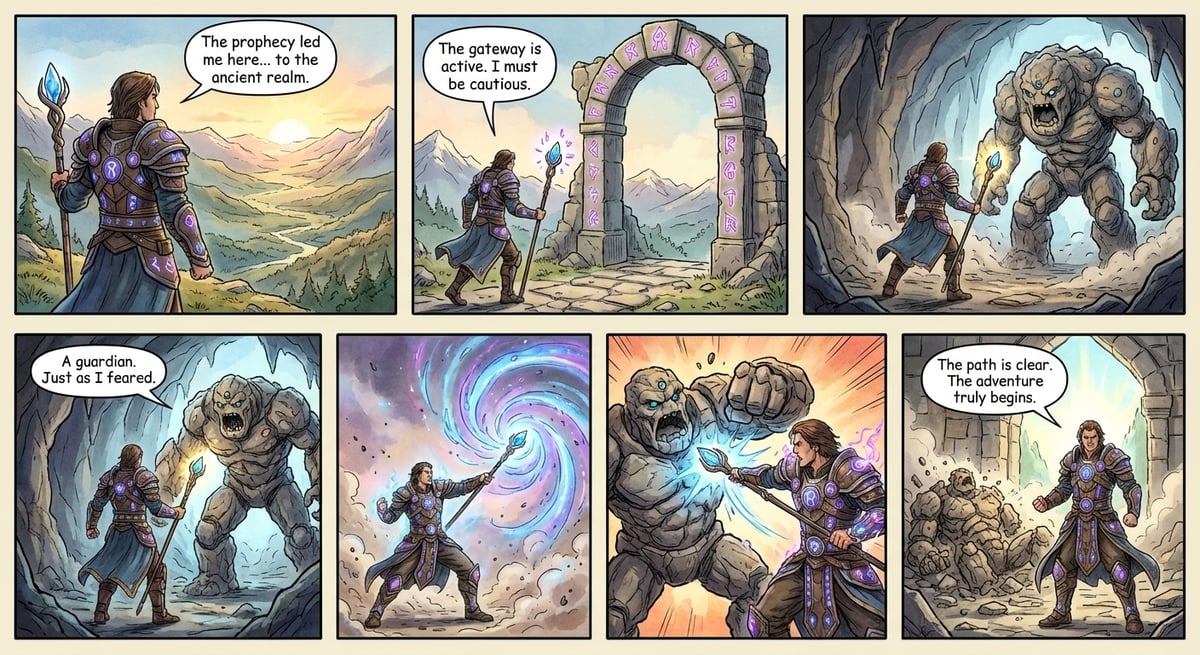
The global comic book market reached USD 17.69 billion in 2025 and is projected to hit USD 27.01 billion by 2034, with fantasy remaining one of the most popular genres driving this growth. An AI fantasy comic generator transforms how creators bring dragons, magic systems, and epic quests to life—solving the persistent challenges of maintaining consistent characters across sprawling narratives and rendering the intricate visual details that fantasy demands.
Why AI fantasy comic generators matter now:
- ✅ Character consistency across epic sagas through reference sheet systems and identity embedding
- ✅ Bold visual style templates (Superhero, Noir, Indie, Franco-Belgian, Sci-Fi/Fantasy)
- ✅ Complex world-building support with persistent story state tracking
- ✅ Access to frontier AI models including GPT-5.2, Claude Opus 4.5, Gemini 3 Pro, and Grok 4.1
According to Fortune Business Insights, fantasy comics are among the most popular genres globally, with Asia Pacific commanding 53.25% market share in 2025—driven largely by fantasy-heavy manga and anime culture.
Quick Answer: What Is an AI Fantasy Comic Generator?
An AI fantasy comic generator is a specialized AI tool that creates professional fantasy comic artwork—from character designs and magical environments to dynamic action sequences and panel layouts—through guided, story-driven workflows that understand the unique visual language of fantasy storytelling.
Unlike generic image generators, AI fantasy comic generators understand:
- Character reference systems that lock appearances across hundreds of panels
- Fantasy-specific style templates matching epic, dark, or whimsical aesthetics
- Complex scene composition for battles, magic effects, and fantastical creatures
- World-building continuity tracking locations, artifacts, and visual motifs
- Narrative memory for maintaining plot threads across long-form serialized projects
The Comic Creator specializes in Western comic aesthetics, supporting complete fantasy sagas from single issues to 200+ page graphic novel epics.
The Problem: Why Fantasy Comics Remain Challenging to Create
Despite fantasy's enduring popularity, aspiring creators face significant barriers—and the genre's visual demands make these obstacles even more pronounced.
💰 The Prohibitive Cost Barrier
Fantasy illustration commands premium rates due to its complexity:
Professional comic illustration costs $50-$300 per page depending on complexity—and fantasy's detailed environments, creature designs, and magical effects push toward the higher end. — Comics Beat Industry Analysis
For a 100-page fantasy graphic novel, illustration costs alone can reach $10,000-$30,000—prohibitive for creators testing story concepts or building audiences.
🐉 The Fantasy-Specific Visual Challenge
Fantasy comics demand more than standard illustration skills:
Creature Design:
- Dragons, demons, and mythical beasts requiring consistent anatomy
- Magical creatures that must remain recognizable across scenes
- Hybrid beings blending multiple reference points
Environment Complexity:
- Castles, dungeons, and otherworldly landscapes
- Consistent architecture across multiple scenes
- Magical effects integrated into backgrounds
Equipment and Artifacts:
- Detailed armor, weapons, and magical items
- Consistent designs for signature artifacts
- Visual storytelling through object design
🎭 The Character Consistency Nightmare
According to MindStudio's analysis of AI comic generation:
"Character consistency is everything in sequential art. When you see a character in panel one, you need to recognize them immediately in panel two, even if they've changed pose, expression, or environment."
Fantasy amplifies this challenge with:
- Characters in elaborate costumes and armor
- Transformations and power-ups that alter appearance
- Large ensemble casts with distinctive visual identities
- Non-human characters requiring consistent proportions
⏱️ The Multi-Skill Burden
Creating fantasy comics requires simultaneous mastery across multiple disciplines. According to Technavio's market analysis, user surveys indicate that over 60% of professionals still require extensive manual edits when using AI tools due to character consistency issues—a problem magnified in fantasy's visually complex narratives.
The Jenova Solution: AI-Powered Fantasy Comic Creation
| Traditional Approach | AI Fantasy Comic Generator |
|---|---|
| $50-$300 per page for professional art | Unlimited page generation with subscription |
| Years of artistic training required | Story-first workflow—no drawing skills needed |
| Weeks per chapter | Pages generated in minutes |
| Manual consistency tracking | Automatic reference system |
| Limited style flexibility | Multiple distinct fantasy art styles |
| Solo creator burnout | AI handles visual execution while you direct |
🏰 Professional Methodology, AI Execution
The Comic Creator implements the same structured approach used by professional fantasy comic studios:
Reference Image System: Every project begins with establishing visual anchors. The AI generates style exemplars and character reference sheets before any story panels, ensuring consistency from the first frame to the last.
Identity Embedding: Modern AI models create mathematical "fingerprints" of characters from reference images. According to MindStudio, this fingerprint captures facial structure, body proportions, distinctive features, and clothing details—ensuring your fantasy hero remains recognizable across every panel.
Persistent Story State: A tracking system maintains your position in the narrative, active plot threads, character states, and continuity notes. This prevents the drift and inconsistency that plagues long-form AI-assisted fantasy projects.
Quality Gates: Each generated page undergoes automatic review against criteria including character consistency, narrative coherence, panel clarity, and style adherence.
🎨 Fantasy-Ready Art Style Templates
Choose from templates suited to fantasy storytelling:
| Template | Best For | Visual Signature |
|---|---|---|
| Sci-Fi/Fantasy | Epic fantasy, space opera | Detailed environments, imaginative design, scale |
| Superhero Action | Heroic fantasy, power fantasy | Bold linework, dynamic poses, dramatic lighting |
| Horror/Dark | Dark fantasy, grimdark | Heavy shadows, atmospheric tension, cinematic framing |
| Indie/Alternative | Literary fantasy, character-driven | Expressive lines, emotional depth, varied compositions |
| Noir/Crime | Urban fantasy, mystery | High contrast, moody atmosphere, urban settings |
Specialized AI Agents for Fantasy Comic Workflows
Comic Creator — Your Personal Comic Book Artist
The dedicated Western comic creation agent supporting complete fantasy storytelling workflows:
- Bold Visual Style Templates: Superhero, Noir, Indie, Franco-Belgian, Sci-Fi/Fantasy, Cartoon, Realistic
- Character Reference Sheets: Lock in designs for visual consistency across entire projects
- Dynamic Panel Layouts: Authentic Western comic reading rhythm and pacing
- Persistent Story State: Tracks continuity, character states, and narrative progression
- Long-Form Production: From single issues to 200+ page graphic novel sagas
Creative Fiction Writer — Story Development Partner
Before visual production, develop your fantasy narrative foundation:
- Deep research integration for authentic world-building
- Magic system development and consistency
- Character arc development and dialogue refinement
- Plot structure and pacing guidance for epic narratives
Manga Creator — Japanese Fantasy Aesthetics
For creators working in manga-influenced fantasy styles:
- Five professional styles: Shonen, Shoujo, Seinen, Slice-of-Life, Chibi
- Panel flow optimization for proper manga reading rhythm
- Plot memory engine for long-form serialized production
- Isekai and fantasy-specific visual conventions
Webtoon Creator — Mobile-First Fantasy Storytelling
Optimized for vertical scroll fantasy content:
- Vertical scroll rhythm and strategic pacing
- Episode hooks and "thumb stop" moments
- Full-color consistency across 100+ episodes
- Platform-ready exports for LINE Webtoon, Tapas, and Lezhin
According to Research and Markets, the webcomics market is valued at USD 9.45 billion in 2025 and projected to reach USD 12.1 billion by 2029—with fantasy among the most popular genres.
How It Works: From Fantasy Concept to Finished Pages
Step 1: Define Your Fantasy World and Characters
Begin by outlining your narrative concept, character profiles, magic system, and visual style preferences. The more detail you provide, the more consistent your results.
"I'm creating an epic fantasy comic called 'The Shattered Crown' about a disgraced knight seeking redemption in a world where magic is dying. The protagonist Kira is 28, has silver-streaked black hair from a magical curse, wears battered plate armor with a distinctive wolf sigil, and carries a broken longsword that glows faintly blue. Her personality is haunted but determined. She has a scar across her left cheek from the battle that cost her honor."
Key elements to include for fantasy characters:
- Physical attributes (body type, facial features, distinctive marks)
- Armor, clothing, and equipment with specific details
- Magical characteristics (glowing eyes, unusual coloring, transformations)
- Personality traits that inform expression and posture
- 2-3 "always" items (signature weapon, amulet, companion creature)
- 2 "never" rules (example: "never remove the wolf sigil; scar always visible")
The Creative Fiction Writer can help expand this into full character profiles, world-building documents, and scene breakdowns.
Step 2: Select Your Fantasy Art Style
Choose from professional art style templates matched to your fantasy subgenre:
| Fantasy Subgenre | Recommended Template | Visual Approach |
|---|---|---|
| Epic/High Fantasy | Sci-Fi/Fantasy | Grand scale, detailed environments, heroic compositions |
| Dark Fantasy/Grimdark | Horror/Dark | Heavy shadows, muted colors, atmospheric tension |
| Heroic Fantasy | Superhero Action | Dynamic poses, dramatic lighting, bold linework |
| Literary Fantasy | Indie/Alternative | Emotional depth, expressive characters, varied compositions |
| Urban Fantasy | Noir/Crime | High contrast, modern settings with magical elements |
Step 3: Generate Reference Materials
Before creating story pages, the AI generates essential reference materials:
- Style Exemplar — One page establishing your visual language
- Character Reference Sheets — All significant characters in neutral poses with labels showing front, side, and three-quarter views
- Creature References — Dragons, familiars, or other fantasy beings
- Location References — Recurring important locations (castle throne room, enchanted forest, etc.)
- Equipment References — Signature weapons, armor, and magical artifacts
These references anchor every subsequent generation, preventing the character inconsistency that typically plagues AI fantasy art projects.
Step 4: Page-by-Page Creation
For each page, the Comic Creator:
- Scripts the page based on your story direction
- Breaks content into panel-by-panel beats (typically 5-9 panels for Western comics)
- Writes dialogue matching each character's established voice
- Selects appropriate panel layout based on narrative rhythm
- Generates the page with all relevant references loaded
- Reviews output against quality criteria before presenting
Step 5: Iteration and Refinement
Request adjustments to any page. The Comic Creator maintains awareness of your project state, ensuring changes propagate correctly through subsequent pages. Character evolutions (new scars, power-ups, costume changes, aging) are tracked with versioned reference sheets.
Results & Use Cases
📚 Fantasy One-Shot Projects
Scenario: Creating a 30-page standalone fantasy story
Traditional Approach: 3-6 months of work or $3,000-$9,000 in illustration costs
With AI fantasy comic generator:
- Complete setup and reference generation in one session
- Page generation with consistent style throughout
- Professional panel layouts and dialogue integration
- Ability to iterate and refine without additional costs
💼 Serialized Fantasy Epics
Scenario: Developing a 200+ page ongoing fantasy series
Traditional Approach: Requires dedicated artists, extensive style guides, and months of production per volume
With the Comic Creator:
- Persistent Story State tracking across sessions
- Character reference versioning for visual evolution
- Landmark page tagging for narrative callbacks
- Automatic continuity maintenance across chapters
📱 Webtoon Fantasy Series
Scenario: Creating vertical-scroll fantasy content for digital platforms
According to Fortune Business Insights, the global webcomics market is projected to reach $14.73 billion by 2034 at a 6.72% CAGR—with fantasy consistently among the top-performing genres.
With the Webtoon Creator:
- Flexible panel layouts for vertical scroll formats
- Style templates adaptable to webtoon aesthetics
- Rapid iteration for platform-specific optimization
- Episode-based narrative structures with built-in hooks
🎯 Crowdfunding and Self-Publishing
Scenario: Launching a fantasy comic on Kickstarter or publishing on Amazon KDP
With AI fantasy comic generation:
- Generate campaign preview pages quickly
- Produce print-ready pages at proper resolution
- Maintain consistency across the entire project
- Iterate based on backer feedback
2026 Market Context: Why AI Fantasy Comic Generators Have Arrived
📈 A Booming Industry Hungry for Fantasy Content
The AI comic generator market has reached unprecedented scale:
The global AI comic generator market size was calculated at USD 33.00 billion in 2025 and is predicted to reach USD 271.06 billion by 2035, expanding at a CAGR of 23.44% from 2026 to 2035. — Precedence Research
Key market dynamics:
- North America dominated with 53.0% share in 2025, attributed to major AI research hubs
- Asia Pacific is the fastest-growing region driven by widespread internet access and high smartphone penetration
- Text-to-comic segment led with approximately 52.3% share in 2025
- Free/freemium models hold 62.0% share, democratizing access
🤖 The AI-Assisted Creation Revolution
According to ICv2's Comic Industry Forecasts for 2026:
"Niche genres continue to proliferate, fueling new content experiments... It's easy to see how the LitRPG model, which brings the game mechanics and leveling-up momentum of video and tabletop games into books, can expand into other subgenres beyond fantasy and sci-fi."
The industry is evolving from basic text-to-image tools toward integrated storytelling suites capable of managing script-to-panel layout, maintaining character consistency, and automating speech bubble placement.
🎨 Character Consistency Is Finally Solved
According to MindStudio's technical analysis, several innovations have converged to solve the character consistency challenge:
- Identity Embeddings: Modern AI models create mathematical "fingerprints" of characters from reference images, capturing facial structure, body proportions, distinctive features, and clothing details
- Multi-Image Context: Tools can now process multiple reference images simultaneously and understand they represent the same subject from different angles
- Structured Prompting: Detailed character descriptions using forensic-level specificity help AI models lock onto identity features
🏭 Industry Transformation
According to Precedence Research:
"Approximately 61% of digital artists now use AI tools, and 57% of comic publishers employ AI for time-intensive tasks such as background rendering and coloring. This adoption has enabled independent creators to compete with major studios, reducing production costs and timelines by over 70%."
Frequently Asked Questions
Is this AI fantasy comic generator free to use?
The Comic Creator is available through Jenova's platform with free access to core features and limited usage. For extended creation sessions and higher usage limits, paid plans start at $20/month. Visit the Subscribe option in the menu for current pricing details.
How does the AI maintain character consistency across panels?
The system uses a reference image architecture. Before generating story pages, you create character reference sheets showing each character in neutral poses and key expressions. These references are loaded with every subsequent panel generation, ensuring visual consistency across your entire project—even across 200+ pages. The AI creates mathematical "fingerprints" of characters that capture facial structure, body proportions, distinctive features, and equipment details.
What AI models power fantasy comic creation?
Jenova provides unified access to frontier AI models including GPT-5.2, Claude Opus 4.5, Gemini 3 Pro, and Grok 4.1—all available through a single platform with no vendor lock-in.
Can I create fantasy comics in different visual styles?
Yes. The Comic Creator supports multiple visual style templates including Sci-Fi/Fantasy, Superhero Action, Horror/Dark, Indie/Alternative, and Noir/Crime. You can also mix styles within a project for different sequences—such as shifting to a darker aesthetic for villain scenes or flashbacks.
Can I create non-human fantasy characters consistently?
Yes. The reference sheet system works for any character type—elves, orcs, dragons, or entirely original creatures. Provide detailed descriptions and reference images, and the AI maintains consistency across your project. Complex creatures may require additional reference angles.
Do I need any drawing skills to use an AI fantasy comic generator?
No drawing skills are required. These tools are designed for writers, storytellers, and creators who have compelling fantasy narratives but lack traditional artistic training. You direct the visual output through detailed text descriptions, reference images, and iterative refinement.
Transform Your Fantasy Worlds Into Professional Comics Today
The comic book industry's continued growth—projected to reach $27.01 billion by 2034 according to Fortune Business Insights—combined with the AI comic generator market's explosive 23.44% CAGR has created unprecedented opportunities for fantasy creators. What once required years of artistic training and significant financial investment is now accessible to anyone with a story to tell.
The Comic Creator brings professional fantasy comic production methodology to storytellers everywhere. No years of artistic training required. No thousands of dollars in illustration costs. Just your creativity, guided by an AI that understands the craft of visual storytelling.
For manga-influenced fantasy, the Manga Creator offers specialized Japanese visual storytelling. For mobile-first vertical formats, the Webtoon Creator handles platform-optimized fantasy content.
Whether you're crafting your first dragon encounter or maintaining an ensemble cast across a serialized epic, AI fantasy comic generators transform your concepts into consistent, professional comics—one panel at a time.
Your characters will stay consistent. Your magical worlds will come alive. Your epic narrative will unfold across as many pages as your story demands.
Get started at www.jenova.ai and bring your fantasy worlds to life.