AI Fanfic Generator Free: Create Fandom-Perfect Stories With AI (April 2026)
2026-04-30
Fanfiction isn't slowing down — it's accelerating. Archive of Our Own set an all-time traffic record in the first week of 2026, while Wattpad continues serving 94 million monthly users who spend 23 billion minutes per month on the platform (Expanded Ramblings / Forbes). AO3 alone processed over 40,000 support tickets and wrangled nearly 5 million tags in 2025, reflecting the sheer scale of creative output flowing through fandom communities (Archive of Our Own). The demand for AI tools that understand fanfiction — not just text generation — has never been more urgent.
Yet most free AI tools treat fanfiction like any other writing task. They forget your characters by chapter three. They sanitize your hurt/comfort scene mid-sentence. They can't tell the difference between your Hermione and your Mikasa. A 2026 head-to-head comparison of five popular AI writing platforms found that the four critical pain points for fanfic writers remain story quality, memory, steering control, and content filters — and most free tools fail on at least two (MeanAry).
The Creative Fiction Writer on Jenova is the free AI fanfic generator built to solve all four — offering persistent cross-session memory, character voice profiles, multi-model flexibility across GPT-5.4, Claude Opus 4.6, and Gemini 3.1 Pro Preview, and three-mode creative workflows that take you from blank page to posted chapter without losing a single plot thread.
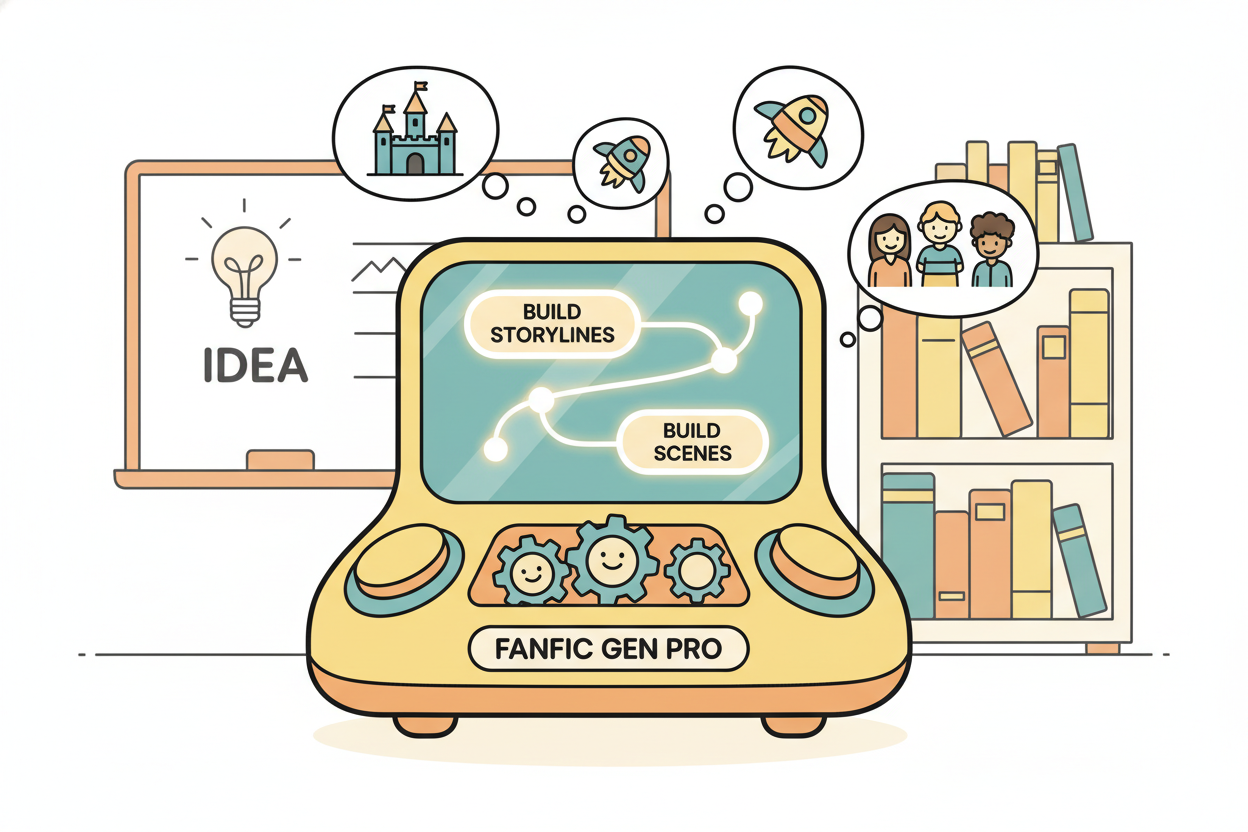
Quick Answer: What Is a Free AI Fanfic Generator?
A free AI fanfic generator is an AI-powered writing tool that helps fanfiction authors brainstorm, draft, and polish stories within established fictional universes — maintaining character voices, canon accuracy, and long-form continuity — without requiring payment.
- ✍️ Canon-aware drafting — The Creative Fiction Writer calibrates to specific character voices, AU rules, and fandom dynamics
- 🧠 Persistent story memory — Subplots, character arcs, and worldbuilding details carry across unlimited sessions
- 🎭 Character voice testing — Use the Roleplay Game Master to audition dialogue and emotional beats before committing to prose
- 🔄 Three creative modes — Planning, Writing, and Critique workflows for every stage of the process
- 💡 Trope-literate brainstorming — The Prompt Generator crafts fandom-specific story seeds with layered trope combinations
The Problem: Why Free AI Tools Keep Failing Fanfic Writers
AI adoption among fiction writers is no longer a fringe experiment. A 2025 Author Guild survey found that 45% of published fiction writers now use AI tools in some part of their creative process (Jenova / Life Note). Among fanfic writers specifically, 34% of active authors have used AI for brainstorming, outlining, drafting, or editing (Jenova / Inkfluence AI). The AI-powered creative writing assistant market has grown from $2.2 billion in 2025 to **$2.67 billion in 2026** (Jenova / Research and Markets).
34% of active fanfic writers have used AI tools in their writing process — yet most AI tools still lose character details by chapter 3. — Inkfluence AI
But the tools that fanfic writers can actually access for free? They're built for everything except fanfiction.
Character Voice Collapse
Fanfic readers are forensic analysts. They've consumed the source material dozens of times and will immediately notice when your Draco Malfoy starts sounding like your Steve Rogers. As one 2026 analysis documented, generic AI tools "will happily write you three paragraphs where your carefully crafted Draco Malfoy sounds exactly like your version of Steve Rogers — because they have no memory, no character awareness, no understanding that these voices need to be different" (Sudowrite via Jenova). Maintaining distinct voices for a cast of 10+ characters across 50 chapters is an administrative nightmare with tools that treat every character as interchangeable.
Memory That Dies Between Sessions
The most devastating limitation of free AI tools is context loss. NovelAI operates within roughly 8,000-token context windows — the AI "forgets your hero's eye color by chapter three" (Metamandrill). ChatGPT and Claude in their free tiers fare no better for serialized work: "no project structure, no chapter management, no outline system" (MeanAry / Inkfluence AI). You plant a Chekhov's gun in chapter 4. By chapter 12, the AI has no memory it exists. Every new session is a blank slate.
Content Filters That Kill Creative Freedom
Fanfiction spans every rating from gen fluff to explicit romance to dark psychological horror. Most mainstream AI tools enforce content filters designed for corporate marketing copy, not creative writing. The 2026 MeanAry comparison confirmed this hierarchy: Character.AI imposes "strict filters" that cut off mid-kiss, Claude maintains "mild filters" that handle PG-13 drama but refuse explicit scenes, and even platforms with relaxed policies vary wildly in what they'll generate (MeanAry). Writers whose stories include "explicit romance or visceral horror" find that "strict filters will frustrate you" — and that this single factor eliminates half the available tools (Metamandrill).
The Free Tier Trap
Many "free" AI writing tools are barely disguised demos. Free credits burn out before Act One. Output quality drops without paid upgrades. Volume caps turn a writing partner into a tease. A 2026 tool comparison found that DreamGen's free tier offers about 2,000 messages per month, NovelAI starts at $10/month with no free writing tier, and Sudowrite starts at $10/month — meaning writers who can't pay are left with general chatbots that weren't designed for fiction (MeanAry).
Why Creative Fiction Writer Is the Free AI Fanfic Generator That Actually Works
This is exactly what the Creative Fiction Writer on Jenova was built for. Not a generic chatbot that happens to produce prose — a dedicated AI storytelling partner with deep editorial intelligence, persistent memory, and access to multiple frontier AI models.
| Challenge | Generic Free AI Tools | Dedicated Fiction Apps ($10-25/mo) | Creative Fiction Writer on Jenova |
|---|---|---|---|
| Character voice | All characters sound the same | Lorebook/trigger-word workarounds | Persistent voice profiles maintain distinct dialogue patterns |
| Story memory | Resets every session | 8K-30K token windows with manual management | Unlimited cross-session memory — every subplot, character, and AU rule persists |
| Content freedom | Filters block mature themes mid-scene | Varies by platform | Supports creative fiction across all ratings and genres |
| Model flexibility | Locked to one model | Single proprietary model | Switch between GPT-5.4, Claude Opus 4.6, Gemini 3.1 Pro Preview mid-conversation |
| Editorial critique | Defaults to "Great job!" | Basic rewrite suggestions | Substantive feedback on pacing, voice, characterization, and show-vs-tell |
| Creative workflow | Unstructured chat | Writing mode only | Planning → Writing → Critique, switchable per task |
| Cost | Free but severely limited | $10-25/month | Core features free, no credit card required |
How It Solves Each Pain Point
Character voice collapse → Persistent voice profiles. Describe how each character speaks — vocabulary level, sentence rhythm, emotional registers, topics they avoid — and the Creative Fiction Writer references these profiles in every subsequent generation. Your Levi Ackerman stays terse and cutting. Your Todoroki stays measured and understated. Neither sounds like a corporate chatbot. Different AI models bring different strengths to character work: Claude Opus 4.6 excels at emotionally nuanced characters with complex interior lives, GPT-5.4 delivers sharp dialogue for characters defined by wit and sarcasm, and Gemini 3.1 Pro Preview handles massive ensemble casts where tracking a dozen distinct voices simultaneously is critical.
Memory death → Unlimited cross-session persistence. Jenova's platform-level memory stores every detail from your project — character arcs, subplot threads, AU worldbuilding rules, relationship dynamics, foreshadowing planted in chapter 4 — and retrieves relevant context automatically when you return. Close the session. Come back weeks later. The AI remembers everything. No lorebook. No manual context management. No copying and pasting your story bible every session.
Content filters → Creative freedom. The Creative Fiction Writer is built for fiction writers across every genre and rating, without the aggressive content filtering that interrupts creative flow mid-scene.
The free tier trap → Genuinely free core. The three-mode workflow (Planning, Writing, Critique), persistent memory, character voice profiles, and multi-model access are available on Jenova's free tier. No credit card required. Many fanfic writers draft, edit, and post entire multi-chapter fics without upgrading.
While tools like ChatGPT and Claude remain the most widely used general AI platforms — ChatGPT holding an 80% selection rate among content professionals and Claude at 55% (Siege Media + Wynter) — neither was designed for serialized creative fiction. As one 2026 review confirmed, they're "not writing systems. Without external tools to manage your character bios, world settings, and scene outlines, you are essentially working in a void" (SidekickWriter via Jenova). The Creative Fiction Writer fills that void.
Start writing with the Creative Fiction Writer free — no credit card required.
Featured Agents You'll Also Like
Roleplay Game Master — Audition Scenes Before You Draft Them
Before committing a pivotal scene to your fic, live it. The Roleplay Game Master provides immersive, unlimited-memory character interactions with perfect consistency — letting you step into any character and improvise dialogue, emotional reactions, and interpersonal dynamics in real time. Many fic writers use it as a rehearsal studio: run the confrontation, the confession, or the reunion, discover the authentic emotional rhythm, then bring those insights back to your manuscript.
- 🎲 Unlimited memory and perfect character consistency across extended sessions
- 🎭 Roleplay as any character to test voice authenticity and emotional registers
- ✨ Discover dialogue patterns and plot directions you wouldn't find through outlining alone
Prompt Generator — Fandom-Specific Story Seeds and Trope Engineering
When the blank page wins, the Prompt Generator produces layered, fandom-specific story prompts engineered for your characters, ships, and trope preferences. Not random word combinations — narrative launchpads with dramatic tension, emotional stakes, and structural bones you can build on immediately.
- 🎯 Specify fandom, ship, rating, genre, word count, and POV for tailored story seeds
- 🔄 Layered trope combinations with subversions (enemies-to-lovers × unreliable narrator × time loop)
- 📖 Iterative refinement — adjust tone, add constraints, deepen complexity with each exchange
Writing Assistant — Line-Level Craft Polish
After drafting, the Writing Assistant provides the line-editing support every fic deserves — tightening prose, varying sentence rhythm, eliminating passive constructions, and ensuring POV consistency. It adapts to your existing writing voice rather than overwriting it with generic AI prose.
- ✍️ Voice-preserving line editing and structural feedback
- 📝 Show-vs-tell analysis, dialogue tag variety, pacing evaluation
- 🎯 Format-aware — understands AO3 prose conventions, Wattpad style, and web serial pacing
How It Works: From Blank Page to Posted Chapter
Step 1: Establish Your Story Foundation
Open the Creative Fiction Writer and describe your fic in plain language — fandom, characters, ship, AU premise, tone, and where you are in the story:
"I'm writing a Genshin Impact fic. Zhongli/Childe, modern AU where Zhongli is a museum curator and Childe is an art thief who keeps targeting his exhibits. Enemies-to-lovers with a heist subplot. Third person limited, alternating POV. Planning around 80K words across 20 chapters."
The AI absorbs all of this into persistent memory. You won't need to repeat it — not next session, not next month.
Step 2: Brainstorm and Outline (Planning Mode)
Switch to Planning mode and build your narrative architecture:
"Give me a chapter-by-chapter outline for the first eight chapters. Each chapter should end with a moment that shifts the power dynamic between them. Mark where Childe's true motivation becomes partially visible to Zhongli — but not fully revealed."
The Creative Fiction Writer produces structural blueprints calibrated to your specific characters and their canon dynamics — not generic three-act templates.
Step 3: Draft Challenging Sections (Writing Mode)
Move to Writing mode and tackle the scenes that matter most — transitions, emotionally loaded dialogue, the moments that define your fic:
"Draft the scene where Zhongli catches Childe mid-heist but doesn't call security. The tension should be intellectual, not physical — two people who respect each other's competence and resent that they do. Subtext over text. Neither says what they actually want."
Step 4: Test Dialogue Through Roleplay
For pivotal confrontations or emotionally charged exchanges, open the Roleplay Game Master and play through the scene in real time. Voice one character while the AI embodies the other — maintaining their established personality, speech patterns, and emotional state. Copy the best lines directly into your draft.
Step 5: Get Honest Editorial Feedback (Critique Mode)
Switch the Creative Fiction Writer to Critique mode and paste your draft:
"Critique this chapter. Does Zhongli's restraint feel earned or does it read as passive? Is Childe's bravado masking vulnerability or just being annoying? Flag any dialogue that breaks the intellectual tension I'm building."
You'll get substantive feedback — "The third paragraph of the heist confrontation breaks your established dynamic. Zhongli wouldn't explain his reasoning aloud here — he'd demonstrate it. Consider showing his deduction through action rather than dialogue."
Step 6: Maintain Continuity Across the Entire Fic
As you write across weeks and months, the Creative Fiction Writer maintains persistent memory of your entire project. When you return after a break, the AI remembers that the Rex Lapis exhibit was introduced in chapter 2, that Childe's cover identity was established in chapter 5, that the subplot with the forged painting was last mentioned in chapter 11, and that your modern AU's rules about Visions were defined in your initial setup.
Results & Use Cases
📖 Finishing a 60K-Word Abandoned WIP
Scenario: A writer has a Jujutsu Kaisen fic sitting at 60,000 words with 14 chapters posted. They wrote themselves into a corner around chapter 12 and haven't updated in five months. Readers are still commenting asking for updates.
Traditional Approach: Re-read all 60,000 words hoping something clicks. Stare at the document. Post on r/FanFiction asking for advice. Eventually start a new fic instead.
With the Creative Fiction Writer: Summarize the story so far, describe where you're stuck, and ask for three possible directions that honor the existing plot threads. The AI analyzes your narrative structure and suggests developments that grow naturally from the seeds you planted 12 chapters ago — not generic plot twists bolted onto an existing story.
🎭 Niche Fandom With No Community Support
Scenario: A writer is passionate about a small-fandom visual novel with fewer than 200 fics on AO3. No beta readers. No prompt blogs. No active Discord server. No one to bounce ideas off.
Traditional Approach: Write every fic from scratch inspiration with zero external feedback. Burn out because there's no community to engage with.
With the Creative Fiction Writer: Describe the source material — characters, world, central tensions, power dynamics — and the AI integrates it into persistent memory for the duration of your project. You get a writing partner who understands your fandom context because you taught it, and who provides the editorial feedback that a human beta reader would offer in a larger fandom.
📱 Mobile Drafting Between Life Obligations
Scenario: A college student gets inspiration during commutes and between classes but loses momentum by the time they sit down at a computer.
With Jenova on mobile: Draft a scene during lunch. Switch to Critique mode on the bus home. Continue the same project on your laptop that evening. Persistent memory across devices means zero context loss. Your fic, your characters, and your editorial conversation continue seamlessly.
💼 Crossover Fic: Multi-Fandom Consistency
Scenario: A writer is creating a Harry Potter × Naruto crossover and needs to keep two magic systems, two sets of character voices, and two worldbuilding frameworks consistent without contradictions.
Traditional Approach: Spreadsheets for each fandom's rules, constant cross-referencing, inevitable contradictions that readers catch in the comments.
With the Creative Fiction Writer: Document rules from both sources in conversation: "Harry Potter magic works through wands and incantations. Naruto chakra is physical and requires hand signs. In this crossover, they interact via [your explanation]." The AI references both frameworks during every generation — no spreadsheets, no Ctrl+F, no manual consistency checks.
🎓 Developing Craft as an Emerging Writer
Scenario: A newer writer wants to improve prose, pacing, and dialogue — the skills that separate fics with 50 kudos from fics with 5,000.
Traditional Approach: Read craft books, hope for constructive comments from readers, join writing groups with inconsistent feedback quality.
With the Creative Fiction Writer in Critique mode: Get specific, actionable craft feedback on every chapter — "your dialogue tags are repetitive in paragraphs 3-7; vary with action beats" and "this scene tells the reader the character is angry instead of showing it through physical action and dialogue subtext." Structured editorial feedback accelerates growth faster than waiting for sporadic reader comments.
FAQ
Is this AI fanfic generator actually free?
Yes. The Creative Fiction Writer on Jenova includes core features — the three-mode workflow (Planning, Writing, Critique), persistent story memory, character voice profiles, and multi-model access — on the free tier. No credit card required. Many fanfic writers draft, edit, and post entire multi-chapter fics on the free plan. Paid plans start at $20/month for expanded usage limits.
Will the AI replace my creative voice?
Only if you use raw AI output as a final draft. The best workflow is hybrid: use AI to brainstorm, draft difficult sections, and test character dynamics — then rewrite in your own voice. Most AI-assisted fanfics are 30-50% AI-generated and 50-70% human-edited (Inkfluence AI via Jenova). The AI handles the blank page problem. You handle the creative decisions that make the fic yours.
How does persistent memory work for long fics?
Jenova's platform-level memory stores every detail from your project — character descriptions, plot threads, AU rules, relationship dynamics, foreshadowing, timeline events — and retrieves relevant context automatically when you return. Close the session, come back weeks later, and the Creative Fiction Writer remembers that your protagonist confessed in chapter 12, that the subplot about the cursed artifact was last mentioned in chapter 8, and that your AU's magic system requires verbal incantations. No lorebook management, no manual re-pasting.
How does this compare to DreamGen, NovelAI, or Sudowrite?
DreamGen offers strong scenario control with a 30,000-token window but starts at $19/month for full features. NovelAI provides excellent lore management with an 8,192-token memory for $10/month. Sudowrite excels at line-level polish for $10/month. All are solid standalone fiction tools. The Creative Fiction Writer differentiates through unlimited persistent memory (no token window workarounds), multi-model access (switch between GPT-5.4, Claude Opus 4.6, and Gemini 3.1 Pro mid-conversation), a three-mode Planning/Writing/Critique workflow, and a broader agent ecosystem — test character dynamics with the Roleplay Game Master, engineer better prompts with the Prompt Generator, all on one platform with a genuinely free tier.
Can I post AI-assisted fanfic on AO3?
Yes. AO3 allows AI-assisted writing as long as you tag the work appropriately and confirm every line is legally yours to share. Tagging your work as "AI-assisted" is considered good practice within the community. Using AI for brainstorming and drafting while doing substantial editing is widely accepted (MeanAry).
Which AI model works best for fanfiction?
Different models bring different strengths. Claude Opus 4.6 excels at emotionally nuanced characters with complex interior lives — ideal for literary fanfic and character studies. GPT-5.4 delivers sharp, witty dialogue and strong trope awareness — suited for banter-heavy ships and genre-savvy stories. Gemini 3.1 Pro Preview handles massive ensemble casts and lore-heavy fandoms where tracking dozens of interconnected elements is critical. On Jenova, you switch between all of them mid-conversation — no vendor lock-in, no restarting your project.
Conclusion
Fanfiction in 2026 is a creative ecosystem of staggering scale — AO3 processing over 40,000 support tickets and nearly 5 million wrangled tags in a single year (Archive of Our Own), Wattpad sustaining 94 million monthly users (Expanded Ramblings), and publishers actively scouting AO3 for their next acquisition. The writers who build audiences and finish their fics are the ones with tools that match the complexity of what they're creating — persistent memory, distinct character voices, and editorial intelligence that understands the difference between a slow burn and enemies-to-lovers.
A free AI fanfic generator shouldn't be a crippled demo that forgets your story every session. The Creative Fiction Writer gives you unlimited cross-session memory, character voice profiles, three-mode Planning/Writing/Critique workflows, and access to frontier AI models — free, with no credit card required. Pair it with the Roleplay Game Master to test character dynamics and the Prompt Generator to never run out of story ideas.
Try the Creative Fiction Writer free — your next chapter starts here.
Explore the full agent library at Jenova.