AI Faction Generator: Create RPG Factions That Drive Play
2026-09-04
Game Designer Assistant helps you generate living factions by turning a setting, a tone, and a few constraints into organizations with goals, leaders, internal tension, and hooks your players can actually use. While most campaign prep stalls on nameless guilds and one-note villains, this AI faction generator produces groups that behave like characters—complete with methods, weaknesses, and rivalries that keep a table moving. In September 2026, dungeon masters still lose entire evenings to worldbuilding that never reaches play.
- ✅ Faction briefs with a one-sentence goal, methods, and identifying marks
- ✅ Relationship maps between allied, rival, and secretly entangled groups
- ✅ Session-ready NPCs, rumors, and adventure hooks
- ✅ Support for Dungeons & Dragons, Pathfinder, sci-fi, and homebrew systems
To understand why this matters, it helps to look at why factions so often collapse into flavor text—and what a purpose-built faction generator changes at the table.
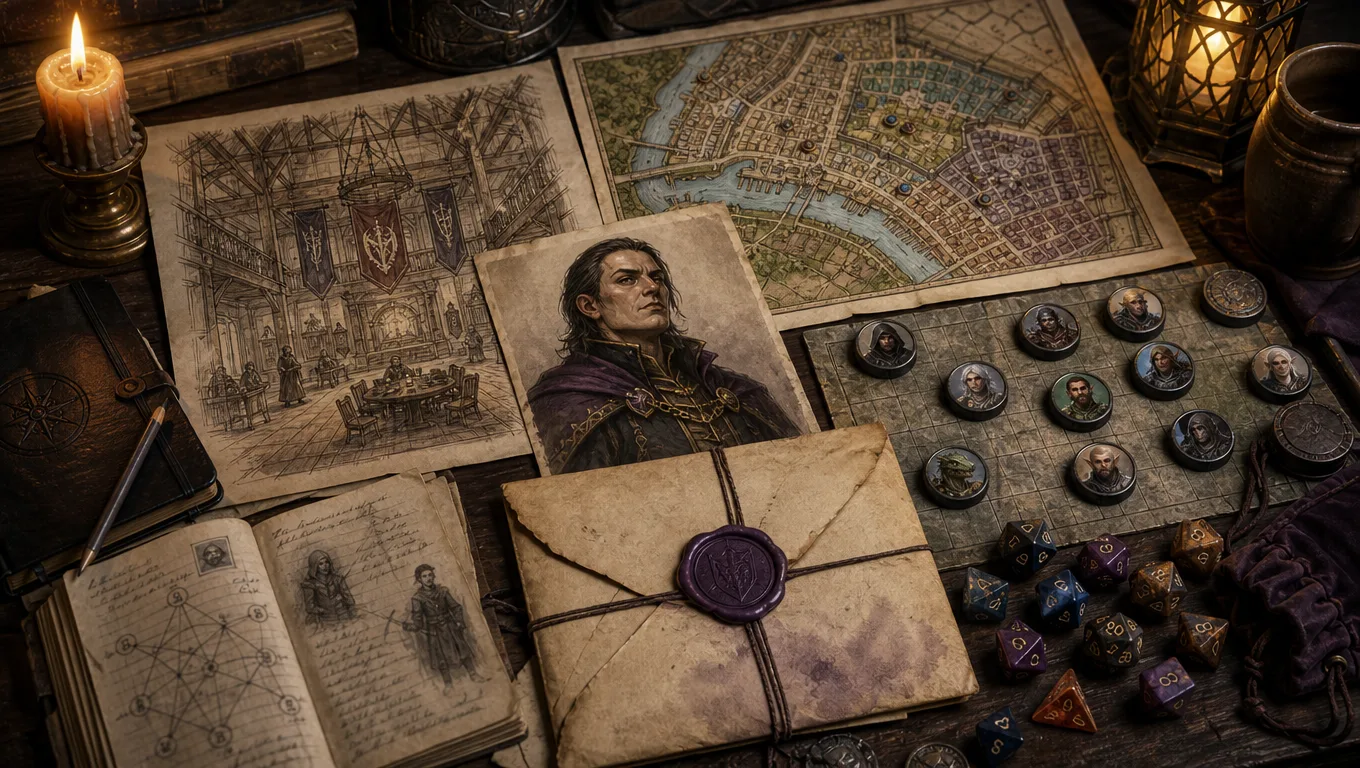
Quick Answer: What Is an AI Faction Generator?
Game Designer Assistant is an AI faction generator that designs living RPG organizations—goals, leaders, NPCs, and rivalries—so you can drop them into a campaign in minutes. It treats a faction as a playable system, not a wiki page.
Key capabilities:
- One-sentence goals with matching methods, fears, and pride
- Leaders, lieutenants, and rank-and-file voices that disagree on method, not just flavor
- Alliance and rivalry maps that generate quests instead of exposition
- Session handoffs: rumors, marks, locations, and what the faction does if the party ignores it
Why Most RPG Factions Never Make It to the Table
Tabletop role-playing is no longer a niche hobby. More than 50 million people worldwide are estimated to have played Dungeons & Dragons, and the dedicated TTRPG market is projected to grow from USD 2.41 billion in 2026 to USD 6.59 billion by 2035. Players show up expecting political texture—guilds that want something, churches that compromise, crews that remember last session.
But getting that texture onto the table is frustratingly difficult:
- Factions are written as lore, not as problems the party can touch
- Relationship webs live in the GM’s head and evaporate between sessions
- Random name lists produce titles without politics, methods, or weaknesses
- Prep time expands until the campaign dies of unfinished worldbuilding
Dozens if not hundreds of hours — typical cost of building a complete RPG world before play
That cost shows up in campaign lifespan. D&D Beyond usage data has indicated that around 90% of games stop by level 10. Momentum dies for many reasons, but empty organizations are a quiet one: if the city watch, the temple, and the thieves’ guild never act unless the party knocks, the world feels paused.
Adventure designers have been clear about the fix. Gnome Stew argues that factions should be woven into backgrounds and story hooks—leaders, structure, goals, motives, and identifying marks—then handed to players as a reference, not a lecture. Michael Ghelfi Studios puts it more sharply: a faction’s job is to give the party opportunities and problems. If you cannot state the goal in a single sentence, it is not ready. And if more than three groups are “on stage” at once, players stop tracking who wants what.
A useful faction generator does not spit out a coat of arms and an alignment. It produces a group the table can bargain with, betray, join, or dismantle.
This is exactly what Game Designer Assistant was built for.
Why Game Designer Assistant
Game Designer Assistant is a game-design partner that brainstorms, pressure-tests systems, and documents results you can run the same night. Used as a faction generator, it starts from play, not encyclopedia entries: who wants what, how they get it, what they fear, and how that collides with the party.
| Traditional Approach | Game Designer Assistant |
|---|---|
| A name, an alignment, and a paragraph of lore | A one-sentence goal with methods, fears, and pride |
| Hours of wiki drafting before session one | A session-ready brief, NPC roster, and rumor list |
| Static flavor the party never touches | Relationships that generate jobs, debts, and complications |
| One GM’s memory across weeks of play | Written marks, locations, and “if ignored” clocks |
Playable goals, not flavor text
Testing a faction against Ghelfi’s one-sentence test is the fastest way to find dead weight. Ask for a goal the party can help, hinder, or accidentally complete. “Protect pre-war technology” is playable. “Be mysterious and ancient” is not. The assistant will push you toward goals that imply actions—smuggling, patronage, inquisition, land grabs—so the group has presence even when the party is elsewhere.
Relationship webs that generate adventures
A faction that only talks to the party is a quest vendor. A faction that owes the harbor master, fears the temple, and is quietly buying the city watch is a campaign engine. Ask for three to five relationships with a verb attached: funds, blackmails, shelters, hunts, imitates. Keep no more than three factions fully active at once, and park the rest in rumor and aftermath.
Session handoffs your table can use
Documentation is the difference between a clever idea and a tool you can reopen next Thursday. Request a one-page handout: public face, secret goal, three NPCs with different amounts of power, identifying marks, a territory tell, and two hooks aimed at the same dungeon, district, or MacGuffin. That matches Gnome Stew’s advice to aim backgrounds and factions at the same pressure point so hooks actually fire.
Systems that fit your game
Whether you run reputation tracks, clocks, fronts, or freeform notes, ask for output in your format. Fifth-edition factions can come with downtime favors and rival rolls. A West Marches table can get a rumor table and a “hearts” list—mines, lieutenants, relics—the party can attack. A narrative game can get bonds and bans. The generator follows the system you name instead of dumping generic lore.
"Generate a canal-city dye smugglers’ guild. Publicly they are a respectable stevedores’ brotherhood. Secretly they move banned pigments for a foreign bank. Give a one-sentence goal, three NPCs who disagree on method, marks, and two hooks for 5th-level characters."
"I have a city watch, a harbor priesthood, and a merchant consortium. Map how they use, undermine, and owe each other. Keep each goal to one sentence and flag which two should be on stage this season."
"Turn last session’s nameless cult into a real faction: what they want, what they will never do, where they are weak, and what they attempt if the party ignores them for two weeks."
Related Agents You'll Also Find Useful
If you are already generating factions, these tools cover the naming, politics, and drama that sit one step away from the brief.
Name Generator
Faction names fail when they sound like the same three nouns reshuffled. Name Generator is a naming consultant with cultural and linguistic range—useful when a dwarven assay office, a riverine mystery cult, and a colonial joint-stock company cannot share a naming logic.
- Culturally grounded names for groups, ships, safehouses, and ranks
- Distinct registers for public brands versus secret true names
- Fast iteration when a name is close but too on-the-nose for the table
Machiavelli Mentor
Once a faction exists, someone has to play it like a power. Machiavelli Mentor maps incentives, patronage, and multi-move campaigns—the layer where a guild’s goal becomes a season of pressure.
- Power maps: who can say no, who can delay, who only looks in charge
- Incentive decoding so NPCs do not all “want gold” in the same way
- Negotiation tactics you can steal for lieutenants who will not die for the boss
Film Screenwriter
Factions become memorable when a scene makes the ideology visible. Film Screenwriter turns a faction brief into confrontation, betrayal, and the one image players will quote later.
- Scene-level structure for audiences, interrogations, and council votes
- Dialogue that reveals method without a lore dump
- Character development for leaders who must remain consistent under stress
Try Game Designer Assistant free — no credit card required.
How to Generate a Faction in Minutes
Step 1: State the pressure, not the encyclopedia
Give the setting in one paragraph, then name the pressure the party will feel this season: a famine, a succession, a new mine, a banned spell, a visiting fleet. Factions exist to make that pressure worse or more interesting. Do not start with a continent’s complete history.
"Port campaign, late autumn, grain rotting in warehouses. The party is level 4. I need factions that care about who controls the granaries—not a full world bible."
Step 2: Generate the core brief
Ask this faction generator for a one-sentence goal, the method, the fear, the pride, and why the party should care in the next two sessions. If the goal cannot be helped or harmed by player action, regenerate. Add system constraints: 5e downtime, clocks, or a hard cap of three named NPCs.
"Create one granary faction. Goal in one sentence. Methods that match. A weakness the party can actually affect. Three NPCs with different power and opinions. No alignment labels."
Step 3: Map relationships and park the extras
Add two neighboring groups and demand verbs, not vibes. Then decide which three are on stage. Everyone else becomes rumor, graffiti, or a letter the party finds. This is where a relationship map earns its keep.
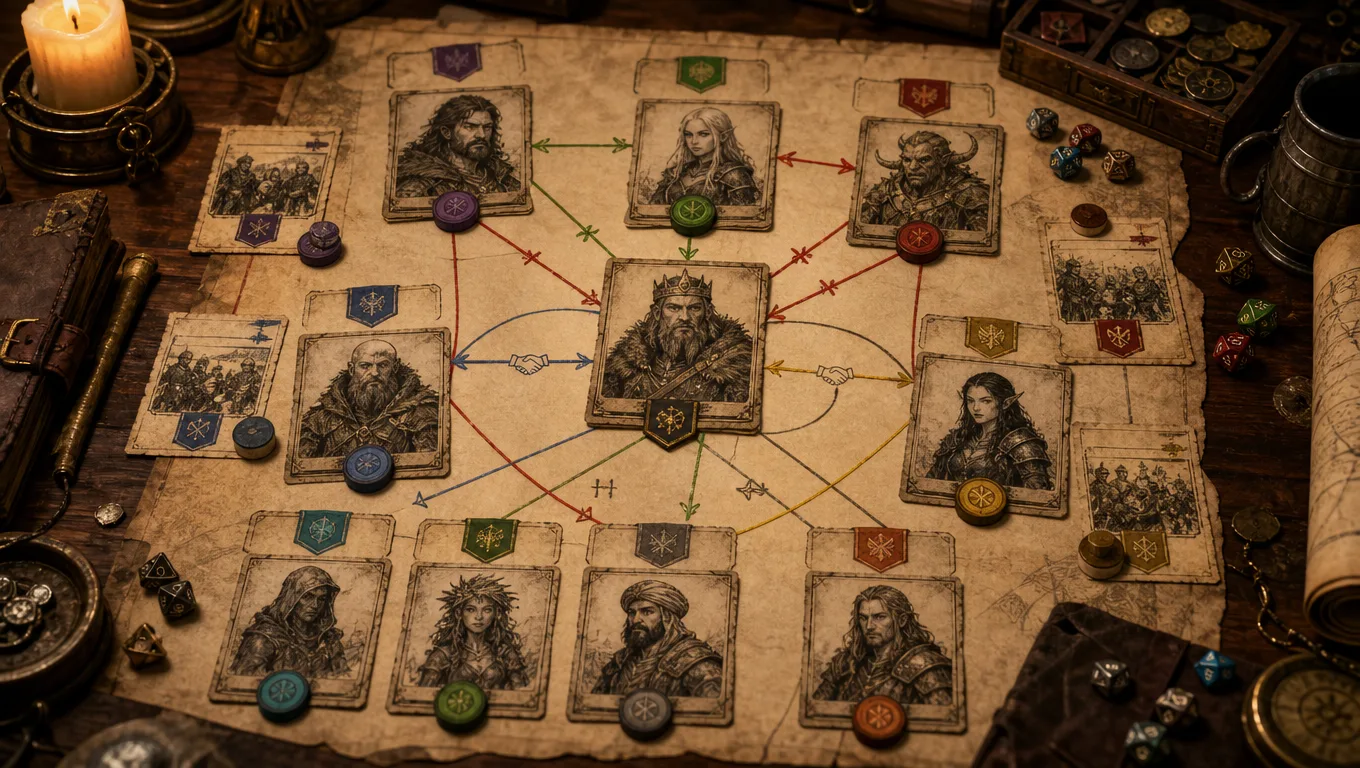
"Add a harbor priesthood and a foreign grain bank. Draw alliances, debts, and one secret overlap. Tell me which three actors are active this month and what the others do offstage."
Step 4: Export a session handoff
Request a player-facing page and a GM-only page. Players get public goal, marks, and who to talk to. You get the secret, the next move if ignored, and two hooks aimed at the same location. Print it, paste it into your VTT, or screenshot it on your phone.
"Output a one-page player handout and a GM sheet: rumors, identifying marks, territory tells, and an 'if ignored for two sessions' move."
Step 5: Update after play
Factions should change. After the session, feed back what the party did. Success makes a group bolder or more visible. Failure makes them sue for peace, purge a lieutenant, or betray an ally. Ask for the new one-sentence goal so the organization does not freeze in last week’s version of itself.
Results & Use Cases
📊 Canal-city politics for a 5e urban campaign
Scenario: A GM has a map, a tavern, and three weeks until session one. Players want intrigue, not another rat cellar.
Traditional Approach: A weekend of wiki pages, then improvising NPCs who all sound like the same fence.
Game Designer Assistant: A stevedores’ brotherhood, a harbor priesthood, and a dye bank, each with a one-sentence goal and NPCs who disagree on method. The party’s first job is a “favor” that is actually a faction test.
- Hooks aimed at one warehouse district instead of twelve plot threads
- Marks and rumors players can notice without a speech
- Room to name officers with Name Generator so the bank, the temple, and the docks do not share a linguistic soup
💼 West Marches hearts and clocks
Scenario: An open table needs factions that produce jobs when whoever shows up that night.
Traditional Approach: A static list of guilds. Players ignore them. The GM invents a dungeon anyway.
The AI design partner: Each faction gets two or three “hearts”—a mine, a lieutenant, a charter hall—that grant a boost while intact. Parties choose which heart to hit. Between sessions, Machiavelli Mentor can pressure-test what a wounded faction does next so the sandbox feels occupied.
- Quests that stay local even when the roster changes
- Clear targets instead of “go make friends with the guild”
- Offstage moves that create rumors for next week’s table
📱 Phone prep on the commute
Scenario: The game is tonight. The last session ended with “you offended the Amber Ledger.” The GM is on a train.
Traditional Approach: Panic-scrolling notes, then a bland tax collector with no leverage.
This faction generator: A three-NPC brief, the Ledger’s actual fear (audit from the capital), and a move they make if the party hides. The GM runs it from a phone with full feature parity on iOS or Android.
- Ten-minute repair of a faction that was only a name
- A player handout you can paste into the group chat
- A scene prompt you can send to Film Screenwriter if you need the confrontation to land in one exchange
FAQ
What is a faction generator for tabletop RPGs?
A faction generator is a tool that creates playable organizations for a campaign—goals, methods, leaders, marks, and relationships—rather than a random name and alignment. Game Designer Assistant approaches the job as game design: every output should give the party something to do, not a paragraph to admire. Use it for D&D, Pathfinder, sci-fi, or homebrew whenever groups in the world need to act without the party in the room.
Is this AI faction generator free?
Jenova offers a free tier with core features and limited monthly usage, so you can generate faction briefs without a credit card. Paid plans increase usage if you are documenting a whole region or iterating every week. Start on free, keep the briefs that work, and upgrade only if the table is burning through organizations faster than the free allowance allows.
How is an AI faction generator different from a random table?
A random table is excellent at nouns: “The Gilded Serpent,” lawful evil, prefers daggers. It will not tell you the Serpent’s one-sentence goal, which lieutenant wants to go legitimate, or what they do if the party ignores them. An AI faction generator built for play asks those questions up front and formats the answer as a handout, a relationship map, and hooks. Keep random tables for spark; use the assistant for structure.
Can I use this for Dungeons & Dragons and other systems?
Yes. Name the rules and the output format. For 5e, request downtime favors, rival rolls, and faction ranks. For PbtA or FitD, request clocks and turf. For a diceless or narrative table, request bonds, bans, and a single iconic scene. The same core—goal, method, weakness, three voices—transfers; the sheet changes.
Does a faction generator work on mobile?
Yes. Jenova runs with feature parity on web, iOS, and Android, which is the difference between “I’ll prep this weekend” and “I’ll generate the Amber Ledger on the train.” Voice input helps when your hands are full of dice bags. Save the handoff, then read it at the table without rebuilding the brief on a laptop.
How many factions should I generate for a campaign?
For anything longer than a one-shot, start with two or three that share a pressure, not a dozen that share a map. Keep no more than three fully active at the same time; park the rest as rumors and aftermath. Generate depth—internal disagreement, a weakness the party can touch, a next move—rather than a directory of unused crests.
Build Factions Players Will Actually Care About
Empty organizations are expensive. They consume the hours worldbuilders already cannot spare, then sit unused while a campaign fights to reach the levels most tables never see. A good faction generator reverses that: one-sentence goals, methods that match, relationships with verbs, and a handoff you can run tonight.
Game Designer Assistant is the AI faction generator that treats organizations as playable systems—then writes them down so they still exist next session. Try it now, and explore more at Jenova.
For Developers: Game Designer Assistant is available programmatically via the Jenova API — integrate AI faction generation into your VTT, campaign app, or worldbuilding tool with a single API call. Full documentation →