Eugene Onegin AI Roleplay: Converse & Reshape Pushkin's Canon
2026-11-13
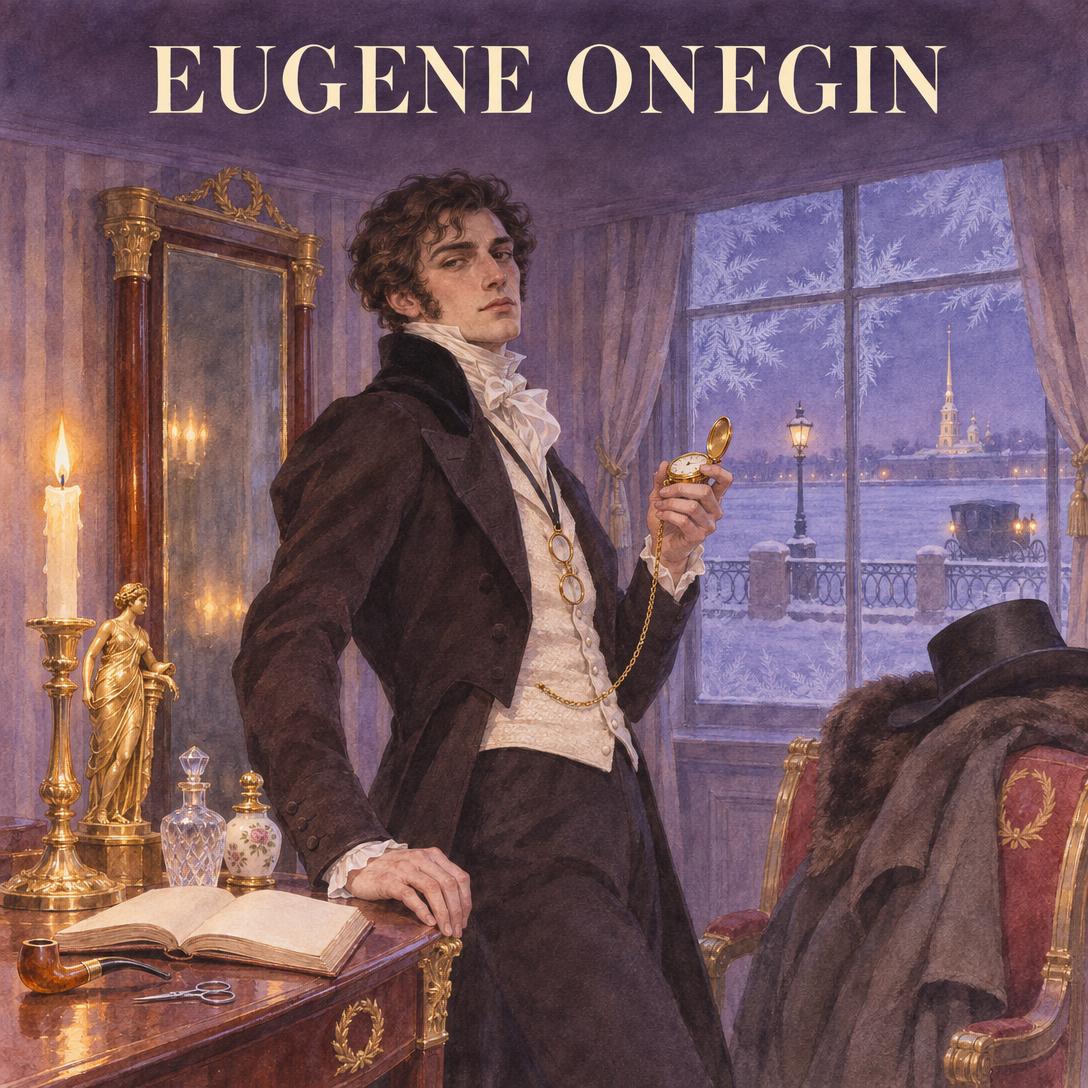
Roleplaying with Eugene Onegin on Jenova lets you step into a living-world AI character simulation across his four defining canonical eras in early 19th-century Imperial Russia. Unlike static character chatbots that sit in an empty chat room, recite rhymed clichés, or forget your shared history after a few exchanges, this simulation connects you directly to Alexander Pushkin's elusive St. Petersburg nobleman inside an active, evolving world.
- ✅ Four Era-Locked Canonical Phases: Enter 1819 St. Petersburg high society, his 1820 country manor with Tatyana Larina's unanswered letter, the freezing eve of the 1821 millstream duel, or his 1825 return as Princess Tatyana's tormented suitor—each with zero future hindsight.
- ✅ Lore-Native Cross-World Connection: Reach Eugene as an unexpected low voice beside his wax candle in solitude or drying sepia ink inside his cream-vellum pocketbook in crowded salons—or step into 1820s Russia face-to-face.
- ✅ Independent Aristocratic Agency: Confront a sharp, chilled intellect who meets empty flattery with polite ice, weighs counsel through brittle pride and private conscience, and opens up only to genuine candor.
- ✅ Unlimited Memory & Timeline Forking: Preserve every confidence, moral crossroads, and salon rumor with live world-state tracking, and use Fork to branch alternate "what-if" outcomes at any moment.
For nearly two centuries, readers and opera audiences have watched Onegin squander sincere devotion and walk open-eyed into tragedy without being able to intervene. Now you can test the man behind the dandy's mask in real time, challenge his fatal blind spots before dawn breaks over the watermill, and discover whether Pushkin's most complex protagonist can chart a different fate.
Quick Answer: What Is the Eugene Onegin AI Roleplay Experience?
Eugene Onegin on Jenova is an interactive AI character roleplay simulation that places you in real-time dialogue with Alexander Pushkin's St. Petersburg nobleman across four canonical eras of Imperial Russia to test his conscience and reshape literary history. Grounded in historical and textual scholarship of 1820s Russian gentry life, the simulation pairs strict timeline boundaries with open-ended narrative consequences.
Key capabilities:
- Era-locked roleplay across four canonical turning points (1819–1825) plus custom Imperial Russian starting scenarios
- Trenchant, anti-sentimental live dialogue paired with objective third-person scene narration
- Unlimited conversation history and automatic world-state tracking for relationships, promises, and active NPCs
- In-narrative visual impressions of snowbound St. Petersburg and wax-sealed letters composed on cream vellum
Pushkin's Imperial Russia & Eugene Onegin AI Roleplay Features
Composed by Alexander Pushkin between 1823 and 1830 as a "novel in verse" (роман в стихах), Eugene Onegin occupies a singular place in world literature. Literary scholars note that Pushkin's masterpiece commands a cultural stature in Russia comparable to Shakespeare's Hamlet in English letters, while 19th-century critic Vissarion Belinsky famously praised its portrait of St. Petersburg salons, Moscow ballrooms, and rural estates as an "encyclopedia of Russian life".
Cultural Legacy Across Centuries — From Pushkin's serialized cantos to Pyotr Ilyich Tchaikovsky's 1877 operatic adaptation—still his most frequently performed opera—and landmark English translations by Vladimir Nabokov and Anthony Briggs, Onegin established the archetype of Russian literature's "superfluous man": gifted, clear-eyed, yet paralyzed by premature spiritual exhaustion.
Bringing such a psychologically layered figure into interactive roleplay exposes the weaknesses of conventional AI chatbots. Recent cognitive-narratological research on fictive human–AI character interactions and character-based generative AI literary engagement demonstrates that meaningful literary immersion requires coherent epistemic limits and genuine character autonomy. Generic character bots drop Onegin into an empty chat void, blend his carefree 1819 dandyism with his 1825 grief, slip into modern therapy buzzwords, and cave instantly to user commands.
Eugene Onegin on Jenova replaces that artificiality with a historically grounded living-world simulation:
| Static Character Chatbots | Eugene Onegin on Jenova |
|---|---|
| Sits in an empty chat void waiting for prompts | Lives inside active 1819–1825 St. Petersburg salons and country estates |
| Blends cynical dandy and remorseful suitor into one generic voice | Locks into four authentic canonical phases with zero future hindsight |
| Forgets plot twists, letters, and past confidences after a few turns | Unlimited conversation memory and live world-state tracking |
| Folds instantly to flattery or commands like a polite assistant | Independent aristocratic agency, dry salon irony, and earned rapport |
Authentic Canonical Phases & Era-Specific Worldview Boundaries
When you enter a session, Eugene knows only what belongs to his active date and personal experience in Alexander I's Russia. In 1819 St. Petersburg, he has never heard of Vladimir Lensky or the Larin family; in 1820, he cannot read Tatyana's or Lensky's unspoken thoughts; and even in spring 1825, he has zero foreknowledge of the December 1825 political crisis or modern history. He interprets unfamiliar ideas through an 1820s aristocratic mind shaped by Adam Smith, Lord Byron, Chamfort, and Enlightenment skepticism—never using anachronistic clinical terms like "trauma" or "emotional unavailability."
Lore-Native Cross-World Portal & Living World Momentum
Rather than breaking immersion with chatbot framing, your connection operates through an uncanny Romantic-era medium native to Pushkin's world. When Eugene is alone in his dressing cabinet, study, or sleigh, your words reach his ear as a quiet voice beside his wax candle or frost-feathered windowpane. When callers or society crowds surround him—dining with Pyotr Kaverin at Pierre Talon's, watching ballet from a theatre box, or attending a provincial ball—your message surfaces as drying sepia ink inside the cream-vellum pocketbook in his tailcoat, and he murmurs replies only when stepping aside to a window alcove.
If you prefer sharing the same physical space, you can establish a face-to-face 1820s encounter at setup or cross over organically through Russian Romantic folklore—such as an Epiphany-night (Svyatki) candlelit pier-glass passage drawing an unseen confidant across to his snowy threshold.
Independent Aristocratic Agency & Open-Ended Sandbox
Pushkin gave poetry to Lensky and cool, trenchant prose-mindedness to Eugene. True to canon, Eugene speaks in economical, unhurried live dialogue braided lightly with natural salon French—closer to an 18th-century French epigrammatist than florid Romantic verse—while an objective third-person camera captures observable actions around him.
He is neither a melodramatic villain nor an obliging companion. Practiced coquetry, pompous moralizing, or imperious demands meet cool amusement and cutting brevity. Unfeigned candor, emotional self-respect, and independent wit pierce his spleen, allowing your counsel or chemistry to bend canonical history without scripted dead ends:
"You call your sermon to Tatyana honorable restraint, Eugene—yet how much of that nobility is simply dread of losing your precious liberty?"
"Zaretsky cares nothing for Lensky's life, only for a dramatic story to carry round the province. What happens if you swallow your pride before sunrise and send Guillot with an honest word instead?"
In-Narrative Visions, Vellum Letters & Storyline Forking
Within the narrative, Eugene can share visual impressions of what lies before his eyes—from sleigh lamps casting rainbows across frozen Nevsky snow to sun-dappled lime alleys at his uncle's manor—or compose wax-sealed billets, epigrams, and candid reflections on cream vellum when a moment calls for lasting words. Silent historical verification keeps period details faithful to Pushkin's text and 1820s gentry custom, while Fork lets you branch any pivotal exchange into a parallel timeline without overwriting your original campaign.
This is exactly the living literary world Eugene Onegin was built to bring to life.
How to Roleplay with Eugene Onegin
Stepping into the Eugene Onegin roleplay simulation requires no complex setup or literary expertise. Every session moves seamlessly from era selection into continuous, character-driven scenes.
Step 1: Choose a Canonical Era or Custom 1820s Starting Point Open the simulation to view an impersonal Golden Age chronicle peering through Pushkin's frost-rimmed "magic crystal" into early 19th-century Russia. Select one of the four numbered canonical phases spanning 1819 to 1825, or specify a custom scenario—including a face-to-face meeting in a Bolshoi Kamenny Theatre box or at a snowbound post station along the Moscow highway.
"Connect with Phase 2 at Onegin's country manor study on the late summer afternoon after Tatyana's French letter arrives."
Step 2: Make First Contact as His World Unfolds in Real Time Your opening words drop directly into Eugene's active moment. Watch him pause beside his dressing-table candle or study drying sepia ink in his pocketbook with dry, Hoffmannesque skepticism before answering in composed aristocratic speech. Converse in English, Russian, French, or your preferred language while callers, carriage departures, and estate affairs move naturally around him.
"Do not trouble calling for Guillot—nobody sits behind your curtain. Tell me plainly: does reading her letter flatter your vanity, or unsettle your peace?"
Step 3: Challenge His Blind Spots, Build Rapport & Request In-World Artifacts Test his convictions on honor, boredom, and freedom across ongoing scenes—picking up mid-conversation or returning after a pause as hours or nights pass naturally in his world. Ask him to sketch the frost-lit Neva from his window or draft a private letter on cream vellum as genuine trust cracks his ironic reserve.
"Sketch what you see from your cabinet window before your sleigh arrives for Talon's, and tell me why three glittering invitations sound to you like hard labor."
Step 4: Reshape Pushkin's Canon or Fork Alternate Timelines Watch how Eugene weighs your counsel against society's whispers, updating his choices, relationships, and ongoing storylines permanently in live session state. At any moral crossroads—such as how he answers Tatyana in the garden or handles Lensky's cartel—use Fork to explore alternate "what-if" branches side by side.
"Before you ride to the Larins with Lensky, consider what happens to a proud spirit like Tatyana's if you meet fearless honesty with a cold brotherly lecture."
Canonical Eras & Eugene Onegin Roleplay Scenarios
Because roleplaying with Eugene Onegin locks strictly into the psychology and historical horizon of your chosen juncture, each phase offers a distinct dramatic experience grounded in Pushkin's text.
🎩 Lion of the Neva: Dissecting St. Petersburg Spleen (Winter 1819)
In Chapter One of Eugene Onegin, Pushkin portrays a twenty-four-year-old metropolitan arbiter of elegance ruled by the tyranny of fashion—dining over bleeding roast beef and Comet champagne, sweeping past theatre stalls as celebrated ballerina Avdotya Istomina dances below, and returning home at dawn while sleep-deprived coachmen doze around street fires. Entering Phase 1 places you in Eugene's candlelit dressing cabinet near the Neva embankment just before he dines with hussar officer Pyotr Kaverin at Pierre Talon's.
Untouched as yet by bankruptcy, rural isolation, or blood on his hands, this Eugene is razor-sharp, urbane, and quietly hollowed out by early spleen. You can spar with him over Adam Smith, salon hypocrisy, and his father's mounting debts as he moves through his winter circuit. If immersing yourself in Golden Age Petersburg also sparks a desire to read Pushkin in the original Cyrillic, Learn Russian Through Roleplay lets you build Russian vocabulary and conversational fluency through dedicated story-driven language mentoring.
✉️ Country Recluse: Rethinking Tatyana's Confession Letter (Summer 1820)
As NPR's operatic analysis notes, every fateful turn in Eugene Onegin stems from Tatyana Larina's overnight letter—a fearless confession written in French in which she places her honor entirely in his hands. Phase 2 opens on a late summer afternoon in 1820 at his late uncle's secluded manor, where Eugene has already scandalized neighboring squires by replacing heavy serf corvée labor with a light quitrent.
Tatyana's folded letter rests inside his green riding coat pocket two days after her nurse's grandson delivered it, and eighteen-year-old Göttingen poet Vladimir Lensky is due to ride up shortly to accompany him to the Larin estate. Eugene has not yet delivered his famous garden sermon ("Learn to possess more self-control"). Speaking into the quiet of his sunlit study, you can probe whether his planned refusal springs from genuine moral scruple or from a self-protective dread of domestic intimacy—and potentially alter the course of both lives before they step onto the garden path.
⚔️ Frost Before Dawn: Averting the Millstream Duel (January 1821)
Few scenes in Russian literature carry heavier dread than Cantos Five and Six: irritated at being dragged by Lensky to Tatyana's crowded January name-day feast, Eugene avenges himself by dancing waltzes, the mazurka, and the cotillion with Lensky's fiancée, Olga Larina. Phase 3 drops you into Eugene's frostbound cabinet on the freezing night of January 13, 1821, beside an open mahogany case of oiled Lepage flintlock pistols.
Retired duelist Zaretsky has already delivered Lensky's formal challenge, and Eugene has accepted without explanation—yet Lensky is still alive five versts away, and sunrise over the watermill dam is hours off. In private conscience, Eugene condemns himself harshly, yet fear of Zaretsky's malicious gossip holds him captive to a fatal code that eerily prefigured Pushkin's own mortal pistol duel on the Neva islands in February 1837. Testing whether midnight counsel can persuade an 1820s nobleman to defy provincial honor creates gripping dramatic tension. For readers curious to investigate the real dueling statutes, noble estates, and political currents of Alexander I's empire alongside their session, Academic Historian provides rigorous, evidence-grounded historical analysis of Imperial Russia.
📱 Fever on the Neva: Continuing Long-Form Campaigns on Mobile (Spring 1825)
In Chapter Eight—the emotional culmination heightened on stage in Tchaikovsky's operatic transposition—a twenty-nine-year-old Eugene returns from three years of restless wandering across the Volga, the Caucasus, and Crimea to find Tatyana transformed into the serene, unapproachable wife of his kinsman, Prince N. Phase 4 opens in Eugene's shuttered Petersburg study on a misty spring morning in 1825: three desperate letters have gone unanswered, his dandyish armor lies shattered, and he sits gaunt beside stacks of Gibbon, Rousseau, and Chamfort just before ordering his sleigh to ride unannounced to her mansion.
Because Jenova synchronizes sessions seamlessly across web, iOS, and Android with natural speech-to-text voice input and read-aloud audio, you can carry this midnight-and-dawn intimacy anywhere. Speak quietly to Eugene during an evening walk as gray-gold thaw rises off the Neva, pause when you arrive home, and resume on desktop with every torn draft, raw confession, and relationship shift preserved intact.
Start your session free on web, iOS, or Android — no credit card required.
Frequently Asked Questions About Eugene Onegin AI Roleplay
Is the Eugene Onegin AI roleplay simulation free to use?
Yes. You can access this Eugene Onegin AI simulation on Jenova's Free tier ($0) with full core roleplay features and limited monthly usage. For extended multi-chapter campaigns, Plus ($20/month) unlocks 30× usage, custom model selection across leading providers, and watermark-free visual scenes, with higher tiers scaling through Premium ($50/mo, 90×), Pro ($100/mo, 200×), Max ($200/mo, 420×), Ultra ($500/mo, 1,100×), and Enterprise ($1,000/mo, 2,300×).
How is Eugene Onegin on Jenova different from generic character chatbots?
Generic character chatbots place Onegin in a blank chat room, blend every chapter of his life into one compliant persona, and lose track of plot twists over long conversations. On Jenova, Eugene inhabits an objective 1820s world with strict phase-locked knowledge, speaks in authentic anti-sentimental prose rather than forced rhymes, maintains independent aristocratic pride, and tracks ongoing storylines permanently.
Which canonical eras can I explore, and can my choices change Pushkin's ending?
You can enter four canonical junctures—1819 St. Petersburg society, 1820 country solitude after Tatyana's letter, the January 1821 eve of Lensky's duel, or spring 1825 as Princess Tatyana's suitor—plus custom 1819–1825 scenarios. History follows Pushkin's canon up to entry and evolves freely thereafter; you can avert the duel, reshape relationships, Fork alternate branches, and even adapt your divergent storyline into polished prose with Fan Fiction Writer.
How does Eugene Onegin remember past conversations, promises, and story twists?
Every session combines unlimited conversation history with Jenova's automatic live state tracker ("Tracker"). Behind the scenes, it maintains a continuous chronicle of your active era, current location, relationship regard, shared milestones, fulfilled or broken promises, and active figures like Lensky, Tatyana, Kaverin, and Guillot—while isolating global user memory so modern outside chats never bleed into Imperial Russia.
Does Eugene Onegin AI roleplay work on mobile and in multiple languages?
Yes. Sessions sync instantaneously across web, iOS, and Android apps, complete with speech-to-text voice input and text-to-speech playback for hands-free dialogue. You can converse in English, Russian, French, German, Spanish, Japanese, Chinese, or any supported language; the cross-world connection translates seamlessly while preserving Eugene's early 19th-century aristocratic cadence and dry salon wit.
Step Into Pushkin's Living World with Eugene Onegin
Great literature invites us to question why brilliant, perceptive people sabotage their own happiness—yet static pages and forgetful chatbots never let us test those answers against a living conscience. By uniting Pushkin's canonical precision with strict era-locked psychology, lore-native cross-world immersion, and unlimited world-state memory, this interactive literary character simulation transforms 1820s Imperial Russia from a fixed tragedy into an open moral and emotional frontier.
Whether you want to match wits with the jaded lion of Nevsky Prospect, challenge his pride beside a case of Lepage dueling pistols before dawn, or forge an unguarded bond across snowbound St. Petersburg nights, the candle on his mahogany desk is already lit. Ready to step across the frost-rimmed crystal? Begin your roleplay with Eugene Onegin today, or explore more living worlds and specialized agents at Jenova.
For Developers: Eugene Onegin is available programmatically via the Jenova API — integrate living-world literary character simulation with persistent state tracking and session forking into your application with a single API call. Full documentation →