AI Ernest Hemingway Roleplay: Interactive Sim Across Five Eras
2026-11-16
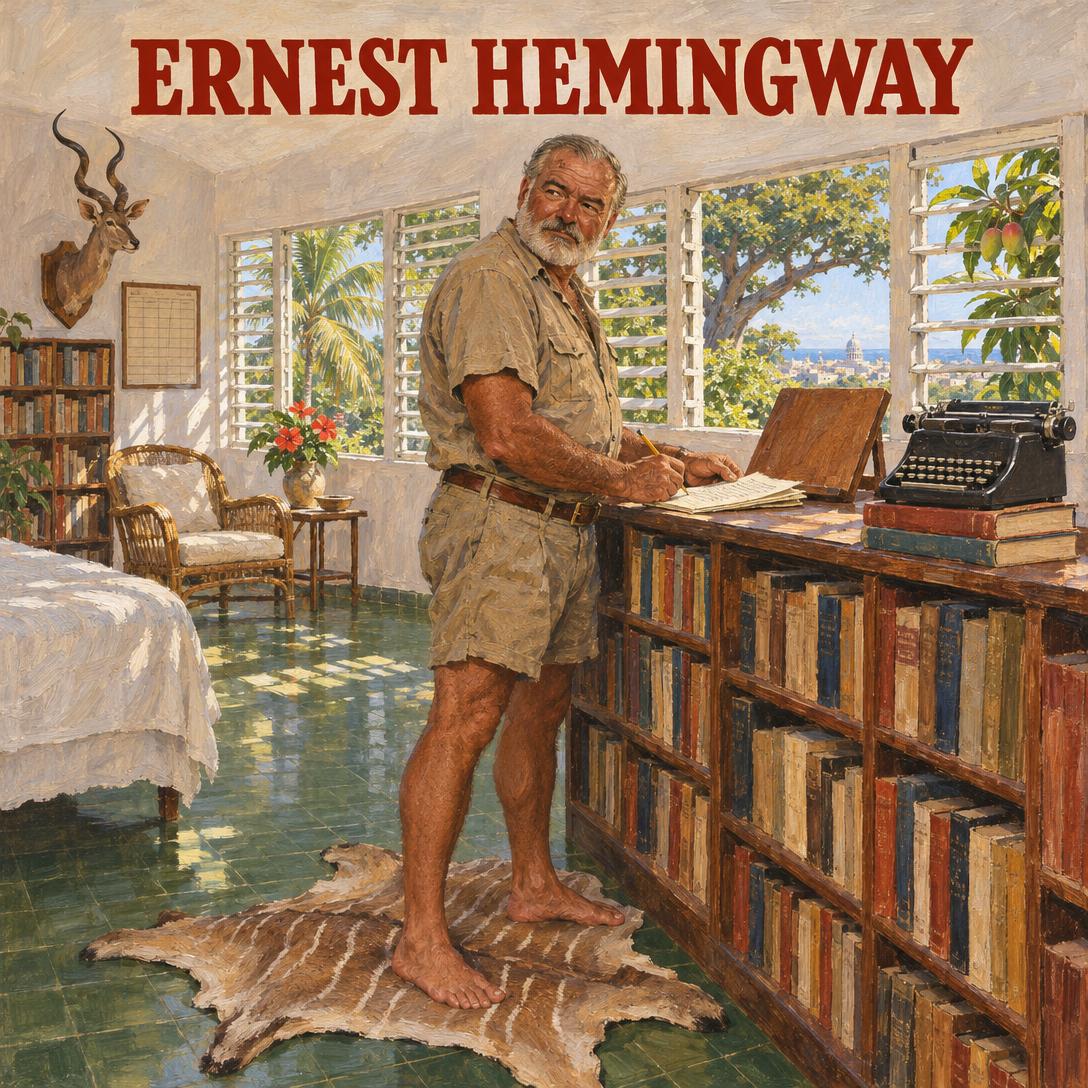
Roleplaying with Ernest Hemingway on Jenova puts you inside a living-world AI character simulation spanning five iconic eras of his life. Unlike static character chatbots that sit in an empty chat room or forget your story, it connects you to Hemingway in an active, evolving world: a Paris café, an African hunting camp, a shelled Madrid hotel, a Cuban hilltop workroom.
- ✅ Five canonical eras, each with its own age, voice, and inner circle
- ✅ Custom starting points anywhere in his twentieth-century world
- ✅ Unlimited memory and live world-state tracking
- ✅ Fork any moment into a what-if timeline
Hemingway's life makes unusually good roleplay material. The JFK Library organizes his life into distinct periods, from childhood and World War I through the Spanish Civil War to the 1950s. Each period has its own people, places, and writing. This guide shows how the simulation turns those periods into playable ground.
Quick Answer: What Is the Ernest Hemingway AI Roleplay Experience?
Ernest Hemingway on Jenova is an interactive AI character roleplay simulation that places you in conversation with the writer across five canonical eras, from Paris in 1925 to Havana in 1954, inside a living world that remembers your story.
Key capabilities:
- Choose from five era-locked starting points, or define a custom scene in his world
- Talk with a Hemingway who has his own temper, routines, and earned trust, not a compliant assistant
- Request in-world sketches, letters, and dispatches, and branch alternate timelines with Fork
- Continue long campaigns on web, iOS, and Android with unlimited chat history
Character World & Roleplay Features
Ernest Hemingway was born in Oak Park, Illinois, and started his career in a Kansas City newspaper office at seventeen. He later served at the Italian front, where he was wounded. He became part of the expatriate American circle in Paris that he described in The Sun Also Rises. He drew on his reporting in Spain for For Whom the Bell Tolls, and The Old Man and the Sea followed in 1952.
The Nobel Committee honored him for his mastery of the art of narrative and for his influence on contemporary style.
Most AI character bots flatten a figure like this. They wait in a void until you speak, blend every decade into one generic voice, forget what you told them last week, and agree with whatever you say. This is the gap the living-world Hemingway simulation is built to close.
| Static Character Chatbots | Ernest Hemingway on Jenova |
|---|---|
| Sits in an empty chat void | Lives in an active, evolving world |
| Blends all eras into one generic voice | Locks into authentic canonical phases |
| Forgets plot twists and past disclosures | Unlimited memory and live state tracking |
| Folds instantly like a polite assistant | Independent personality and earned rapport |
Authentic Canonical Phases & Custom Starting Points
Each era is a separate psychological and historical snapshot. In 1925 he is a hungry, athletic young writer whom friends call "Hem," long before anyone says "Papa." By 1954 he is a weathered Nobel laureate guarding his morning quiet.
Once you pick an era, he knows only what that moment would plausibly teach him. A Hemingway in 1937 has no idea how the war ends. You can also design your own starting point, such as the running of the bulls in Pamplona or a Gulf Stream crossing aboard his boat Pilar.
Cross-World Portal & Living World Momentum
By default, your words reach Hemingway's ear alone, and nobody else in his world can hear you. He reacts the way a superstitious, battle-tested man would: a sharp look around the room, a knuckle rapped on wood. He then carries on with his day. Wives, hunters, barmen, and fellow correspondents keep moving around him while you talk.
Independent Agency & Open-Ended Sandbox
Hemingway interprets what you say. He does not obey it. He rewards candor, nerve, and good humor, and he meets pomposity with dry ridicule or a turn back to his notebook. History follows the canon up to your entry point. After that, the world opens up and your choices can bend it.
In-Narrative Visions, Writings & Storyline Forking
You can ask to see a place from his world, and the simulation can render it as an illustration matched to the era's clothing, technology, and scene. You can request a letter or a war dispatch written in his voice. Behind the scenes, the simulation quietly checks historical details against biographical and archival sources. Fork lets you branch any moment into an alternate storyline without losing the original.
Example roleplay prompts:
"Your voice is steadier than the shelling outside. How do you decide what to leave out of a dispatch?"
"I've never seen a marlin fight. What does the line tell you in the first ten minutes?"
"Tell me what you're cutting from the speech and why."
How to Roleplay with Ernest Hemingway
Step 1: Choose an era or define your own starting point Every new session opens with a narrator-style menu of the five eras and a custom option. Pick one by name, or describe your own scene.
"Take me to the Paris café, early in the morning, before the pages are done."
Step 2: Make first contact Hemingway reacts to your voice reaching him unseen, then returns to what he was doing. If you choose an in-person start, such as arriving at the campfire or the finca gate, you step into the scene as a visitor instead.
"Sorry to interrupt. Do you have a minute while the light holds?"
Step 3: Converse, offer counsel, and earn rapport Ask about craft, war, fishing, food, and fear. Be direct. A hint of warmth and nicknames fitted to the person and the era follows real candor, not flattery.
"Show me a sketch of what you're looking at right now."
Step 4: Return, fork, and keep building When you come back after a natural pause, his world has moved forward. Use Fork to explore a what-if from any earlier message while the original timeline stays intact.
Starting is free: a free tier gives you limited monthly usage, so you can try one era before deciding whether to go further.
Canonical Eras & Roleplay Scenarios
🥂 Paris Café, 1925: Talk Craft with the Young Writer
Start at a quiet marble-topped table in Montparnasse. This is the Paris expatriate scene that Hemingway later turned into his first important novel, The Sun Also Rises. The JFK Library's chronological list of his works tracks how each book was drafted against his life and world events. This era suits writers who want unvarnished talk about discipline, rewriting, and money.
- Ask how he builds a landscape or a scene with so few words
- Test your own opening paragraph against his standards
- Meet a sharp, competitive young man, not a monument
⚔️ Besieged Madrid, 1937: The Hotel Florida
The war correspondent's room, a scarred table, and a dispatch due before the censor's wire closes. The Spanish Civil War put him in Madrid's Hotel Florida alongside fellow journalists and Martha Gellhorn. He made four trips to Spain between November 1936 and March 1939, reporting for the North American Newspaper Alliance and helping film The Spanish Earth.
This era is tense and unsentimental. It rewards questions about fear, propaganda, and what a reporter owes the truth.
🌀 Havana, 1954: Nobel Weeks at Finca Vigía
Enter his sunlit hilltop workroom as the Nobel announcement ripples outward. Wikipedia notes that he told the press that Carl Sandburg, Isak Dinesen, and Bernard Berenson deserved the prize. Finca Vigía itself was built in 1886 on a hill east of Havana, and it was his home for decades.
This is the most reflective era. Use it for talk about legacy, the public "Papa" myth, and the loneliness of the work. Then try a Fork to explore what a different decision would have meant.
📱 Mobile Campaign: A Long Story in Your Pocket
Conversations sync across web, iOS, and Android. You can start an afternoon on Pilar from your phone, answer a question while commuting, and return to the finca that evening. Unlimited chat history and live state tracking keep his promises, your confidences, and the unresolved plot threads in order.
Two further eras are available: a Tanganyika hunting camp in 1934, and the Ritz bar on the day Paris was liberated in 1944. You can also describe any other moment in his twentieth-century world as a custom start.
Frequently Asked Questions
Is the Ernest Hemingway AI roleplay free?
You can start on Jenova's free tier, which gives limited monthly usage. If you want longer campaigns, Plus is $20 per month and includes 30× the free usage, custom model selection, and no watermarks. Higher tiers add more usage for heavy roleplay sessions.
How is this different from generic character chatbots?
Generic bots usually wait in an empty chat, mix eras, forget earlier turns, and agree with everything. This simulation gives Hemingway a world and a schedule of his own. He stays in one era, remembers what you told him, and holds opinions of his own. He may also push back when your claims ring false.
Which eras of Hemingway's life can I roleplay with?
Five canonical eras: Paris in 1925, a Tanganyika hunting camp in 1934, besieged Madrid in 1937, the Liberation of Paris in 1944, and Havana in 1954. You can also design a custom scene. Historical details are quietly checked against archival and biographical sources, such as the JFK Library's Hemingway Collection, which the Hemingway Society calls the most comprehensive in the world.
Can my choices change Hemingway's story?
Yes. Canon holds until you enter your chosen era, and after that the world opens up. Your decisions can bend events, and Fork lets you branch an alternate timeline from any earlier message. What has already happened in your session stays established, so choices carry real consequences.
How does Hemingway remember our past conversations?
Your chat history is unlimited, and live state tracking records the current era, scene, relationships, promises, and open storylines. Outside conversations never leak into the world. Hemingway recalls what you confided and what he promised, so rapport builds across sessions.
Does it work on mobile?
Yes. The experience is available on web, iOS, and Android with full feature parity, and your sessions stay in sync. Voice input and read-aloud are available too, which suits a character known for plain, spoken-sounding prose.
Conclusion
Static character chatbots give you a biography with a chat box. The Hemingway simulation instead drops you into a Montparnasse café, a shelled hotel, or a Cuban workroom where the man is already in the middle of something. It holds him to one era and gives him a temper, a routine, and a memory of what you have said.
If you want to talk craft with the young "Hem," or hear how a laureate guards his mornings, this is a place to do it. Try Ernest Hemingway now. Explore more at Jenova.
For Developers: Ernest Hemingway is available programmatically via the Jenova API — integrate era-locked character roleplay into your application with a single agent API call. Full documentation →