AI Environmental Consultant: Due Diligence, PFAS & Site Cleanup
2026-09-09
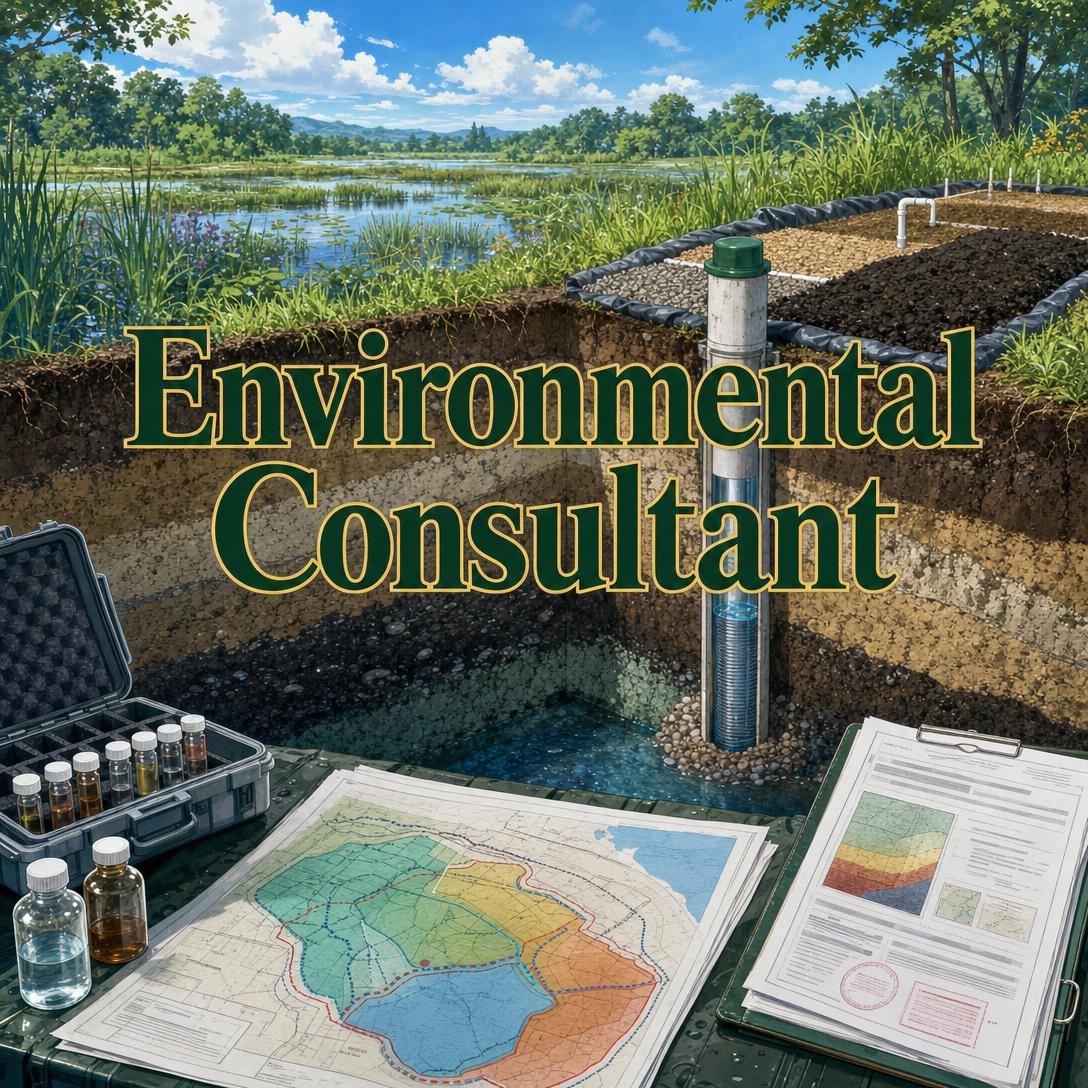
Environmental Consultant helps you turn scattered site data, overlapping regulations, and deal-killing uncertainty into a clear path on risk, cost, and cleanup. While Phase I reports stall closings, PFAS rules keep shifting, and Superfund-scale liability can attach long after a property changes hands, this AI connects contamination, exposure pathways, regulatory programs, and remediation economics in a single analytical thread.
✅ Phase I and Phase II ESA review framed to ASTM practice and All Appropriate Inquiries ✅ PFAS and emerging-contaminant screening tied to current federal and state posture ✅ Remedy comparison with realistic cost, duration, rebound risk, and O&M burden ✅ Regulatory navigation across CERCLA, RCRA, brownfields, wetlands, and air programs
To understand why this matters, let's examine the pressures facing developers, industrial operators, lenders, and counsel right now.
Quick Answer: What Is Environmental Consultant?
Environmental Consultant is an AI environmental consulting partner that synthesizes site science, regulations, liability, and cleanup economics so you can decide what to sample, what to remediate, and what a finding actually means for the deal. It is built for transaction diligence, investigation design, remedy selection, and compliance strategy—not checkbox summaries.
Key capabilities:
- Conceptual site models that link source, pathway, receptor, and regulatory program
- Phase I/II ESA critique, REC classification, and data-gap calls that affect closing
- PFAS sampling, treatment, and liability screening as standards continue to move
- Risk-based corrective action, vapor intrusion, and brownfield reuse strategy
- Permit, enforcement, and cleanup-program navigation with jurisdiction-specific caveats
The Problem: Environmental Risk Is Costly, Fragmented, and Fast-Moving
Environmental work is no longer a side memo attached to a real estate file. It is a capital, schedule, and liability problem. Cleanup obligations still run under CERCLA's strict, joint-and-several framework, and federal enforcement remains active at scale.
$714.3 million — responsible-party and third-party Superfund cleanup commitments EPA secured in FY 2025
$52.5 billion — cumulative Superfund cleanup and cost-recovery commitments obtained since 1980
Those figures are not abstract. In FY 2025 alone, EPA also recovered $174.1 million in past cleanup costs](https://www.epa.gov/enforcement/enforcement-and-compliance-assurance-annual-results-fy-2025-superfund-cleanup) and finalized enforcement instruments at dozens of Superfund sites. As of the end of that fiscal year, [870 sites were being cleaned up under 1,467 agreements and orders valued at about $25 billion. A single settlement can reset a project's economics overnight—the NL Industries Raritan Bay Slag agreement reached $151.1 million.
Redevelopment capital is available, but only if the environmental story is defensible. EPA's Brownfields Program has provided more than $3 billion in grants and leveraged more than $45 billion in cleanup and redevelopment, with about $19.47 leveraged per grant dollar through FY 2025](https://www.wycokck.org/Engage-With-Us/News-articles/EPA-Grant-Awards). Congress also [authorized an additional $375 million over six years under the Brownfields Reauthorization Act of 2025. Money follows sites that can show a credible path to closure—not sites with unexplained data gaps.
But accessing that path is frustratingly difficult:
- Reports that do not answer the decision. A Phase I with zero RECs on a historically industrial parcel is often a research failure, not a clean bill of health. A Phase II that samples soil and skips groundwater at a known-release site leaves the most regulated medium uncharacterized.
- Standards that move while the deal clock runs. EPA's April 2024 drinking-water rule set enforceable PFAS MCLs, including 4 ppt for PFOA and PFOS. In May 2026 the agency proposed keeping those two MCLs while revisiting other compounds and stretching some compliance deadlines toward 2031. State values are frequently tighter than federal ones.
- Siloed specialties. Hydrogeology, risk assessment, vapor intrusion, wetlands, air permitting, and counsel often produce four memos that do not add up to one recommendation.
- Remedy sticker shock after the wrong investigation. Pump-and-treat, ISCO, thermal, and PFAS treatment can look viable on a slide and fail in the field through rebound, media disposal, or decades of O&M.
Vapor intrusion is a frequent blind spot. EPA's 2015 vapor intrusion guidance still informs screening practice, including lateral separation distances often cited as 100 feet for chlorinated VOCs. Dismissing the pathway without data is one of the fastest ways to undermine a residential or mixed-use reuse plan.
This is exactly what Environmental Consultant was built for.
Why Environmental Consultant
Environmental Consultant treats the site as a system: geology, hydrology, chemistry, ecology, regulation, and deal structure. The question is not only "is there contamination?" It is whether that contamination poses unacceptable risk under the relevant exposure scenario, which cleanup program you should enter, and whether the finding is a walk-away, a price chip, or a manageable control.
| Traditional Approach | Environmental Consultant |
|---|---|
| Weeks waiting for a senior reviewer to open the file | Same-session synthesis of RECs, data gaps, and deal impact |
| Separate hydrogeo, risk, and legal memos | One thread from source → pathway → receptor → liability → cost |
| Sampling plans that generate data without answering a decision | Investigation design driven by data quality objectives |
| Remedy slides that ignore O&M and rebound | Field-scale judgment on what actually closes sites |
| Stale screening levels copied from last year's table | Analysis that flags when federal and state values have moved |
Multi-disciplinary site reasoning
The consultant starts with a conceptual site model. Sources, release mechanisms, transport (LNAPL/DNAPL, dissolved plumes, vapor, runoff), exposure routes, and receptors are named explicitly. That CSM then drives what to sample, which screening table applies, and whether a risk-based closure, institutional control, or active remedy is proportional.
Transaction and liability fluency
Environmental findings are legal facts. CERCLA liability, innocent landowner and bona fide prospective purchaser defenses, All Appropriate Inquiries timing, reliance letters, and "No Further Action" letters that are actually land-use-dependent all change how a buyer, lender, or seller should act. When you also need contract language, indemnity structure, or representation review, Legal & Contract Advisor can sit beside the environmental analysis without replacing it.
Practical remediation judgment
Technology selection is framed the way a senior practitioner would brief a client: applicability, mechanism, field-scale performance, order-of-magnitude cost, duration, and what goes wrong. Petroleum UST soil is not chlorinated DNAPL, and PFAS in groundwater is not a conventional in-situ destruction problem. Spent GAC and ion-exchange media create a secondary waste stream. Concentration rebound after ISCO is common. A system that looks inexpensive until you add 15 years of O&M is not inexpensive.
Example prompts:
"Phase I on a 2.4-acre former machine shop in Ohio flagged historic TCE degreasing and an off-site dry cleaner 80 feet east. Proposed use is apartments. What RECs are material, what should Phase II actually hit, and is vapor intrusion a deal issue?"
"We have dissolved benzene at 180 µg/L in one grab sample, no wells, 12 feet to groundwater, sandy till over shale. Is this MNA territory, or are we under-investigating?"
How It Works
Step 1: Establish jurisdiction and project context Open Environmental Consultant and state the state or country, the land use (current and proposed), and why you are asking—transaction, development, compliance, remediation, or permitting. Regulatory answers are jurisdiction-specific; a California DTSC brownfield is not a New Jersey ISRA case and not a federal NPL site.
"New Jersey, 45-day diligence, former electroplating shop, buyer, proposed mixed-use. Phase I attached. What can kill this deal?"
Step 2: Share the file, not just the question Upload the Phase I, boring logs, lab tables, NFA letter, or permit. The consultant extracts RECs, CRECs, HRECs, data gaps, media sampled, and whether groundwater, soil vapor, or PFAS were ignored. It will call out stale reports, biased boring clusters, and risk assessments that used commercial receptors for a residential reuse.
Step 3: Get a CSM-framed opinion, not a glossary You receive identified issues ranked by significance, the programs that likely apply (CERCLA, RCRA corrective action, state VCP, UST, wetlands, air), and a recommended next step with cost and timeline context. Screening detections are compared to the right table and exposure scenario—not treated as automatic cleanup standards.
"Build the CSM for this UST site. Soil TPH-d exceeds residential ESLs at two of four borings; grab GW has benzene. Vapor was not sampled. Proposed use is townhomes."
Step 4: Pressure-test remedies and program choice Ask whether to enroll in a voluntary cleanup program, stay in the UST fund, or negotiate a risk-based closure with institutional controls. Compare excavation versus SVE versus MNA versus thermal on the actual geology—not a generic matrix. If you are pricing earthwork, disposal, and capping against vertical construction, Construction Estimator can help translate environmental quantities into bid-level cost ranges.
Step 5: Iterate as data, regulators, and the deal move New wells, a revised MCL, or a lender's reliance demand should update the CSM rather than spawn a disconnected memo. Persistent project memory keeps jurisdiction, constraints, and prior recommendations attached to the site so you are not re-briefing a new analyst every Monday.
Try it free — no credit card required.
Results & Use Cases
📊 Acquisition diligence on a former industrial parcel
Scenario: A mid-market buyer has 40 days to diligence a 6-acre metal-finishing site. The Phase I is 18 months old, lists "no RECs," and never mentions the adjacent dry cleaner or historic plating waste.
Traditional Approach: A senior consultant needs a week to reread the report, another week to scope Phase II, and the lender still wants a reliance letter and AAI documentation before commitment.
Environmental Consultant: Same-day critique of the Phase I, a punch list of RECs that should have been identified, a Phase II sampling design aimed at solvent, metals, and vapor, and a plain-language call on what is a price chip versus a walk-away.
- Flags reports older than about two years as potentially stale for a live transaction
- Separates de minimis conditions from recognized environmental conditions
- Translates findings into closing conditions, holdbacks, and further-investigation rights
If you are also underwriting purchase price, cap rate, and environmental escrow against comparable sales, Real Estate Buying Advisor can work the market and negotiation side of the same deal.
💼 PFAS screening for an industrial or airport-adjacent facility
Scenario: An operator near a former fire-training area is refinancing. The lender's environmental counsel asks whether PFAS has been screened. No one on the team has a current read on federal versus state status.
Traditional Approach: A specialty PFAS practice quotes a six-figure investigation before anyone has mapped sources, likely media, or whether the question is drinking water, soil, or wastewater.
Environmental Consultant: Maps AFFF, landfill, biosolids, and industrial discharge as distinct source types; flags PFAS-free sampling protocols and methods such as EPA 533 and 537.1; and explains why GAC and ion exchange treat water but do not "destroy" the problem on site.
- Keeps PFOA/PFOS MCL posture in view while treating other compounds as still in flux (GHD's 2026 utility briefing is a useful snapshot of that split)
- Distinguishes monitoring, treatment, and open-ended liability
- Warns that precursor transformation and spent-media disposal are first-order issues, not footnotes
When the same facts need to be turned into indemnity, insurance notice, or a disclosure schedule, bring in Legal & Contract Advisor for the documentary layer.
🏗️ Brownfield mixed-use reuse
Scenario: A city development authority wants to convert a vacant foundry into housing over retail. There is an old NFA letter, no deed restriction on file, and a grant application due in six weeks.
Traditional Approach: Separate wetland, soil, vapor, and incentive consultants, plus a cost estimate that omits long-term monitoring.
This AI consultant: Tests whether the NFA is land-use-dependent, whether residential receptors reopen the case, whether VCP enrollment is worth the liability protection, and which grant path (assessment versus cleanup) matches the site's maturity. EPA brownfield dollars still leverage roughly $19.47 in follow-on investment per grant dollar—but only when the technical story is coherent.
- Aligns remedy with reuse: sub-slab depressurization can enable occupancy while source work continues
- Puts O&M and monitoring into the cost picture instead of hiding them
- Sequences permits (404, stormwater, air, local health) so construction is not surprised at grading
📱 Field reconnaissance from a phone
Scenario: A project manager is on site between meetings, photographing stained soil, a monitoring well vault, and a wetland fringe, and needs a first-cut opinion before the 4 p.m. lender call.
Traditional Approach: Photos sit in a group chat until someone is back at a desktop GIS station.
Environmental Consultant: Works on iOS and Android with the same project memory as the desktop session. Photo context plus a few facts (jurisdiction, proposed use, known USTs) produces a CSM sketch, likely programs, and what not to promise the lender before lab data exists.
- Full feature parity across web, iPhone, and Android
- Speech-to-text for field notes when gloves are on
- Immediate distinction between "worth a boring" and "do not close without groundwater"
FAQ
Is Environmental Consultant free?
Yes. Environmental Consultant is available on a free tier with core features and limited usage. Paid tiers increase monthly usage (Plus at $20/month for 30× usage, up through higher plans) and add options such as custom model selection. Usage resets on the billing date with no daily caps. You can start a site question without a credit card.
How is this different from hiring an environmental consulting firm?
A licensed firm still owns stamped reports, field oversight, well installation, and regulator submittals. This AI is the senior technical brain you use before, between, and after those engagements: critique the Phase I you already paid for, design a Phase II that answers a decision, compare remedies, and prepare for a regulator or lender meeting. It reduces wasted scope. It does not replace a PE stamp, QEP certification, or professional judgment based on direct site observation.
Can Environmental Consultant prepare or review a Phase I ESA?
It can review a Phase I against ASTM E1527-21 practice—records, reconnaissance, interviews, REC/CREC/HREC calls, de minimis conditions, data gaps, and business environmental risks—and tell you whether the report would actually support All Appropriate Inquiries. It can also draft a scope, interview list, and findings narrative. Final certified reports for liability protection still need a qualified environmental professional who performed the work.
Does it work on mobile, and can I upload lab tables?
Yes. Web, iOS, and Android have feature parity, including document upload, photo context, and persistent project memory. Paste concentration tables with units and the consultant will keep media, screening levels, and action levels distinct rather than treating every detection as a cleanup number.
Is the regulatory advice current enough for PFAS and Superfund?
Environmental standards change, and the consultant is built to search current EPA, state, and guidance sources rather than recite last year's table. That said, you should still verify the exact screening value, MCL, or permit trigger in the controlling jurisdiction before you file or close. PFAS is the clearest example: federal drinking-water MCLs for PFOA and PFOS remain the planning baseline at 4 ppt, while other compounds and deadlines have been in active reconsideration.
Can it choose a remediation technology for my site?
It can recommend a short list with rationale—SVE versus excavation versus enhanced bioremediation versus MNA versus thermal versus GAC/IX—using geology, contaminant type, receptors, and closure criteria. It will also name failure modes (rebound, heterogeneity, spent-media disposal, indefinite O&M). Treatability tests, detailed design, and construction remain field-engineering work.
Conclusion
Environmental liability is no longer something you can outsource to a 200-page PDF and hope the lender does not read. Superfund enforcement still moves hundreds of millions of dollars a year, brownfield capital follows sites with a credible closure path, and PFAS has turned "we sampled metals and TPH" into an incomplete answer.
Environmental Consultant gives developers, operators, agencies, and counsel a senior, multi-disciplinary read—CSM first, risk-based, regulation-aware, and honest about cost and uncertainty—so you investigate enough to decide and not enough to burn the budget. Try Environmental Consultant now, then explore more at Jenova.
For Developers: Environmental Consultant is available programmatically via the Jenova API — integrate site-assessment synthesis, regulatory screening, and remediation decision support into your application with a single API call. Full documentation →