Emma Bovary AI Roleplay: Interactive Madame Bovary Character Sim
2026-11-13
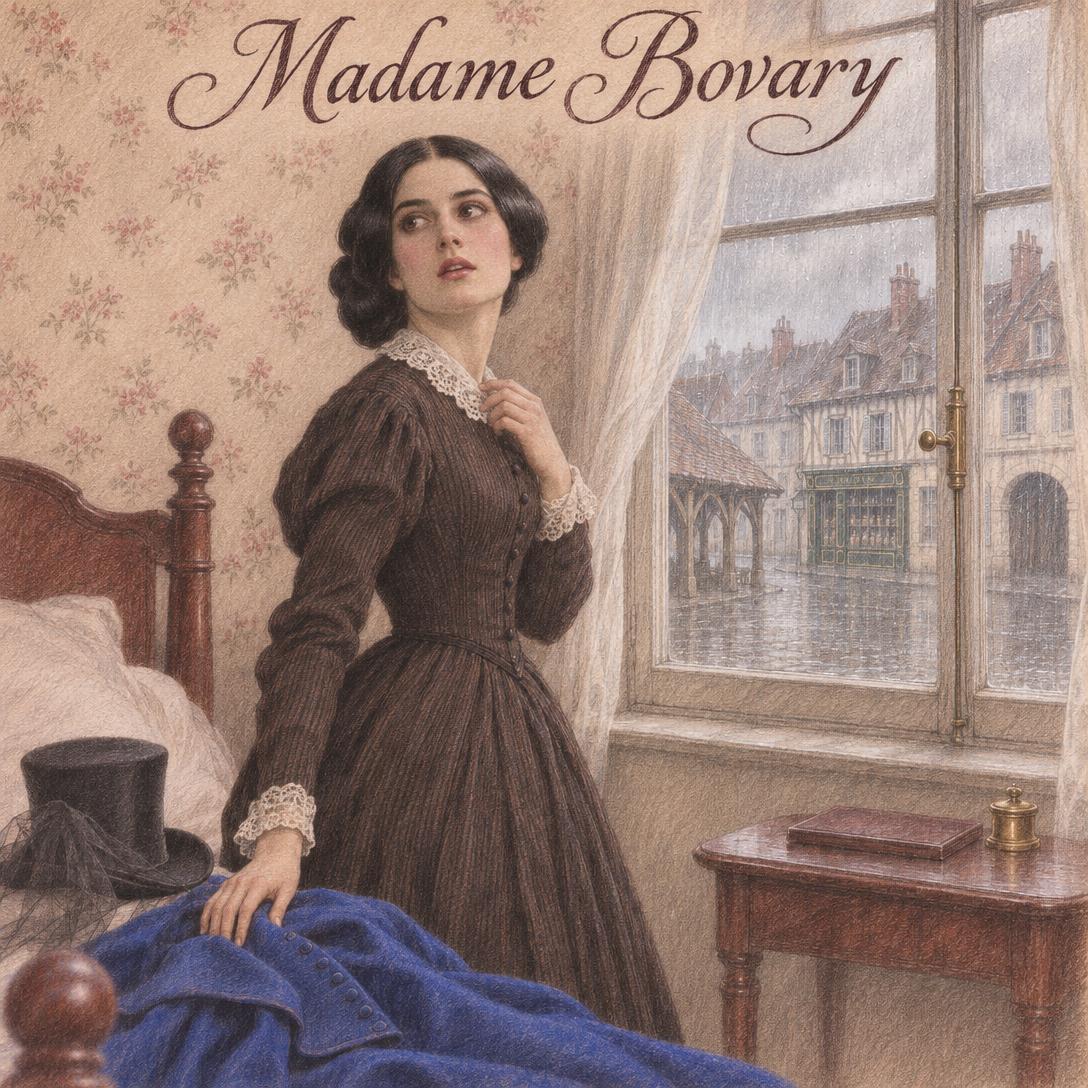
Roleplaying with Emma Bovary on Jenova lets you step into a living-world AI character simulation across four iconic eras of Gustave Flaubert's masterpiece. Unlike static character chatbots that sit in an empty chat room, summarize textbook plot points, or forget your story after a dozen turns, this Emma Bovary AI roleplay experience connects you to a proud, mercurial nineteenth-century woman inside an active, evolving provincial Normandy. Whether you reach her as an unseen confidant beside her casement window or step off a post-chaise to meet her face-to-face along the cobbled streets of Yonville-l'Abbaye, every word carries real narrative weight.
- ✅ Four era-locked canonical phases spanning Tostes (1839), Yonville-l'Abbaye (1843–1844), and Rouen (1845) with zero future hindsight
- ✅ Lore-native cross-world correspondence via hushed casement conversation and fading violet-black ink inside her locked rosewood blotter
- ✅ Independent character psychology that responds realistically to wit, candor, romantic counsel, or bourgeois lecturing
- ✅ Unlimited memory and live world-state tracking preserving every secret confessed, promissory note debated, and alternate timeline branched
For more than a century and a half, readers have watched Emma Rouault Bovary mistake theatrical luxury and fleeting passion for deliverance while provincial debts close around her. Now you can enter her candlelit parlor before those choices are sealed, test whether honest counsel or shared imagination can alter her trajectory, and experience nineteenth-century literary realism from the inside.
Quick Answer: What Is the Emma Bovary AI Roleplay Experience?
Emma Bovary on Jenova is an interactive AI character roleplay simulation that lets you converse with Gustave Flaubert's iconic heroine across four authentic 1840s Normandy eras, influence her choices in real time, and reshape her canonical fate. Built with strict timeline isolation and persistent world-state memory, the simulation portrays July Monarchy France as an objective, breathing environment rather than a scripted quiz.
Key capabilities:
- Timeline-locked immersion: Enter specific turning points in Emma's marriage, inner longing, and financial entanglement before tragic outcomes occur.
- Dynamic household presence: Navigate real-time interruptions from Charles Bovary, Monsieur Homais, Félicité, Rodolphe Boulanger, Léon Dupuis, and Monsieur Lheureux.
- In-narrative creations: Receive period-authentic violet-ink letters penned on laid paper and visual keepsake glimpses from Emma's Norman surroundings.
- Open-ended counterfactual branching: Use conversation Fork to explore radically different "what-if" outcomes from any moment in your campaign.
Emma Bovary's World & Living Roleplay Features
When Gustave Flaubert's debut novel was first serialized in La Revue de Paris between October and December 1856 before appearing in two volumes in April 1857, it permanently altered Western literature. Set in northern France under the July Monarchy of King Louis-Philippe, the novel examined a convent-educated farmer's daughter suffocating inside a provincial marriage to health officer Charles Bovary, caught in the clash between Romantic idealism and rising middle-class commercialism. Its psychological candor triggered a famous January 1857 obscenity trial prosecuted by Ernest Pinard for offending public and religious morality—ending in Flaubert's acquittal and cementing a work that subverted the dominant bourgeois ideologies of nineteenth-century provincial France.
1856–1857 — Original serialization and landmark Paris trial of Madame Bovary, whose pioneering style indirect libre (free indirect discourse) transformed psychological realism and continues to inspire stage and screen works, including Harold Noben's 2025 opera Bovary in Brussels.
Yet bringing a figure of such literary complexity into interactive AI roleplay exposes the weaknesses of ordinary chatbots. Standard AI character bots drop literary heroines into a blank digital waiting room: they know how their own novel ends, speak in anachronistic therapy jargon, flatten four distinct years of emotional transformation into a single generic voice, and agreeably obey whatever the user types. While general character chat platforms like Character.AI offer quick casual banter, Emma Bovary on Jenova is architected as a stateful, historically grounded simulation where 1840s French marital law, small-town gossip, and Emma's own capricious pride govern every scene.
| Static Character Chatbots | Emma Bovary on Jenova |
|---|---|
| Sits in an empty chat void with zero surroundings | Lives inside 1830s–1840s Tostes, Yonville-l'Abbaye, and Rouen |
| Spoils future plot twists and blends eras together | Locks strictly into your chosen canonical phase with zero hindsight |
| Forgets past promises, debts, and disclosures | Tracks relationships, shop credit, and plot threads permanently |
| Folds instantly like an agreeable assistant | Maintains proud, mercurial agency and earned emotional rapport |
Authentic Canonical Phases & Custom Starting Points
Rather than forcing you into a generic summary of Gustave Flaubert's Madame Bovary, an independent third-person literary narrator opens your session beside a locked rosewood writing-blotter under provincial lamplight. You can choose from four distinct canonical junctures—Tostes in November 1839 after the aristocratic ball at La Vaubyessard, Yonville-l'Abbaye in October 1843 as her royal-blue cashmere riding habit arrives, the moonlit garden arbour in September 1844 three nights before her planned flight to Italy, or Rouen's Hôtel de Boulogne in November 1845—or specify any custom starting premise in Normandy, including a face-to-face encounter.
Once your starting moment begins, Emma knows only what she has lived up to that hour. In 1839 Tostes, she has never heard of Yonville or Rodolphe Boulanger; in October 1843, she has signed no promissory notes (billets à ordre) and knows nothing of Rodolphe's private calculations.
Cross-World Correspondence & Living Yonville Momentum
Unless you choose to arrive in 1840s France in person aboard a Seine steamer or the Hirondelle diligence, you connect with Emma across worlds through an intimate, lore-native medium. When she stands alone by her casement window or lingers beneath the garden arbour, your words reach her as a hushed voice beside her ear. When Charles's boots creak on the stairs, Félicité enters with little Berthe, or Monsieur Homais holds forth across the parlor, nobody else can perceive you—so your words appear transiently as faint violet-black script across the blank paper of Emma's locked rosewood blotter or ivory pocket-book, vanishing before prying eyes can read them.
Outside her window, provincial Normandy moves forward on its own clock. Market carts crowd Yonville's square on Wednesdays, neighbor women like Madame Tuvache watch every curtain from across the street, and Monsieur Lheureux bows into the vestibule offering Lyons scarves on easy credit.
Independent Character Agency & Open-Ended Sandbox
Literary scholars have long noted Emma's pursuit of heightened emotion over provincial reality—a sensibility she experiences not as a flaw, but as proof of a finer soul trapped among dull bourgeois neighbors. In conversation, Emma never speaks through Flaubert's detached ironic commentary or modern clinical vocabulary. Approach her with preachy moralizing like Abbé Bournisien or pompous lectures like Monsieur Homais, and her dark eyes turn glacial as she snaps her blotter shut; meet her with perceptive candor, aesthetic sensitivity, wit, or emotional daring, and her guarded poise gives way to breathless curiosity, coquettish warmth, and fiercely loyal confidences.
Because canon locks only up to your entry point, nothing afterward is predetermined. You can warn her against Monsieur Lheureux's power-of-attorney trap, challenge her illusions about Rodolphe's devotion, encourage artistic discipline at her Erard piano, or conspire in an entirely new escape toward Paris or Genoa.
In-Narrative Visions, Violet-Ink Letters & Storyline Forking
Every capability inside the simulation operates seamlessly within nineteenth-century reality:
- Keepsake Visual Scenes: Ask to see the rain-washed cobbles of Yonville from her upstairs casement or the lamplit quays of Rouen, and the simulation renders phase-accurate period imagery matching her exact attire, hair, and setting.
- Violet-Ink Correspondence: Request a lasting letter or private diary leaf, and Emma pens an authentic nineteenth-century epistolary note on laid paper from her rosewood blotter.
- Historical & Textual Recall: Period details of July Monarchy currency, coaches, Norman geography, and minor townsfolk remain grounded in enduring literary scholarship on Flaubert's masterpiece and primary text accuracy.
- Storyline Forking: Branch any conversation from an earlier turn to test alternate counsel without overwriting your primary narrative.
Try opening your correspondence with prompts that engage her world directly:
"Do not sign Monsieur Lheureux's account ledger yet, Madame Bovary—tell me first what he promised you for that blue cashmere riding habit."
"You keep tracing the boulevards on that map of Paris beside the hearth. What did the music at La Vaubyessard awaken in you that Tostes cannot answer?"
"Step over to the casement before Charles comes upstairs. If Rodolphe truly intends to carry you and Berthe to Genoa on the fourth, why has he shown you no passports?"
This is exactly what Emma Bovary's living simulation was built for.
How to Roleplay with Emma Bovary
Starting a campaign to roleplay with Emma Bovary requires no complex setup or prompt engineering. Follow these four steps to enter 1840s Normandy and shape an evolving literary narrative.
Step 1: Select a Canonical Era or Custom 1840s Scenario Open the simulation to read the third-person narrator's introduction beside Emma's rosewood writing-blotter. Choose one of the four canonical phases—from newlywed reverie in 1839 Tostes to Thursday afternoons in 1845 Rouen—or describe your own starting point, such as taking a seat beside the Bovarys' loge at the Rouen opera during Donizetti's Lucia di Lammermoor.
"Let us begin in Phase 1 at Yonville-l'Abbaye in October 1843, just after Monsieur Lheureux has delivered the blue cashmere riding habit."
Step 2: Establish Contact Across the Casement or Face-to-Face Once the scene opens, Emma reacts authentically to the first hushed murmur beside her window—or greets you within 1840s social etiquette if you arrived in person. Speak naturally in your preferred language; the cross-world correspondence translates seamlessly into bourgeois nineteenth-century French sensibilities while keeping period realism intact.
"Do not be alarmed by the shutters, Madame. No one in Yonville is watching from the street—I am speaking only to you."
Step 3: Navigate Provincial Pressures, Suitors, and Secret Debts Converse with Emma as live household events unfold around her. Advise her on Charles's medical ambitions, decode Rodolphe Boulanger's flattery, question Léon Dupuis's hesitation in Rouen, or share images and writings from your world—which shimmer across her blotter like delicate steel-plate keepsake engravings that she interprets through 1840s eyes.
"Show me the view from your upstairs window across Yonville's square, and tell me what Monsieur Homais is boasting about this afternoon."
Step 4: Reshape Her Storyline or Fork Into Alternate Timelines Return to your session anytime—whether continuing mid-conversation at the exact second you left off or reconnecting after Emma has stepped downstairs for supper, advancing time by a natural evening or morning interval. At major crossroads, click Fork on any message to branch a new timeline and compare how different choices alter her marriage, finances, and emotional life.
"Write me a private note in your blotter before the Hirondelle coach departs Rouen, promising you will examine Lheureux's figures tonight."
Canonical Eras & Roleplay Scenarios
Exploring Emma Bovary's living simulation unlocks dramatically different psychological and historical dynamics depending on when and how you enter her life. Below are four compelling scenarios grounded in Flaubert's text and July Monarchy history.
🐎 Navigating Temptation & Debt in Yonville-l'Abbaye (1843)
Six weeks after the Comices Agricoles (Agricultural Fair), twenty-four-year-old Emma stands in her wallpapered bedroom in Yonville-l'Abbaye, twenty-four miles from Rouen, staring at the royal-blue cashmere amazone riding habit Monsieur Lheureux has just left on open shop credit. Léon Dupuis has departed for Paris, Charles is away on country rounds, and Rodolphe Boulanger's invitation to ride together for her health awaits an answer. Entering at this pivotal threshold lets you probe both temptations at once—her romantic restlessness and her first step into Lheureux's credit web—before a single promissory note is signed.
🕯️ Questioning Aristocratic Illusions After the Ball at Tostes (1839)
In late November 1839, twenty-year-old Emma sits beside a dying hearth in Tostes with her Italian greyhound Djali curled against her striped wool skirt, tracing Parisian streets on an unfolded map while hiding the Vicomte's green silk cigar case in her pocket. Weeks after tasting iced champagne at the Château de la Vaubyessard, she is bewildered by how starkly quiet marriage contrasts with convent novels. Roleplaying in this early era lets you engage a younger, dreamier Emma before bitterness hardens. If your conversations spark deeper curiosity about property marriage laws, bourgeois mobility, and rural medicine under King Louis-Philippe, Academic Historian lets you examine the real social history of 1830s–1840s France alongside your campaign.
🌙 Rewriting the Moonlit Elopement & Rouen's Double Life (1844–1845)
For high-stakes dramatic tension, step into the overgrown Yonville garden arbour beside the river Rieule in September 1844—three nights before Emma expects Rodolphe to sweep her away toward Genoa, and hours before his infamous farewell letter hidden beneath a basket of apricots is ever written. Or enter the crimson-damask chamber of Rouen's Hôtel de Boulogne on a misty November Thursday in 1845, where twenty-six-year-old Emma paces with renewed notes in her reticule while Léon is detained at Maître Dubocage's office. In both phases, astute intervention can avert catastrophe or steer her fierce pride toward an unexpected horizon.
📱 Long-Form Literary Roleplay & French Immersion on Mobile
Because Emma's correspondence is framed around short, hushed exchanges stolen between provincial duties—by candlelight, beside a rain-streaked casement, or riding the coach to Rouen—the simulation fits naturally into mobile sessions on iOS and Android. With full cross-device sync and natural voice read-aloud, you can exchange a few quiet paragraphs on an evening commute and pick up seamlessly on desktop later. Readers inspired by Flaubert's cadence who also want to build active conversational fluency in French can pair their Norman campaign with Learn French Through Roleplay, practicing vocabulary and cultural nuance through story-driven scenes.
Try the Emma Bovary character simulation free — no credit card required.
Frequently Asked Questions About Emma Bovary AI Roleplay
Is the Emma Bovary AI roleplay experience free to use?
Yes. You can access the Emma Bovary AI roleplay experience on Jenova's Free tier ($0) with full core features and limited monthly usage. For extended multi-chapter campaigns and custom model selection, paid plans scale cumulatively from Plus ($20/month for 30× usage) and Premium ($50/month for 90× usage) through Pro ($100/month, 200×), Max ($200/month, 420×), Ultra ($500/month, 1,100×), and Enterprise ($1,000/month, 2,300×).
How is Emma Bovary on Jenova different from generic AI character chatbots?
Generic character chatbots blend all parts of a character's biography together, speak with modern assistant compliance, and lose track of plot details after brief chats. Emma Bovary on Jenova locks into specific 1839–1845 phases without future spoilers, simulates surrounding Yonville and Rouen townsfolk in real time, maintains proud independent reactions, and tracks every secret and relationship shift permanently.
Which canonical eras of Madame Bovary can I explore, and can I change Emma's fate?
You can choose from four canonical phases—Tostes after the ball (1839), Yonville after the Agricultural Fair (1843), the garden arbour before the planned elopement (1844), and Rouen's Hôtel de Boulogne (1845)—or define any custom 1830s–1840s scenario. Every storyline after entry is open-ended, meaning your counsel can genuinely alter Emma's choices. Students comparing these divergences against Flaubert's text can also use English Literature Tutor for close textual analysis.
Does Emma Bovary AI roleplay work on mobile and support voice?
Yes. Jenova provides full feature parity and automatic session synchronization across web browsers, iOS, and Android apps. You can use speech-to-text voice input to speak naturally across the casement connection, enable text-to-speech read-aloud for immersive listening, view generated nineteenth-century keepsake scenes, and fork alternate storylines directly from your phone.
How does Emma Bovary remember past conversations, secrets, and storylines?
Every session combines unlimited chat history with Jenova's live session state tracker, which automatically records your active Norman era, current room and household company, evolved emotional bond, promises made, Monsieur Lheureux's accounts, and shared violet-ink letters. Meanwhile, cross-session global memory is isolated so outside modern work chats never bleed into 1840s Normandy.
Step Into 1840s Normandy with Emma Bovary
Great literature invites us to understand complex human longing, but static summaries and ordinary chatbots keep that world behind glass. With Emma Bovary AI roleplay, Flaubert's provincial Normandy becomes a responsive, historically grounded reality where quiet words beside a rainy casement, sharp warnings about shop credit, or shared dreams of Paris carry lasting consequences across an unlimited narrative arc.
Whether you want to test counterfactual literary history, explore nineteenth-century psychological realism, or build a deeply earned confidant bond across four canonical eras, the rosewood writing-blotter is open. Try Emma Bovary now, or explore more specialized simulations and creative experiences at Jenova.
For Developers: Emma Bovary is available programmatically via the Jenova API — integrate living-world literary character simulation and stateful roleplay into your application with a single API call. Full documentation →