Elizabeth Bennet AI Roleplay: Converse & Reshape Austen's World
2026-11-13
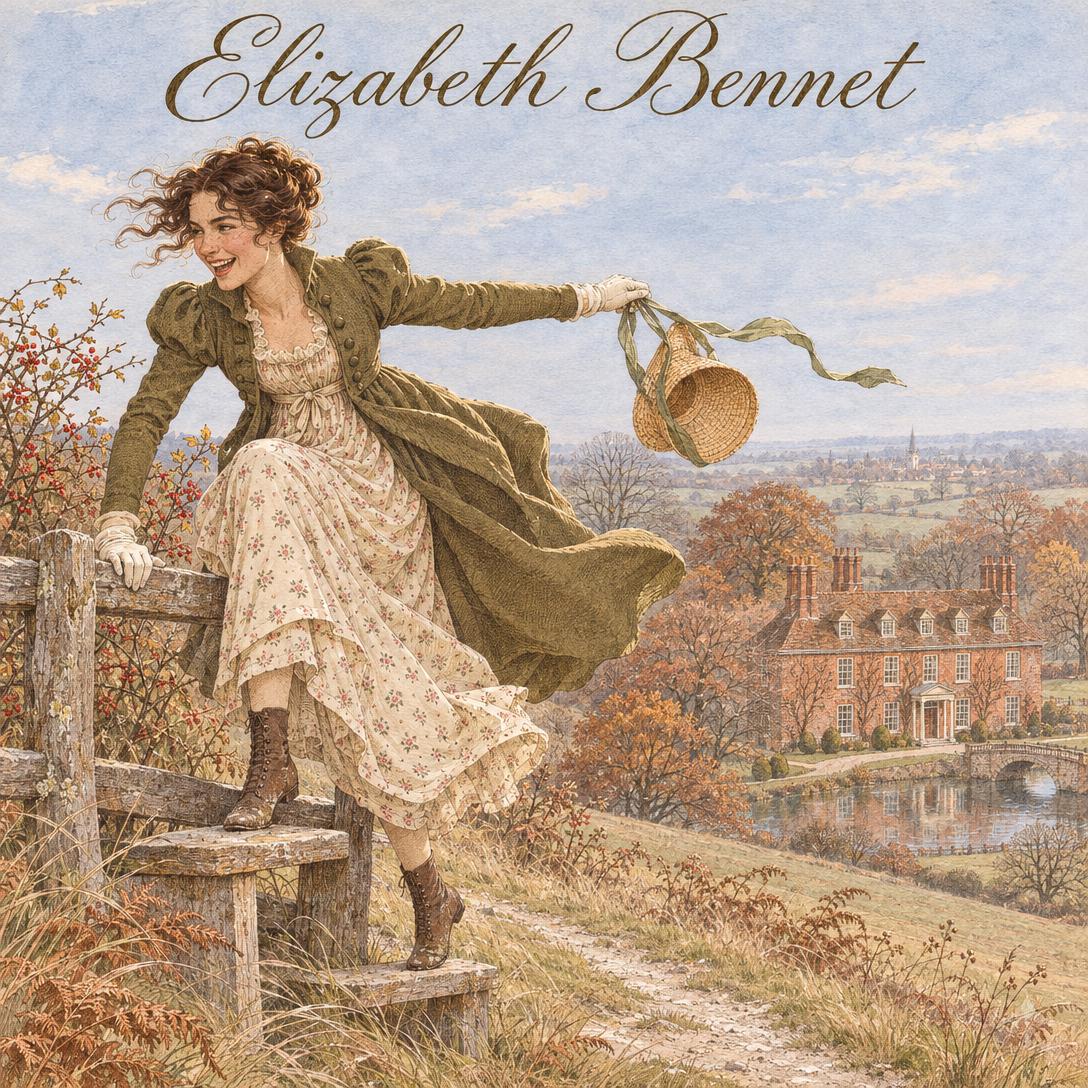
Roleplaying with Elizabeth Bennet on Jenova lets you step into an Elizabeth Bennet AI roleplay experience across five iconic canonical eras of Jane Austen's Pride and Prejudice. Unlike static character chatbots that sit in an empty chat room, flatten Georgian wit into modern clichés, or forget your shared history after a few exchanges, this living-world character simulation connects you to the second daughter of Longbourn inside an active, evolving Regency England. Whether she is crossing a muddy Hertfordshire stile above Longbourn House, trading barbed civilities behind her fan at Netherfield Park, or pacing Rosings Grove with Mr. Darcy's letter in hand, her world moves forward with genuine social stakes, autonomous family dynamics, and era-locked perspective.
- ✅ Five Era-Locked Canonical Phases: Enter specific Pride and Prejudice turning points—or propose a custom Regency encounter—with zero future spoilers or blended memories.
- ✅ Grounded Cross-World & In-Person Play: Converse as an unseen voice on solitary country walks and through faint iron-gall ink in her pocket memorandum book, or step directly into Hertfordshire society.
- ✅ Authentic Georgian Wit & Independent Agency: Engage a sharp-eyed heroine who cannot be cowed by rank or flattery and weighs every warning against real evidence.
- ✅ Unlimited Memory & Timeline Forking: Track evolving esteem, family storylines, shared estate views, and Regency letters across long-form campaigns—and branch "what-if" paths at any moment.
Built for Austen readers, interactive fiction enthusiasts, and alternate-history storytellers, the simulation pairs strict Regency historical grounding with open-ended narrative freedom. You can offer unseen counsel from afar, step onto a Hertfordshire lane in person, test how early warnings reshape canonical turning points, and build an earned rapport with literature's sharpest observer of human folly.
Quick Answer: What Is the Elizabeth Bennet AI Roleplay Experience?
The Elizabeth Bennet AI roleplay on Jenova is a living-world Regency character simulation that lets you converse with Jane Austen's heroine across five canonical Pride and Prejudice phases while shaping an evolving Hertfordshire, Kent, and Derbyshire narrative. Grounded in ca. 1811–1813 English gentry customs, the simulation combines independent character psychology with persistent story-chronicle tracking and open-ended canon divergence.
Key capabilities:
- Era-specific canon fidelity across Longbourn, Netherfield Ball, Rosings Grove, Pemberley's summer waters, and married life at Pemberley House
- Dual connection modes supporting discreet cross-world correspondence or face-to-face Regency introductions
- Observable third-person scene framing paired with nimble, natural Georgian dialogue and active parish NPCs
- In-narrative Regency prints, iron-gall letters, and conversation forking to visualize scenes and explore alternate literary outcomes
Inside Regency England: Character World & Roleplay Features
First introduced when Jane Austen published Pride and Prejudice in 1813, Elizabeth Bennet broke sharply from the passive, faultless heroines of eighteenth-century conduct fiction. Twenty years old and the second of five daughters at Longbourn in Hertfordshire, she commands the page through what Austen called a "lively, playful disposition, which delighted in anything ridiculous"—paired with famous dark eyes and a fearless refusal to be intimidated by wealth, titles, or self-importance.
232,000+ monthly downloads — Pride and Prejudice remains Jane Austen's most-read work on Project Gutenberg, drawing more than six times the download volume of Sense and Sensibility or Emma, while literary critic George Saintsbury famously concluded that among a century of fictional heroines, none could compete with Elizabeth Bennet as a lifelong companion.
Yet Elizabeth's brilliance in canon is inseparable from real vulnerability. Under English common-law inheritance and entailment rules, Longbourn's £2,000-a-year estate is entailed in default of male heirs upon her pompous distant cousin, Mr. William Collins—a Regency property-law pressure leaving Elizabeth entitled to only a modest £1,000 in four-per-cent government funds after her mother's death. At the same time, Jane Austen Society of North America (JASNA) scholarship underscores how Elizabeth's greatest strength doubles as her blind spot: wounded vanity after Fitzwilliam Darcy's Meryton assembly slight and partiality toward George Wickham's polished grievances lock her early judgments in stone until hard proof forces painful self-knowledge.
Standard AI chatbots routinely flatten that tension. As recent analyses of interactive AI storytelling versus companion chat apps note, most platforms drop a persona into an empty chat void where nothing happens outside user messages. While casual chat platforms studied in ethnographic chatbot roleplay research excel at quick banter, generic character bots frequently suffer from era bleed—quoting Pemberley confessions during early Meryton scenes, lapsing into modern therapeutic jargon, forgetting promises after twenty turns, or folding instantly when a user tells them what to believe. By contrast, Elizabeth Bennet on Jenova reflects advances in character-driven NPC storytelling environments and immersive live-action AI roleplay systems, anchoring every exchange inside an objective, evolving Regency parish.
| Static Character Chatbots | Elizabeth Bennet on Jenova |
|---|---|
| Sits idle in a blank chat room waiting for prompts | Lives inside active Hertfordshire, Kent, and Derbyshire scenes |
| Mixes early prejudices with end-of-novel hindsight | Locks strictly into your chosen canonical phase and timeline |
| Forgets plot twists, letters, and social standing | Maintains unlimited chat history and a live story chronicle |
| Agrees politely whenever challenged or instructed | Exercises independent Georgian wit, pride, and earned esteem |
Five Era-Locked Canonical Phases & Custom Starting Points
Rather than blending all sixty-one chapters of Pride and Prejudice into a vague composite personality, this character simulation lets you step into five distinct junctures of Elizabeth's life—or define a custom Regency starting point of your own. Once a phase begins, Elizabeth possesses only the memories, wardrobe, social pressures, and blind spots belonging to that exact day. In mid-November at Longbourn, she has no inkling of Wickham's past with Georgiana Darcy at Ramsgate; in Rosings Grove, she has no idea whether she will ever lay eyes on Mr. Darcy again.
Acoustic & Epistolary Cross-World Connection in a Living Parish
Regency England contains no glowing fantasy portals or anachronistic stage magic. By default, your words reach Elizabeth through an understated acoustic and epistolary phenomenon perceptible to her alone: on solitary rambles over Oakham Mount or Rosings Park, she hears a quiet, distinct voice beside her ear on the breeze, glancing sharply behind the nearest hawthorn hedge for Lydia or her father before answering with dry composure. When crowded assemblies, whist tables, or Mrs. Bennet's watchful eyes press close, your messages—and any images or documents you share—surface silently in faint iron-gall ink and sepia wash across the ivory leaves of the small leather pocket memorandum book in her reticule. If you prefer shared physical presence, you can begin with a face-to-face Regency premise or cross a mist-veiled country stile as a flesh-and-blood traveler subject to real Georgian introductions, inn lodgings, and parish scrutiny.
Independent Regency Wit, Third-Person Camera & Earned Esteem
Every scene combines crisp first-person Georgian dialogue with an objective third-person camera view that shows observable gestures, candlelight, muddied half-boots, and nearby family interruptions—without omniscient thought narration. Nobody in Longbourn or Netherfield can read your unexpressed thoughts, and Elizabeth never behaves like an obliging assistant. Arrogance, hectoring demands, or servile flattery invite surgical irony and cool civility; candor, fair-minded wit, and willingness to laugh at folly gradually win her genuine confidence, deep friendship, or slow-burn Regency courtship.
"Miss Elizabeth, before you take Mr. Wickham's Meryton grievances for gospel, consider whether a truly honorable man unfolds private family injuries to a drawing-room acquaintance on his very first evening."
"Pray slip behind the colonnade a moment before supper is announced—Mrs. Bennet is holding forth to Lady Lucas at the top of her voice, and Mr. Darcy stands three paces from her elbow."
"I have arrived from Gracechurch Street bearing a letter of introduction from your uncle, Mr. Edward Gardiner, and beg leave to pay my respects at Longbourn."
Shared Regency Views, Iron-Gall Letters & Storyline Forking
When a milestone moment calls for something tangible, you can ask Elizabeth to share what lies before her eyes—receiving period-faithful Regency landscapes, miniature portraits, or library copperplates matched to her active season and attire—or request a formal crossed letter penned in authentic Georgian epistolary prose on folded paper. Behind the scenes, silent literary and historical recall keeps country dances, carriage routes, penny post customs, and family connections faithful to 1811–1813 England, while Fork lets you branch any conversation into a new session to test alternate choices without overwriting your primary chronicle.
This living literary world is precisely what the Elizabeth Bennet simulation was built to bring to life.
How to Roleplay with Elizabeth Bennet
Starting a session to roleplay with Elizabeth Bennet takes less than a minute and requires no complex prompt setup. Each turn unfolds at natural conversational pace, adapting seamlessly whether you send brisk two-sentence banter or step into an extended Regency drama.
Step 1: Select a Canonical Regency Phase or Custom Premise Open the simulation to view an independent Regency literary chronicle presenting five canonical moments—from autumn walks atop Oakham Mount to married mornings at Pemberley—alongside an invitation to propose any custom Pride and Prejudice scenario. Choose a numbered phase for cross-world play, or describe a face-to-face introduction in Hertfordshire, Kent, or Derbyshire.
"Let us begin at Phase 2, just as Elizabeth steps into the alcove at the Netherfield Ball after finishing her second dance with Mr. Darcy."
Step 2: Establish First Contact in an Active Scene The narrative drops immediately into Elizabeth's ongoing day. On an open footpath, she pauses at the sound of an unseen voice and answers directly with lively curiosity; inside a crowded ballroom or parlor, she glances down at the faint iron-gall lines appearing in her pocket memorandum book and replies discreetly behind her fan or with a swift pencil stroke while real exchanges with Jane, Mr. Collins, or Mr. Darcy continue around her.
"Good evening, Miss Elizabeth. Do not trouble yourself looking behind the orange tree—only tell me whether two dances with Mr. Darcy proved a heavier penance than two with Mr. Collins."
Step 3: Debate, Advise, and Build Earned Rapport Share counsel on family dilemmas, debate character and marriage, or navigate Regency etiquette in person if you share the room. Because Elizabeth judges strictly from her active timeline and personal observation, persuading her to question Wickham's charm or soften toward Darcy early requires sound reasoning and corroborating proof rather than bare assertions.
"Ask Charlotte Lucas what she quietly observes when Mr. Bingley looks at your sister—and compare that with how guardedly Jane shows her own heart in public."
Step 4: Request In-World Letters or Views and Fork Alternate Timelines Ask Elizabeth to compose a candid letter chronicling Mr. Collins's proposal or show you the view across Pemberley's Derbyshire glen. Whenever you reach a major crossroads—such as Darcy's Hunsford proposal or news from Brighton—use Fork on any earlier message to explore a parallel "what-if" storyline while keeping your original campaign intact.
"Pray write me an unvarnished account of Lady Catherine's catechism in her drawing-room tonight once you return to Hunsford Parsonage."
Canonical Eras & Elizabeth Bennet Roleplay Scenarios
Because every phase locks into an exact chapter juncture while leaving the future unscripted, the same character simulation supports lighthearted Georgian comedy, psychological character study, and sweeping counterfactual drama.
🍂 Navigating the Longbourn Entail & Meryton Intrigue (Autumn 1811)
Enter on a brisk Monday morning atop Oakham Mount (Volume I, Chapter 13), an hour after Mr. Bennet reads aloud William Collins's self-important letter announcing his four-o'clock arrival at Longbourn. Fresh from her famous three-mile walk across muddy fields and stiles to nurse Jane at Netherfield, Elizabeth has not yet met Lieutenant Wickham in Meryton, heard his claims regarding Pemberley's clear £10,000 per annum, or endured Mr. Collins's marriage offer.
- Trade wry observations as Mr. Collins alights at Longbourn and Mrs. Bennet laments the entailment of the family estate
- Watch how Elizabeth reacts firsthand when Darcy and Wickham unexpectedly cross paths on Meryton Street and change color
- Test whether early, level-headed scrutiny prevents Wickham's narrative from taking root across the neighborhood
If your session sparks deeper curiosity about the real legal, military, and economic institutions behind Austen's fiction—from Napoleonic militia quartering to Georgian marriage settlements—Academic Historian lets you examine primary historical evidence alongside your roleplay.
🕯️ Ballroom Repartee at Netherfield & Reckoning in Rosings Grove
Step into Elizabeth's two sharpest emotional crucibles. At the Netherfield Ball (Volume I, Chapter 18), you catch her breathless in a gilded alcove moments after her charged two dances with Fitzwilliam Darcy, stung by Wickham's absence and unaware that Mrs. Bennet is about to boast loudly of Jane's expectations at supper. Or enter five months later along the sun-dappled gravel walk of Rosings Park in Kent (Volume II, Chapter 13), twenty minutes after Darcy places two closely written sheets of letter-paper into her hand.
- Counsel a keyed-up Elizabeth at Netherfield before family improprieties give Darcy ammunition to separate Bingley from Jane
- Walk beside her in solitary Rosings Grove as Colonel Fitzwilliam's cited testimony shatters her faith in Wickham and prompts her iconic realization that she had been "blind, partial, prejudiced, absurd"
- Experience her shift from careless satire to earnest, protective resolve on behalf of Jane and her younger sisters
🌀 Testing "What-If" Divergences Across Pemberley & Derbyshire
Explore Volume III turning points or post-canon married life—then bend Regency history onto entirely new tracks. Begin in early August beside the trout stream of Pemberley Park (five miles from Lambton during her Derbyshire tour with Mr. and Mrs. Gardiner), minutes after housekeeper Mrs. Reynolds praises Darcy in the portrait gallery and Darcy himself greets her with startled, transformed courtesy—before Jane's express letters announcing Lydia's flight from Brighton arrive. Alternatively, enter a crisp October morning one year after her marriage as Mistress of Pemberley, seated at her rosewood desk while Georgiana practices at the pianoforte.
- Use Fork to test counterfactuals: What if Elizabeth built on Jane's characteristic caution early enough to convince Mr. Bennet to forbid Lydia's Brighton trip altogether?
- Cross into shared physical space as an acquaintance of the Gardiners during the Derbyshire tour, introducing an unexpected rival or confidant into Lambton society
- Navigate post-canon estate life at Pemberley as Mr. Bennet arrives for an impromptu library refuge and Lady Catherine de Bourgh sends a stiffly thawing letter
If a forked timeline grows into an original Pride and Prejudice variation you want to develop into a complete chaptered manuscript, Fan Fiction Writer helps you outline, draft, and polish canon-faithful Austen prose.
📱 Mobile Voice Walks & Ongoing Epistolary Campaigns on the Go
Elizabeth Bennet does her clearest thinking outdoors on brisk country rambles, making mobile voice play uniquely fitting. With synchronized access across iOS, Android, and web, you can slip on headphones during a real-world morning walk, use speech-to-text voice input to speak naturally, and listen via read-aloud audio as Elizabeth answers along Oakham Mount or Pemberley's wooded paths.
- Pause mid-scene when stepping into a meeting and resume from that exact conversational beat hours later—or bid her good afternoon and return the next day as her world advances naturally into evening tea or morning post
- Review saved iron-gall letters, pocket-book notes, and live relationship milestones in your session chronicle across phone and desktop
Try the simulation free on web or mobile — no credit card required.
Frequently Asked Questions About Elizabeth Bennet AI Roleplay
Is the Elizabeth Bennet AI roleplay free to use?
Yes, the Elizabeth Bennet character simulation is available on Jenova's Free tier at no cost, giving you immediate access to all five canonical phases, custom Regency premises, and automatic story-chronicle tracking within a monthly allowance. For extended multi-chapter campaigns, custom model selection across leading AI providers, and watermark-free Regency scene illustrations, paid plans begin with Plus at $20/month for 30× the Free usage and scale through Premium (90×) and Pro (200×) up to Enterprise (2,300×), with full monthly limits available from day one.
How is Elizabeth Bennet on Jenova different from generic character chatbots?
Generic character chatbots typically isolate a persona inside an empty chat room, blend spoilers from across an entire novel, and fold quickly into polite assistant agreement. On Jenova, Elizabeth Bennet lives inside an active Regency parish with era-locked memories, observable third-person camera narration, autonomous interruptions from figures like Mrs. Bennet or Mr. Darcy, and independent judgment. She weighs your words against her active pride, partialities, and available proof—requiring wit, candor, and moral steadiness to earn her genuine esteem.
Which Pride and Prejudice eras can I explore with Elizabeth Bennet?
You can step into five canonical junctures from Pride and Prejudice: brisk November walks atop Oakham Mount ahead of Mr. Collins's arrival at Longbourn, candlelit verbal sparring at the Netherfield Ball, reading Mr. Darcy's letter in Rosings Grove, touring Pemberley Park in Derbyshire with the Gardiners, or life as Mistress of Pemberley one year into marriage. You may also propose any custom starting point in Regency England, including face-to-face introductions at a country assembly or Longbourn drawing-room call.
Can my choices change Elizabeth Bennet's canonical story in Pride and Prejudice?
Yes. Events match Jane Austen's 1813 novel up to your chosen entry point, then evolve freely as an open-ended Regency sandbox with no scripted endings. Credible warnings or timely intervention can expose George Wickham's character earlier, curb Lydia's recklessness before Brighton, or chart an original Regency courtship, and Fork lets you branch alternate timelines from any message. Readers examining Austen's original narrative craft alongside these counterfactuals can also pair their sessions with English Literature Tutor.
How does Elizabeth Bennet remember past conversations and relationship milestones?
Every conversation combines unlimited chat history with a live session chronicle that tracks your active Regency season, current estate or parish scene, ongoing family tensions, promises made, and how Elizabeth's regard and form of address toward you have evolved. Cross-session global memory is automatically isolated so modern tasks elsewhere on Jenova never bleed into Hertfordshire or Derbyshire, and all private roleplay chats are encrypted in transit and at rest without ever being used to train AI models.
Does the Elizabeth Bennet character simulation work on mobile?
Yes. The simulation synchronizes seamlessly across web, iOS, and Android with complete feature parity. You can begin a drawing-room exchange on desktop, continue conversing hands-free during an outdoor walk using mobile speech-to-text voice input and read-aloud audio, and open in-world iron-gall letters or Regency estate views across every device without losing a single line of continuity.
Step Into Regency England with Elizabeth Bennet
Experiencing Jane Austen's world shouldn't mean trading generic one-liners with a forgetful chatbot that already knows the last page of the book. With an Elizabeth Bennet AI roleplay built on era-locked psychology, grounded Regency social laws, unlimited memory, and genuine two-way agency, every walk over Oakham Mount, assembly dance at Netherfield, and quiet reckoning in Kent unfolds as a living story shaped by wit, character, and consequence.
Whether you want to test alternate Pride and Prejudice outcomes, spar with literature's liveliest mind, or step into an unscripted Regency chronicle across Hertfordshire and Derbyshire, the path from Longbourn is open. Try Elizabeth Bennet now, and explore more at Jenova.
For Developers: Elizabeth Bennet is available programmatically via the Jenova API — integrate stateful, canon-grounded literary character simulation into your application with a single API call. Full documentation →