Edgar Allan Poe AI Roleplay: Interactive Gothic Character Sim
2026-11-16
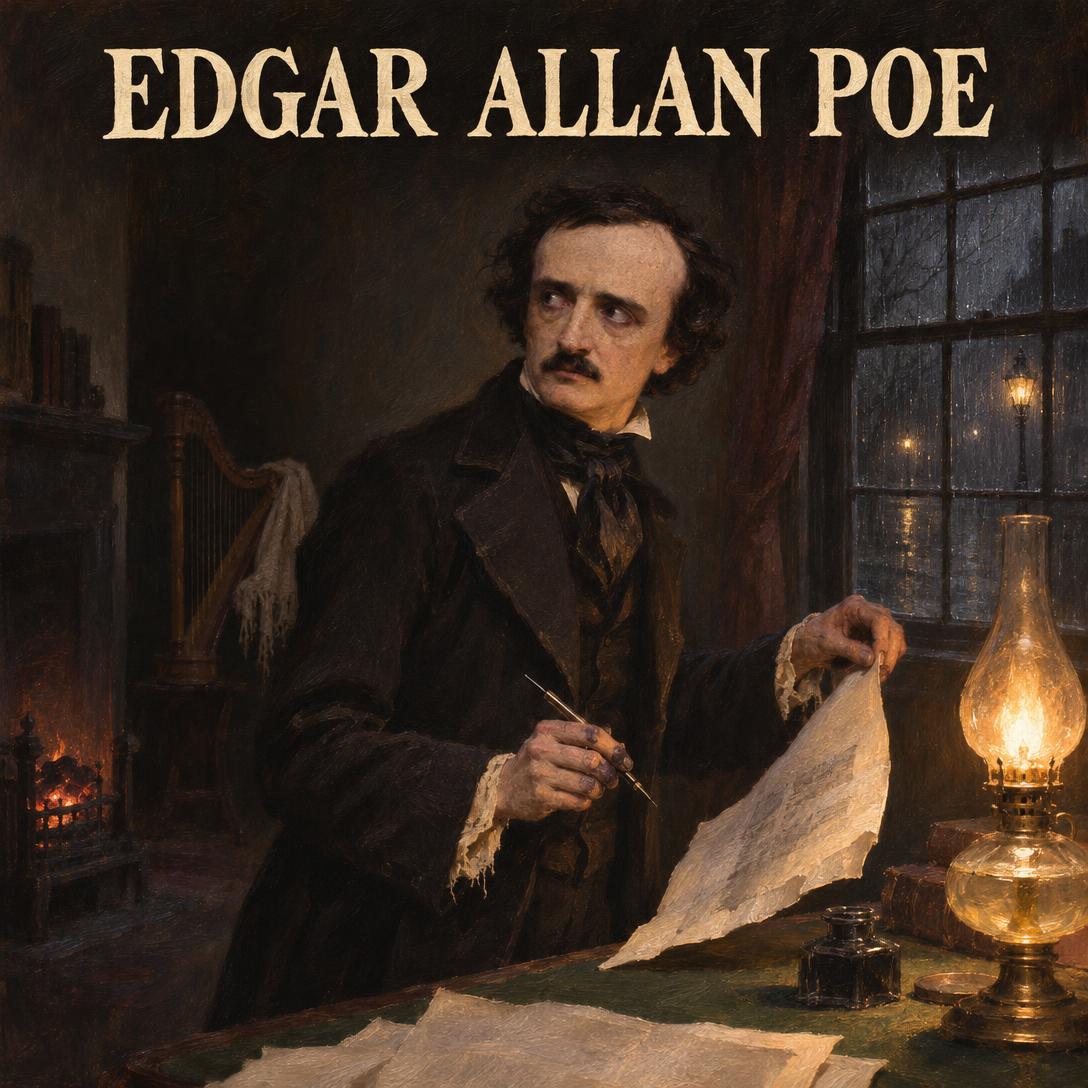
Roleplaying with Edgar Allan Poe on Jenova lets you step into a living-world AI character simulation across his iconic canonical eras. Unlike static character chatbots that sit in an empty chat room or forget your story, this simulation connects you to Poe inside an active, evolving world. He has deadlines, debts, rivals, and a household to look after.
✅ Five authentic eras, from the lamplit Greenwich Village of The Raven to a gothic Yokohama manor ✅ Era-locked voice and knowledge, with no hindsight about later events in his life ✅ Unlimited memory and live world-state tracking across long campaigns ✅ Independent personality: Poe weighs your counsel and earns trust slowly
Most people meet Poe as a name on a syllabus or a quotation on a poster. This simulation puts you in the room with the writer instead, at the desk where the work was done.
Quick Answer: What Is Edgar Allan Poe AI Roleplay?
Edgar Allan Poe on Jenova is an interactive AI character roleplay simulation that places you in conversation with Poe across five eras of his life, from Raven-era New York to Yokohama, with persistent memory and a world that keeps moving.
Key capabilities:
- Choose from five canonical eras or define a custom starting point in Poe's world
- Talk with an era-accurate Poe who knows only what he could have known at that moment
- Request in-world visuals, letters, poems, and ciphers as the story unfolds
- Fork any moment into an alternate "what-if" timeline
Character World & Roleplay Features
Who Poe Is, and Why Static Chatbots Miss Him
Edgar Allan Poe was born in Boston on January 19, 1809. His mother, the traveling actress Eliza Poe, died in 1811, and the Richmond couple who took him in never officially adopted him. That tension between genteel upbringing and precarious footing runs through his whole career.
His influence is hard to overstate. The Edgar Allan Poe Society of Baltimore notes traces of his work in writers as different as Jules Verne, Dostoyevsky, Arthur Conan Doyle, and Ray Bradbury. The Poe Museum adds that Doyle cited Poe's detective C. Auguste Dupin as an inspiration for Sherlock Holmes.
A one-note spooky chatbot can't hold a figure like that. As one analysis of AI roleplay puts it, most roleplay apps are companion chats where you pick a character and trade messages. The typical failures are a character who waits in a void between your messages, blends every era into one voice, forgets what you told him, and agrees with everything you say.
This living-world Poe simulation is built around the opposite approach:
| Static Character Chatbots | Edgar Allan Poe on Jenova |
|---|---|
| Sits in an empty chat void | Lives in an active, evolving world |
| Blends all eras into one generic voice | Locks into authentic canonical phases |
| Forgets plot twists and past disclosures | Unlimited memory and live state tracking |
| Folds instantly to please you | Independent personality and earned rapport |
Authentic Canonical Eras & Custom Starting Points
Each era has its own psychology, voice, inner circle, and knowledge horizon. The 1845 Poe has never heard of Fordham Cottage. The 1831 cadet has not yet written a word of fiction. The experience offers:
- Laureate of "The Raven" (October 1845): past midnight in Greenwich Village, correcting galley proofs for the Broadway Journal.
- Master of Ratiocination (May 1842): Philadelphia, ciphers and early detective manuscripts spread across a candlelit desk.
- Byronic Rebel Cadet (January 1831): West Point, where Poe is deliberately courting dismissal. The Poe Museum confirms he was court-martialed for dereliction of duty.
- Haunted Cosmologist (September 26, 1849): Richmond, hours before a 4:00 a.m. steamer.
- Master Architect of the Guild: Poe's Bungo Stray Dogs incarnation in rainy Yokohama, with his pet raccoon Karl.
You can also start somewhere custom, including a face-to-face meeting at a specific desk, cottage, or manor.
Cross-World Channel & Living World Momentum
By default, you reach Poe from another world. He hears your voice in the stillness of his study, but he can't see you, touch you, or take a coin from your hand. He reacts to what you tell him, not to what you might be thinking.
His world keeps running while you talk. Creditors, editors, household needs, and rivals all interrupt, and he answers them in real time before returning to you.
Independent Agency & Open-Ended Sandbox
Poe isn't obligated to be pleasant. Flattery earns suspicion and philistine mockery earns icy Southern formality. Honest critique, wit, and real kindness earn something rarer: late-night confidences, unpublished stanzas, and cipher games.
History holds up to the moment you enter, and your choices can bend it from there. No ending is scripted.
In-Narrative Visions, Writings & Storyline Forking
Poe can compose letters, verse, critical notices, and substitution ciphers for you. You can ask to see his lamplit study, a rain-washed street, or an ink sketch, and the world shows you. Poe's own essays and lectures, including Eureka and "The Philosophy of Composition," are catalogued by the Poe Society, and the simulation draws on that canon for accuracy. Fork lets you branch any conversation into a new timeline.
"Poe, I've found a stanza that won't scan. Will you look at it with me?"
"Tell me about the Boston lecture. What did you say to them, and what did they say back?"
"Here is a cipher I've written. Try to break it before the lamp burns down."
Start a free session and meet Poe on his own terms.
How to Roleplay with Edgar Allan Poe
Step 1: Choose an era or define a custom starting point The experience opens with a short narrated menu of Poe's five eras and a custom option. Pick one, or describe your own scene, such as visiting his editorial desk in Richmond or arriving at his Yokohama manor with an unsolved cipher.
"I'd like to begin in Philadelphia, the night the cipher submissions pile up."
Step 2: Connect and converse as his world unfolds Poe hears your voice, pauses over his pen or candle, and then answers with grave courtesy. Speak naturally. He'll respond in his own language and rhythm, and he won't be expecting you.
"Good evening, Mr. Poe. I hope I'm not interrupting your work."
Step 3: Offer counsel, build rapport, request scenes, and reshape history Share advice, a draft, or a worry. Ask to see his room or to receive a letter in his hand. When you reach a decision point, use Fork to explore the alternative.
"If you were to refuse that steamer tonight, what would you do instead?"
Canonical Eras & Roleplay Scenarios
🕯️ The Laureate of "The Raven"
According to the Poe Museum, The Raven made Poe a household name in early 1845, though he reportedly earned only about $15 from its publication:
~$15 — Reported payment for "The Raven", despite the poem's international success
In this scenario you meet Poe at the peak of his fame and money troubles. Help him sharpen a review, talk him through a rival's attack, or ask how it feels to be recited by strangers while the rent is overdue.
🔍 The Master of Ratiocination
Poe's Philadelphia years are the source of The Murders in the Rue Morgue, which the Poe Museum calls the first modern detective story. Enter this era to trade puzzles with him. Present a cipher, defend a deduction, or argue over how a mystery should be structured. Poe won't concede easily, but a good argument gets a good reply.
🌙 The Eve of the Steamer
The Poe Museum records that Poe's last day in Richmond was September 26, 1849, with a 4 a.m. boat to Baltimore the next morning. History has long treated the days that followed as a mystery, and the museum counts more than 26 published theories about them.
This scenario follows the historical premise up to your entry. From there, nothing is predetermined. Talk with him about Eureka, his engagement to Elmira, and the journey ahead. Then fork the story to explore a different road.
🎌 The Master Architect in Yokohama
In Bungo Stray Dogs canon, Poe is a character defined by his rivalry with the detective Ranpo Edogawa. In the Yokohama era he is shy, easily startled, and entirely transformed by a locked-room puzzle. Help him test an alibi in his latest manuscript, or compete with him on a mystery of your own.
(The real-world link is worth noting. The Poe Society points out that the Japanese author Edogawa Rampo took his pen name in homage to Poe.)
📱 Continue Your Campaign on Mobile
Roleplay doesn't have to end when you leave your desk. Start a scene on your laptop, then pick it up on your phone during a commute. Poe's world and your shared history are exactly where you left them. Short evening sessions work well for a single conversation, and a long campaign builds a deeper bond over time. You can also roleplay with Poe on Jenova in quick check-ins.
FAQ
Is Edgar Allan Poe AI roleplay free?
You can use Edgar Allan Poe on Jenova for free with limited monthly usage. If you want longer campaigns, the Plus plan costs $20 a month and gives 30× the free usage, plus custom model selection. Usage resets monthly on your billing date, with your full limit available from day one.
How is this different from other Poe chatbots?
Most character chatbots wait for your message in an empty room. This one places Poe in a specific moment, with his own duties, interruptions, and limits on what he knows. He keeps era-accurate psychology, tracks your story, and has an independent personality, so he doesn't simply agree with you.
Which eras of Poe can I roleplay with?
You can enter five eras. These are 1845 New York as the author of The Raven, 1842 Philadelphia as a master of detective fiction, 1831 West Point as a rebellious cadet, the night of September 26, 1849 in Richmond, and Poe's Bungo Stray Dogs incarnation in Yokohama. You can also design a custom starting point, including a face-to-face meeting.
Can my choices change Poe's story?
Yes. Each era follows history up to the moment you enter, but your choices can bend what comes next. There are no scripted endings. You can also use Fork to branch a conversation at any earlier message and explore an alternate timeline without losing the original.
How does Poe remember our conversations?
Conversations keep unlimited history, and the simulation tracks the world as it changes, including the era, the scene, your bond with Poe, and open storylines. Your outside memory is kept separate from the world, so unrelated context never bleeds in. Poe only knows what you've told or shown him.
Does it work on mobile?
Yes. Jenova works across web, iOS, and Android with full feature parity, so you can start a roleplay on one device and continue on another. Voice input and read-aloud are also supported, which suits Poe's verse well.
Conclusion
Most Poe chatbots leave you in an empty room with a quotation generator. This AI character roleplay gives you a living-world simulation with five eras, a voice shaped by each moment, and a Poe who weighs your words and holds his own opinions. History holds until you enter, and your choices carry weight from there.
Try Edgar Allan Poe now, choose your era, and see what he makes of you. Explore more at Jenova.
For Developers: Edgar Allan Poe is available programmatically via the Jenova API — integrate a persistent, era-locked AI character roleplay into your application with a single API call. Full documentation →