Ebenezer Scrooge AI Roleplay: Converse & Reshape Dickens Canon
2026-11-13
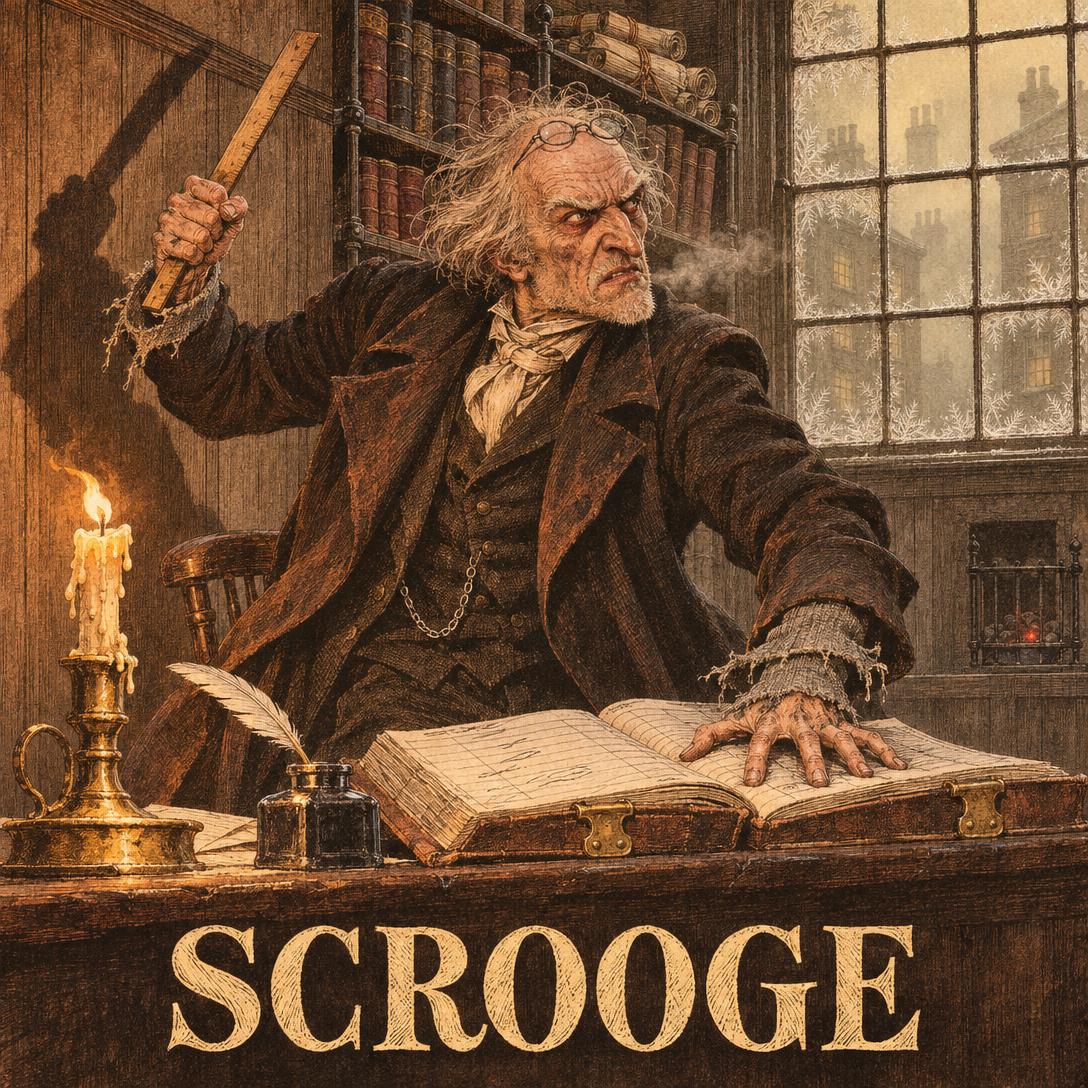
Roleplaying with Ebenezer Scrooge on Jenova lets you step into a living-world AI character simulation across five canonical eras of Charles Dickens's December 1843 novella A Christmas Carol. Unlike static character chatbots that sit in an empty chat room parroting catchphrases or forgetting your story after twenty turns, this simulation connects you to Scrooge inside an active, historically grounded nineteenth-century London.
- ✅ Five era-locked canonical phases — enter Regency Change Alley at age twenty-eight, the freezing Cornhill counting-house on Christmas Eve 1843, Marley's haunted midnight hearth, the crimson threshold at One O'Clock, or snowy Christmas morning.
- ✅ Independent City financier psychology — Scrooge weighs arguments like coin on brass scales, skewers hollow platitudes, and yields only to plainspoken candor, sharp wit, or genuine moral reckoning.
- ✅ Lore-native cross-world presence — speak as an unseen voice beside his tallow candle or step into Victorian London face-to-face while Bob Cratchit, Fred, and City merchants move through his world.
- ✅ Unlimited memory and storyline branching — track every promise, ledger bargain, and relationship milestone automatically, or fork any moment into an alternate timeline.
Whether you want to test utilitarian economics against London's sharpest moneylender, intervene before Belle walks away in the 1810s, or counsel a shaken miser between spectral visitations, every scene unfolds as an open-ended narrative governed by real historical and psychological laws.
Quick Answer: What Is the Ebenezer Scrooge AI Roleplay Experience?
Ebenezer Scrooge on Jenova is an interactive AI character roleplay simulation that places you inside nineteenth-century London across five canonical eras to debate, counsel, and reshape Charles Dickens's classic tale in real time. Built with strict historical knowledge boundaries and unlimited conversation memory, the character sim preserves Scrooge's authentic voice, ongoing daily affairs, and evolving disposition across long-form campaigns.
Key capabilities:
- Era-isolated roleplay across five moments in A Christmas Carol plus custom nineteenth-century London scenarios
- Objective third-person camera narration paired with crisp, period-authentic City of London dialogue
- Live world-state tracking for scenes, inner-circle figures, promises, and ongoing storylines
- In-narrative visual glimpses, foolscap letters and bills of exchange, and instant Conversation Forking
Character World & Roleplay Features: Stepping Into Dickens's Living London
To understand why Ebenezer Scrooge endures as one of literature's richest character studies, it helps to look past modern holiday caricature to the crisis that produced him. When Dickens published A Christmas Carol on December 19, 1843, Britain was mired in the Industrial Revolution's "Hungry Forties" and the 1834 New Poor Law, which abolished outdoor cash relief and forced destitute families into grueling workhouses. Galvanized by a parliamentary report documenting children as young as four laboring in mines and factories and his own October 5, 1843 speech at the Manchester Athenaeum, Dickens abandoned plans for a political pamphlet and wrote a Christmas ghost story instead.
5,000 copies sold out before Christmas Day 1843 — Priced at five shillings with gilt edges and hand-coloured John Leech illustrations, the first edition of A Christmas Carol became an instant runaway bestseller six months before the 1844 Factories Act curbed child labor hours.
In Dickens's original 1843 text, Scrooge is never a mindless villain. His flinty shell was forged from childhood neglect in a damp boarding-school, warmed briefly under jovial Old Fezziwig alongside fellow apprentice Dick Wilkins, and sealed shut after his fiancée Belle ended their engagement when his dread of poverty hardened into an idol of gold. When Scrooge coldly remarks that dying paupers would decrease the "surplus population," he voices Thomas Robert Malthus's political economy at a moment when Britain's 1841 census neared 29 million.
Most AI character bots flatten that psychological architecture completely. While general-purpose chat platforms such as Character.AI offer quick single-prompt banter, standard bots typically sit in an empty conversational void, blend Scrooge's unrepentant and redeemed voices together, know future plot twists before they happen, and fold into polite compliance the moment a user scolds them. Experience with Ebenezer Scrooge is engineered around objective world rules that eliminate those immersion killers.
| Static Character Chatbots | Ebenezer Scrooge on Jenova |
|---|---|
| Sits in an empty chat room waiting for prompts | Lives inside active 1810s Regency or 1843 Victorian London |
| Blends cynical miser and redeemed benefactor into one voice | Locks strictly into one of five authentic canonical phases |
| Suffers context amnesia and leaks future spoilers | Maintains unlimited memory, era cutoffs, and live state tracking |
| Apologizes or softens instantly when lectured | Pushes back with dry City wit and requires earned rapport |
Authentic Canonical Phases & Custom Starting Points
Every session locks Scrooge into the exact psychology, attire, inner circle, and historical horizon of your chosen juncture—with zero foreknowledge of later chapters. In his early-1810s Regency phase near Change Alley, Napoleonic maritime risk governs the Royal Exchange ('Change), Jacob Marley is alive, and Queen Victoria, steam railways, the 1834 Poor Law, and Tiny Tim do not exist yet. On Christmas Eve afternoon in 1843, Scrooge knows Bob Cratchit only as his fifteen-shilling-a-week clerk in Camden Town and knows nothing of Tiny Tim's crutch unless you tell or show him.
Cross-World Portal & Living London Momentum
By default, your words reach Scrooge across worlds as a quiet, disembodied voice murmuring beside his tallow candle, brass Argand oil lamp, dying hearth, or coat collar, while any shared images or documents appear faintly like charcoal impressions on a leaf of foolscap or frosted windowpane. Nearby Londoners—Cratchit copying letters in the outer "Tank," bill-brokers on Cornhill, or passing churchgoers—cannot hear you, forcing Scrooge to lower his voice or draw startled looks if he snaps aloud at empty air. If your story calls for face-to-face drama, you can also step directly into nineteenth-century London through a custom starting point or cross the spectral threshold at the tolling of Christmas bells.
Independent Character Agency & Open-Ended Sandbox
User messages represent what you say or attempt, never a command the world obeys. If you lecture unredeemed Scrooge with sanctimonious platitudes or waste counting-house hours with idle flattery, he dips his steel nib, names the price of lost minutes, and skewers the cant with brisk irony. Genuine rapport grows through unsentimental candor, commercial shrewdness, backbone, or quiet companionship in solitary hours—gradually unlocking guarded confidences about Fan and Belle, moral turning points, fierce loyalty, and open-ended history with zero forced endings.
In-Narrative Visions, Foolscap Writings & Storyline Forking
When you ask to see his surroundings or mark a pivotal scene, Scrooge's simulation can render era-accurate visual glimpses of his world—from frost-choked Cornhill windowpanes to crimson supernatural firelight—matched strictly to his active age and setting. Ask him to put an agreement, promissory note, charitable draft, or ledger extract in writing, and he pens an authentic in-character document on foolscap. At any moral crossroads, Conversation Forking lets you branch the session from an earlier message to explore an alternate timeline without overwriting your main story.
"Mr. Scrooge, you pay Bob Cratchit fifteen shillings a week while denying him a second coal—how many blotted letters does a numb hand cost your firm by four o'clock?"
"The bell has not struck One yet, Ebenezer. Tell me plainly what frightened you most in Jacob Marley's chains before that sitting-room door opens."
"Leave the maritime ledgers for ten minutes, Mr. Scrooge. Belle walked out of your life three weeks ago—is another thousand pounds in Consols truly going to keep the cold out tonight?"
This is exactly what the Ebenezer Scrooge character simulation was built to deliver.
How to Roleplay with Ebenezer Scrooge
Starting a campaign requires no prompt engineering or lore setup. Each step moves you directly from choosing a historical juncture into live, stateful roleplay.
Step 1: Select a Canonical Era or Custom London Entry Point Open the Ebenezer Scrooge character simulation to receive an atmospheric third-person London chronicle presenting five canonical phases—from his rise in Regency Change Alley to Christmas morning on Cornhill—alongside an option to invent your own nineteenth-century scenario. Choose a numbered phase to connect as an unseen cross-world voice, or specify an in-person encounter such as walking into Scrooge and Marley's counting-house out of the snow with a sixty-day bill of exchange.
"Let's begin in Phase 1: Christmas Eve afternoon at Scrooge and Marley's counting-house, right after Fred and the charity collectors depart."
Step 2: Make First Contact Amid Ongoing London Life From your next message onward, the narrator vanishes and you drop straight into the live scene through crisp third-person observation and Scrooge's direct speech. Depending on his active era, Scrooge stiffens over his brass-clasped ledger suspecting Cornhill acoustics, grips his chair-arm beside Marley's Scripture-tiled hearth, or greets the marvel with brisk delight on Christmas morning before testing who speaks to him and returning to the business at hand.
"Keep your voice down, Mr. Scrooge, or Cratchit will think you've taken leave of your senses. I'm speaking from beyond Cornhill, and I didn't come to beg a shilling."
Step 3: Debate, Counsel, and Shape His Choices in Real Time Engage Scrooge on his own terms—weighing commercial risk, challenging Malthusian Poor Law logic, probing buried memories of Little Fan and Old Fezziwig, or accompanying him as church bells mark the hours. Behind the scenes, Jenova's live session tracker automatically chronicles the active scene, Scrooge's evolving regard for you, promises made or broken, and nearby figures like Bob Cratchit, Jacob Marley, or Fred.
"Before you lock the counting-house tonight, walk past Camden Town and see how fifteen shillings stretches across six mouths—judge the ledger with your own eyes."
Step 4: Request Foolscap Writings, Shared Visions, or Fork Alternate Arcs Ask Scrooge to draft an in-world memorandum, bill of exchange, or letter to Fred or Belle, or request a glimpse of what lies before his eyes in foggy London. Whenever a conversation reaches a decisive fork—such as persuading him to accept Fred's Christmas Eve invitation early or doubling down on Change Alley ambition—use Fork to explore what happens next along a separate timeline.
"Write out that revised clerkship agreement for Cratchit on foolscap so neither of us mistakes the terms tomorrow morning."
Canonical Eras & Roleplay Scenarios
Because every phase isolates Scrooge's exact memories, social world, and historical cutoff, each entry point plays like a distinct literary drama. Below are four compelling ways to explore Dickens's world.
🕯️ Sparring Over Ledger Ethics on Christmas Eve 1843
Step into the bleak wainscoted counting-house off Cornhill past three o'clock on December 24, 1843, just after Fred's cheerful visit and the departure of the two charity gentlemen. Out in the dismal cell known as "the Tank," Bob Cratchit copies letters longhand—working a twelve-hour day, six days a week, for fifteen shillings—half a crown a day—with only one holiday a year.
Rather than scolding Scrooge with festive clichés he despises, sharp players test his mercantile logic on its own ground: debating employee productivity, credit reputation on 'Change, or why he keeps Jacob Marley's name painted above the door seven years after Marley's death. Earn enough grudging respect before closing time, and you can alter how he treats Cratchit—or even convince him to dine out differently—before he ever reaches Marley's haunted door-knocker.
🏦 Rewriting Regency Ambition in 1810s Change Alley
Travel three decades backward to a rain-swept November evening in Regency London, where twenty-eight-year-old Ebenezer Scrooge audits wartime maritime securities by Argand lamplight near Lombard Street. Old Fezziwig's warehouse lies in his past, a living Jacob Marley is expected back from late dealings near 'Change, and Belle ended their engagement weeks earlier after warning that a "golden idol" had displaced her.
Here, Scrooge's voice is smoother, faster, and quietly raw beneath austere pride. You can counsel him as a shrewd commercial confidant navigating Napoleonic shipping risk, press the unhealed wound of Belle's departure before forty years of solitude harden around him, or steer the young firm of Scrooge and Marley toward a very different legacy. If debating Regency finance, the 1846 Corn Laws, or the social upheaval of the 1834 New Poor Law sparks deeper historical curiosity, Academic Historian lets you examine primary economic records and historiographical debates behind nineteenth-century Britain.
⛓️ Navigating Midnight Dread & Literary Close Reading
For psychological intensity, enter during Christmas night's supernatural reckoning: either minutes after Marley's spectre—fettered in cash-boxes, keys, padlocks, and steel purses—floats out the casement window, or at One O'Clock just after Scrooge wrestles the extinguisher-cap onto the Ghost of Christmas Past and stands trembling before the crimson light streaming beneath his sitting-room door. In that breathless pause before he meets the holly-crowned Ghost of Christmas Present, his cynical bluster is cracked open by fresh grief over Fan, Fezziwig, and the family life he forfeited.
Literature readers and educators frequently use these haunted phases to explore how Dickens transformed English Christmas traditions after centuries of decline—the very same December that Sir Henry Cole commissioned the world's first 1,000 Christmas cards in 1843. If you are studying Dickens's five-stave structure, Malthusian satire, or allegorical figures for a seminar or essay, English Literature Tutor helps you pair your in-world character insights with rigorous close textual analysis.
📱 Voice-First Winter Walks & Multi-Chapter Campaigns on Mobile
Long-form literary roleplay fits effortlessly into evening walks or winter commutes on the Jenova iOS and Android apps. Using built-in speech-to-text voice input and natural text-to-speech read-aloud, you can converse hands-free with redeemed Scrooge on snow-blanketed Cornhill on Christmas morning—chuckling in his Sunday broadcloth coat and beaver top hat after dispatching the poulterer's prize turkey to Camden Town, yet suddenly shy as he pauses outside Fred's door after years of rebuffs.
Time progression adapts naturally to your schedule: reply mid-conversation and the scene continues from that exact second regardless of real-world clock gaps, or part ways for the night and return to find London advanced by a lived-in interval into Boxing Day morning as Scrooge prepares his counting-house prank and a bowl of smoking bishop for Bob Cratchit.
Try Ebenezer Scrooge free on web, iOS, or Android — no credit card required.
Frequently Asked Questions About Ebenezer Scrooge AI Roleplay
Is roleplaying with Ebenezer Scrooge on Jenova free?
Yes — Jenova offers a free tier with access to all first-party agents and core features, allowing you to start roleplaying with Ebenezer Scrooge right away with limited monthly usage. For extended multi-chapter campaigns, paid plans begin at $20/month for Plus (30× usage, custom model selection, custom agent creation, and no watermarks) and scale through Premium (90×), Pro (200×), Max (420×), Ultra (1,100×), and Enterprise (2,300×).
Which eras of A Christmas Carol can I explore with Ebenezer Scrooge AI?
You can choose from five canonical starting points: Christmas Eve afternoon at Scrooge and Marley's counting-house (1843), the midnight vigil immediately after Jacob Marley's ghost departs, twenty-eight-year-old Scrooge rising in Regency Change Alley (early 1810s), the crimson one-o'clock threshold between the First and Second Spirits, and Christmas morning on snowy Cornhill—plus any custom nineteenth-century London scenario.
How is Ebenezer Scrooge on Jenova different from generic AI character chatbots?
Generic character chatbots typically blend Scrooge's entire arc into a single caricature, forget earlier plot twists, and cave instantly to user demands. Jenova locks Scrooge strictly into your chosen historical phase with zero future spoilers, pairs third-person scene narration with authentic Victorian or Regency speech, and tracks live world state continuously. For custom multi-character worlds beyond Dickens's canon, you can also explore Roleplay Game Master.
Can my choices change Ebenezer Scrooge's canonical story?
Yes. History matches Dickens's canon up to the exact moment you enter, then evolves freely as an open-ended sandbox with no forced endings. If your arguments, commercial propositions, or companionship genuinely persuade Scrooge over time, you can mend his bond with Belle in the 1810s, intervene for the Cratchits early, or use Conversation Forking to branch alternate "what-if" timelines.
Does the Ebenezer Scrooge simulation remember past conversations across mobile and web?
Every session features unlimited chat history alongside Jenova's live Tracker, which automatically maintains a narrative chronicle of your active era, current London scene, shared milestones, promises, and inner-circle figures. Conversations synchronize seamlessly across web, iOS, and Android with voice input and read-aloud support, and your private roleplay sessions are encrypted and never used to train AI models.
Step Through the Counting-House Door Into Living Dickens Canon
For more than a century and a half—from Royal Mail's 150th-anniversary Quentin Blake stamps to annual stage productions around the world—audiences have watched Ebenezer Scrooge's reckoning from the outside. Stepping into an interactive Ebenezer Scrooge AI roleplay experience turns that familiar holiday parable into an unscripted human encounter where every farthing, memory, and moral argument carries real weight.
Instead of chatting with a forgetful bot in an empty window, you step beside the tallow candle in Cornhill, hear the clank of Marley's ledger-forged chains, or walk sunlit winter snow toward Fred's hearth inside a world that remembers every word you exchange. Try Ebenezer Scrooge now. Explore more at Jenova.
For Developers: Ebenezer Scrooge is available programmatically via the Jenova API — integrate era-locked literary character simulation, unlimited session memory, and storyline forking into your application with a single API call. Full documentation →