AI Dungeon vs Friends and Fables: Rules, Memory, Pricing Compared
2026-10-15
Choosing between AI Dungeon and Friends and Fables in October 2026 comes down to one question: do you want unlimited story freedom, or a rules-driven tabletop campaign? AI Dungeon offers open-ended storytelling. Friends & Fables offers a D&D 5e–inspired game with structured state. Roleplay Game Master is a third option for players who want open-ended roleplay with persistent memory and consistent characters, without being tied to one ruleset or one device.
- ✅ AI Dungeon supports open-ended stories in any genre, with tiered context lengths
- ✅ Friends & Fables is governed by the D&D 5e ruleset and stores structured game state
- ✅ Roleplay Game Master offers creative freedom, persistent memory, and character consistency
- ✅ This guide compares rules, memory, multiplayer, pricing, and platform access, using sources for each claim
Neither platform is objectively "better." Each one is built around a different idea of what AI roleplay should be. To pick well, you need to know where each one excels and where it falls short. We'll start with the core differences, then cover the trade-offs that matter most over a long campaign.
Quick Answer: What Is the Difference Between AI Dungeon and Friends and Fables?
AI Dungeon is an open-ended AI text adventure with no fixed ruleset, while Friends & Fables is a D&D 5e–inspired AI tabletop RPG that tracks structured game state like stats, quests, locations, and party members. Choose AI Dungeon for genre freedom. Choose Friends & Fables for rules-driven campaigns.
Key differences:
- Rules: AI Dungeon has no specific ruleset. Friends & Fables follows D&D 5e.
- Memory: AI Dungeon's context ranges from 4k tokens on the free tier to 32k on Mythic and Ultimate. Friends & Fables grounds its AI game master in a dedicated game-state database.
- Group play: Friends & Fables offers 3- to 6-player campaigns depending on tier.
- Third option: Roleplay Game Master offers freeform roleplay with persistent memory on web, iOS, and Android.
AI Dungeon vs Friends & Fables: Where Each Platform Makes Trade-Offs
AI Dungeon began as a hackathon project in March 2019 and later scaled to more than 1,000,000 users. Friends & Fables is newer. It describes itself as a DnD-inspired text RPG with an AI game master named Franz. Both platforms come up often in community comparisons, including this
and a Steam Community discussion.| Feature | AI Dungeon | Friends & Fables |
|---|---|---|
| Core design | Open-ended text adventure, any genre | D&D 5e–inspired tabletop RPG |
| Rules | No specific ruleset | 5e ruleset, skill checks, inventory with carrying capacity |
| Memory approach | Tiered context, Story Cards, Plot Essentials | Structured game state plus long-term memories |
| Multiplayer | Supported; Voyage public multiplayer is free | 3–6 player campaigns; friends play free |
| Free tier | Wanderer (free, 25 memories) | Up to 25 turns per day |
| Paid tiers | $14.99–$99.99/month | $19.95–$39.95/month |
| Maturity | Established since 2019 | Labeled early access beta |
Choosing between them is harder than it looks:
- Freedom and structure pull in opposite directions
- Memory limits show up in long campaigns, often after you've already committed
- Group features and solo flexibility depend heavily on pricing tier
- Device support and response speed vary in ways marketing pages don't highlight
Freedom vs. Structure
Friends & Fables' own comparison says that AI Dungeon has no specific ruleset, "which gives you much more freedom," while its own engine follows D&D 5e. That includes an inventory system with carrying capacity, and spell-slot checks before the AI narrates a Fireball. Note that this post was written in 2024 by Friends & Fables itself, so AI Dungeon's current feature set may have changed since.
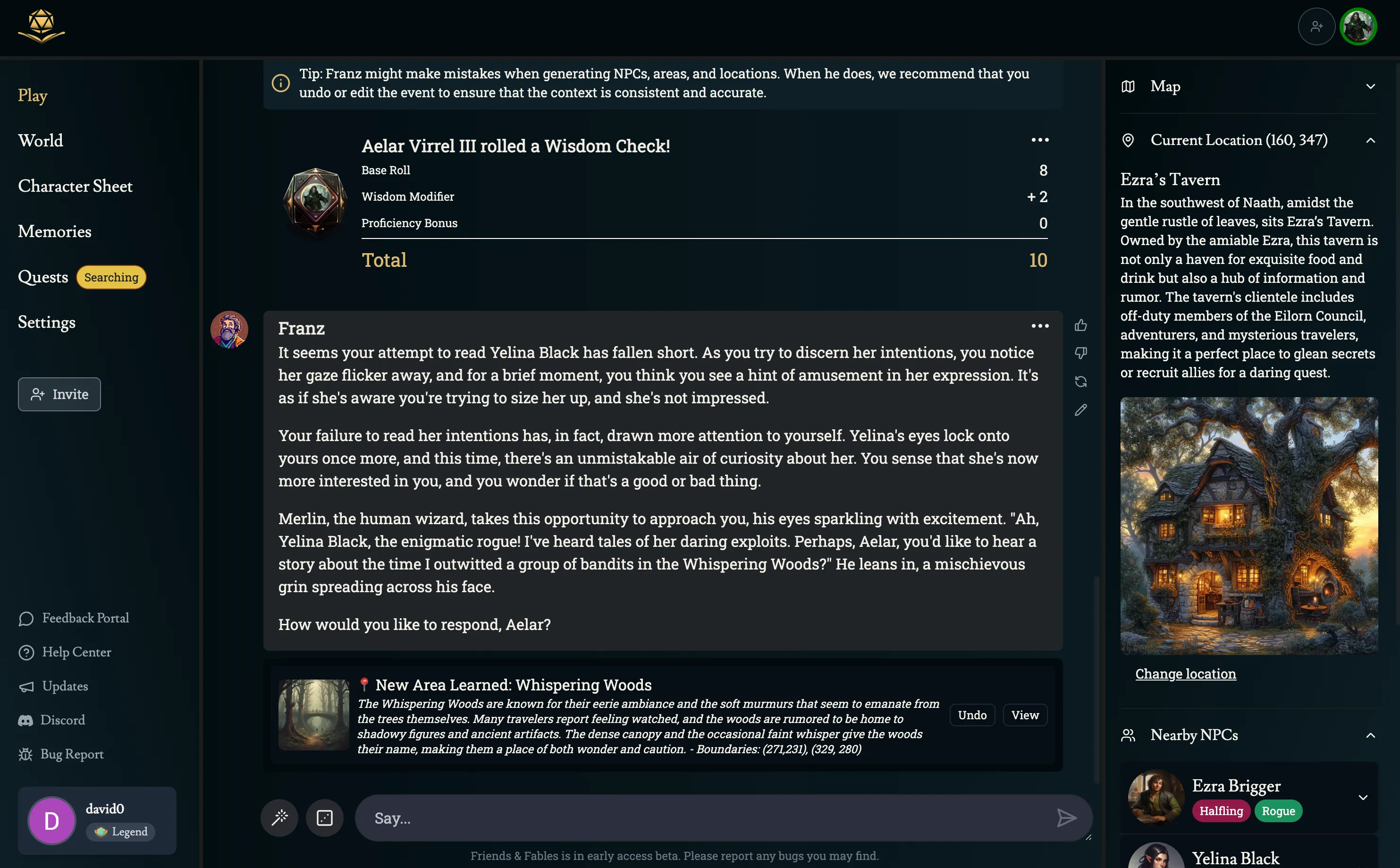
The screenshot above shows how this works in practice. A Wisdom check is resolved with a base roll, modifier, and proficiency bonus. Franz then narrates the failed result. A "New Area Learned" card logs the Whispering Woods, and the sidebar tracks the current location and nearby NPCs. AI Dungeon takes a different approach. Players steer the story through AI Instructions, Story Summary, Plot Essentials, Author's Notes, and Story Cards, rather than through a rules engine.
Memory and Long Campaigns
4k → 32k tokens — AI Dungeon context length from the free tier to Mythic and Ultimate
AI Dungeon's help center explains the limitation directly: with shorter context, "the beginning of your Adventure will likely be trimmed, or Story Cards may be removed." Paid members can spend Credits to temporarily extend context on certain models.
Friends & Fables uses a retrieval-based approach. According to a competitor's side-by-side analysis citing Friends & Fables documentation, memories are created automatically every five turns. However, "not all memories are always included because of cost, speed, and performance tradeoffs."
Multiplayer and Group Play
Up to 6 players — Friends & Fables Legend tier party size, with friends playing free
Friends & Fables also supports asynchronous play-by-post campaigns. AI Dungeon is described as a single-player/multiplayer text adventure, and its separate Voyage mode offers public multiplayer that is free for everyone.
There are a few caveats. The same competitor analysis reports that Friends & Fables combat is currently off by default while the team revamps it. It also reports that the interface is designed primarily for desktop. Since that source sells a rival product, verify these points yourself.
Pricing and Access
$19.95 / $29.95 / $39.95 per month — Friends & Fables Starter, Pro, and Legend tiers
$14.99 to $99.99 per month — AI Dungeon Journey, Legend, Mythic, and Ultimate memberships
The two platforms define a "turn" differently. On Friends & Fables, a turn counts only when Franz sends you a message, and paid tiers include unlimited standard turns. AI Dungeon lets you play its base models endlessly at your tier's context level, with monthly Credits that don't expire. Both services updated tier names and pricing in late 2025, so check the live pricing pages before you subscribe.
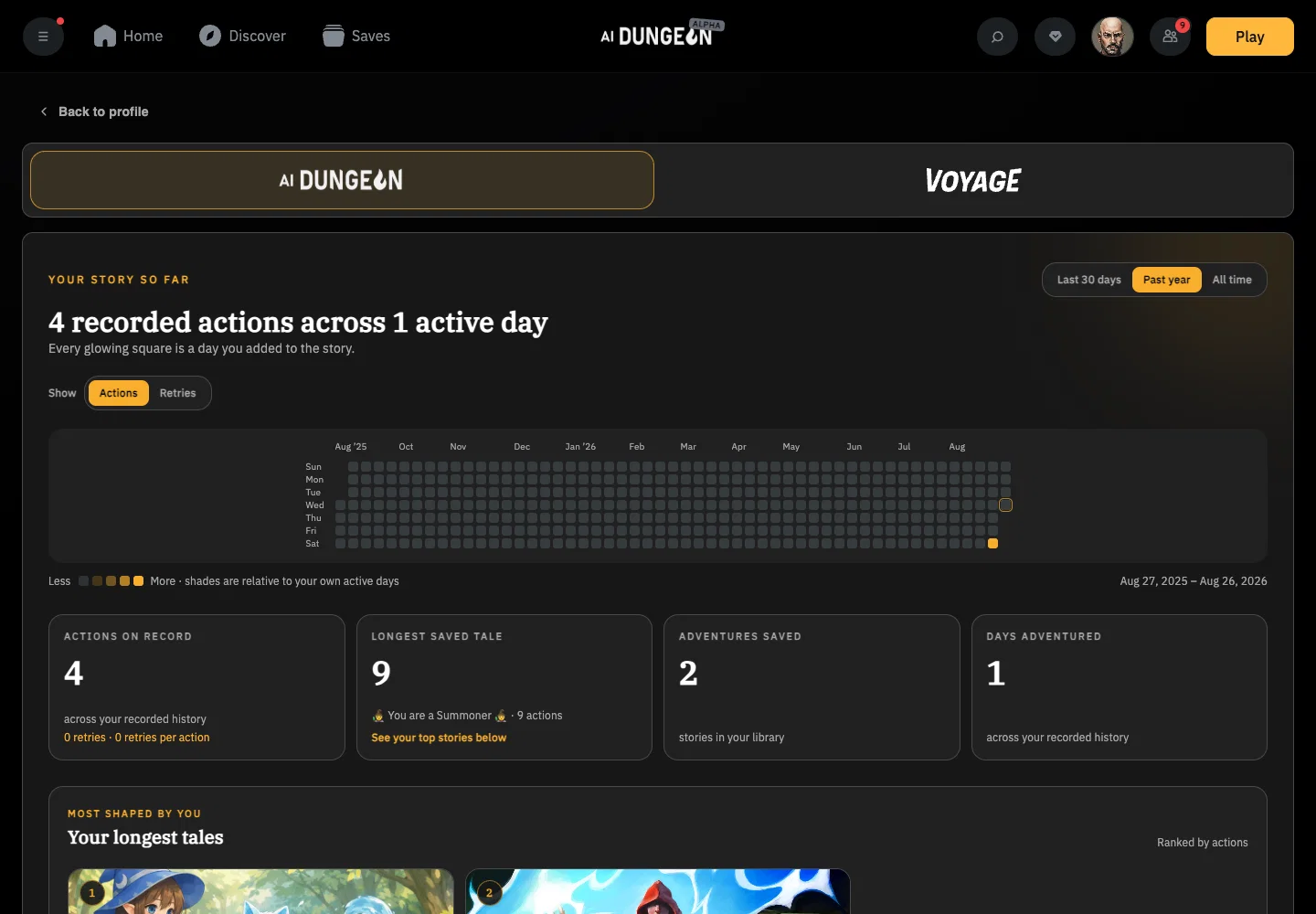
If you want AI Dungeon's open-ended freedom with memory that persists across sessions and devices, that is the gap Roleplay Game Master was built to fill.
Why Roleplay Game Master
Roleplay Game Master is an AI storyteller for immersive roleplay in any genre or scenario. It offers persistent memory and keeps characters consistent from scene to scene. It doesn't require you to learn 5e mechanics, and it doesn't trim your early chapters to fit a small context window.
It is a conversation-first experience. If you specifically want a visual mini map, clickable character sheets, and a dedicated 5e combat mode, Friends & Fables is purpose-built for that. If you want narrative freedom that holds together over weeks of play, this AI is the better fit.
| Dedicated AI RPG Apps | Roleplay Game Master |
|---|---|
| Choose between open freedom and rigid rules | Freeform by default; add rules only when you want them |
| Context windows tied to subscription tier | Persistent memory across sessions |
| Characters can drift as stories grow | Built to keep characters consistent |
| Desktop-first interfaces (Friends & Fables) | Full feature parity on web, iOS, and Android |
Story Memory That Lasts
NPCs remember your betrayals. Faction grudges carry forward, and a throwaway detail from session two can come back in session twenty. You spend less time re-explaining the plot and more time playing.
Any Genre, Any Tone
You can play a grim fantasy siege, a cyberpunk heist, a slow-burn mystery, or a political drama. You set the tone, pacing, and content boundaries.
Rules When You Want Them
You can ask for dice rolls, stat tracking, or inventory management directly in the story. Unlike a hard-coded ruleset, you can drop these mechanics again whenever they slow the scene down.
"Run a low-magic dark fantasy campaign. I'm a disgraced knight hunting the man who framed me. Track my wounds and coin, and make the world react to my reputation."
"Start a noir mystery in 1940s Manila. I'm a private investigator. Keep the suspects' alibis consistent and let me solve it through questioning."
Related Agents You'll Also Find Useful
Character Creator If you build original characters before you play, this agent designs OCs for roleplay and fiction, either quickly or through a guided build.
- Quick-gen or step-by-step character builds
- Research into existing media for reference
- Character portraits across genres
Game Designer Assistant If you're homebrewing a setting or tuning a campaign's systems, this agent helps you brainstorm, analyze mechanics, and document your world.
- Systems analysis and balancing
- Concept art generation
- Design documentation across genres
Creative Fiction Writer If a roleplay session turns into a story worth keeping, this agent helps you turn it into polished prose.
- Research for authentic worlds
- Editorial feedback on structure and voice
- Support from first draft to final manuscript
The Mansion If you want a ready-made scenario instead of building one, this agent drops you into a mansion with no memory of how you arrived, where every room hides secrets.
- Exploration-driven horror mystery
- Choices with lasting consequences
- No setup required
Try Roleplay Game Master free — no credit card required.
How to Start an AI Roleplay Campaign
Step 1: Open the Agent Open Roleplay Game Master on web, iOS, or Android. Your campaign syncs across devices, so you can start on a laptop and continue on your phone.
Step 2: Set the Premise and Tone Describe the genre, your character, and the tone you want. The more specific your opening, the more grounded the first scene will be.
"High-fantasy intrigue. I'm Aelar, an elven bard with a gambling debt. Mature tone, slow-burn political plots, minimal combat."
Step 3: Choose Your Level of Structure Decide whether you want pure narrative or light mechanics. You can switch at any point.
"Use d20 rolls for risky actions, and show me the result before narrating the outcome."
Step 4: Play, Steer, and Return Take actions, talk to NPCs, and redirect the story whenever you like. When you come back days later, the agent picks up where you left off.
"Recap where we left off, then let's confront the guildmaster about the forged ledger."
Results & Use Cases
🧙 Long-Running Solo Fantasy Campaign
Scenario: A player wants a months-long campaign with recurring villains and evolving alliances.
Traditional Approach: On AI Dungeon's free tier, 4k tokens of context means early chapters get trimmed. Keeping them requires paid tiers or spending Credits.
Roleplay Game Master: Persistent memory keeps the campaign continuous.
- Villains remember earlier encounters
- Less manual upkeep of plot notes
- Consistent NPC personalities across sessions
📱 Quick Sessions on Your Phone
Scenario: A commuter wants 15-minute story sessions on the train.
Traditional Approach: Friends & Fables runs in a browser, but reportedly is designed primarily for desktop.
Roleplay Game Master: The same campaign is available on iOS and Android, with full feature parity.
- Voice input through speech-to-text
- Settings and progress sync automatically
- Easy to pick up mid-scene
🎭 Genre-Hopping Storyteller
Scenario: A writer alternates between sci-fi, horror, and romance experiments each week.
Traditional Approach: A 5e-governed engine is built for D&D-style fantasy, and a Western setting won't accept a lightsaber.
Roleplay Game Master: Any genre, with tone and boundaries set by the player.
- No ruleset to work against
- Strong sessions can be expanded with Creative Fiction Writer
- Characters stay distinct across separate stories
🎲 Prepping a Homebrew World for Game Night
Scenario: A group's DM wants a custom setting ready before friends join a session.
Traditional Approach: Hours of manual worldbuilding before the first session.
Jenova Agents: Game Designer Assistant drafts factions and systems, and Character Creator builds the cast.
- Faster preparation of the setting
- Portraits for key NPCs
- The finished world works on any platform, including Friends & Fables for live group play
Frequently Asked Questions
Is AI Dungeon or Friends and Fables better for D&D?
Friends & Fables is the better fit for D&D-style play. Its engine is governed by the D&D 5e ruleset, with skill checks, inventory, carrying capacity, a mini map, and a combat mode. AI Dungeon has no fixed ruleset, so it suits open-ended storytelling in any genre better than strict tabletop mechanics.
How much do AI Dungeon and Friends and Fables cost?
Both platforms have free tiers. AI Dungeon's paid memberships run from $14.99 to $99.99 per month, and Journey and Legend include a one-week trial. Friends & Fables offers a free tier with up to 25 turns per day, plus paid tiers at $19.95, $29.95, and $39.95 per month with unlimited standard turns.
Which platform has better memory for long campaigns?
Each takes a different approach. AI Dungeon's context grows with tier, from 4k tokens on the free plan to 32k on Mythic and Ultimate, and Credits can extend it. Friends & Fables stores structured game state and creates long-term memories automatically. For persistent memory without tier-based context limits, Roleplay Game Master is built for long-running stories.
Can I play Friends and Fables with friends for free?
Yes. On every Friends & Fables tier, friends can join your campaign for free. Party size depends on the host's plan: three players on Free, four on Starter, five on Pro, and six on Legend. Campaigns can run live or asynchronously in play-by-post style.
Is there an AI roleplay option that works well on mobile?
AI Dungeon memberships work across multiple devices when you sign into the same account. Friends & Fables runs in a browser but is reportedly desktop-first. Roleplay Game Master offers full feature parity on web, iOS, and Android, with synced progress and speech-to-text input.
Conclusion
The AI Dungeon vs Friends and Fables decision comes down to what kind of play you want. AI Dungeon offers open-ended freedom in any genre. Friends & Fables offers rules-driven, D&D 5e–inspired campaigns with structured game state and parties of up to six players. Each involves trade-offs in memory limits, pricing tiers, and device support.
If you want freedom without losing story continuity, choose an AI roleplay partner that remembers your campaign and works across all your devices. Try Roleplay Game Master now. Explore more at Jenova.
For Developers: Roleplay Game Master is available programmatically via the Jenova API — integrate persistent-memory AI roleplay into your game or storytelling app with a single API call. Full documentation →