AI Dungeon Master: Run Solo D&D Campaigns Anytime (August 2026)
2026-08-06
The Roleplay Game Master is an AI dungeon master that runs full tabletop campaigns for you on demand — improvising NPCs, adjudicating your choices, and holding your world's continuity across unlimited sessions. Scheduling five adults around one table is genuinely difficult; this AI removes that constraint entirely while keeping the improvisational feel that makes tabletop roleplaying worth playing.
✅ Zero scheduling friction — start a session at 2 AM or during a 20-minute lunch break ✅ Unlimited memory — your NPCs, factions, and plot threads persist across every session ✅ Any setting, any tone — grimdark, high fantasy, sci-fi, homebrew worlds, or established universes ✅ Perfect character consistency — the tavernkeeper you met 40 sessions ago still remembers your debt
To understand why an AI dungeon master matters right now, it helps to look at what's actually blocking people from playing. Tabletop roleplaying is growing fast, but the two hardest problems in the hobby — finding a DM and getting everyone in the same room — haven't gotten any easier.
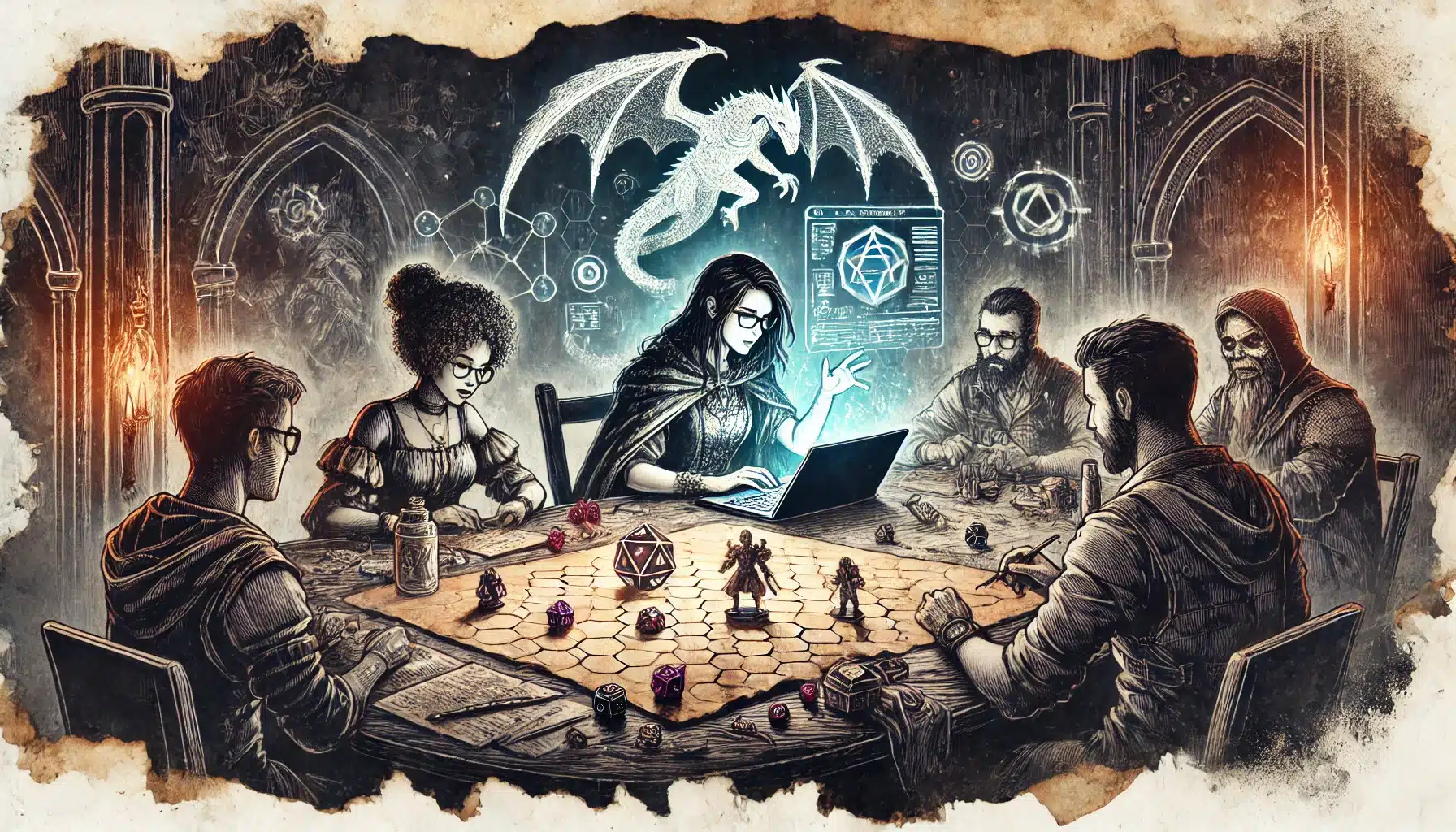
Quick Answer: What Is an AI Dungeon Master?
An AI dungeon master is a conversational AI that runs tabletop roleplaying campaigns — narrating scenes, voicing NPCs, adjudicating player choices, and maintaining world continuity — available on demand without a human game master or a scheduled group.
Key capabilities:
- Narrates scenes and improvises reactions to any player action, including ones no module anticipated
- Voices a full cast of NPCs with consistent personalities, motives, and memory of past interactions
- Tracks campaign state — quests, factions, relationships, consequences — across unlimited sessions
- Adapts tone, difficulty, and pacing to how you actually want to play, from combat-heavy to pure social intrigue
- Runs solo play, character concept testing, and DM prep work with equal fluency
The Problem: Why It's So Hard to Actually Play
Tabletop roleplaying is not a niche hobby anymore. The global TTRPG market is valued at USD 2.41 billion in 2026 and projected to reach USD 6.59 billion by 2035, growing at a CAGR of 11.84%. Demand is not the bottleneck.
48% — Digital TTRPG platform adoption rate, showing players are already moving toward virtual and hybrid play
42% — Share of new players deterred by complex rules and expensive starter kits
But converting interest into an actual session at an actual table is frustratingly difficult:
- The DM shortage. Every table needs one; almost nobody wants the prep workload.
- Scheduling collapse. Five adults, five calendars, one recurring three-hour block. Campaigns die here more than anywhere else.
- Prep burden. Maps, stat blocks, NPC names, encounter balance — hours of unpaid work per session.
- No room for experimentation. As one longtime player put it, there's nothing quite like having seven character concepts and being in one game that meets once a month.
- Onboarding friction. New players face a rulebook wall before they roll a single die.
The DM Bottleneck
A campaign needs one person willing to absorb the overhead of world design, encounter prep, rules arbitration, and improvisational performance — every single week. Groups routinely wait months for someone to volunteer. The result is a permanent supply imbalance: far more people want to play than want to run.
Scheduling Is the Real Campaign Killer
Most campaigns don't end because the story concluded. They end because three consecutive sessions got cancelled and momentum evaporated. Adult schedules simply do not accommodate a fixed weekly commitment reliably, and one absent player often means the whole night is off.
Prep Work Nobody Sees
Behind a three-hour session sits map-building, stat block adjustment, NPC preparation, and improvisation contingencies. Even seasoned DMs report never missing an opportunity to create a battle map for a possible interaction or fight — enormous invisible labor for content players may never reach.
This is exactly what an AI dungeon master was built for.
Why the Roleplay Game Master Works as an AI Dungeon Master
The Roleplay Game Master removes the two hard constraints — availability and prep — without flattening the thing that makes tabletop compelling: a responsive narrator who reacts to choices no script anticipated.
| Traditional Tabletop | Roleplay Game Master |
|---|---|
| Weeks of scheduling to secure one session | Session starts the moment you open the chat |
| Hours of DM prep per game night | Zero prep — world generates as you play |
| One character concept per campaign | Test unlimited concepts, abandon and restart freely |
| Notes lost between sessions; details forgotten | Unlimited memory — NPCs, factions, and threads persist |
| Fixed setting chosen by the DM | Any world, any genre, any tone you describe |
| Group pace dictates your progress | Play a 20-minute scene or a six-hour arc, your call |
Persistent Memory That Actually Holds
The most common failure of generic chatbots running campaigns is memory drift. Players report AI DMs that get random things like your Armor Class wrong or start addressing you by a different character's nickname. This AI dungeon master is built around unlimited memory and character consistency — the merchant who cheated you in session three still has that history in session thirty.
Improvisation Without a Rail
Video game RPGs eventually run out of dialogue paths. One DM described hitting 500 hours in a major CRPG and finding nowhere left to go that hadn't been thoroughly explored. A generative game master has no such ceiling — the world extends in whatever direction you push it.
Tone and Difficulty You Control
A recurring complaint about generic AI DMs is that they act like the "Friend DM" — no isn't something it says often. Because this agent takes explicit direction on stakes and difficulty, you can set the terms up front:
"Run this as low-magic grimdark. Failure should have permanent consequences, and I don't want the world bending in my favor."
"I'm playing a Tiefling warlock who broke her pact. Start me mid-flight from the entity's cultists, night, raining, no allies."
"Escalate the encounter. Add two more hostiles and let the enemy commander act tactically instead of charging."
Solo Play as a First-Class Mode
You are the protagonist by design. There's real appeal in main character energy — you set the goals, name who you want to meet, and drive the plot without negotiating spotlight time with four other players.
Related Agents You'll Also Find Useful
Most people running AI campaigns end up building alongside them — characters, worlds, and systems. These agents slot naturally into that workflow.
Character Creator
If you're spinning up new player characters or an NPC cast to hand your game master, Character Creator handles the design work end to end before you ever start the session.
- Quick generation or guided step-by-step builds
- Media research for genre-accurate archetypes and naming conventions
- Portrait generation so your party has faces, not just stat lines
Game Designer Assistant
If you're homebrewing systems, subclasses, or an entire ruleset rather than just playing one, Game Designer Assistant is the systems-side counterpart to your AI dungeon master.
- Mechanics balancing and systems analysis for homebrew content
- Design documentation for campaigns you plan to publish or share
- Concept art generation for factions, regions, and creatures
Fiction and Narrative Companions
If your campaign is generating material worth turning into something permanent, the Comic Creator and Manga Creator can adapt your best sessions into illustrated sequential art — a surprisingly popular use for long-running solo campaign logs.
Try the Roleplay Game Master free — no credit card required.
How an AI Dungeon Master Works
Step 1: Define your world and tone
Tell the game master what kind of campaign you want. Genre, tone, magic level, and content boundaries all get set here. Be specific — vague setup produces generic fantasy.
"High fantasy with heavy political intrigue. Three warring noble houses in a coastal city-state. Magic is rare and legally restricted. I want dialogue-heavy scenes and very little dungeon crawling."
Step 2: Build or import your character
Describe your character or let the AI generate one. Include class, background, motivations, and any relationships you want woven into the opening. Keep your own copy of the sheet as a backup reference.
"I'm playing Kessa Vaelin, a disgraced house-guard turned informant. Chaotic neutral, sharp tongue, in debt to a smuggling ring. Start me being summoned by the person I owe."
Step 3: Play the scene
Describe what your character does in plain language. The game master narrates outcomes, voices NPCs, and pushes the world forward in response to your choices. No prompt engineering required — just play.
"I don't take the offered coin. I ask him who else he's approached about this job, and I watch his hands while he answers."
Step 4: Steer the campaign as you go
You can adjust mid-campaign. Ask for higher stakes, faster pacing, more combat, or a hard time skip. The AI dungeon master takes direction as a collaborator, not a fixed program.
"Skip ahead three weeks. Kessa has been working for the house. Open on the moment she realizes she's been set up."
Step 5: Return anytime
Close the session and come back whenever. Because memory persists, you pick up with the same NPCs, the same grudges, and the same unresolved threads — no recap needed.
Results & Use Cases
🎲 Solo Campaigns Without a Group
Scenario: You want to play D&D-style fantasy, but you don't have a group and don't want to run one. Traditional Approach: Recruit 3-5 players, find a willing DM, coordinate schedules, wait weeks for session one. Roleplay Game Master: A full campaign starts in under two minutes, and continues whenever you have time.
- No recruitment, no scheduling, no session-zero negotiation
- Full narrative control over setting, tone, and pacing
- Campaign persists indefinitely — pick it back up after a three-month break with continuity intact
🧙 Testing Character Concepts
Scenario: You have six character ideas and one monthly game slot. Traditional Approach: Commit to one concept for a year and hope it plays well. Roleplay Game Master: Run each concept through a few scenes, keep the one that clicks.
- Discover whether a class or personality actually plays how you imagined
- Abandon a concept with zero social cost to the group
- Arrive at your real table already knowing how your character talks
📱 Mobile Sessions in Dead Time
Scenario: Commute, waiting room, lunch break — 20 minutes with nothing to do. Traditional Approach: Tabletop requires a table, dice, books, and a group. None of that fits a bus seat. Roleplay Game Master: Full campaign in your pocket with feature parity across web, iOS, and Android.
- Play a single scene, save progress automatically, resume later
- Voice-to-text for narrating actions hands-free
- Settings and history sync across every device
📖 DM Prep and Worldbuilding
Scenario: You're the DM for a human group and need NPCs, hooks, and improvisational practice. Traditional Approach: Hours of solo prep with no feedback loop until game night. Roleplay Game Master: Stress-test your world by playing inside it before your players do.
- Generate NPC voices and motivations you can lift directly into your table game
- Rehearse how a session might derail and prepare responses
- Pair with the Game Designer Assistant for mechanics work alongside narrative prep
FAQ
Is the AI dungeon master free?
Yes — the Roleplay Game Master is available on the free tier with all core features and limited monthly usage. Paid tiers starting at $20/month increase usage substantially and unlock custom model selection, which lets you pick the underlying AI model that best matches your preferred narrative style. Usage resets monthly on your billing date with no daily caps.
Can an AI dungeon master replace a human DM?
For solo play and between-session gaming, it's a genuine substitute. For the social experience, it isn't — as one veteran DM noted, no program replicates getting together with your real-world friends consistently, sharing meals and a lot of laughs. Most people use both: AI for solo and prep, human tables for group nights.
Does it remember my campaign between sessions?
Yes. Unlimited chat history and persistent memory mean NPCs, factions, unresolved plot threads, and your character's history carry forward across every session indefinitely. This is the main advantage over generic chatbots, which commonly lose track of campaign details mid-story.
What settings and genres can it run?
Any of them. High fantasy, grimdark, cyberpunk, cosmic horror, historical, sci-fi, or entirely homebrew worlds you describe from scratch. You define the setting, tone, magic level, and content boundaries at the start, and can revise them at any point mid-campaign.
Does it work on mobile?
Yes — full feature parity across web, iOS, and Android, with settings and campaign history syncing across all devices. Speech-to-text lets you narrate actions verbally, which works well for hands-free play. Sessions are designed to work in short bursts, so a 15-minute scene is just as viable as a long session.
Can I use it to prep for my human tabletop group?
Absolutely. Many DMs use it to generate NPCs, test encounter pacing, rehearse improvisation, and pressure-test their worlds before running them live. Pair it with Character Creator for portraits and NPC rosters you can bring straight to your table.
Conclusion
The barrier to tabletop roleplaying has never been interest — the TTRPG market is growing at nearly 12% annually and shows no sign of slowing. The barrier is logistics: finding a DM, aligning five calendars, and absorbing hours of prep for a single night of play.
An AI dungeon master eliminates all three. You get a responsive narrator with persistent memory, unlimited world generation, and complete creative freedom — available at 2 AM on a Tuesday or in the twenty minutes before a meeting. It doesn't replace your Friday night group. It means you never have to wait for Friday night to play.
Start your campaign with the Roleplay Game Master now. Explore more specialized agents at Jenova.
For Developers: The Roleplay Game Master is available programmatically via the Jenova API — integrate persistent-memory interactive storytelling into your game or app with a single API call. Full documentation →